Ricardo AEA (United Kingdom)
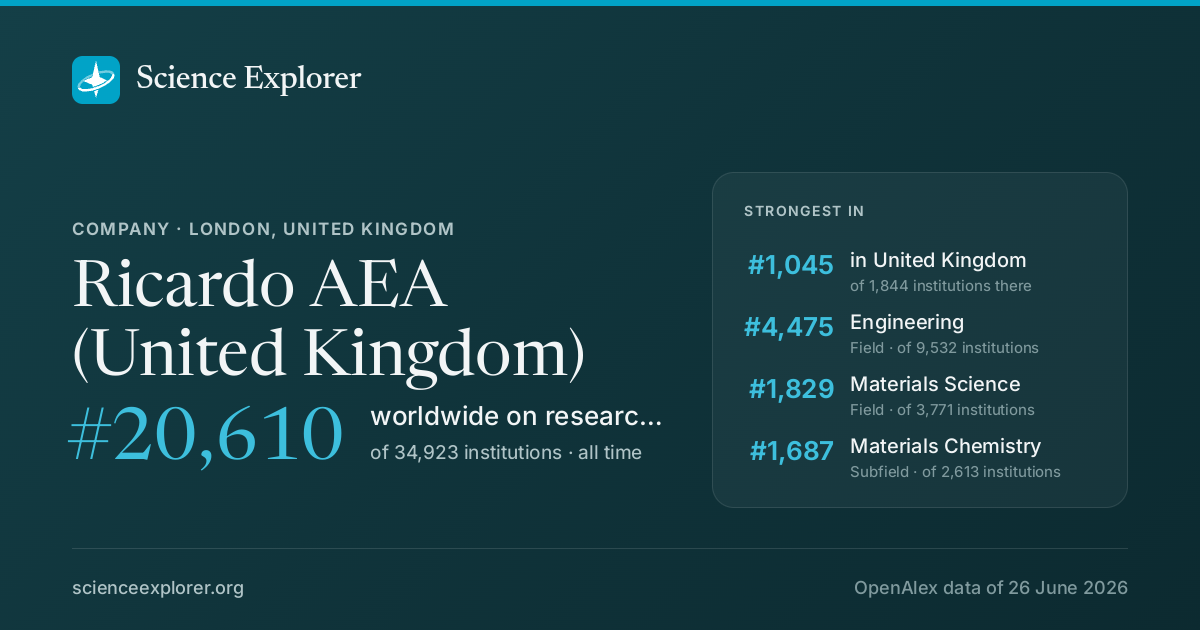
In research, Ricardo AEA (United Kingdom) stands highest in Engineering (#4,475 of 9,532 worldwide), Materials Science (#1,829 of 3,771 worldwide) and Materials Chemistry (#1,687 of 2,613 worldwide), over all time.
- World rank, all time
- #20,610 of 34,923
- Rank in United Kingdom
- #1,045 of 1,844
- Research works
- 1.6k ▼ 17% vs 2018-21
- Citations
- 36k 22.9 per fractional work
- Top-10% rate
- 9.0% all institutions 10.0%
- vs its own fields
- 0.83× 1.00× is exactly expected
- Open access
- 7% world 40%
- International
- 15% world 18%
What is Ricardo AEA (United Kingdom) known for in research?
The fields where it stands highest, over all time, ranked among every institution above the floor in each field.
| Field | World rank | Where that sits | Top-10% rate | Works |
|---|---|---|---|---|
| EngineeringField | #4,475 of 9,532 | 9.4% | 653 | |
| Materials ScienceField | #1,829 of 3,771 | 14.4% | 236 | |
| Materials ChemistrySubfield | #1,687 of 2,613 | 15.1% | 174 | |
| Mechanical EngineeringSubfield | #1,910 of 2,525 | 11.0% | 129 | |
| Environmental ScienceField | #4,406 of 5,407 | 11.3% | 186 | |
| Physical SciencesDomain | #14,991 of 17,446 | 10.4% | 1,389 | |
| Physics and AstronomyField | #2,519 of 2,917 | 7.4% | 121 |
Each strip is that field's whole ranked pool, with the notch where Ricardo AEA (United Kingdom) sits in it, in the colour of the band that rank falls in. The track under the rate is the rate itself: it carries no average mark, because the average differs by field (from about 6% in Dentistry to 21% in Economics).
Which fields of science does Ricardo AEA (United Kingdom) work in?
In all years, 87% of research at Ricardo AEA (United Kingdom) is in Physical Sciences, 6% in Health Sciences. Its largest fields are Engineering (41%), Materials Science (15%), Environmental Science (12%). It does 2.1× the world's share of Physical Sciences.
Each ring splits the one inside it: the four domains of science, their fields, their subfields. Size is fractional works in all years. Every slice is a page; the interactive view zooms down to single topics and colours each by how much more of it this institution does than the world.
Its 4 domains and 26 fields, with their numbers
- Physical Sciences1,38987.3%
- Engineering65341.1%
- Materials Science23614.8%
- Environmental Science18611.7%
- Physics and Astronomy1217.6%
- Earth and Planetary Sciences644.0%
- Chemistry563.5%
- Computer Science402.5%
- Chemical Engineering171.1%
- Energy100.6%
- Mathematics60.4%
- Health Sciences956.0%
- Medicine623.9%
- Health Professions301.9%
- Nursing30.2%
- Veterinary00.0%
- Dentistry00.0%
- Social Sciences704.4%
- Decision Sciences261.6%
- Social Sciences171.1%
- Business, Management and Accounting130.8%
- Arts and Humanities60.3%
- Economics, Econometrics and Finance50.3%
- Psychology40.2%
- Life Sciences372.3%
Field profile
Location quotient across every field it publishes in: outside the ring is more than an institution of this size would be expected to publish, inside it is less.
Rings at 0.5×, 1× and 2×. Widest outward: Engineering, 4.2×. Every wedge is a field page.
All 9 fields, with their numbers
- Engineering4.17×3 works
- Physics and Astronomy1.72×0 works
- Environmental Science1.66×0 works
- Decision Sciences1.59×0 works
- Economics, Econometrics and Finance1.43×0 works
- Social Sciences1.08×1 works
- Earth and Planetary Sciences0.98×0 works
- Business, Management and Accounting0.34×0 works
- Medicine0.23×0 works
Who are the top researchers at Ricardo AEA (United Kingdom)?
Ranked on the quality score, W.J. Phythian, Tim P. Murrells and John R. Stedman lead among researchers whose main affiliation is Ricardo AEA (United Kingdom).
- 1
W.J. Phythian
 United Kingdom · #2,093,240 worldwide
2.2k citations · 41 works
- 2
Tim P. Murrells
United Kingdom · #2,099,709 worldwide
3.3k citations · 44 works
- 3
John R. Stedman
United Kingdom · #2,375,748 worldwide
3k citations · 69 works
- 4
J.A. Garland
United Kingdom · #2,406,369 worldwide
2.9k citations · 88 works
- 5
J.A. Ogilvy
United Kingdom · #2,507,000 worldwide
2.5k citations · 49 works
- 6
Pierre R. Graves
United Kingdom · #2,697,317 worldwide
1.6k citations · 28 works
- 7
John M. Stewart
United Kingdom · #2,808,632 worldwide
1.6k citations · 66 works
- 8
Richard P. J. Swannell
United Kingdom · #2,939,677 worldwide
2k citations · 30 works
- 9
Neil L. Hancox
United Kingdom · #3,014,640 worldwide
3k citations · 101 works
- 10
Andrew J. Kent
United Kingdom · #3,487,176 worldwide
1k citations · 16 works
Which keywords describe research at Ricardo AEA (United Kingdom)?
By fractional works in all years, weighted toward what it does more of than the world: Health Effects, Mechanical Properties, Hydrogen Embrittlement, Raman Spectroscopy, Oxidation Resistance, Density Functional Theory, Radionuclides and High Temperature Behavior.
- Black Carbon
- Bioremediation
- Nanoindentation
- Soil Contamination
- Nuclear Graphite
- Radiation Protection
- Small-Angle Scattering
- Radiography
- Environmental Impacts
- Oxidation Behavior
- Adsorption
- Tomography
- Thin Films
- Heat Transfer
- Fuel Cladding
- Accident Tolerant Fuels
- Radionuclides
- Oxidation Resistance
- Hydrogen Embrittlement
- Mechanical Properties
- Health Effects
- Environmental Impact
- Raman Spectroscopy
- Density Functional Theory
- High Temperature Behavior
- Finite Element Analysis
- Air Quality
- Particulate Matter
- Thermal Properties
- Actinides
- Microstructure
- X-ray Photoelectron Spectroscopy
- Data Analysis
- Neutron Imaging
- Nuclear Fuel
- Microstructural Characterization
- Extraction
- Coatings
- Chemical Composition
- Atmospheric Aerosols
Size is fractional works in all years in the topics tagged with each word; colour is the word's share of this institution's work against its share of the world's. The 40 words are chosen for being large and distinctive. Each links to the topic it comes from most.
All 40 words, with their numbers
- Health Effects89▲ 9.3×15 topics
- Mechanical Properties82▲ 5.5×29 topics
- Environmental Impact61▲ 2.9×32 topics
- Hydrogen Embrittlement58▲ 35×3 topics
- Raman Spectroscopy51▲ 14×6 topics
- Oxidation Resistance47▲ 21×3 topics
- Density Functional Theory44▲ 10×6 topics
- Radionuclides42▲ 49×2 topics
- High Temperature Behavior40▲ 26×2 topics
- Accident Tolerant Fuels38▲ 49×1 topic
- Finite Element Analysis38▲ 10×9 topics
- Fuel Cladding38▲ 49×1 topic
- Air Quality36▲ 12×4 topics
- Heat Transfer36▲ 4.5×16 topics
- Particulate Matter34▲ 19×2 topics
- Thin Films34▲ 7.9×9 topics
- Thermal Properties34▲ 14×5 topics
- Tomography33▲ 7.7×5 topics
- Actinides33▲ 26×2 topics
- Adsorption33▲ 8.8×5 topics
- Microstructure33▲ 4.1×16 topics
- Oxidation Behavior33▲ 34×2 topics
- X-ray Photoelectron Spectroscopy31▲ 14×2 topics
- Environmental Impacts30▲ 8.6×6 topics
- Data Analysis29▲ 5.6×3 topics
- Radiography28▲ 21×2 topics
- Neutron Imaging28▲ 22×1 topic
- Small-Angle Scattering28▲ 13×1 topic
- Nuclear Fuel26▲ 57×1 topic
- Radiation Protection26▲ 57×1 topic
- Microstructural Characterization26▲ 53×1 topic
- Nuclear Graphite26▲ 53×1 topic
- Extraction25▲ 8.8×2 topics
- Soil Contamination25▲ 42×3 topics
- Coatings25▲ 18×1 topic
- Nanoindentation25▲ 19×1 topic
- Chemical Composition25▲ 15×2 topics
- Bioremediation25▲ 10×6 topics
- Atmospheric Aerosols25▲ 22×1 topic
- Black Carbon25▲ 22×1 topic
Which research topics does Ricardo AEA (United Kingdom) publish most on?
By volume in 2022-now: Vehicle Noise and Vibration Control, Acoustic Wave Phenomena Research, Teacher Professional Development and Motivation and Magnetic confinement fusion research.
Area is fractional works; colour is the subfield each topic belongs to.
- 1 Vehicle Noise and Vibration Control Automotive Engineering 0 works
- 2 Acoustic Wave Phenomena Research Biomedical Engineering 0 works
- 3 Teacher Professional Development and Motivation Education 0 works
- 4 Magnetic confinement fusion research Nuclear and High Energy Physics 0 works
- 5 Aluminum Alloys Composites Properties Mechanical Engineering 0 works
- 6 Nuclear Engineering Thermal-Hydraulics Aerospace Engineering 0 works
- 7 Advanced materials and composites Mechanical Engineering 0 works
- 8 Superconducting Materials and Applications Biomedical Engineering 0 works
- 9 Aluminum Alloy Microstructure Properties Aerospace Engineering 0 works
- 10 Electric and Hybrid Vehicle Technologies Automotive Engineering 0 works
How open and international is its research?
Against the world's own shares: the tick on each track. Both are shares of its output, so they sit on one scale and can be read against each other as well as against the world.
World: 40% of research is openly available.
World: 18% is written across borders.
How has Ricardo AEA (United Kingdom)'s research output changed?
Output in 2022-2025 was 17% lower than in 2018-2021.
The same series as a ribbon: one cell per year, darker for more. The line above answers how much; this answers when.
Its share of all research
Growing output can still be a shrinking share: all of science grows. This is Ricardo AEA (United Kingdom) as a percentage of every work published that year, 0.0000096% in 2024.
Fractional works of Ricardo AEA (United Kingdom) over all fractional works that year. How the balance of science has shifted.
How much of it reaches the world top 10%
Year by year, against all institutions in the same year.
Of each year's output, the share that reached the world's 10% most cited for its field and year. Peak 14.0% in 2000.
Other research institutions in London
- University College London
- Imperial College London
- King's College London
- Queen Mary University of London
- London School of Economics and Political Science
- University of London
- Barts Health NHS Trust
- Brunel University of London



Share Ricardo AEA (United Kingdom)'s ranking
Badges for a website1Each links back here and updates with every snapshot

Research measures only: rankings here say nothing about teaching, admissions or student experience. Comparable institutions and collaboration partners have tabs of their own, above.
Discussion
Ask a question or share a note about Ricardo AEA (United Kingdom). Keep it to the research: no personal attacks, advertising or links. Any reader can report a post, which collapses it for everyone until it is opened.