Science Explorer Back to mapMap
Discussion
Government institution · Moscow · Russia

Russian Venture Company

In research, Russian Venture Company stands highest in Physical Sciences (#13,649 of 17,446 worldwide) and Engineering (#8,823 of 9,532 worldwide), over all time.

World rank, all time
#26,567
of 34,923
Rank in Russia
#466
of 967
Research works
283
▼ 36% vs 2018-21
Citations
1k
3.5 per fractional work
Top-10% rate
5.5%
all institutions 10.0%
vs its own fields
0.76×
1.00× is exactly expected
Open access
22%
world 40%
International
13%
world 18%

What is Russian Venture Company known for in research?

The fields where it stands highest, over all time, ranked among every institution above the floor in each field.

FieldWorld rankWhere that sitsTop-10% rateWorks
Physical SciencesDomain #13,649 of 17,446 4.0%214
EngineeringField #8,823 of 9,532 4.1%122

Each strip is that field's whole ranked pool, with the notch where Russian Venture Company sits in it, in the colour of the band that rank falls in. The track under the rate is the rate itself: it carries no average mark, because the average differs by field (from about 6% in Dentistry to 21% in Economics).

Which fields of science does Russian Venture Company work in?

In 2022-now, 54% of research at Russian Venture Company is in Physical Sciences, 23% in Social Sciences. Its largest fields are Engineering (25%), Medicine (16%), Computer Science (11%). It does 1.3× the world's share of Physical Sciences.

Physical Sciences: 25 fractional works · 53.5% of its workEngineering: 12 fractional works · 25.4% of its workElectrical and Electronic Engineering: 2 fractional works · 3.7% of its workControl and Systems Engineering: 2 fractional works · 3.6% of its workBuilding and Construction: 2 fractional works · 3.5% of its workMechanical Engineering: 1 fractional works · 2.9% of its workMechanics of Materials: 1 fractional works · 2.8% of its workAerospace Engineering: 1 fractional works · 2.6% of its workOcean Engineering: 1 fractional works · 2.0% of its workCivil and Structural Engineering: 1 fractional works · 1.8% of its workBiomedical Engineering: 1 fractional works · 1.6% of its workIndustrial and Manufacturing Engineering: 0 fractional works · 0.6% of its workComputational Mechanics: 0 fractional works · 0.2% of its workSmaller subfields together: 0 fractional works · 0.2% of its workComputer Science: 5 fractional works · 11.2% of its workArtificial Intelligence: 2 fractional works · 3.5% of its workInformation Systems: 1 fractional works · 2.8% of its workComputational Theory and Mathematics: 1 fractional works · 2.2% of its workComputer Networks and Communications: 1 fractional works · 1.2% of its workComputer Vision and Pattern Recognition: 0 fractional works · 0.9% of its workSignal Processing: 0 fractional works · 0.4% of its workComputer Graphics and Computer-Aided Design: 0 fractional works · 0.2% of its workMaterials Science: 4 fractional works · 8.0% of its workMaterials Chemistry: 3 fractional works · 5.4% of its workGeneral Materials Science: 1 fractional works · 1.9% of its workCeramics and Composites: 0 fractional works · 0.4% of its workPolymers and Plastics: 0 fractional works · 0.4% of its workMathematics: 1 fractional works · 2.4% of its workStatistics and Probability: 1 fractional works · 2.4% of its workEnergy: 1 fractional works · 2.2% of its workNuclear Energy and Engineering: 1 fractional works · 1.6% of its workRenewable Energy, Sustainability and the Environment: 0 fractional works · 0.6% of its workEnvironmental Science: 1 fractional works · 1.9% of its workManagement, Monitoring, Policy and Law: 0 fractional works · 0.6% of its workEnvironmental Engineering: 0 fractional works · 0.4% of its workGlobal and Planetary Change: 0 fractional works · 0.2% of its workPollution: 0 fractional works · 0.2% of its workWater Science and Technology: 0 fractional works · 0.2% of its workSmaller subfields together: 0 fractional works · 0.2% of its workEarth and Planetary Sciences: 1 fractional works · 1.7% of its workOceanography: 0 fractional works · 0.8% of its workGeology: 0 fractional works · 0.4% of its workAtmospheric Science: 0 fractional works · 0.3% of its workSmaller subfields together: 0 fractional works · 0.3% of its workChemistry: 0 fractional works · 0.6% of its workAnalytical Chemistry: 0 fractional works · 0.6% of its workSocial Sciences: 11 fractional works · 23.3% of its workBusiness, Management and Accounting: 4 fractional works · 8.9% of its workManagement of Technology and Innovation: 2 fractional works · 4.2% of its workStrategy and Management: 2 fractional works · 3.2% of its workAccounting: 0 fractional works · 1.1% of its workManagement Information Systems: 0 fractional works · 0.4% of its workSocial Sciences: 3 fractional works · 7.3% of its workPolitical Science and International Relations: 2 fractional works · 3.5% of its workDemography: 0 fractional works · 1.1% of its workSociology and Political Science: 0 fractional works · 0.9% of its workDevelopment: 0 fractional works · 0.6% of its workEducation: 0 fractional works · 0.4% of its workGender Studies: 0 fractional works · 0.4% of its workLaw: 0 fractional works · 0.4% of its workEconomics, Econometrics and Finance: 2 fractional works · 4.9% of its workEconomics and Econometrics: 2 fractional works · 3.3% of its workGeneral Economics, Econometrics and Finance: 1 fractional works · 1.5% of its workSmaller subfields together: 0 fractional works · 0.2% of its workDecision Sciences: 1 fractional works · 1.7% of its workManagement Science and Operations Research: 0 fractional works · 0.9% of its workInformation Systems and Management: 0 fractional works · 0.4% of its workStatistics, Probability and Uncertainty: 0 fractional works · 0.4% of its workPsychology: 0 fractional works · 0.6% of its workDevelopmental and Educational Psychology: 0 fractional works · 0.5% of its workSmaller subfields together: 0 fractional works · 0.2% of its workHealth Sciences: 8 fractional works · 17.5% of its workMedicine: 7 fractional works · 16.0% of its workSurgery: 1 fractional works · 2.6% of its workPulmonary and Respiratory Medicine: 1 fractional works · 1.6% of its workEpidemiology: 1 fractional works · 1.6% of its workOrthopedics and Sports Medicine: 1 fractional works · 1.6% of its workOncology: 1 fractional works · 1.5% of its workDermatology: 0 fractional works · 0.8% of its workPathology and Forensic Medicine: 0 fractional works · 0.8% of its workPublic Health, Environmental and Occupational Health: 0 fractional works · 0.8% of its workPhysiology: 0 fractional works · 0.7% of its workRadiology, Nuclear Medicine and Imaging: 0 fractional works · 0.7% of its workRehabilitation: 0 fractional works · 0.6% of its workPediatrics, Perinatology and Child Health: 0 fractional works · 0.6% of its workPsychiatry and Mental health: 0 fractional works · 0.5% of its workCardiology and Cardiovascular Medicine: 0 fractional works · 0.2% of its workInfectious Diseases: 0 fractional works · 0.2% of its workOphthalmology: 0 fractional works · 0.2% of its workOtorhinolaryngology: 0 fractional works · 0.2% of its workSmaller subfields together: 0 fractional works · 0.7% of its workHealth Professions: 0 fractional works · 0.8% of its workGeneral Health Professions: 0 fractional works · 0.4% of its workPharmacy: 0 fractional works · 0.4% of its workSmaller subfields together: 0 fractional works · 0.1% of its workVeterinary: 0 fractional works · 0.4% of its workSmall Animals: 0 fractional works · 0.4% of its workNursing: 0 fractional works · 0.2% of its workNutrition and Dietetics: 0 fractional works · 0.2% of its workLife Sciences: 3 fractional works · 5.7% of its workAgricultural and Biological Sciences: 2 fractional works · 3.4% of its workPlant Science: 0 fractional works · 1.1% of its workFood Science: 0 fractional works · 0.9% of its workInsect Science: 0 fractional works · 0.7% of its workAquatic Science: 0 fractional works · 0.4% of its workEcology, Evolution, Behavior and Systematics: 0 fractional works · 0.2% of its workSmaller subfields together: 0 fractional works · 0.0% of its workBiochemistry, Genetics and Molecular Biology: 1 fractional works · 1.6% of its workMolecular Biology: 0 fractional works · 0.7% of its workCancer Research: 0 fractional works · 0.6% of its workGenetics: 0 fractional works · 0.4% of its workNeuroscience: 0 fractional works · 0.5% of its workNeurology: 0 fractional works · 0.4% of its workSmaller subfields together: 0 fractional works · 0.2% of its workImmunology and Microbiology: 0 fractional works · 0.2% of its workALL ITS WORKRussian VentureCompany46fractional works, 2022-now
Life Sciences6%Physical Sciences54%Health Sciences17%Social Sciences23%

Each ring splits the one inside it: the four domains of science, their fields, their subfields. Size is fractional works in 2022-now. Every slice is a page; the interactive view zooms down to single topics and colours each by how much more of it this institution does than the world.

Its 4 domains and 21 fields, with their numbers
    1. Engineering1225.4%
    2. Computer Science511.2%
    3. Materials Science48.0%
    4. Mathematics12.4%
    5. Energy12.2%
    6. Environmental Science11.9%
    7. Earth and Planetary Sciences11.7%
    8. Chemistry00.6%
    1. Business, Management and Accounting48.9%
    2. Social Sciences37.3%
    3. Economics, Econometrics and Finance24.9%
    4. Decision Sciences11.7%
    5. Psychology00.6%
    1. Medicine716.0%
    2. Health Professions00.8%
    3. Veterinary00.4%
    4. Nursing00.2%
    1. Agricultural and Biological Sciences23.4%
    2. Biochemistry, Genetics and Molecular Biology11.6%
    3. Neuroscience00.5%
    4. Immunology and Microbiology00.2%
All of science, and how each field's share has moved since 1950: the Science domain explorer

Field profile

Location quotient across every field it publishes in: outside the ring is more than an institution of this size would be expected to publish, inside it is less.

Agricultural and Biological Sciences: 0.71× its world share, 2 worksAgricultural and Bio…Biochemistry, Genetics and Molecular Biology: 0.30× its world share, 1 worksBiochemistry, Geneti…Immunology and Microbiology: 0.18× its world share, 0 worksImmunology and Micro…Neuroscience: 0.33× its world share, 0 worksNeuroscienceChemistry: 0.38× its world share, 0 worksChemistryComputer Science: 1.44× its world share, 5 worksComputer ScienceEarth and Planetary Sciences: 1.08× its world share, 1 worksEarth and Planetary …Energy: 2.41× its world share, 1 worksEnergyEngineering: 1.70× its world share, 12 worksEngineeringEnvironmental Science: 0.39× its world share, 1 worksEnvironmental ScienceMaterials Science: 2.30× its world share, 4 worksMaterials ScienceMathematics: 2.03× its world share, 1 worksMathematicsHealth Professions: 0.32× its world share, 0 worksHealth ProfessionsMedicine: 0.83× its world share, 7 worksMedicineNursing: 0.49× its world share, 0 worksNursingVeterinary: 2.64× its world share, 0 worksVeterinaryBusiness, Management and Accounting: 2.75× its world share, 4 worksBusiness, Management…Decision Sciences: 1.73× its world share, 1 worksDecision SciencesEconomics, Econometrics and Finance: 2.27× its world share, 2 worksEconomics, Econometr…Psychology: 0.21× its world share, 0 worksPsychologySocial Sciences: 0.57× its world share, 3 worksSocial Sciences1×world share
more than its size predictsabout as predictedless

Rings at 0.5×, 1× and 2×. Widest outward: Business, Management and Accounting, 2.8×. Every wedge is a field page.

All 21 fields, with their numbers
  1. Business, Management and Accounting2.75×4 works
  2. Veterinary2.64×0 works
  3. Energy2.41×1 works
  4. Materials Science2.30×4 works
  5. Economics, Econometrics and Finance2.27×2 works
  6. Mathematics2.03×1 works
  7. Decision Sciences1.73×1 works
  8. Engineering1.70×12 works
  9. Computer Science1.44×5 works
  10. Earth and Planetary Sciences1.08×1 works
  11. Medicine0.83×7 works
  12. Agricultural and Biological Sciences0.71×2 works
  13. Social Sciences0.57×3 works
  14. Nursing0.49×0 works
  15. Environmental Science0.39×1 works
  16. Chemistry0.38×0 works
  17. Neuroscience0.33×0 works
  18. Health Professions0.32×0 works
  19. Biochemistry, Genetics and Molecular Biology0.30×1 works
  20. Psychology0.21×0 works
  21. Immunology and Microbiology0.18×0 works

Who are the top researchers at Russian Venture Company?

Ranked on the quality score, Alexander Akulin, А. Л. Довбиш and Yu. I. Kazantsev lead among researchers whose main affiliation is Russian Venture Company.

  1. 1 Alexander Akulin Russia · #3,427,202 worldwide 7 citations · 16 works
  2. 2 А. Л. Довбиш Russia · #4,868,374 worldwide 23 citations · 15 works
  3. 3 Yu. I. Kazantsev Russia · #5,042,061 worldwide 6 citations · 19 works
  4. 4 I. I. Trusova Russia · #5,095,000 worldwide 13 citations · 20 works
  5. 5 V. S. Rybin Russia · #5,302,771 worldwide 8 citations · 24 works
  6. 6 E. I. Storchai Russia · #5,307,050 worldwide 10 citations · 23 works
  7. 7 G. K. Zibert Russia · #5,507,079 worldwide 17 citations · 31 works
  8. 8 А. М. Домашенко Russia · #5,801,366 worldwide 59 citations · 34 works
All ranked researchers at Russian Venture Company

What are the most cited papers from Russian Venture Company?

The most cited paper from Russian Venture Company is "Migraine and sleep disorders: a systematic review" (Cindy Tiseo, Alessandro Vacca, Anton Felbush et al., 2020), with 292 citations. Next come "Evidence of subsurface anaerobic biodegradation of hydrocarbons and potential secondary methanogenesis in terrestrial mud volcanoes" (134) and "Middle Atokan sediment gravity flows in the Red Oak field, Arkoma Basin, Oklahoma: A sedimentary analysis using electrical borehole images and wireline logs" (62).

Most cited papers
#PaperReleasedCitations
1 Migraine and sleep disorders: a systematic review Cindy Tiseo, Alessandro Vacca, Anton Felbush et al. · The Journal of Headache and Pain ReviewOpen access 27 Oct 2020 292
2 Evidence of subsurface anaerobic biodegradation of hydrocarbons and potential secondary methanogenesis in terrestrial mud volcanoes Giuseppe Etiope, Akper A. Feyzullayev, Alexei V. Milkov et al. · Marine and Petroleum Geology 26 Dec 2008 134
3 Middle Atokan sediment gravity flows in the Red Oak field, Arkoma Basin, Oklahoma: A sedimentary analysis using electrical borehole images and wireline logs Chunming Xu, Thomas P. Cronin, Thalbert E. McGinness et al. · AAPG Bulletin 29 Dec 2008 62
4 Directly diode-pumped tunable continuous-wave room-temperature Cr^4+:YAG laser Irina T. Sorokina, С. В. Наумов, Evgeni Sorokin et al. · Optics Letters 15 Nov 1999 55
5 Thermo-tectonic history of the Junggar Alatau within the Central Asian Orogenic Belt (SE Kazakhstan, NW China): Insights from integrated apatite U/Pb, fission track and (U–Th)/He thermochronology Stijn Glorie, A. Otasevic, Jack Gillespie et al. · Geoscience Frontiers Open access 30 May 2019 53
All 63 most cited papers, with filters and sorting

Which keywords describe research at Russian Venture Company?

By fractional works in 2022-now, weighted toward what it does more of than the world: Energy Efficiency, Digital Transformation, Sustainable Development, Fault Tolerance, Cyber-Physical Systems, Innovation, Digital Economy and Economic Development.

▲ more of its work than of the world's◆ about the world's share▼ less than the world's

Size is fractional works in 2022-now in the topics tagged with each word; colour is the word's share of this institution's work against its share of the world's. The 28 words are chosen for being large and distinctive. Each links to the topic it comes from most.

All 28 words, with their numbers
  1. Energy Efficiency4▲ 8.1×13 topics
  2. Sustainable Development3▲ 4.7×12 topics
  3. Digital Transformation3▲ 11×6 topics
  4. Innovation2▲ 4.5×8 topics
  5. Cyber-Physical Systems2▲ 15×2 topics
  6. Fault Tolerance2▲ 26×3 topics
  7. Globalization2▲ 2.0×6 topics
  8. Economic Development2▲ 4.6×6 topics
  9. Sustainability2▲ 1.48×6 topics
  10. Artificial Intelligence2▲ 2.4×4 topics
  11. Digital Economy2▲ 17×5 topics
  12. Environmental Management1▲ 7.4×4 topics
  13. Epidemiology1▼ 0.74×10 topics
  14. Economic Growth1▲ 3.3×4 topics
  15. Human Rights1▲ 2.5×3 topics
  16. Machine Learning1▼ 0.79×7 topics
  17. Nanotechnology1▲ 14×2 topics
  18. Regional Development1▲ 7.3×4 topics
  19. Digitalization1▲ 12×4 topics
  20. Fraud Detection1▲ 18×2 topics
  21. Innovation Management1▲ 15×1 topic
  22. Metal Nanoparticles1▲ 14×2 topics
  23. Quality Management1▲ 17×1 topic
  24. Benford's Law1▲ 512×1 topic
  25. Deep Learning1▼ 0.64×6 topics
  26. QCA1▲ 178×1 topic
  27. Quantum-dot Cellular Automata1▲ 178×1 topic
  28. election irregularities1▲ 512×1 topic

Which research topics does Russian Venture Company publish most on?

By volume in 2022-now: Economic and Technological Systems Analysis, Benford’s Law and Fraud Detection, Structural mechanics and materials and Quantum-Dot Cellular Automata.

  1. 1 Economic and Technological Systems Analysis Management of Technology and Innovation 1 works
  2. 2 Benford’s Law and Fraud Detection Statistics and Probability 1 works
  3. 3 Structural mechanics and materials Materials Chemistry 1 works
  4. 4 Quantum-Dot Cellular Automata Computational Theory and Mathematics 1 works
  5. 5 Material Properties and Applications General Materials Science 1 works
  6. 6 Advanced Energy Technologies and Civil Engineering Innovations Nuclear Energy and Engineering 1 works
  7. 7 Hydraulic Fracturing and Reservoir Analysis Mechanical Engineering 1 works
  8. 8 Advanced Data Processing Techniques Control and Systems Engineering 1 works
  9. 9 Hydrocarbon exploration and reservoir analysis Mechanics of Materials 0 works
  10. 10 Economic Development and Digital Transformation General Economics, Econometrics and Finance 0 works

How open and international is its research?

Against the world's own shares: the tick on each track. Both are shares of its output, so they sit on one scale and can be read against each other as well as against the world.

openly available22.4%not open77.6%

World: 40% of research is openly available.

with international co-authors13.4%domestic only86.6%

World: 18% is written across borders.

How has Russian Venture Company's research output changed?

Output in 2022-2025 was 36% lower than in 2018-2021.

still counting200020102020
grewheldshrank

The same series as a ribbon: one cell per year, darker for more. The line above answers how much; this answers when.

Its share of all research

Growing output can still be a shrinking share: all of science grows. This is Russian Venture Company as a percentage of every work published that year, 0.00020% in 2024.

still counting0.0010%0.0020%Russian Venture Company0.00015% in 202519801990200020102020

Fractional works of Russian Venture Company over all fractional works that year. How the balance of science has shifted.

Other research institutions in Moscow

All research institutions in Moscow

Share Russian Venture Company's ranking
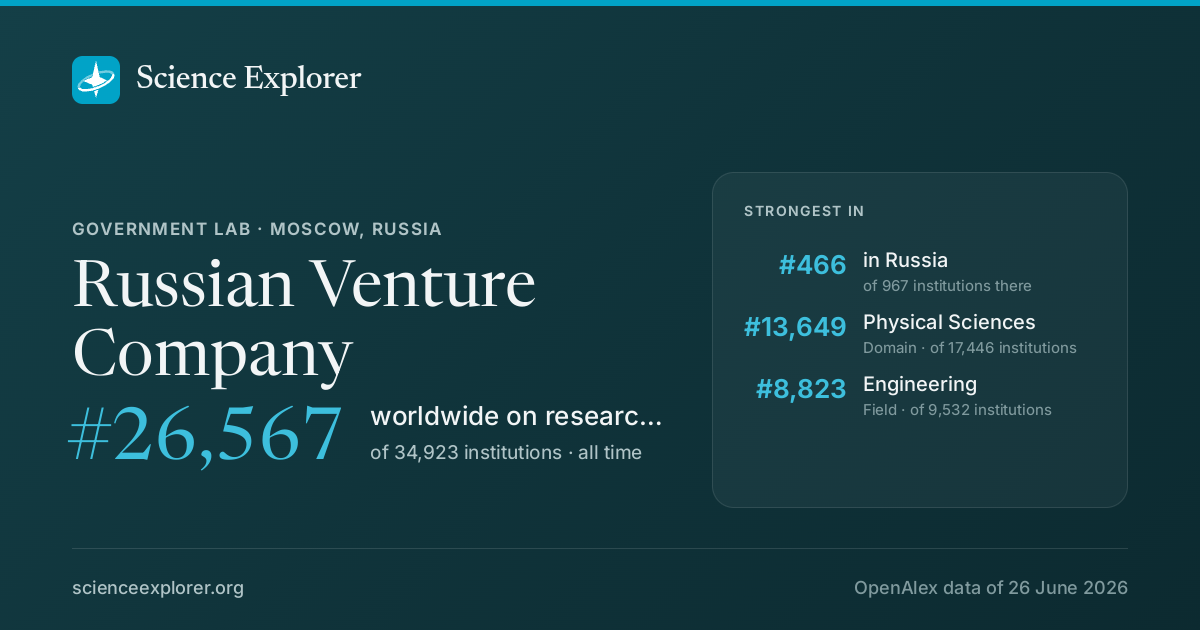
Russian Venture Company on Science Explorer

A card with Russian Venture Company's standing and the fields it leads in, for a post or a slide. A link to this page previews as the same card.

Download the card

1200 × 630 PNG, sized for social posts, drawn from the latest snapshot.

Badges for a website1Each links back here and updates with every snapshot

Research measures only: rankings here say nothing about teaching, admissions or student experience. Comparable institutions and collaboration partners have tabs of their own, above.

Discussion

Ask a question or share a note about Russian Venture Company. Keep it to the research: no personal attacks, advertising or links. Any reader can report a post, which collapses it for everyone until it is opened.