Science Explorer Back to mapMap
Discussion
University · Sarasota · United States

Sarasota University

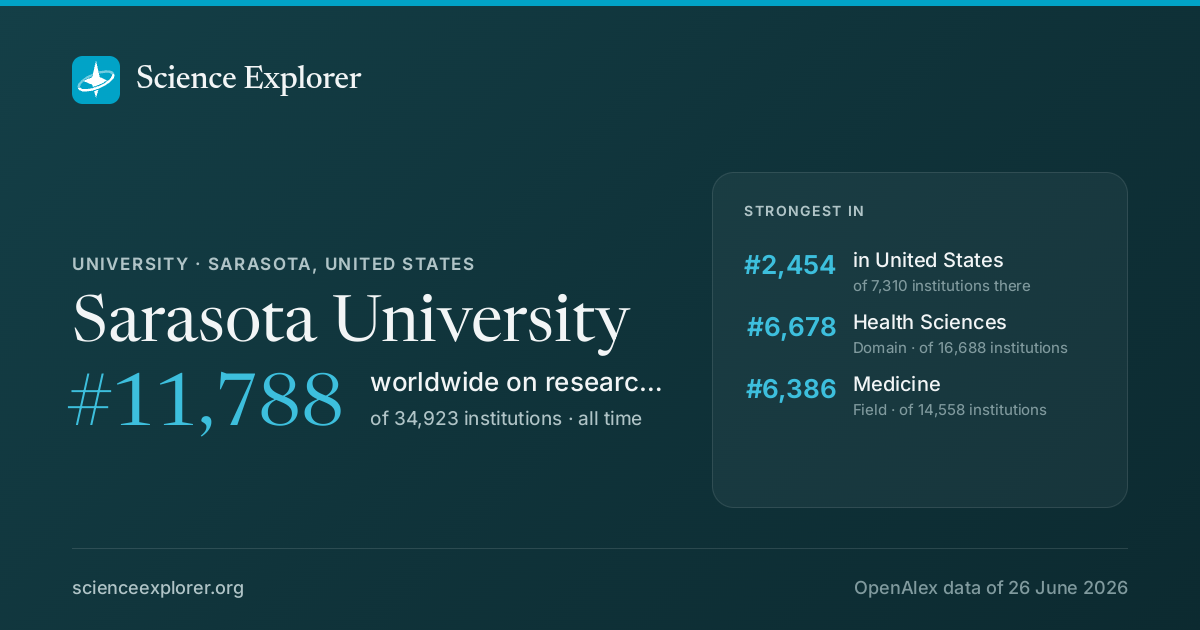
In research, Sarasota University stands highest in Health Sciences (#6,678 of 16,688 worldwide) and Medicine (#6,386 of 14,558 worldwide), over all time.

World rank, all time
#11,788
of 34,923
Rank in United States
#2,454
of 7,310
Research works
416
▼ 2% vs 2018-21
Citations
6.2k
14.8 per fractional work
Top-10% rate
6.1%
all institutions 10.0%
vs its own fields
0.97×
1.00× is exactly expected
Open access
22%
world 40%
International
6%
world 18%

What is Sarasota University known for in research?

The fields where it stands highest, over all time, ranked among every institution above the floor in each field.

FieldWorld rankWhere that sitsTop-10% rateWorks
Health SciencesDomain #6,678 of 16,688 8.2%181
MedicineField #6,386 of 14,558 9.3%154

Each strip is that field's whole ranked pool, with the notch where Sarasota University sits in it, in the colour of the band that rank falls in. The track under the rate is the rate itself: it carries no average mark, because the average differs by field (from about 6% in Dentistry to 21% in Economics).

Which fields of science does Sarasota University work in?

In 2022-now, 55% of research at Sarasota University is in Health Sciences, 25% in Social Sciences. Its largest fields are Medicine (48%), Social Sciences (12%), Psychology (4%). It does 2.1× the world's share of Health Sciences.

Health Sciences: 24 fractional works · 55.5% of its workMedicine: 21 fractional works · 48.2% of its workCardiology and Cardiovascular Medicine: 5 fractional works · 11.1% of its workSurgery: 3 fractional works · 7.2% of its workEpidemiology: 2 fractional works · 4.6% of its workEndocrinology, Diabetes and Metabolism: 1 fractional works · 2.8% of its workPsychiatry and Mental health: 1 fractional works · 2.2% of its workOncology: 1 fractional works · 1.8% of its workPublic Health, Environmental and Occupational Health: 1 fractional works · 1.7% of its workPulmonary and Respiratory Medicine: 1 fractional works · 1.6% of its workEmergency Medicine: 1 fractional works · 1.4% of its workRadiology, Nuclear Medicine and Imaging: 1 fractional works · 1.4% of its workGenetics: 1 fractional works · 1.3% of its workPhysiology: 0 fractional works · 1.1% of its workPharmacology: 0 fractional works · 1.0% of its workNeurology: 0 fractional works · 0.9% of its workHematology: 0 fractional works · 0.9% of its workRheumatology: 0 fractional works · 0.8% of its workOphthalmology: 0 fractional works · 0.8% of its workComplementary and alternative medicine: 0 fractional works · 0.7% of its workPathology and Forensic Medicine: 0 fractional works · 0.6% of its workFamily Practice: 0 fractional works · 0.6% of its workDermatology: 0 fractional works · 0.5% of its workPediatrics, Perinatology and Child Health: 0 fractional works · 0.4% of its workObstetrics and Gynecology: 0 fractional works · 0.4% of its workRehabilitation: 0 fractional works · 0.4% of its workReproductive Medicine: 0 fractional works · 0.4% of its workOtorhinolaryngology: 0 fractional works · 0.4% of its workAnesthesiology and Pain Medicine: 0 fractional works · 0.3% of its workOrthopedics and Sports Medicine: 0 fractional works · 0.3% of its workSmaller subfields together: 0 fractional works · 0.6% of its workHealth Professions: 2 fractional works · 4.4% of its workGeneral Health Professions: 2 fractional works · 3.6% of its workMedical Terminology: 0 fractional works · 0.8% of its workSmaller subfields together: 0 fractional works · 0.0% of its workDentistry: 1 fractional works · 1.7% of its workPeriodontics: 0 fractional works · 0.8% of its workGeneral Dentistry: 0 fractional works · 0.4% of its workOral Surgery: 0 fractional works · 0.4% of its workSmaller subfields together: 0 fractional works · 0.1% of its workVeterinary: 0 fractional works · 1.1% of its workSmall Animals: 0 fractional works · 1.1% of its workSocial Sciences: 11 fractional works · 25.1% of its workSocial Sciences: 5 fractional works · 12.0% of its workSociology and Political Science: 2 fractional works · 3.8% of its workUrban Studies: 1 fractional works · 2.3% of its workEducation: 1 fractional works · 1.3% of its workGender Studies: 0 fractional works · 1.1% of its workHealth: 0 fractional works · 0.8% of its workAnthropology: 0 fractional works · 0.8% of its workTransportation: 0 fractional works · 0.8% of its workPolitical Science and International Relations: 0 fractional works · 0.5% of its workCultural Studies: 0 fractional works · 0.3% of its workSmaller subfields together: 0 fractional works · 0.3% of its workPsychology: 2 fractional works · 4.4% of its workClinical Psychology: 1 fractional works · 2.3% of its workDevelopmental and Educational Psychology: 0 fractional works · 0.9% of its workExperimental and Cognitive Psychology: 0 fractional works · 0.8% of its workSocial Psychology: 0 fractional works · 0.4% of its workSmaller subfields together: 0 fractional works · 0.0% of its workArts and Humanities: 2 fractional works · 4.0% of its workArcheology: 1 fractional works · 1.3% of its workReligious studies: 0 fractional works · 0.8% of its workConservation: 0 fractional works · 0.6% of its workLiterature and Literary Theory: 0 fractional works · 0.4% of its workHistory: 0 fractional works · 0.4% of its workPhilosophy: 0 fractional works · 0.4% of its workSmaller subfields together: 0 fractional works · 0.1% of its workBusiness, Management and Accounting: 1 fractional works · 3.2% of its workMarketing: 1 fractional works · 2.3% of its workAccounting: 0 fractional works · 0.8% of its workSmaller subfields together: 0 fractional works · 0.2% of its workDecision Sciences: 0 fractional works · 1.0% of its workInformation Systems and Management: 0 fractional works · 0.6% of its workManagement Science and Operations Research: 0 fractional works · 0.4% of its workEconomics, Econometrics and Finance: 0 fractional works · 0.6% of its workEconomics and Econometrics: 0 fractional works · 0.6% of its workPhysical Sciences: 5 fractional works · 11.9% of its workEnvironmental Science: 2 fractional works · 4.0% of its workGlobal and Planetary Change: 0 fractional works · 0.9% of its workEcology: 0 fractional works · 0.8% of its workNature and Landscape Conservation: 0 fractional works · 0.8% of its workPollution: 0 fractional works · 0.8% of its workWater Science and Technology: 0 fractional works · 0.5% of its workEnvironmental Engineering: 0 fractional works · 0.3% of its workSmaller subfields together: 0 fractional works · 0.0% of its workMathematics: 1 fractional works · 2.3% of its workAlgebra and Number Theory: 0 fractional works · 0.8% of its workApplied Mathematics: 0 fractional works · 0.8% of its workDiscrete Mathematics and Combinatorics: 0 fractional works · 0.8% of its workSmaller subfields together: 0 fractional works · 0.0% of its workComputer Science: 1 fractional works · 2.1% of its workArtificial Intelligence: 0 fractional works · 1.1% of its workInformation Systems: 0 fractional works · 0.8% of its workSmaller subfields together: 0 fractional works · 0.2% of its workEngineering: 1 fractional works · 1.5% of its workAerospace Engineering: 0 fractional works · 0.8% of its workBiomedical Engineering: 0 fractional works · 0.4% of its workBuilding and Construction: 0 fractional works · 0.4% of its workMaterials Science: 1 fractional works · 1.5% of its workBiomaterials: 1 fractional works · 1.5% of its workEarth and Planetary Sciences: 0 fractional works · 0.4% of its workPaleontology: 0 fractional works · 0.3% of its workSmaller subfields together: 0 fractional works · 0.1% of its workPhysics and Astronomy: 0 fractional works · 0.1% of its workLife Sciences: 3 fractional works · 7.5% of its workBiochemistry, Genetics and Molecular Biology: 1 fractional works · 2.4% of its workGenetics: 1 fractional works · 1.6% of its workMolecular Biology: 0 fractional works · 0.6% of its workSmaller subfields together: 0 fractional works · 0.2% of its workImmunology and Microbiology: 1 fractional works · 2.1% of its workImmunology: 1 fractional works · 2.1% of its workAgricultural and Biological Sciences: 1 fractional works · 1.5% of its workEcology, Evolution, Behavior and Systematics: 1 fractional works · 1.3% of its workSmaller subfields together: 0 fractional works · 0.2% of its workNeuroscience: 0 fractional works · 1.0% of its workCognitive Neuroscience: 0 fractional works · 1.0% of its workSmaller subfields together: 0 fractional works · 0.0% of its workPharmacology, Toxicology and Pharmaceutics: 0 fractional works · 0.4% of its workToxicology: 0 fractional works · 0.3% of its workSmaller subfields together: 0 fractional works · 0.2% of its workALL ITS WORKSarasotaUniversity44fractional works, 2022-now
Life Sciences7%Physical Sciences12%Health Sciences55%Social Sciences25%

Each ring splits the one inside it: the four domains of science, their fields, their subfields. Size is fractional works in 2022-now. Every slice is a page; the interactive view zooms down to single topics and colours each by how much more of it this institution does than the world.

Its 4 domains and 22 fields, with their numbers
    1. Medicine2148.2%
    2. Health Professions24.4%
    3. Dentistry11.7%
    4. Veterinary01.1%
    1. Social Sciences512.0%
    2. Psychology24.4%
    3. Arts and Humanities24.0%
    4. Business, Management and Accounting13.2%
    5. Decision Sciences01.0%
    6. Economics, Econometrics and Finance00.6%
    1. Environmental Science24.0%
    2. Mathematics12.3%
    3. Computer Science12.1%
    4. Engineering11.5%
    5. Materials Science11.5%
    6. Earth and Planetary Sciences00.4%
    7. Physics and Astronomy00.1%
    1. Biochemistry, Genetics and Molecular Biology12.4%
    2. Immunology and Microbiology12.1%
    3. Agricultural and Biological Sciences11.5%
    4. Neuroscience01.0%
    5. Pharmacology, Toxicology and Pharmaceutics00.4%
All of science, and how each field's share has moved since 1950: the Science domain explorer

Field profile

Location quotient across every field it publishes in: outside the ring is more than an institution of this size would be expected to publish, inside it is less.

Agricultural and Biological Sciences: 0.31× its world share, 1 worksAgricultural and Bio…Biochemistry, Genetics and Molecular Biology: 0.46× its world share, 1 worksBiochemistry, Geneti…Immunology and Microbiology: 2.08× its world share, 1 worksImmunology and Micro…Neuroscience: 0.64× its world share, 0 worksNeurosciencePharmacology, Toxicology and Pharmaceutics: 1.15× its world share, 0 worksPharmacology, Toxico…Computer Science: 0.27× its world share, 1 worksComputer ScienceEarth and Planetary Sciences: 0.24× its world share, 0 worksEarth and Planetary …Engineering: 0.10× its world share, 1 worksEngineeringEnvironmental Science: 0.81× its world share, 2 worksEnvironmental ScienceMaterials Science: 0.44× its world share, 1 worksMaterials ScienceMathematics: 1.94× its world share, 1 worksMathematicsPhysics and Astronomy: 0.04× its world share, 0 worksPhysics and AstronomyDentistry: 3.58× its world share, 1 worksDentistryHealth Professions: 1.66× its world share, 2 worksHealth ProfessionsMedicine: 2.51× its world share, 21 worksMedicineVeterinary: 8.40× its world share, 0 worksVeterinaryArts and Humanities: 1.38× its world share, 2 worksArts and HumanitiesBusiness, Management and Accounting: 1.00× its world share, 1 worksBusiness, Management…Decision Sciences: 0.98× its world share, 0 worksDecision SciencesEconomics, Econometrics and Finance: 0.27× its world share, 0 worksEconomics, Econometr…Psychology: 1.45× its world share, 2 worksPsychologySocial Sciences: 0.95× its world share, 5 worksSocial Sciences1×world share
more than its size predictsabout as predictedless

Rings at 0.5×, 1× and 2×. Widest outward: Veterinary, 8.4×. Every wedge is a field page.

All 22 fields, with their numbers
  1. Veterinary8.40×0 works
  2. Dentistry3.58×1 works
  3. Medicine2.51×21 works
  4. Immunology and Microbiology2.08×1 works
  5. Mathematics1.94×1 works
  6. Health Professions1.66×2 works
  7. Psychology1.45×2 works
  8. Arts and Humanities1.38×2 works
  9. Pharmacology, Toxicology and Pharmaceutics1.15×0 works
  10. Business, Management and Accounting1.00×1 works
  11. Decision Sciences0.98×0 works
  12. Social Sciences0.95×5 works
  13. Environmental Science0.81×2 works
  14. Neuroscience0.64×0 works
  15. Biochemistry, Genetics and Molecular Biology0.46×1 works
  16. Materials Science0.44×1 works
  17. Agricultural and Biological Sciences0.31×1 works
  18. Computer Science0.27×1 works
  19. Economics, Econometrics and Finance0.27×0 works
  20. Earth and Planetary Sciences0.24×0 works
  21. Engineering0.10×1 works
  22. Physics and Astronomy0.04×0 works

Who are the top researchers at Sarasota University?

Ranked on the quality score, Mahfouz El Shahawy, Jeffrey Kaine and Seth I. Rosenberg lead among researchers whose main affiliation is Sarasota University.

  1. 1 Mahfouz El Shahawy United States · #153,421 worldwide 4.4k citations · 87 works
  2. 2 Jeffrey Kaine United States · #222,408 worldwide 3.3k citations · 52 works
  3. 3 Seth I. Rosenberg United States · #1,496,629 worldwide 3k citations · 81 works
  4. 4 Evelyn Millis Duvall United States · #2,515,111 worldwide 846 citations · 89 works
  5. 5 George H. Bressler United States · #2,558,856 worldwide 74 citations · 45 works
  6. 6 Woods Je United States · #2,854,719 worldwide 842 citations · 46 works
  7. 7 Herbert Silverstein United States · #3,154,196 worldwide 5.8k citations · 224 works
  8. 8 Frederick B. Marbut United States · #3,283,674 worldwide 71 citations · 19 works
  9. 9 Antonella Sabatini United States · #3,293,557 worldwide 213 citations · 45 works
  10. 10 Joseph F. Greco United States · #3,653,608 worldwide 680 citations · 71 works
All ranked researchers at Sarasota University

What are the most cited papers from Sarasota University?

The most cited paper from Sarasota University is "Comparison of Early Invasive and Conservative Strategies in Patients with Unstable Coronary Syndromes Treated with the Glycoprotein IIb/IIIa Inhibitor Tirofiban" (Christopher Paul Cannon, William S. Weintraub, Laura A. Demopoulos et al., 2001), with 2,118 citations. Next come "Intramuscular Injection of Botulinum Toxin for the Treatment of Wrist and Finger Spasticity after a Stroke" (563) and "A review of mild head trauma. part I: Meta-analytic review of neuropsychological studies" (505).

Most cited papers
#PaperReleasedCitations
1 Comparison of Early Invasive and Conservative Strategies in Patients with Unstable Coronary Syndromes Treated with the Glycoprotein IIb/IIIa Inhibitor Tirofiban Christopher Paul Cannon, William S. Weintraub, Laura A. Demopoulos et al. · New England Journal of Medicine Open access 21 Jun 2001 2,118
2 Intramuscular Injection of Botulinum Toxin for the Treatment of Wrist and Finger Spasticity after a Stroke Allison Brashear, Mark Forrest Gordon, Elie Paul Elovic et al. · New England Journal of Medicine Open access 8 Aug 2002 563
3 A review of mild head trauma. part I: Meta-analytic review of neuropsychological studies Laurence M. Binder, Martin L. Rohling, Glenn J. Larrabee · Journal of Clinical and Experimental Neuropsychology Jun 1997 505
4 Performance Validity and Symptom Validity in Neuropsychological Assessment Glenn J. Larrabee · Journal of the International Neuropsychological Society 8 May 2012 423
5 Molecular Testing for miRNA, mRNA, and DNA on Fine-Needle Aspiration Improves the Preoperative Diagnosis of Thyroid Nodules With Indeterminate Cytology Emmanuel Labourier, Alexander L. Shifrin, Anne E. Busseniers et al. · The Journal of Clinical Endocrinology & Metabolism Open access 12 May 2015 281
All 60 most cited papers, with filters and sorting

Which keywords describe research at Sarasota University?

By fractional works in 2022-now, weighted toward what it does more of than the world: Cardiovascular Disease, Obesity, Atherosclerosis, Endothelial Function, Inflammation, Coronary Artery Disease, Epicardial Fat and Perivascular Adipose Tissue.

▲ more of its work than of the world's◆ about the world's share▼ less than the world's

Size is fractional works in 2022-now in the topics tagged with each word; colour is the word's share of this institution's work against its share of the world's. The 22 words are chosen for being large and distinctive. Each links to the topic it comes from most.

All 22 words, with their numbers
  1. Cardiovascular Disease5▲ 11×10 topics
  2. Obesity4▲ 12×5 topics
  3. Inflammation4▲ 4.2×10 topics
  4. Epidemiology4▲ 2.1×23 topics
  5. Atherosclerosis3▲ 27×3 topics
  6. Endothelial Function3▲ 77×2 topics
  7. Coronary Artery Disease3▲ 50×2 topics
  8. Epicardial Fat2▲ 124×1 topic
  9. Perivascular Adipose Tissue2▲ 124×1 topic
  10. Metabolic Syndrome2▲ 4.8×6 topics
  11. Globalization2▲ 1.82×3 topics
  12. Insulin Resistance2▲ 7.6×4 topics
  13. Risk Factors1▲ 2.8×9 topics
  14. Climate Change1◆ 0.98×8 topics
  15. Heart Failure1▲ 6.0×5 topics
  16. Public Health1▲ 1.93×5 topics
  17. Quality of Life1▲ 1.93×9 topics
  18. Branding1▲ 409×1 topic
  19. Clinical Trials1▲ 3.5×5 topics
  20. Economic Development1▲ 2.9×1 topic
  21. Marketing1▲ 20×1 topic
  22. Social Innovation1▲ 15×1 topic

Which research topics does Sarasota University publish most on?

By volume in 2022-now: Cardiovascular Disease and Adiposity, American History and Culture, Social Sciences and Governance and Cardiovascular Function and Risk Factors.

  1. 1 Cardiovascular Disease and Adiposity Cardiology and Cardiovascular Medicine 2 works
  2. 2 American History and Culture Marketing 1 works
  3. 3 Social Sciences and Governance Urban Studies 1 works
  4. 4 Cardiovascular Function and Risk Factors Cardiology and Cardiovascular Medicine 1 works
  5. 5 Diabetes, Cardiovascular Risks, and Lipoproteins Endocrinology, Diabetes and Metabolism 1 works
  6. 6 Sexual function and dysfunction studies Psychiatry and Mental health 1 works
  7. 7 Genital Health and Disease Surgery 0 works
  8. 8 Health and Conflict Studies General Health Professions 0 works
  9. 9 Sexuality, Behavior, and Technology Clinical Psychology 0 works
  10. 10 Lipoproteins and Cardiovascular Health Surgery 0 works

How open and international is its research?

Against the world's own shares: the tick on each track. Both are shares of its output, so they sit on one scale and can be read against each other as well as against the world.

openly available21.5%not open78.5%

World: 40% of research is openly available.

with international co-authors6.2%domestic only93.8%

World: 18% is written across borders.

How has Sarasota University's research output changed?

Output in 2022-2025 was 2% lower than in 2018-2021.

still counting1990200020102020
grewheldshrank

The same series as a ribbon: one cell per year, darker for more. The line above answers how much; this answers when.

Its share of all research

Growing output can still be a shrinking share: all of science grows. This is Sarasota University as a percentage of every work published that year, 0.00017% in 2024.

still counting0.0020%0.0040%Sarasota University0.00018% in 202519801990200020102020

Fractional works of Sarasota University over all fractional works that year. How the balance of science has shifted.

Other research institutions in Sarasota

All research institutions in Sarasota

Share Sarasota University's ranking

Sarasota University on Science Explorer

A card with Sarasota University's standing and the fields it leads in, for a post or a slide. A link to this page previews as the same card.

Download the card

1200 × 630 PNG, sized for social posts, drawn from the latest snapshot.

Badges for a website1Each links back here and updates with every snapshot

Research measures only: rankings here say nothing about teaching, admissions or student experience. Comparable institutions and collaboration partners have tabs of their own, above.

Discussion

Ask a question or share a note about Sarasota University. Keep it to the research: no personal attacks, advertising or links. Any reader can report a post, which collapses it for everyone until it is opened.