Schön Klinik Neustadt
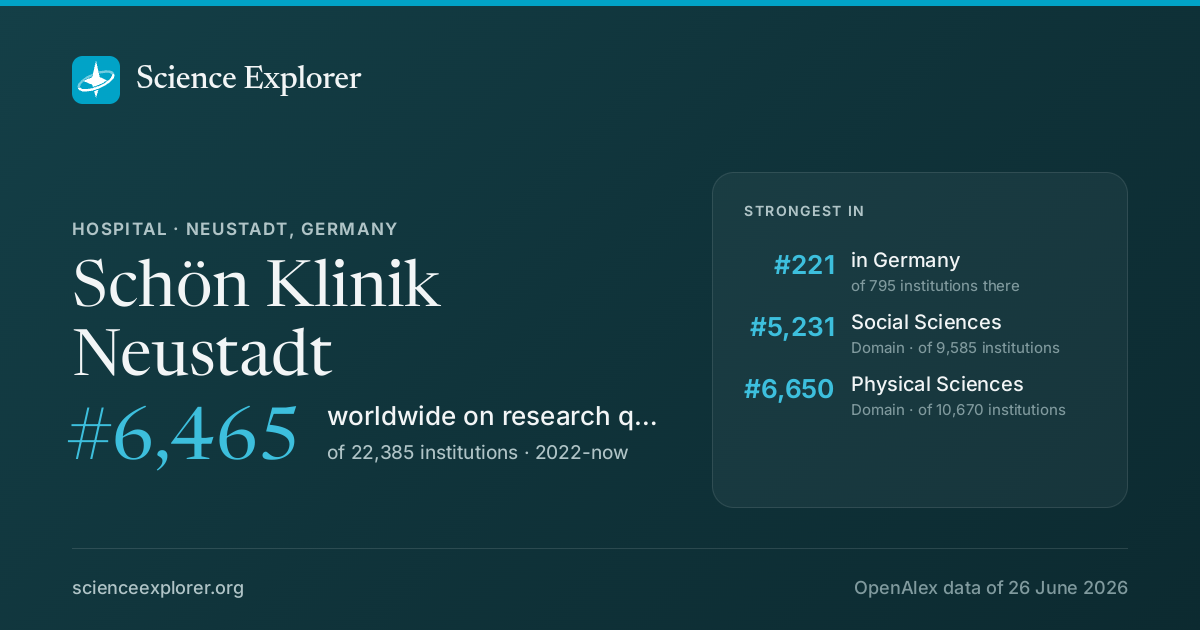
In research, Schön Klinik Neustadt stands highest in Social Sciences (#5,231 of 9,585 worldwide) and Physical Sciences (#6,650 of 10,670 worldwide), 2022-now. Relative to its size it is most specialised in Theoretical Computer Science, Mathematics and Strategy and Management (Theoretical Computer Science is 482.1× its share of world research).
- World rank, 2022-now
- #6,465 of 22,385 · #7,140 all time
- Rank in Germany
- #221 of 795
- Research works
- 858 ▲ 211% vs 2018-21
- Citations
- 5.1k 5.9 per fractional work
- Top-10% rate
- 2.4% all institutions 10.0%
- vs its own fields
- 1.00× 1.00× is exactly expected
- Open access
- 12% world 40%
- International
- 8% world 18%
What is Schön Klinik Neustadt known for in research?
The fields where it stands highest, 2022-now, ranked among every institution above the floor in each field.
| Field | World rank | Where that sits | Top-10% rate | Works | All time |
|---|---|---|---|---|---|
| Social SciencesDomain | #5,231 of 9,585 | 2.0% | 134 | #7955 | |
| Physical SciencesDomain | #6,650 of 10,670 | 1.3% | 83 | #8662 |
Each strip is that field's whole ranked pool, with the notch where Schön Klinik Neustadt sits in it, in the colour of the band that rank falls in. The track under the rate is the rate itself: it carries no average mark, because the average differs by field (from about 6% in Dentistry to 21% in Economics).
Which fields of science does Schön Klinik Neustadt work in?
In 2022-now, 50% of research at Schön Klinik Neustadt is in Social Sciences, 30% in Physical Sciences. Its largest fields are Business, Management and Accounting (16%), Arts and Humanities (16%), Medicine (14%). It does 2.0× the world's share of Social Sciences.
Each ring splits the one inside it: the four domains of science, their fields, their subfields. Size is fractional works in 2022-now. Every slice is a page; the interactive view zooms down to single topics and colours each by how much more of it this institution does than the world.
Its 4 domains and 25 fields, with their numbers
- Social Sciences14349.7%
- Business, Management and Accounting4716.3%
- Arts and Humanities4616.1%
- Social Sciences3713.0%
- Psychology82.8%
- Economics, Econometrics and Finance41.3%
- Decision Sciences10.2%
- Physical Sciences8730.1%
- Mathematics3813.0%
- Engineering279.4%
- Computer Science93.0%
- Environmental Science62.0%
- Physics and Astronomy41.4%
- Energy10.5%
- Chemistry10.4%
- Earth and Planetary Sciences10.2%
- Materials Science00.1%
- Chemical Engineering00.1%
- Health Sciences4415.3%
- Medicine4013.7%
- Health Professions31.1%
- Veterinary10.4%
- Nursing00.0%
- Life Sciences144.9%
What does Schön Klinik Neustadt specialise in?
Where its research is concentrated relative to its size: Theoretical Computer Science takes 482.1× the share of its output that it takes of world research.
- Theoretical Computer ScienceSubfield · 23.7 works482×
- MathematicsField · 37.5 works11×
- Strategy and ManagementSubfield · 24.6 works9.8×
Location quotient, a volume reading rather than an impact one. It surfaces small, lopsided specialities.
Field profile
Location quotient across every field it publishes in: outside the ring is more than an institution of this size would be expected to publish, inside it is less.
Rings at 0.5×, 1× and 2×. Widest outward: Mathematics, 11.1×. Every wedge is a field page.
All 25 fields, with their numbers
- Mathematics11.09×38 works
- Arts and Humanities5.56×46 works
- Business, Management and Accounting5.04×47 works
- Veterinary3.16×1 works
- Social Sciences1.03×38 works
- Psychology0.93×8 works
- Pharmacology, Toxicology and Pharmaceutics0.82×1 works
- Medicine0.71×40 works
- Physics and Astronomy0.64×4 works
- Engineering0.63×27 works
- Economics, Econometrics and Finance0.61×4 works
- Energy0.50×1 works
- Agricultural and Biological Sciences0.46×6 works
- Environmental Science0.41×6 works
- Health Professions0.41×3 works
- Neuroscience0.38×2 works
- Computer Science0.38×8 works
- Immunology and Microbiology0.30×1 works
- Biochemistry, Genetics and Molecular Biology0.27×4 works
- Chemistry0.24×1 works
- Decision Sciences0.24×1 works
- Chemical Engineering0.17×0 works
- Earth and Planetary Sciences0.15×1 works
- Nursing0.09×0 works
- Materials Science0.03×0 works
- Mathematics 11.1×
- Arts and Humanities 5.6×
- Business, Management and Accounting 5.0×
- Veterinary 3.2×
- Social Sciences 1.0×
- Psychology 0.9×
- Pharmacology, Toxicology and Pharmaceutics 0.8×
- Medicine 0.7×
- Physics and Astronomy 0.6×
- Engineering 0.6×
- Economics, Econometrics and Finance 0.6×
- Energy 0.5×
- Agricultural and Biological Sciences 0.5×
- Environmental Science 0.4×
- Health Professions 0.4×
- Neuroscience 0.4×
- Computer Science 0.4×
- Immunology and Microbiology 0.3×
- Biochemistry, Genetics and Molecular Biology 0.3×
- Chemistry 0.2×
- Decision Sciences 0.2×
- Chemical Engineering 0.2×
- Earth and Planetary Sciences 0.1×
- Nursing 0.1×
- Materials Science 0.0×
Who are the top researchers at Schön Klinik Neustadt?
Ranked on the quality score, Markus Quante, Henry F. H. Halm and Helmut H. Wannenwetsch lead among researchers whose main affiliation is Schön Klinik Neustadt.
- 1
Markus Quante
 Germany · #1,123,662 worldwide
6.4k citations · 175 works
- 2
Henry F. H. Halm
Germany · #1,812,443 worldwide
4.6k citations · 125 works
- 3
Helmut H. Wannenwetsch
Germany · #1,911,801 worldwide
320 citations · 260 works
- 4
Thomas Hellweg
Germany · #2,091,304 worldwide
1 citations · 114 works
- 5
Robert Hartig
Germany · #2,337,675 worldwide
456 citations · 80 works
- 6
Karl Waldkirch
Germany · #2,777,593 worldwide
28 citations · 50 works
- 7
Sprengel
Germany · #2,820,715 worldwide
10 citations · 25 works
- 8
F. Stellwaag
Germany · #2,958,489 worldwide
148 citations · 60 works
- 9
Andreas Wolfs
Germany · #2,999,879 worldwide
0 citations · 22 works
- 10
Jochen Lehnhoff
Germany · #3,079,056 worldwide
8 citations · 23 works
Which keywords describe research at Schön Klinik Neustadt?
By fractional works in 2022-now, weighted toward what it does more of than the world: Teaching Methods, Cultural Transmission, Mathematics Education, Historical Sources, Mathematical Concepts, Information Technology, Customer Relationship Management and Strategic Marketing.
- Spinal Fusion
- Employee Engagement
- Psychodrama
- Hyperbolic
- Emotional Regulation
- Professional Development
- Leadership
- History
- Fluid Dynamics
- Thermal Management
- Business Models
- Education
- Big Data
- Renewable Energy
- Digital Transformation
- Digital Capital
- Customer Relationship Management
- Information Technology
- Historical Sources
- Cultural Transmission
- Teaching Methods
- Mathematics Education
- Mathematical Concepts
- Sustainable Development
- Strategic Marketing
- Value Chains
- Artificial Intelligence
- Sustainability
- Customer Experience
- E-commerce
- Technology Innovation
- Engineering
- Philosophy
- Ethics
- Metaphysics
- Outcomes
- Geometry
- Coaching
- Qualitative Inhaltsanalyse
- Organizational Change
Size is fractional works in 2022-now in the topics tagged with each word; colour is the word's share of this institution's work against its share of the world's. The 40 words are chosen for being large and distinctive. Each links to the topic it comes from most.
All 40 words, with their numbers
- Teaching Methods26▲ 55×3 topics
- Cultural Transmission25▲ 114×3 topics
- Mathematics Education24▲ 180×2 topics
- Historical Sources24▲ 482×1 topic
- Mathematical Concepts24▲ 482×1 topic
- Information Technology23▲ 17×6 topics
- Sustainable Development21▲ 4.8×12 topics
- Customer Relationship Management20▲ 50×2 topics
- Strategic Marketing20▲ 323×2 topics
- Digital Capital19▲ 385×1 topic
- Value Chains19▲ 385×1 topic
- Digital Transformation18▲ 12×5 topics
- Artificial Intelligence17▲ 4.1×8 topics
- Renewable Energy16▲ 3.9×8 topics
- Sustainability16▲ 2.3×12 topics
- Big Data13▲ 4.8×5 topics
- Customer Experience13▲ 27×3 topics
- Education12▲ 2.5×11 topics
- E-commerce12▲ 7.5×2 topics
- Business Models12▲ 58×1 topic
- Technology Innovation12▲ 123×1 topic
- Thermal Management11▲ 12×2 topics
- Engineering11▲ 86×1 topic
- Fluid Dynamics11▲ 28×1 topic
- Philosophy11▲ 8.8×10 topics
- History11▲ 5.6×8 topics
- Ethics7▲ 5.0×5 topics
- Leadership7▲ 5.0×6 topics
- Metaphysics6▲ 53×3 topics
- Professional Development6▲ 11×3 topics
- Outcomes6▲ 25×2 topics
- Emotional Regulation6▲ 83×2 topics
- Geometry6▲ 129×1 topic
- Hyperbolic6▲ 129×1 topic
- Coaching6▲ 108×1 topic
- Psychodrama6▲ 101×1 topic
- Qualitative Inhaltsanalyse5▲ 47×2 topics
- Employee Engagement5▲ 9.9×3 topics
- Organizational Change5▲ 23×2 topics
- Spinal Fusion5▲ 18×2 topics
Which research topics does Schön Klinik Neustadt publish most on?
By volume in 2022-now: History and Theory of Mathematics, Corporate Governance and Management, Digital Innovation in Industries and Physics and Engineering Research Articles.
Area is fractional works; colour is the subfield each topic belongs to.
- 1 History and Theory of Mathematics Theoretical Computer Science 24 works
- 2 Corporate Governance and Management Strategy and Management 19 works
- 3 Digital Innovation in Industries Management of Technology and Innovation 12 works
- 4 Physics and Engineering Research Articles Computational Mechanics 11 works
- 5 Mathematics and Applications Geometry and Topology 6 works
- 6 Psychology, Coaching, and Therapy Social Psychology 6 works
- 7 Linguistic research and analysis Language and Linguistics 5 works
- 8 Corporate Management and Leadership Organizational Behavior and Human Resource Management 4 works
- 9 Religion, Theology, and Education Religious studies 4 works
- 10 Philosophy, Science, and History History and Philosophy of Science 4 works
How open and international is its research?
Against the world's own shares: the tick on each track. Both are shares of its output, so they sit on one scale and can be read against each other as well as against the world.
World: 40% of research is openly available.
World: 18% is written across borders.
How has Schön Klinik Neustadt's research output changed?
Output in 2022-2025 was 211% higher than in 2018-2021.
The same series as a ribbon: one cell per year, darker for more. The line above answers how much; this answers when.
Its share of all research
Growing output can still be a shrinking share: all of science grows. This is Schön Klinik Neustadt as a percentage of every work published that year, 0.00069% in 2024.
Fractional works of Schön Klinik Neustadt over all fractional works that year. How the balance of science has shifted.
How much of it reaches the world top 10%
Year by year, against all institutions in the same year.
Of each year's output, the share that reached the world's 10% most cited for its field and year. Peak 6.7% in 2021.
Other research institutions in Neustadt
- Dienstleistungszentrum Ländlicher Raum
- Marienhaus Klinikum Hetzelstift Neustadt
- RLP AgroScience (Germany)
- Advanced Medical Solutions (Germany)
Share Schön Klinik Neustadt's ranking
Badges for a website1Each links back here and updates with every snapshot

Research measures only: rankings here say nothing about teaching, admissions or student experience. Comparable institutions and collaboration partners have tabs of their own, above.
Discussion
Ask a question or share a note about Schön Klinik Neustadt. Posts are plain text and can be reported.