Scottish Enterprise
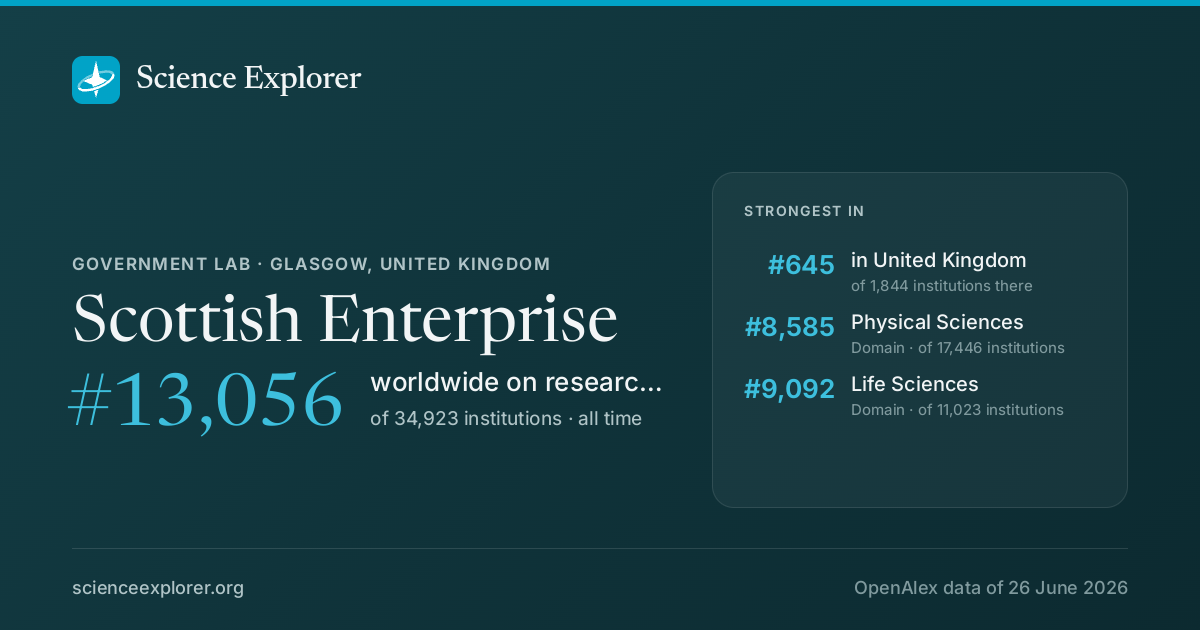
In research, Scottish Enterprise stands highest in Physical Sciences (#8,585 of 17,446 worldwide) and Life Sciences (#9,092 of 11,023 worldwide), over all time.
- World rank, all time
- #13,056 of 34,923
- Rank in United Kingdom
- #645 of 1,844
- Research works
- 427 ▼ 44% vs 2018-21
- Citations
- 15k 34.4 per fractional work
- Top-10% rate
- 8.8% all institutions 10.0%
- vs its own fields
- 1.18× 1.00× is exactly expected
- Open access
- 40% world 40%
- International
- 26% world 18%
What is Scottish Enterprise known for in research?
The fields where it stands highest, over all time, ranked among every institution above the floor in each field.
| Field | World rank | Where that sits | Top-10% rate | Works |
|---|---|---|---|---|
| Physical SciencesDomain | #8,585 of 17,446 | 13.1% | 207 | |
| Life SciencesDomain | #9,092 of 11,023 | 9.1% | 131 |
Each strip is that field's whole ranked pool, with the notch where Scottish Enterprise sits in it, in the colour of the band that rank falls in. The track under the rate is the rate itself: it carries no average mark, because the average differs by field (from about 6% in Dentistry to 21% in Economics).
Which fields of science does Scottish Enterprise work in?
In all years, 48% of research at Scottish Enterprise is in Physical Sciences, 31% in Life Sciences. Its largest fields are Agricultural and Biological Sciences (24%), Earth and Planetary Sciences (22%), Environmental Science (14%). It does 2.0× the world's share of Life Sciences.
Each ring splits the one inside it: the four domains of science, their fields, their subfields. Size is fractional works in all years. Every slice is a page; the interactive view zooms down to single topics and colours each by how much more of it this institution does than the world.
Its 4 domains and 26 fields, with their numbers
- Physical Sciences20748.5%
- Earth and Planetary Sciences9522.2%
- Environmental Science6214.4%
- Engineering225.1%
- Physics and Astronomy102.2%
- Computer Science92.2%
- Chemistry71.6%
- Materials Science20.4%
- Energy10.3%
- Chemical Engineering00.1%
- Mathematics00.0%
- Life Sciences13130.6%
- Social Sciences6415.0%
- Health Sciences256.0%
- Medicine112.5%
- Nursing71.6%
- Health Professions71.6%
- Veterinary10.2%
- Dentistry00.0%
Field profile
Location quotient across every field it publishes in: outside the ring is more than an institution of this size would be expected to publish, inside it is less.
Rings at 0.5×, 1× and 2×. Widest outward: Earth and Planetary Sciences, 25.2×. Every wedge is a field page.
All 17 fields, with their numbers
- Earth and Planetary Sciences25.25×8 works
- Environmental Science3.00×3 works
- Physics and Astronomy2.55×1 works
- Nursing2.28×0 works
- Decision Sciences1.89×0 works
- Arts and Humanities1.14×1 works
- Computer Science1.07×2 works
- Psychology0.85×0 works
- Engineering0.66×2 works
- Energy0.61×0 works
- Chemistry0.36×0 works
- Health Professions0.36×0 works
- Social Sciences0.34×1 works
- Biochemistry, Genetics and Molecular Biology0.30×0 works
- Medicine0.20×1 works
- Agricultural and Biological Sciences0.13×0 works
- Materials Science0.08×0 works
- Earth and Planetary Sciences 25.2×
- Environmental Science 3.0×
- Physics and Astronomy 2.5×
- Nursing 2.3×
- Decision Sciences 1.9×
- Arts and Humanities 1.1×
- Computer Science 1.1×
- Psychology 0.8×
- Engineering 0.7×
- Energy 0.6×
- Chemistry 0.4×
- Health Professions 0.4×
- Social Sciences 0.3×
- Biochemistry, Genetics and Molecular Biology 0.3×
- Medicine 0.2×
- Agricultural and Biological Sciences 0.1×
- Materials Science 0.1×
Who are the top researchers at Scottish Enterprise?
Ranked on the quality score, Charlotte Bryant, Ronald Boyne and Douglas D. Harkness lead among researchers whose main affiliation is Scottish Enterprise.
- 1
Charlotte Bryant
 United Kingdom · #320,700 worldwide
7.2k citations · 150 works
- 2
Ronald Boyne
United Kingdom · #922,452 worldwide
1.2k citations · 28 works
- 3
Douglas D. Harkness
United Kingdom · #971,383 worldwide
1.5k citations · 29 works
- 4
Hildur Gestsdóttir
United Kingdom · #2,185,586 worldwide
870 citations · 34 works
- 5
Jean F. Malcolmson
United Kingdom · #2,245,824 worldwide
791 citations · 21 works
- 6
George Cockerham
United Kingdom · #2,706,533 worldwide
511 citations · 15 works
- 7
M. Kay
United Kingdom · #2,805,925 worldwide
644 citations · 37 works
- 8
Smith
United Kingdom · #3,748,073 worldwide
438 citations · 17 works
- 9
M. H. Arnold
United Kingdom · #3,941,989 worldwide
157 citations · 22 works
- 10
J T Walker
United Kingdom · #4,264,143 worldwide
579 citations · 20 works
Which keywords describe research at Scottish Enterprise?
By fractional works in all years, weighted toward what it does more of than the world: Climate Change, Holocene, Sea Level, Paleoclimatology, Solar Influence, Glacial Cycles, Monsoon Dynamics and Potato.
- Smart Specialization
- Plant Breeding
- Innovation Policy
- Genetic Mapping
- Regional Growth
- Maillard Reaction
- Radionuclides
- Metabolism
- Geochronology
- late blight resistance
- Health Effects
- Radiocarbon Dating
- Plate Tectonics
- Stable Isotopes
- Toxicity
- Genome Sequencing
- Potato
- Glacial Cycles
- Paleoclimatology
- Holocene
- Climate Change
- Sea Level
- Solar Influence
- Monsoon Dynamics
- Genetic Diversity
- Phylogenetic Analysis
- Tectonics
- Trophic Position
- Agricultural Origins
- Plant Pathogens
- Phytophthora
- Thermodynamic Modeling
- Zircon
- Antioxidants
- Acrylamide
- Quantitative Trait Loci
- Subduction
- Disease Resistance
- Territorial Capital
- European Union Cohesion Policy
Size is fractional works in all years in the topics tagged with each word; colour is the word's share of this institution's work against its share of the world's. The 40 words are chosen for being large and distinctive. Each links to the topic it comes from most.
All 40 words, with their numbers
- Climate Change65▲ 5.7×37 topics
- Holocene30▲ 43×3 topics
- Sea Level28▲ 47×2 topics
- Paleoclimatology28▲ 52×2 topics
- Solar Influence28▲ 55×2 topics
- Glacial Cycles28▲ 59×1 topic
- Monsoon Dynamics28▲ 59×1 topic
- Potato25▲ 120×2 topics
- Genetic Diversity23▲ 11×9 topics
- Genome Sequencing21▲ 28×3 topics
- Phylogenetic Analysis20▲ 12×10 topics
- Toxicity19▲ 10×6 topics
- Tectonics18▲ 25×3 topics
- Stable Isotopes17▲ 89×1 topic
- Trophic Position17▲ 89×1 topic
- Plate Tectonics16▲ 17×3 topics
- Agricultural Origins15▲ 95×1 topic
- Radiocarbon Dating15▲ 95×1 topic
- Plant Pathogens14▲ 80×2 topics
- Health Effects14▲ 5.5×9 topics
- Phytophthora14▲ 142×1 topic
- late blight resistance14▲ 142×1 topic
- Thermodynamic Modeling12▲ 17×2 topics
- Geochronology12▲ 30×1 topic
- Zircon12▲ 30×1 topic
- Metabolism12▲ 4.3×5 topics
- Antioxidants12▲ 6.4×3 topics
- Radionuclides12▲ 51×2 topics
- Acrylamide11▲ 99×1 topic
- Maillard Reaction11▲ 99×1 topic
- Quantitative Trait Loci11▲ 33×3 topics
- Regional Growth10▲ 23×3 topics
- Subduction9▲ 22×3 topics
- Genetic Mapping9▲ 22×3 topics
- Disease Resistance9▲ 44×3 topics
- Innovation Policy9▲ 26×2 topics
- Territorial Capital9▲ 67×2 topics
- Plant Breeding9▲ 19×3 topics
- European Union Cohesion Policy9▲ 81×1 topic
- Smart Specialization9▲ 55×1 topic
Which research topics does Scottish Enterprise publish most on?
By volume in 2022-now: Geology and Paleoclimatology Research, Geological and Geochemical Analysis, Archaeology and ancient environmental studies and Isotope Analysis in Ecology.
Area is fractional works; colour is the subfield each topic belongs to.
- 1 Geology and Paleoclimatology Research Atmospheric Science 2 works
- 2 Geological and Geochemical Analysis Geophysics 1 works
- 3 Archaeology and ancient environmental studies Paleontology 1 works
- 4 Isotope Analysis in Ecology Ecology 1 works
- 5 Geochemistry and Geologic Mapping Artificial Intelligence 1 works
- 6 Pleistocene-Era Hominins and Archaeology Anthropology 1 works
- 7 Advanced Text Analysis Techniques Artificial Intelligence 0 works
- 8 Flow Measurement and Analysis Mechanics of Materials 0 works
- 9 Complex Network Analysis Techniques Statistical and Nonlinear Physics 0 works
- 10 Geological formations and processes Earth-Surface Processes 0 works
How open and international is its research?
Against the world's own shares: the tick on each track. Both are shares of its output, so they sit on one scale and can be read against each other as well as against the world.
World: 40% of research is openly available.
World: 18% is written across borders.
How has Scottish Enterprise's research output changed?
Output in 2022-2025 was 44% lower than in 2018-2021.
The same series as a ribbon: one cell per year, darker for more. The line above answers how much; this answers when.
Its share of all research
Growing output can still be a shrinking share: all of science grows. This is Scottish Enterprise as a percentage of every work published that year, 0.000078% in 2024.
Fractional works of Scottish Enterprise over all fractional works that year. How the balance of science has shifted.
Other research institutions in Glasgow
- University of Glasgow
- University of Strathclyde
- Glasgow Caledonian University
- NHS Greater Glasgow and Clyde
- Glasgow Life
- Institute of Nanotechnology
- Turing Institute
- Beatson West of Scotland Cancer Centre


Share Scottish Enterprise's ranking
Badges for a website1Each links back here and updates with every snapshot

Research measures only: rankings here say nothing about teaching, admissions or student experience. Comparable institutions and collaboration partners have tabs of their own, above.
Discussion
Ask a question or share a note about Scottish Enterprise. Keep it to the research: no personal attacks, advertising or links. Any reader can report a post, which collapses it for everyone until it is opened.