SELEX Sistemi Integrati
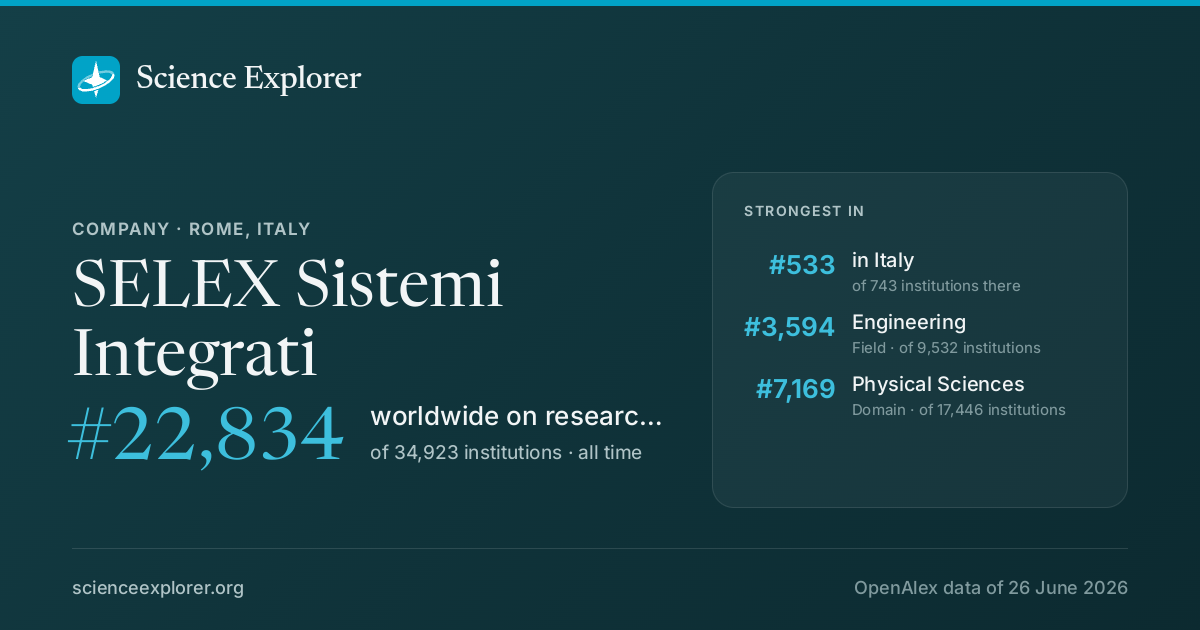
In research, SELEX Sistemi Integrati stands highest in Engineering (#3,594 of 9,532 worldwide) and Physical Sciences (#7,169 of 17,446 worldwide), over all time.
- World rank, all time
- #22,834 of 34,923
- Rank in Italy
- #533 of 743
- Research works
- 392 ▼ 62% vs 2018-21
- Citations
- 5.6k 14.4 per fractional work
- Top-10% rate
- 12.0% all institutions 10.0%
- vs its own fields
- 0.97× 1.00× is exactly expected
- Open access
- 14% world 40%
- International
- 19% world 18%
What is SELEX Sistemi Integrati known for in research?
The fields where it stands highest, over all time, ranked among every institution above the floor in each field.
| Field | World rank | Where that sits | Top-10% rate | Works |
|---|---|---|---|---|
| EngineeringField | #3,594 of 9,532 | 10.2% | 238 | |
| Physical SciencesDomain | #7,169 of 17,446 | 10.0% | 373 |
Each strip is that field's whole ranked pool, with the notch where SELEX Sistemi Integrati sits in it, in the colour of the band that rank falls in. The track under the rate is the rate itself: it carries no average mark, because the average differs by field (from about 6% in Dentistry to 21% in Economics).
Which fields of science does SELEX Sistemi Integrati work in?
In all years, 95% of research at SELEX Sistemi Integrati is in Physical Sciences, 3% in Social Sciences. Its largest fields are Engineering (61%), Computer Science (22%), Physics and Astronomy (8%). It does 2.3× the world's share of Physical Sciences.
Each ring splits the one inside it: the four domains of science, their fields, their subfields. Size is fractional works in all years. Every slice is a page; the interactive view zooms down to single topics and colours each by how much more of it this institution does than the world.
Its 4 domains and 20 fields, with their numbers
- Physical Sciences37395.2%
- Engineering23860.8%
- Computer Science8521.7%
- Physics and Astronomy307.8%
- Earth and Planetary Sciences61.5%
- Environmental Science41.0%
- Materials Science41.0%
- Mathematics30.7%
- Chemistry20.6%
- Chemical Engineering00.1%
- Social Sciences122.9%
- Health Sciences41.0%
- Medicine40.9%
- Health Professions00.1%
- Life Sciences30.9%
Field profile
Location quotient across every field it publishes in: outside the ring is more than an institution of this size would be expected to publish, inside it is less.
Rings at 0.5×, 1× and 2×. Widest outward: Engineering, 4.1×. Every wedge is a field page.
All 7 fields, with their numbers
- Engineering4.14×6 works
- Computer Science3.12×2 works
- Decision Sciences2.99×0 works
- Physics and Astronomy1.56×0 works
- Environmental Science0.58×0 works
- Earth and Planetary Sciences0.55×0 works
- Social Sciences0.27×0 works
Who are the top researchers at SELEX Sistemi Integrati?
Ranked on the quality score, Alfonso Farina, M. D’Urso and A. Graziano lead among researchers whose main affiliation is SELEX Sistemi Integrati.
- 1
Alfonso Farina
 Italy · #1,132,740 worldwide
16k citations · 645 works
- 2
M. D’Urso
Italy · #1,499,659 worldwide
2.3k citations · 116 works
- 3
A. Graziano
Italy · #2,566,202 worldwide
1.5k citations · 64 works
- 4
Aniello Buonanno
Italy · #3,124,862 worldwide
405 citations · 21 works
- 5
Michele Fiorini
Italy · #3,294,805 worldwide
352 citations · 35 works
- 6
Dario Della Noce
Italy · #3,604,323 worldwide
4 citations · 20 works
- 7
Sofia Giompapa
Italy · #3,802,184 worldwide
274 citations · 26 works
- 8
Massimiliano Dispenza
Italy · #4,007,379 worldwide
424 citations · 71 works
- 9
A. Nanni
Italy · #4,130,511 worldwide
751 citations · 47 works
- 10
Pietro Vinetti
Italy · #4,383,058 worldwide
306 citations · 37 works
Which keywords describe research at SELEX Sistemi Integrati?
By fractional works in all years, weighted toward what it does more of than the world: Signal Processing, MIMO Radar, Waveform Design, Automotive Radar, Cognitive Radar, Sensor Fusion, State Estimation and Bayesian Inference.
- Light-Emitting Diodes
- Sparse Representation
- Semiconductors
- Nanowires
- Microstrip
- Antenna
- Frequency Synthesizer
- Beamforming
- Wireless Sensor Networks
- Micro-Doppler Effect
- Integrated Circuits
- Doppler Radar
- Antenna Arrays
- Differential Evolution
- Optimization
- Nonlinear Estimation
- State Estimation
- Deep Learning
- Automotive Radar
- MIMO Radar
- Signal Processing
- Waveform Design
- Cognitive Radar
- Sensor Fusion
- Bayesian Inference
- Particle Filters
- Genetic Algorithms
- Particle Swarm Optimization
- Sparse Arrays
- Convolutional Neural Networks
- Wireless Communications
- Synthetic Aperture Radar
- Metamaterial
- Millimeter-Wave
- CMOS
- Low-Noise Amplifiers
- Oscillators
- Band Parameters
- GaN
- III-Nitrides
Size is fractional works in all years in the topics tagged with each word; colour is the word's share of this institution's work against its share of the world's. The 40 words are chosen for being large and distinctive. Each links to the topic it comes from most.
All 40 words, with their numbers
- Signal Processing49▲ 101×4 topics
- MIMO Radar42▲ 325×2 topics
- Waveform Design33▲ 252×2 topics
- Automotive Radar32▲ 404×1 topic
- Cognitive Radar32▲ 404×1 topic
- Deep Learning27▲ 3.2×24 topics
- Sensor Fusion25▲ 72×2 topics
- State Estimation24▲ 85×2 topics
- Bayesian Inference24▲ 48×3 topics
- Nonlinear Estimation23▲ 181×1 topic
- Particle Filters23▲ 181×1 topic
- Optimization22▲ 11×6 topics
- Genetic Algorithms22▲ 36×3 topics
- Differential Evolution21▲ 81×2 topics
- Particle Swarm Optimization21▲ 48×2 topics
- Antenna Arrays21▲ 178×1 topic
- Sparse Arrays21▲ 178×1 topic
- Doppler Radar17▲ 77×2 topics
- Convolutional Neural Networks17▲ 10×4 topics
- Integrated Circuits17▲ 18×3 topics
- Wireless Communications16▲ 27×3 topics
- Micro-Doppler Effect16▲ 192×1 topic
- Synthetic Aperture Radar16▲ 192×1 topic
- Wireless Sensor Networks16▲ 10×6 topics
- Metamaterial14▲ 44×2 topics
- Beamforming14▲ 34×4 topics
- Millimeter-Wave14▲ 69×2 topics
- Frequency Synthesizer14▲ 56×2 topics
- CMOS14▲ 45×2 topics
- Antenna13▲ 48×1 topic
- Low-Noise Amplifiers13▲ 82×1 topic
- Microstrip13▲ 48×1 topic
- Oscillators13▲ 82×1 topic
- Nanowires12▲ 13×3 topics
- Band Parameters12▲ 24×2 topics
- Semiconductors10▲ 9.9×3 topics
- GaN10▲ 49×2 topics
- Sparse Representation10▲ 14×4 topics
- III-Nitrides10▲ 56×1 topic
- Light-Emitting Diodes10▲ 19×1 topic
Which research topics does SELEX Sistemi Integrati publish most on?
By volume in 2022-now: Radar Systems and Signal Processing, Advanced SAR Imaging Techniques, Direction-of-Arrival Estimation Techniques and Synthetic Aperture Radar (SAR) Applications and Techniques.
Area is fractional works; colour is the subfield each topic belongs to.
- 1 Radar Systems and Signal Processing Aerospace Engineering 2 works
- 2 Advanced SAR Imaging Techniques Aerospace Engineering 1 works
- 3 Direction-of-Arrival Estimation Techniques Signal Processing 1 works
- 4 Synthetic Aperture Radar (SAR) Applications and Techniques Aerospace Engineering 1 works
- 5 Target Tracking and Data Fusion in Sensor Networks Artificial Intelligence 1 works
- 6 Quantum Information and Cryptography Artificial Intelligence 0 works
- 7 Microwave Imaging and Scattering Analysis Biomedical Engineering 0 works
- 8 Robotics and Sensor-Based Localization Aerospace Engineering 0 works
- 9 Scientific Measurement and Uncertainty Evaluation Statistics, Probability and Uncertainty 0 works
- 10 Acoustic Wave Resonator Technologies Biomedical Engineering 0 works
How open and international is its research?
Against the world's own shares: the tick on each track. Both are shares of its output, so they sit on one scale and can be read against each other as well as against the world.
World: 40% of research is openly available.
World: 18% is written across borders.
How has SELEX Sistemi Integrati's research output changed?
Output in 2022-2025 was 62% lower than in 2018-2021.
The same series as a ribbon: one cell per year, darker for more. The line above answers how much; this answers when.
Its share of all research
Growing output can still be a shrinking share: all of science grows. This is SELEX Sistemi Integrati as a percentage of every work published that year, 0.000029% in 2024.
Fractional works of SELEX Sistemi Integrati over all fractional works that year. How the balance of science has shifted.
How much of it reaches the world top 10%
Year by year, against all institutions in the same year.
Of each year's output, the share that reached the world's 10% most cited for its field and year. Peak 15.7% in 2013.
Other research institutions in Rome
- National Research Council
- Sapienza University of Rome
- University of Rome Tor Vergata
- Istituti di Ricovero e Cura a Carattere Scientifico
- National Institute for Astrophysics
- Istituto Nazionale di Fisica Nucleare
- Roma Tre University
- Istituto Superiore di Sanità



Share SELEX Sistemi Integrati's ranking
Badges for a website1Each links back here and updates with every snapshot

Research measures only: rankings here say nothing about teaching, admissions or student experience. Comparable institutions and collaboration partners have tabs of their own, above.
Discussion
Ask a question or share a note about SELEX Sistemi Integrati. Posts are plain text and can be reported.