Sellafield (United Kingdom)
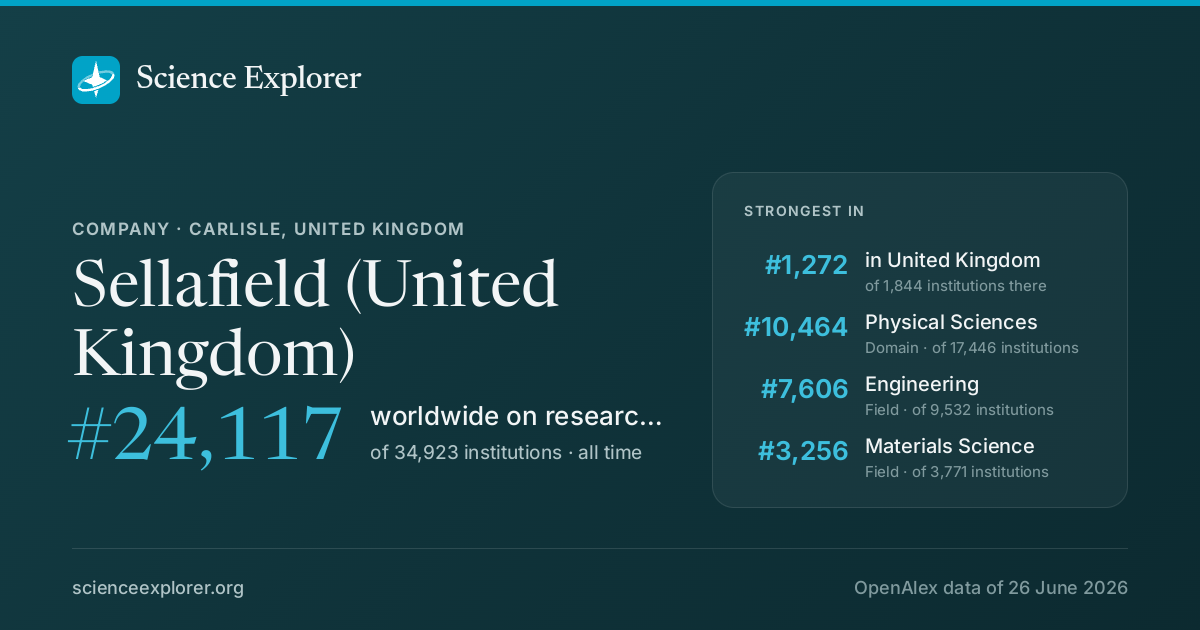
In research, Sellafield (United Kingdom) stands highest in Physical Sciences (#10,464 of 17,446 worldwide), Engineering (#7,606 of 9,532 worldwide) and Materials Science (#3,256 of 3,771 worldwide), over all time.
- World rank, all time
- #24,117 of 34,923
- Rank in United Kingdom
- #1,272 of 1,844
- Research works
- 521 ▲ 4% vs 2018-21
- Citations
- 6.1k 11.8 per fractional work
- Top-10% rate
- 11.8% all institutions 10.0%
- vs its own fields
- 0.80× 1.00× is exactly expected
- Open access
- 23% world 40%
- International
- 14% world 18%
What is Sellafield (United Kingdom) known for in research?
The fields where it stands highest, over all time, ranked among every institution above the floor in each field.
| Field | World rank | Where that sits | Top-10% rate | Works |
|---|---|---|---|---|
| Physical SciencesDomain | #10,464 of 17,446 | 8.1% | 468 | |
| EngineeringField | #7,606 of 9,532 | 8.9% | 182 | |
| Materials ScienceField | #3,256 of 3,771 | 6.7% | 129 |
Each strip is that field's whole ranked pool, with the notch where Sellafield (United Kingdom) sits in it, in the colour of the band that rank falls in. The track under the rate is the rate itself: it carries no average mark, because the average differs by field (from about 6% in Dentistry to 21% in Economics).
Which fields of science does Sellafield (United Kingdom) work in?
In 2022-now, 87% of research at Sellafield (United Kingdom) is in Physical Sciences, 7% in Social Sciences. Its largest fields are Engineering (33%), Materials Science (24%), Chemistry (9%). It does 2.1× the world's share of Physical Sciences.
Each ring splits the one inside it: the four domains of science, their fields, their subfields. Size is fractional works in 2022-now. Every slice is a page; the interactive view zooms down to single topics and colours each by how much more of it this institution does than the world.
Its 4 domains and 18 fields, with their numbers
- Physical Sciences5386.6%
- Engineering2033.1%
- Materials Science1523.8%
- Chemistry69.1%
- Environmental Science46.4%
- Physics and Astronomy35.7%
- Computer Science23.1%
- Earth and Planetary Sciences23.0%
- Chemical Engineering11.7%
- Energy00.8%
- Social Sciences57.5%
- Health Sciences34.3%
- Medicine23.1%
- Health Professions11.2%
- Life Sciences11.5%
Field profile
Location quotient across every field it publishes in: outside the ring is more than an institution of this size would be expected to publish, inside it is less.
Rings at 0.5×, 1× and 2×. Widest outward: Materials Science, 6.8×. Every wedge is a field page.
All 18 fields, with their numbers
- Materials Science6.83×15 works
- Chemistry5.81×6 works
- Chemical Engineering4.77×1 works
- Physics and Astronomy2.55×4 works
- Engineering2.21×20 works
- Earth and Planetary Sciences1.89×2 works
- Environmental Science1.28×4 works
- Business, Management and Accounting0.98×2 works
- Energy0.87×0 works
- Decision Sciences0.56×0 works
- Health Professions0.46×1 works
- Computer Science0.40×2 works
- Economics, Econometrics and Finance0.38×0 works
- Social Sciences0.22×2 works
- Agricultural and Biological Sciences0.17×0 works
- Medicine0.16×2 works
- Biochemistry, Genetics and Molecular Biology0.13×0 works
- Arts and Humanities0.06×0 works
- Materials Science 6.8×
- Chemistry 5.8×
- Chemical Engineering 4.8×
- Physics and Astronomy 2.5×
- Engineering 2.2×
- Earth and Planetary Sciences 1.9×
- Environmental Science 1.3×
- Business, Management and Accounting 1.0×
- Energy 0.9×
- Decision Sciences 0.6×
- Health Professions 0.5×
- Computer Science 0.4×
- Economics, Econometrics and Finance 0.4×
- Social Sciences 0.2×
- Agricultural and Biological Sciences 0.2×
- Medicine 0.2×
- Biochemistry, Genetics and Molecular Biology 0.1×
- Arts and Humanities 0.1×
Who are the top researchers at Sellafield (United Kingdom)?
Ranked on the quality score, George Henry Fox, A. R. Garlick and Robert C. Thied lead among researchers whose main affiliation is Sellafield (United Kingdom).
- 1
George Henry Fox
 United Kingdom · #2,882,379 worldwide
753 citations · 34 works
- 2
A. R. Garlick
United Kingdom · #2,886,342 worldwide
413 citations · 23 works
- 3
Robert C. Thied
United Kingdom · #3,388,089 worldwide
798 citations · 38 works
- 4
Helen M. Steele
United Kingdom · #3,447,564 worldwide
1.2k citations · 48 works
- 5
A. C. Rapier
United Kingdom · #3,692,438 worldwide
199 citations · 16 works
- 6
Alexandros Plianos
United Kingdom · #3,849,499 worldwide
188 citations · 16 works
- 7
P. J. W. Rance
United Kingdom · #3,932,224 worldwide
107 citations · 15 works
- 8
G.A. Welch
United Kingdom · #3,955,275 worldwide
268 citations · 18 works
- 9
D. H. MacGregor
United Kingdom · #4,025,140 worldwide
170 citations · 47 works
- 10
Iain S. Denniss
United Kingdom · #4,148,441 worldwide
452 citations · 26 works
Which keywords describe research at Sellafield (United Kingdom)?
By fractional works in 2022-now, weighted toward what it does more of than the world: Actinides, Hydrogen Embrittlement, High Temperature Behavior, Oxidation Resistance, Density Functional Theory, Accident Tolerant Fuels, Fuel Cladding and Adsorption.
- Vortex Dynamics
- Lean Manufacturing
- Tomography
- Non-Destructive Testing
- Inorganic Scintillators
- Circular Economy
- Large-Eddy Simulation
- Environmental Impacts
- Health Effects
- Nuclear Waste Disposal
- Nuclear Reactor
- Environmental Impact
- Nuclear Fuel
- Microstructural Characterization
- Raman Spectroscopy
- Lanthanides
- Adsorption
- Accident Tolerant Fuels
- High Temperature Behavior
- Hydrogen Embrittlement
- Actinides
- Density Functional Theory
- Oxidation Resistance
- Fuel Cladding
- Bioremediation
- Uranium
- Oxidation Behavior
- Nuclear Graphite
- Radiation Protection
- Molten Salt
- Ceramics
- Pyrochlore
- Radionuclides
- Heat Transfer
- Soil Contamination
- Fukushima Daiichi
- Metal Recovery
- Scintillation Detectors
- nuclear accident
- Rare Earth Elements
Size is fractional works in 2022-now in the topics tagged with each word; colour is the word's share of this institution's work against its share of the world's. The 40 words are chosen for being large and distinctive. Each links to the topic it comes from most.
All 40 words, with their numbers
- Actinides6▲ 201×2 topics
- Hydrogen Embrittlement6▲ 123×2 topics
- Density Functional Theory6▲ 90×2 topics
- High Temperature Behavior6▲ 167×2 topics
- Oxidation Resistance6▲ 87×2 topics
- Accident Tolerant Fuels6▲ 263×1 topic
- Fuel Cladding6▲ 263×1 topic
- Adsorption5▲ 41×2 topics
- Bioremediation5▲ 59×2 topics
- Lanthanides4▲ 172×1 topic
- Uranium4▲ 223×1 topic
- Raman Spectroscopy4▲ 33×4 topics
- Oxidation Behavior3▲ 92×2 topics
- Microstructural Characterization3▲ 260×1 topic
- Nuclear Graphite3▲ 260×1 topic
- Nuclear Fuel3▲ 320×1 topic
- Radiation Protection3▲ 320×1 topic
- Environmental Impact3▲ 2.5×6 topics
- Molten Salt2▲ 127×1 topic
- Nuclear Reactor2▲ 127×1 topic
- Ceramics2▲ 21×2 topics
- Nuclear Waste Disposal2▲ 161×1 topic
- Pyrochlore2▲ 161×1 topic
- Health Effects2▲ 4.4×2 topics
- Radionuclides2▲ 69×2 topics
- Environmental Impacts2▲ 9.1×3 topics
- Heat Transfer2▲ 5.1×4 topics
- Large-Eddy Simulation1▲ 12×2 topics
- Soil Contamination1▲ 76×2 topics
- Circular Economy1▲ 7.0×2 topics
- Fukushima Daiichi1▲ 123×1 topic
- Inorganic Scintillators1▲ 59×1 topic
- Metal Recovery1▲ 10×3 topics
- Non-Destructive Testing1▲ 22×3 topics
- Scintillation Detectors1▲ 59×1 topic
- Tomography1▲ 11×4 topics
- nuclear accident1▲ 123×1 topic
- Lean Manufacturing1▲ 10×1 topic
- Rare Earth Elements1▲ 13×3 topics
- Vortex Dynamics1▲ 16×2 topics
Which research topics does Sellafield (United Kingdom) publish most on?
By volume in 2022-now: Nuclear Materials and Properties, Radioactive element chemistry and processing, Graphite, nuclear technology, radiation studies and Nuclear and radioactivity studies.
Area is fractional works; colour is the subfield each topic belongs to.
- 1 Nuclear Materials and Properties Materials Chemistry 6 works
- 2 Radioactive element chemistry and processing Inorganic Chemistry 4 works
- 3 Graphite, nuclear technology, radiation studies Materials Chemistry 3 works
- 4 Nuclear and radioactivity studies Safety, Risk, Reliability and Quality 3 works
- 5 Nuclear reactor physics and engineering Aerospace Engineering 2 works
- 6 Nuclear materials and radiation effects Materials Chemistry 2 works
- 7 Radiation Detection and Scintillator Technologies Radiation 1 works
- 8 Radioactive contamination and transfer Global and Planetary Change 1 works
- 9 Quality and Supply Management Management Information Systems 1 works
- 10 Fluid Dynamics and Turbulent Flows Computational Mechanics 1 works
How open and international is its research?
Against the world's own shares: the tick on each track. Both are shares of its output, so they sit on one scale and can be read against each other as well as against the world.
World: 40% of research is openly available.
World: 18% is written across borders.
How has Sellafield (United Kingdom)'s research output changed?
Output in 2022-2025 was 4% higher than in 2018-2021.
The same series as a ribbon: one cell per year, darker for more. The line above answers how much; this answers when.
Its share of all research
Growing output can still be a shrinking share: all of science grows. This is Sellafield (United Kingdom) as a percentage of every work published that year, 0.00028% in 2024.
Fractional works of Sellafield (United Kingdom) over all fractional works that year. How the balance of science has shifted.
Other research institutions in Carlisle
- University of Cumbria
- Cumberland Infirmary
- Crown Holdings (United Kingdom)
- Friends of Cumbria Archives
- Dove Cottage & the Wordsworth Museum
- Tullie House Museum and Art Gallery
- Foundation for Common Land
- Cybermoor (United Kingdom)
Share Sellafield (United Kingdom)'s ranking
Badges for a website1Each links back here and updates with every snapshot

Research measures only: rankings here say nothing about teaching, admissions or student experience. Comparable institutions and collaboration partners have tabs of their own, above.
Discussion
Ask a question or share a note about Sellafield (United Kingdom). Keep it to the research: no personal attacks, advertising or links. Any reader can report a post, which collapses it for everyone until it is opened.