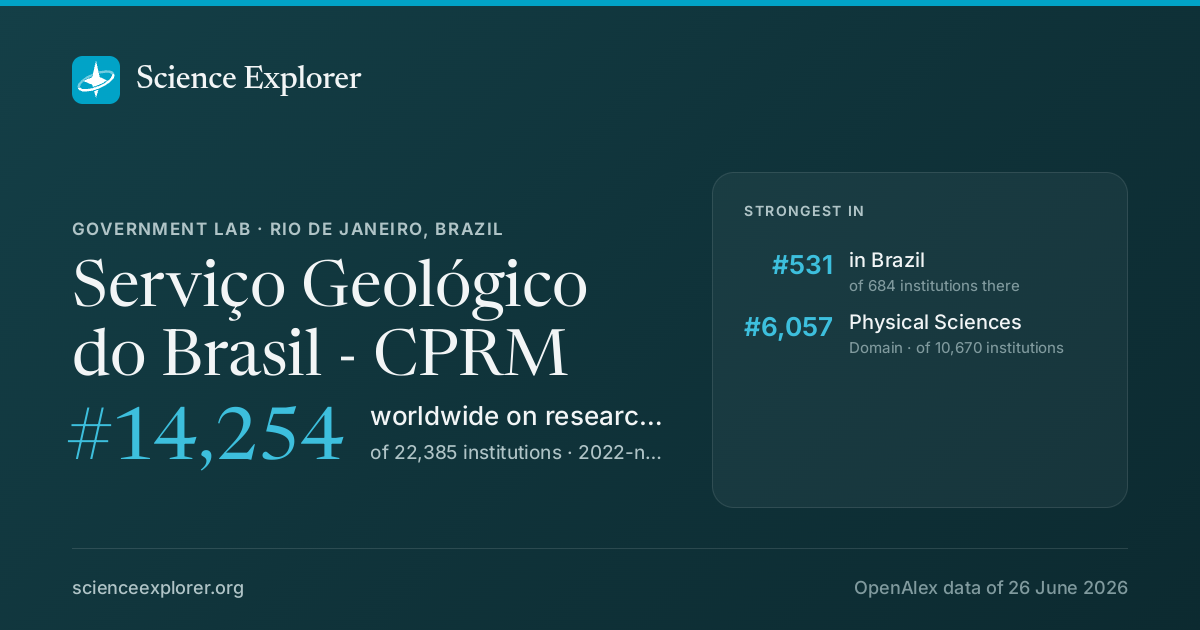
Serviço Geológico do Brasil - CPRM
In research, Serviço Geológico do Brasil - CPRM stands highest in Physical Sciences (#6,057 of 10,670 worldwide), 2022-now. Relative to its size it is most specialised in Geophysics and Earth and Planetary Sciences (Geophysics is 46.8× its share of world research).
- World rank, 2022-now
- #14,254 of 22,385 · #9,611 all time
- Rank in Brazil
- #531 of 684
- Research works
- 819 ▼ 20% vs 2018-21
- Citations
- 9.8k 12.0 per fractional work
- Top-10% rate
- 7.1% all institutions 10.0%
- vs its own fields
- 0.98× 1.00× is exactly expected
- Open access
- 64% world 40%
- International
- 28% world 18%
What is Serviço Geológico do Brasil - CPRM known for in research?
The fields where it stands highest, 2022-now, ranked among every institution above the floor in each field.
| Field | World rank | Where that sits | Top-10% rate | Works | All time |
|---|---|---|---|---|---|
| Physical SciencesDomain | #6,057 of 10,670 | 6.8% | 124 | #3739 |
Each strip is that field's whole ranked pool, with the notch where Serviço Geológico do Brasil - CPRM sits in it, in the colour of the band that rank falls in. The track under the rate is the rate itself: it carries no average mark, because the average differs by field (from about 6% in Dentistry to 21% in Economics).
Which fields of science does Serviço Geológico do Brasil - CPRM work in?
In 2022-now, 85% of research at Serviço Geológico do Brasil - CPRM is in Physical Sciences, 7% in Social Sciences. Its largest fields are Earth and Planetary Sciences (38%), Environmental Science (24%), Computer Science (13%). It does 2.1× the world's share of Physical Sciences.
Each ring splits the one inside it: the four domains of science, their fields, their subfields. Size is fractional works in 2022-now. Every slice is a page; the interactive view zooms down to single topics and colours each by how much more of it this institution does than the world.
Its 4 domains and 23 fields, with their numbers
- Physical Sciences14184.8%
- Earth and Planetary Sciences6338.1%
- Environmental Science3923.6%
- Computer Science2213.3%
- Engineering127.2%
- Materials Science21.2%
- Physics and Astronomy10.5%
- Energy10.4%
- Chemistry10.3%
- Mathematics00.1%
- Chemical Engineering00.0%
- Social Sciences127.1%
- Life Sciences74.3%
- Health Sciences63.8%
- Health Professions42.4%
- Medicine21.1%
- Nursing00.3%
What does Serviço Geológico do Brasil - CPRM specialise in?
Where its research is concentrated relative to its size: Geophysics takes 46.8× the share of its output that it takes of world research.
- GeophysicsSubfield · 27.1 works47×
- Earth and Planetary SciencesField · 63.2 works24×
Location quotient, a volume reading rather than an impact one. It surfaces small, lopsided specialities.
Field profile
Location quotient across every field it publishes in: outside the ring is more than an institution of this size would be expected to publish, inside it is less.
Rings at 0.5×, 1× and 2×. Widest outward: Earth and Planetary Sciences, 24.3×. Every wedge is a field page.
All 23 fields, with their numbers
- Earth and Planetary Sciences24.32×63 works
- Environmental Science4.74×39 works
- Computer Science1.71×22 works
- Decision Sciences0.92×2 works
- Health Professions0.91×4 works
- Agricultural and Biological Sciences0.71×6 works
- Nursing0.58×0 works
- Engineering0.48×12 works
- Energy0.42×1 works
- Social Sciences0.42×9 works
- Materials Science0.35×2 works
- Immunology and Microbiology0.27×0 works
- Physics and Astronomy0.25×1 works
- Chemistry0.21×1 works
- Chemical Engineering0.14×0 works
- Business, Management and Accounting0.13×1 works
- Biochemistry, Genetics and Molecular Biology0.11×1 works
- Arts and Humanities0.09×0 works
- Mathematics0.06×0 works
- Medicine0.06×2 works
- Economics, Econometrics and Finance0.05×0 works
- Neuroscience0.02×0 works
- Psychology0.02×0 works
- Earth and Planetary Sciences 24.3×
- Environmental Science 4.7×
- Computer Science 1.7×
- Decision Sciences 0.9×
- Health Professions 0.9×
- Agricultural and Biological Sciences 0.7×
- Nursing 0.6×
- Engineering 0.5×
- Energy 0.4×
- Social Sciences 0.4×
- Materials Science 0.3×
- Immunology and Microbiology 0.3×
- Physics and Astronomy 0.2×
- Chemistry 0.2×
- Chemical Engineering 0.1×
- Business, Management and Accounting 0.1×
- Biochemistry, Genetics and Molecular Biology 0.1×
- Arts and Humanities 0.1×
- Mathematics 0.1×
- Medicine 0.1×
- Economics, Econometrics and Finance 0.1×
- Neuroscience 0.0×
- Psychology 0.0×
Who are the top researchers at Serviço Geológico do Brasil - CPRM?
Ranked on the quality score, Carlos E. Ganade, Daniel Medeiros Moreira and Carlos Eduardo Ganade de Araújo lead among researchers whose main affiliation is Serviço Geológico do Brasil - CPRM.
- 1
Carlos E. Ganade
 Brazil · #344,794 worldwide
1.2k citations · 55 works
- 2
Daniel Medeiros Moreira
Brazil · #564,825 worldwide
1.7k citations · 84 works
- 3
Carlos Eduardo Ganade de Araújo
Brazil · #1,256,879 worldwide
811 citations · 16 works
- 4
Luiz Carlos da Silva
Brazil · #1,293,391 worldwide
2.2k citations · 54 works
- 5
Gabriel Soares de Almeida
Brazil · #1,768,397 worldwide
61 citations · 15 works
- 6
Edilton José dos Santos
Brazil · #1,810,156 worldwide
1.7k citations · 77 works
- 7
Jaime Estevão Scandolara
Brazil · #1,868,231 worldwide
877 citations · 54 works
- 8
Rafael Tarantino Amarante
Brazil · #1,961,486 worldwide
64 citations · 15 works
- 9
Marcos Figueiredo Salviano
Brazil · #2,158,557 worldwide
140 citations · 21 works
- 10
Júlio César Lana
Brazil · #2,249,807 worldwide
56 citations · 41 works
Which keywords describe research at Serviço Geológico do Brasil - CPRM?
By fractional works in 2022-now, weighted toward what it does more of than the world: Remote Sensing, Geological Mapping, Support Vector Machines, Hyperspectral Imaging, Compositional Data Analysis, Mineral Prospectivity, Machine Learning and Tectonics.
- Water Resources
- Phylogenetic Analysis
- Evolution
- Sequence Stratigraphy
- Sedimentation
- Electrical Resistivity Tomography
- Plate Boundaries
- Geoheritage
- Paleoredox
- Geodetic Measurements
- Marine Sediments
- Geochemistry
- Biodiversity
- Environmental Conservation
- Climate Change
- Geochronology
- Tectonics
- Compositional Data Analysis
- Support Vector Machines
- Machine Learning
- Remote Sensing
- Geological Mapping
- Hyperspectral Imaging
- Mineral Prospectivity
- Plate Tectonics
- Zircon
- Sustainable Development
- Hydrographic Basins
- Environmental Impacts
- Ecosystem Services
- Subduction
- Paleoproductivity
- Earthquakes
- Geotourism
- Rare Earth Elements
- Magnetotelluric Imaging
- Fluvial Systems
- Hydrological Modeling
- Manganese Oxides
- Sedimentary Rocks
Size is fractional works in 2022-now in the topics tagged with each word; colour is the word's share of this institution's work against its share of the world's. The 40 words are chosen for being large and distinctive. Each links to the topic it comes from most.
All 40 words, with their numbers
- Remote Sensing40▲ 20×16 topics
- Machine Learning26▲ 4.7×14 topics
- Geological Mapping23▲ 175×2 topics
- Support Vector Machines22▲ 41×3 topics
- Hyperspectral Imaging21▲ 47×2 topics
- Compositional Data Analysis20▲ 196×1 topic
- Mineral Prospectivity20▲ 196×1 topic
- Tectonics19▲ 93×3 topics
- Plate Tectonics16▲ 65×3 topics
- Geochronology14▲ 121×1 topic
- Zircon14▲ 121×1 topic
- Climate Change13▲ 2.8×33 topics
- Sustainable Development13▲ 4.9×9 topics
- Environmental Conservation8▲ 48×1 topic
- Hydrographic Basins8▲ 233×1 topic
- Biodiversity8▲ 6.2×10 topics
- Environmental Impacts7▲ 15×5 topics
- Geochemistry6▲ 58×4 topics
- Ecosystem Services6▲ 9.2×5 topics
- Marine Sediments6▲ 55×2 topics
- Subduction6▲ 45×3 topics
- Geodetic Measurements5▲ 31×2 topics
- Paleoproductivity5▲ 99×1 topic
- Paleoredox5▲ 99×1 topic
- Earthquakes5▲ 53×1 topic
- Geoheritage5▲ 419×1 topic
- Geotourism5▲ 419×1 topic
- Plate Boundaries5▲ 53×1 topic
- Rare Earth Elements5▲ 20×3 topics
- Electrical Resistivity Tomography5▲ 104×1 topic
- Magnetotelluric Imaging5▲ 104×1 topic
- Sedimentation5▲ 53×2 topics
- Fluvial Systems5▲ 100×1 topic
- Sequence Stratigraphy5▲ 100×1 topic
- Hydrological Modeling4▲ 11×5 topics
- Evolution4▲ 8.5×3 topics
- Manganese Oxides4▲ 69×1 topic
- Phylogenetic Analysis4▲ 7.1×4 topics
- Sedimentary Rocks4▲ 69×1 topic
- Water Resources4▲ 9.2×5 topics
Which research topics does Serviço Geológico do Brasil - CPRM publish most on?
By volume in 2022-now: Geochemistry and Geologic Mapping, Geological and Geochemical Analysis, Geography and Environmental Studies and Paleontology and Stratigraphy of Fossils.
Area is fractional works; colour is the subfield each topic belongs to.
- 1 Geochemistry and Geologic Mapping Artificial Intelligence 20 works
- 2 Geological and Geochemical Analysis Geophysics 14 works
- 3 Geography and Environmental Studies Water Science and Technology 8 works
- 4 Paleontology and Stratigraphy of Fossils Paleontology 5 works
- 5 Geotourism and Geoheritage Conservation Geology 5 works
- 6 earthquake and tectonic studies Geophysics 5 works
- 7 Geophysical and Geoelectrical Methods Geophysics 5 works
- 8 Geological formations and processes Earth-Surface Processes 5 works
- 9 Geochemistry and Elemental Analysis Geochemistry and Petrology 4 works
- 10 Paleontology and Evolutionary Biology Paleontology 3 works
How open and international is its research?
Against the world's own shares: the tick on each track. Both are shares of its output, so they sit on one scale and can be read against each other as well as against the world.
World: 40% of research is openly available.
World: 18% is written across borders.
How has Serviço Geológico do Brasil - CPRM's research output changed?
Output in 2022-2025 was 20% lower than in 2018-2021.
The same series as a ribbon: one cell per year, darker for more. The line above answers how much; this answers when.
Its share of all research
Growing output can still be a shrinking share: all of science grows. This is Serviço Geológico do Brasil - CPRM as a percentage of every work published that year, 0.00059% in 2024.
Fractional works of Serviço Geológico do Brasil - CPRM over all fractional works that year. How the balance of science has shifted.
How much of it reaches the world top 10%
Year by year, against all institutions in the same year.
Of each year's output, the share that reached the world's 10% most cited for its field and year. Peak 16.2% in 2018.
Other research institutions in Rio de Janeiro
- Universidade Federal do Rio de Janeiro
- Universidade do Estado do Rio de Janeiro
- Fundação Oswaldo Cruz
- Pontifícia Universidade Católica do Rio de Janeiro
- Universidade Federal do Estado do Rio de Janeiro
- Fundação Getulio Vargas
- Petrobras (Brazil)
- State University of Norte Fluminense


Share Serviço Geológico do Brasil - CPRM's ranking
Badges for a website1Each links back here and updates with every snapshot

Research measures only: rankings here say nothing about teaching, admissions or student experience. Comparable institutions and collaboration partners have tabs of their own, above.
Discussion
Ask a question or share a note about Serviço Geológico do Brasil - CPRM. Posts are plain text and can be reported.