Science Explorer Back to mapMap
Discussion
University · Daegu · South Korea

Taegu Science University

In research, Taegu Science University stands highest in Physical Sciences (#14,031 of 17,446 worldwide), Health Sciences (#14,080 of 16,688 worldwide) and Medicine (#12,701 of 14,558 worldwide), over all time.

World rank, all time
#18,931
of 34,923
Rank in South Korea
#270
of 512
Research works
500
▼ 18% vs 2018-21
Citations
10k
20.6 per fractional work
Top-10% rate
10.8%
all institutions 10.0%
vs its own fields
0.77×
1.00× is exactly expected
Open access
33%
world 40%
International
15%
world 18%

What is Taegu Science University known for in research?

The fields where it stands highest, over all time, ranked among every institution above the floor in each field.

FieldWorld rankWhere that sitsTop-10% rateWorks
Physical SciencesDomain #14,031 of 17,446 8.2%182
Health SciencesDomain #14,080 of 16,688 6.3%178
MedicineField #12,701 of 14,558 6.3%134

Each strip is that field's whole ranked pool, with the notch where Taegu Science University sits in it, in the colour of the band that rank falls in. The track under the rate is the rate itself: it carries no average mark, because the average differs by field (from about 6% in Dentistry to 21% in Economics).

Which fields of science does Taegu Science University work in?

In 2022-now, 34% of research at Taegu Science University is in Health Sciences, 27% in Physical Sciences. Its largest fields are Medicine (22%), Engineering (13%), Social Sciences (12%). It does 1.3× the world's share of Health Sciences.

Health Sciences: 11 fractional works · 34.2% of its workMedicine: 7 fractional works · 21.6% of its workPhysiology: 1 fractional works · 3.3% of its workPharmacology: 1 fractional works · 3.0% of its workPublic Health, Environmental and Occupational Health: 1 fractional works · 2.1% of its workOrthopedics and Sports Medicine: 1 fractional works · 1.9% of its workRehabilitation: 0 fractional works · 1.2% of its workSurgery: 0 fractional works · 1.2% of its workPsychiatry and Mental health: 0 fractional works · 0.9% of its workCardiology and Cardiovascular Medicine: 0 fractional works · 0.8% of its workEpidemiology: 0 fractional works · 0.7% of its workPulmonary and Respiratory Medicine: 0 fractional works · 0.6% of its workComplementary and alternative medicine: 0 fractional works · 0.5% of its workCritical Care and Intensive Care Medicine: 0 fractional works · 0.5% of its workGeriatrics and Gerontology: 0 fractional works · 0.5% of its workObstetrics and Gynecology: 0 fractional works · 0.5% of its workPediatrics, Perinatology and Child Health: 0 fractional works · 0.5% of its workDermatology: 0 fractional works · 0.5% of its workRadiology, Nuclear Medicine and Imaging: 0 fractional works · 0.4% of its workBiochemistry: 0 fractional works · 0.3% of its workImmunology and Allergy: 0 fractional works · 0.3% of its workPathology and Forensic Medicine: 0 fractional works · 0.3% of its workNeurology: 0 fractional works · 0.3% of its workEmergency Medicine: 0 fractional works · 0.2% of its workGastroenterology: 0 fractional works · 0.2% of its workInfectious Diseases: 0 fractional works · 0.2% of its workOncology: 0 fractional works · 0.2% of its workHealth Professions: 3 fractional works · 8.2% of its workPhysical Therapy, Sports Therapy and Rehabilitation: 1 fractional works · 2.8% of its workGeneral Health Professions: 1 fractional works · 2.7% of its workRadiological and Ultrasound Technology: 0 fractional works · 1.6% of its workEmergency Medical Services: 0 fractional works · 0.7% of its workSpeech and Hearing: 0 fractional works · 0.3% of its workSmaller subfields together: 0 fractional works · 0.2% of its workNursing: 1 fractional works · 2.8% of its workLeadership and Management: 1 fractional works · 1.8% of its workNutrition and Dietetics: 0 fractional works · 1.0% of its workDentistry: 0 fractional works · 1.6% of its workPeriodontics: 0 fractional works · 1.0% of its workGeneral Dentistry: 0 fractional works · 0.5% of its workPhysical Sciences: 8 fractional works · 26.6% of its workEngineering: 4 fractional works · 12.8% of its workElectrical and Electronic Engineering: 1 fractional works · 3.0% of its workBuilding and Construction: 1 fractional works · 2.1% of its workCivil and Structural Engineering: 1 fractional works · 2.1% of its workMedia Technology: 1 fractional works · 2.1% of its workBiomedical Engineering: 1 fractional works · 1.8% of its workMechanical Engineering: 0 fractional works · 0.9% of its workIndustrial and Manufacturing Engineering: 0 fractional works · 0.3% of its workAerospace Engineering: 0 fractional works · 0.2% of its workComputational Mechanics: 0 fractional works · 0.2% of its workSafety, Risk, Reliability and Quality: 0 fractional works · 0.2% of its workComputer Science: 3 fractional works · 8.2% of its workInformation Systems: 1 fractional works · 1.8% of its workArtificial Intelligence: 1 fractional works · 1.7% of its workComputer Graphics and Computer-Aided Design: 0 fractional works · 1.6% of its workComputer Vision and Pattern Recognition: 0 fractional works · 1.0% of its workHuman-Computer Interaction: 0 fractional works · 1.0% of its workComputer Networks and Communications: 0 fractional works · 0.3% of its workComputer Science Applications: 0 fractional works · 0.3% of its workSignal Processing: 0 fractional works · 0.3% of its workMaterials Science: 1 fractional works · 2.5% of its workMaterials Chemistry: 0 fractional works · 1.0% of its workPolymers and Plastics: 0 fractional works · 0.8% of its workElectronic, Optical and Magnetic Materials: 0 fractional works · 0.7% of its workSmaller subfields together: 0 fractional works · 0.0% of its workEnvironmental Science: 1 fractional works · 1.9% of its workEnvironmental Engineering: 0 fractional works · 1.6% of its workEcology: 0 fractional works · 0.3% of its workEarth and Planetary Sciences: 0 fractional works · 0.5% of its workAtmospheric Science: 0 fractional works · 0.5% of its workEnergy: 0 fractional works · 0.3% of its workRenewable Energy, Sustainability and the Environment: 0 fractional works · 0.3% of its workPhysics and Astronomy: 0 fractional works · 0.2% of its workAtomic and Molecular Physics, and Optics: 0 fractional works · 0.2% of its workChemical Engineering: 0 fractional works · 0.1% of its workSocial Sciences: 7 fractional works · 23.0% of its workSocial Sciences: 4 fractional works · 12.2% of its workEducation: 1 fractional works · 4.4% of its workSociology and Political Science: 1 fractional works · 3.0% of its workHealth: 0 fractional works · 1.3% of its workGeography, Planning and Development: 0 fractional works · 1.0% of its workSafety Research: 0 fractional works · 0.7% of its workCultural Studies: 0 fractional works · 0.5% of its workDemography: 0 fractional works · 0.5% of its workCommunication: 0 fractional works · 0.3% of its workTransportation: 0 fractional works · 0.3% of its workPsychology: 2 fractional works · 6.9% of its workClinical Psychology: 1 fractional works · 2.9% of its workSocial Psychology: 1 fractional works · 2.1% of its workNeuropsychology and Physiological Psychology: 0 fractional works · 1.0% of its workApplied Psychology: 0 fractional works · 0.5% of its workDevelopmental and Educational Psychology: 0 fractional works · 0.3% of its workEconomics, Econometrics and Finance: 1 fractional works · 4.0% of its workEconomics and Econometrics: 1 fractional works · 4.0% of its workLife Sciences: 5 fractional works · 16.1% of its workAgricultural and Biological Sciences: 3 fractional works · 8.4% of its workPlant Science: 1 fractional works · 3.1% of its workFood Science: 1 fractional works · 2.8% of its workAquatic Science: 1 fractional works · 2.1% of its workEcology, Evolution, Behavior and Systematics: 0 fractional works · 0.3% of its workBiochemistry, Genetics and Molecular Biology: 2 fractional works · 5.6% of its workMolecular Biology: 1 fractional works · 2.9% of its workGenetics: 0 fractional works · 1.1% of its workCell Biology: 0 fractional works · 0.7% of its workBiotechnology: 0 fractional works · 0.5% of its workCancer Research: 0 fractional works · 0.3% of its workNeuroscience: 0 fractional works · 1.3% of its workNeurology: 0 fractional works · 0.9% of its workCellular and Molecular Neuroscience: 0 fractional works · 0.3% of its workSmaller subfields together: 0 fractional works · 0.2% of its workPharmacology, Toxicology and Pharmaceutics: 0 fractional works · 0.5% of its workPharmaceutical Science: 0 fractional works · 0.5% of its workImmunology and Microbiology: 0 fractional works · 0.3% of its workImmunology: 0 fractional works · 0.3% of its workALL ITS WORKTaegu ScienceUniversity32fractional works, 2022-now
Life Sciences16%Physical Sciences27%Health Sciences34%Social Sciences23%

Each ring splits the one inside it: the four domains of science, their fields, their subfields. Size is fractional works in 2022-now. Every slice is a page; the interactive view zooms down to single topics and colours each by how much more of it this institution does than the world.

Its 4 domains and 20 fields, with their numbers
    1. Medicine721.6%
    2. Health Professions38.2%
    3. Nursing12.8%
    4. Dentistry01.6%
    1. Engineering412.8%
    2. Computer Science38.2%
    3. Materials Science12.5%
    4. Environmental Science11.9%
    5. Earth and Planetary Sciences00.5%
    6. Energy00.3%
    7. Physics and Astronomy00.2%
    8. Chemical Engineering00.1%
    1. Social Sciences412.2%
    2. Psychology26.9%
    3. Economics, Econometrics and Finance14.0%
    1. Agricultural and Biological Sciences38.4%
    2. Biochemistry, Genetics and Molecular Biology25.6%
    3. Neuroscience01.3%
    4. Pharmacology, Toxicology and Pharmaceutics00.5%
    5. Immunology and Microbiology00.3%
All of science, and how each field's share has moved since 1950: the Science domain explorer

Field profile

Location quotient across every field it publishes in: outside the ring is more than an institution of this size would be expected to publish, inside it is less.

Agricultural and Biological Sciences: 1.76× its world share, 3 worksAgricultural and Bio…Biochemistry, Genetics and Molecular Biology: 1.05× its world share, 2 worksBiochemistry, Geneti…Immunology and Microbiology: 0.35× its world share, 0 worksImmunology and Micro…Neuroscience: 0.80× its world share, 0 worksNeurosciencePharmacology, Toxicology and Pharmaceutics: 1.48× its world share, 0 worksPharmacology, Toxico…Chemical Engineering: 0.30× its world share, 0 worksChemical EngineeringComputer Science: 1.05× its world share, 3 worksComputer ScienceEarth and Planetary Sciences: 0.33× its world share, 0 worksEarth and Planetary …Energy: 0.38× its world share, 0 worksEnergyEngineering: 0.86× its world share, 4 worksEngineeringEnvironmental Science: 0.39× its world share, 1 worksEnvironmental ScienceMaterials Science: 0.72× its world share, 1 worksMaterials SciencePhysics and Astronomy: 0.09× its world share, 0 worksPhysics and AstronomyDentistry: 3.23× its world share, 0 worksDentistryHealth Professions: 3.13× its world share, 3 worksHealth ProfessionsMedicine: 1.12× its world share, 7 worksMedicineNursing: 5.69× its world share, 1 worksNursingEconomics, Econometrics and Finance: 1.86× its world share, 1 worksEconomics, Econometr…Psychology: 2.25× its world share, 2 worksPsychologySocial Sciences: 0.96× its world share, 4 worksSocial Sciences1×world share
more than its size predictsabout as predictedless

Rings at 0.5×, 1× and 2×. Widest outward: Nursing, 5.7×. Every wedge is a field page.

All 20 fields, with their numbers
  1. Nursing5.69×1 works
  2. Dentistry3.23×0 works
  3. Health Professions3.13×3 works
  4. Psychology2.25×2 works
  5. Economics, Econometrics and Finance1.86×1 works
  6. Agricultural and Biological Sciences1.76×3 works
  7. Pharmacology, Toxicology and Pharmaceutics1.48×0 works
  8. Medicine1.12×7 works
  9. Biochemistry, Genetics and Molecular Biology1.05×2 works
  10. Computer Science1.05×3 works
  11. Social Sciences0.96×4 works
  12. Engineering0.86×4 works
  13. Neuroscience0.80×0 works
  14. Materials Science0.72×1 works
  15. Environmental Science0.39×1 works
  16. Energy0.38×0 works
  17. Immunology and Microbiology0.35×0 works
  18. Earth and Planetary Sciences0.33×0 works
  19. Chemical Engineering0.30×0 works
  20. Physics and Astronomy0.09×0 works

Who are the top researchers at Taegu Science University?

Ranked on the quality score, Yun Kang, Jang-Won Choi and Jun Tae Bae lead among researchers whose main affiliation is Taegu Science University.

  1. 1 Yun Kang South Korea · #2,126,517 worldwide 291 citations · 17 works
  2. 2 Jang-Won Choi South Korea · #3,660,436 worldwide 816 citations · 16 works
  3. 3 Jun Tae Bae South Korea · #3,728,514 worldwide 704 citations · 19 works
  4. 4 Seok Yoon Hwang South Korea · #4,548,310 worldwide 516 citations · 28 works
  5. 5 Young Sook Chung South Korea · #4,636,325 worldwide 375 citations · 21 works
  6. 6 K. H. Nahm South Korea · #4,668,106 worldwide 974 citations · 52 works
  7. 7 Young-Suk Park South Korea · #4,771,177 worldwide 221 citations · 31 works
  8. 8 Soo-Kyung Jung South Korea · #4,815,487 worldwide 241 citations · 17 works
  9. 9 Yunhee Kwon South Korea · #4,967,711 worldwide 182 citations · 26 works
  10. 10 Shin Kun Kim South Korea · #5,373,576 worldwide 19 citations · 15 works
All ranked researchers at Taegu Science University

What are the most cited papers from Taegu Science University?

The most cited paper from Taegu Science University is "Fructooligosaccharides—Occurrence, preparation, and application" (Jong Won Yun, 1996), with 490 citations. Next come "MTT assay to evaluate the cytotoxic potential of a drug" (434) and "Purification and characterization of an extracellular polysaccharide from haloalkalophilic Bacillus sp. I-450" (330).

Most cited papers
#PaperReleasedCitations
1 Fructooligosaccharides—Occurrence, preparation, and application Jong Won Yun · Enzyme and Microbial Technology Aug 1996 490
2 MTT assay to evaluate the cytotoxic potential of a drug Ashutosh Bahuguna, Imran Khan, Vivek Kumar Bajpai et al. · Bangladesh Journal of Pharmacology Open access 8 Apr 2017 434
3 Purification and characterization of an extracellular polysaccharide from haloalkalophilic Bacillus sp. I-450 Chityal Ganesh Kumar, Han-Seung Joo, Jang-Won Choi et al. · Enzyme and Microbial Technology 26 Apr 2004 330
4 Study on multi-stage logistic chain network: a spanning tree-based genetic algorithm approach Admi Syarif, YoungSu Yun, Mitsuo Gen · Computers & Industrial Engineering Jul 2002 314
5 Consumer Decision‐Making Styles: Comparison Between United States and Korean Young Consumers Jeanne L. Hafstrom, JUNG SOOK CHAE, Young Sook Chung · Journal of Consumer Affairs Jun 1992 307
All 59 most cited papers, with filters and sorting

Which keywords describe research at Taegu Science University?

By fractional works in 2022-now, weighted toward what it does more of than the world: Self-Efficacy, Elderly, Social Support, Virtual Reality, Disability, Quality of Life, Sustainability and Critical Thinking.

▲ more of its work than of the world's◆ about the world's share▼ less than the world's

Size is fractional works in 2022-now in the topics tagged with each word; colour is the word's share of this institution's work against its share of the world's. The 14 words are chosen for being large and distinctive. Each links to the topic it comes from most.

All 14 words, with their numbers
  1. Epidemiology2▲ 1.70×14 topics
  2. Self-Efficacy2▲ 25×5 topics
  3. Sustainability2▲ 2.6×3 topics
  4. Elderly2▲ 22×3 topics
  5. Quality of Life2▲ 3.7×4 topics
  6. Social Support2▲ 9.3×5 topics
  7. Virtual Reality2▲ 9.6×5 topics
  8. Artificial Intelligence1▲ 2.9×3 topics
  9. Disability1▲ 36×2 topics
  10. Mental Health1▲ 2.6×5 topics
  11. Global Burden1▲ 6.2×3 topics
  12. Machine Learning1◆ 0.99×6 topics
  13. Critical Thinking1▲ 27×2 topics
  14. Muscle Strength1▲ 29×2 topics

Which research topics does Taegu Science University publish most on?

By volume in 2022-now: Balance, Gait, and Falls Prevention, Simulation-Based Education in Healthcare, Smart Cities and Technologies and Education, Innovation and Language Studies.

  1. 1 Balance, Gait, and Falls Prevention Physical Therapy, Sports Therapy and Rehabilitation 1 works
  2. 2 Simulation-Based Education in Healthcare Physiology 1 works
  3. 3 Smart Cities and Technologies Media Technology 1 works
  4. 4 Education, Innovation and Language Studies Education 1 works
  5. 5 Urban and Freight Transport Logistics Building and Construction 1 works
  6. 6 Economic and Industrial Development Economics and Econometrics 1 works
  7. 7 Musculoskeletal pain and rehabilitation Pharmacology 1 works
  8. 8 Transportation Systems and Logistics Civil and Structural Engineering 1 works
  9. 9 Engineering and Agricultural Innovations Aquatic Science 1 works
  10. 10 Healthcare Education and Workforce Issues Leadership and Management 1 works

How open and international is its research?

Against the world's own shares: the tick on each track. Both are shares of its output, so they sit on one scale and can be read against each other as well as against the world.

openly available33.4%not open66.6%

World: 40% of research is openly available.

with international co-authors15.3%domestic only84.7%

World: 18% is written across borders.

How has Taegu Science University's research output changed?

Output in 2022-2025 was 18% lower than in 2018-2021.

still counting1990200020102020
grewheldshrank

The same series as a ribbon: one cell per year, darker for more. The line above answers how much; this answers when.

Its share of all research

Growing output can still be a shrinking share: all of science grows. This is Taegu Science University as a percentage of every work published that year, 0.000099% in 2024.

still counting0.0020%0.0040%Taegu Science University0.00013% in 202519801990200020102020

Fractional works of Taegu Science University over all fractional works that year. How the balance of science has shifted.

How much of it reaches the world top 10%

Year by year, against all institutions in the same year.

5%10%15%Taegu Science University11.3% in 2002all institutions10.0% in 20022000

Of each year's output, the share that reached the world's 10% most cited for its field and year. Peak 11.3% in 2002.

Other research institutions in Daegu

All research institutions in Daegu

Share Taegu Science University's ranking
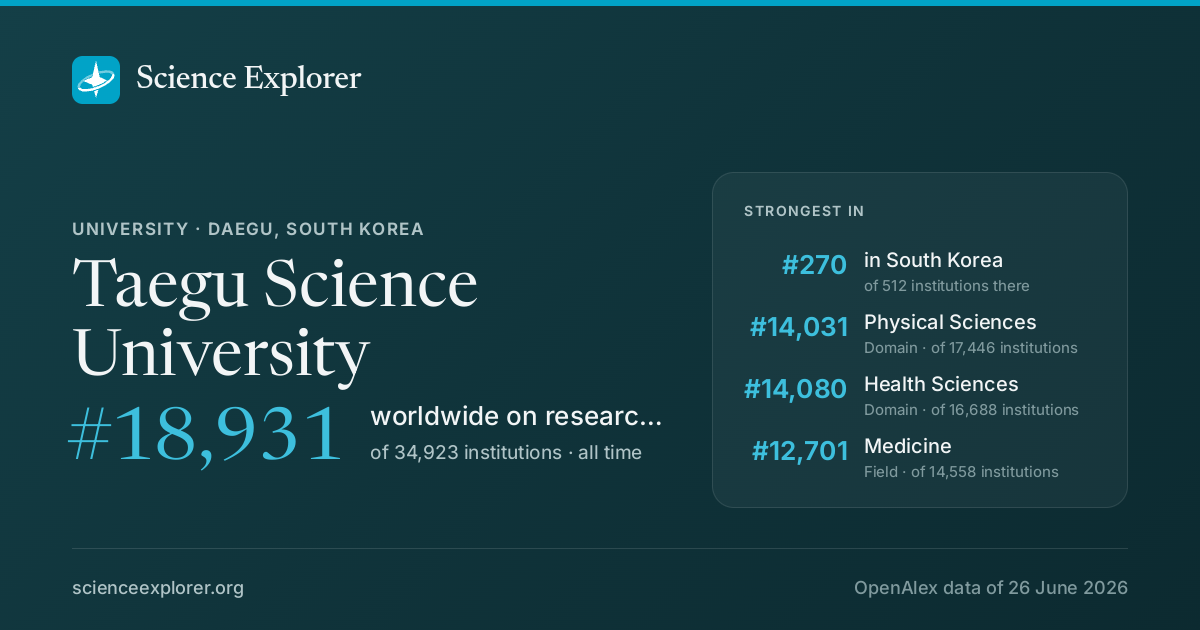
Taegu Science University on Science Explorer

A card with Taegu Science University's standing and the fields it leads in, for a post or a slide. A link to this page previews as the same card.

Download the card

1200 × 630 PNG, sized for social posts, drawn from the latest snapshot.

Badges for a website1Each links back here and updates with every snapshot

Research measures only: rankings here say nothing about teaching, admissions or student experience. Comparable institutions and collaboration partners have tabs of their own, above.

Discussion

Ask a question or share a note about Taegu Science University. Posts are plain text and can be reported.