- World rank, 2022-now
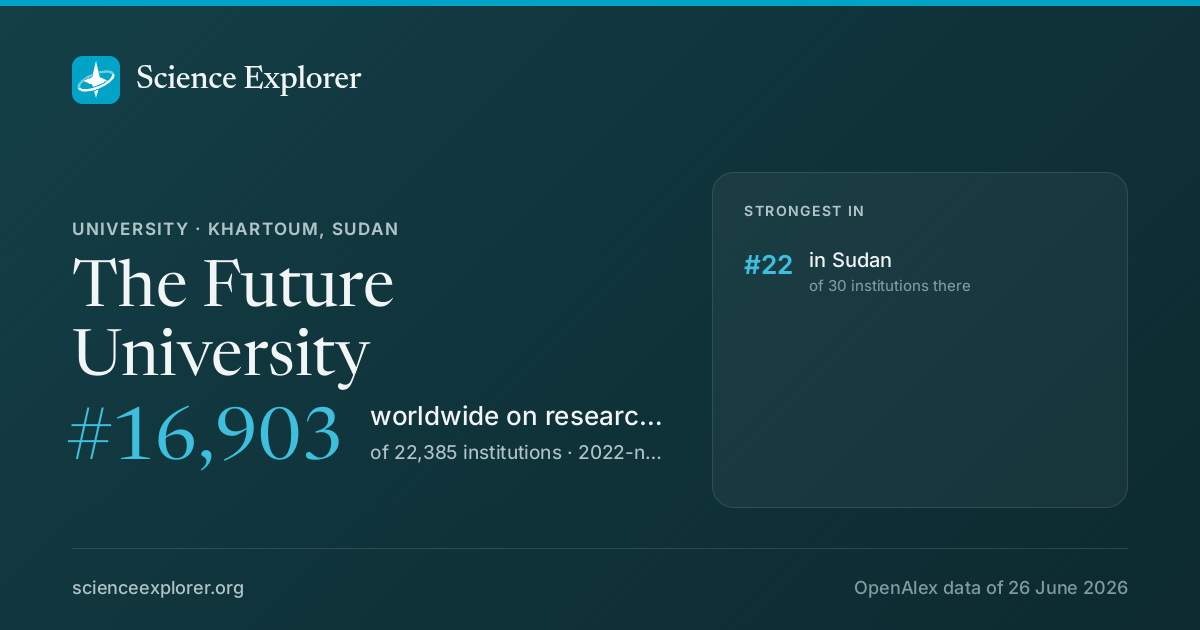
- #16,903 of 22,385 · #24,539 all time
- Rank in Sudan
- #22 of 30
- Research works
- 178 ▲ 26% vs 2018-21
- Citations
- 747 4.2 per fractional work
- Top-10% rate
- 8.8% all institutions 10.0%
- vs its own fields
- 0.97× 1.00× is exactly expected
- Open access
- 63% world 40%
- International
- 52% world 18%
Which fields of science does The Future University work in?
In 2022-now, 50% of research at The Future University is in Physical Sciences, 34% in Social Sciences. Its largest fields are Engineering (21%), Computer Science (18%), Social Sciences (16%). It does 1.3× the world's share of Social Sciences.
Each ring splits the one inside it: the four domains of science, their fields, their subfields. Size is fractional works in 2022-now. Every slice is a page; the interactive view zooms down to single topics and colours each by how much more of it this institution does than the world.
Its 4 domains and 25 fields, with their numbers
- Physical Sciences4150.5%
- Engineering1721.2%
- Computer Science1518.5%
- Materials Science33.7%
- Environmental Science23.0%
- Physics and Astronomy11.5%
- Energy11.0%
- Chemical Engineering00.5%
- Mathematics00.4%
- Earth and Planetary Sciences00.3%
- Chemistry00.3%
- Social Sciences2733.7%
- Life Sciences78.3%
- Health Sciences67.5%
- Medicine56.3%
- Dentistry10.7%
- Health Professions00.3%
- Veterinary00.1%
Field profile
Location quotient across every field it publishes in: outside the ring is more than an institution of this size would be expected to publish, inside it is less.
Rings at 0.5×, 1× and 2×. Widest outward: Economics, Econometrics and Finance, 2.8×. Every wedge is a field page.
All 25 fields, with their numbers
- Economics, Econometrics and Finance2.81×5 works
- Computer Science2.37×15 works
- Chemical Engineering1.58×0 works
- Business, Management and Accounting1.58×4 works
- Dentistry1.50×1 works
- Decision Sciences1.46×1 works
- Engineering1.41×17 works
- Social Sciences1.30×13 works
- Energy1.07×1 works
- Pharmacology, Toxicology and Pharmaceutics1.06×0 works
- Materials Science1.06×3 works
- Veterinary1.02×0 works
- Immunology and Microbiology0.98×1 works
- Agricultural and Biological Sciences0.89×3 works
- Psychology0.88×2 works
- Arts and Humanities0.72×2 works
- Physics and Astronomy0.69×1 works
- Environmental Science0.61×2 works
- Biochemistry, Genetics and Molecular Biology0.42×2 works
- Mathematics0.35×0 works
- Medicine0.33×5 works
- Neuroscience0.28×0 works
- Earth and Planetary Sciences0.19×0 works
- Chemistry0.17×0 works
- Health Professions0.13×0 works
- Economics, Econometrics and Finance 2.8×
- Computer Science 2.4×
- Chemical Engineering 1.6×
- Business, Management and Accounting 1.6×
- Dentistry 1.5×
- Decision Sciences 1.5×
- Engineering 1.4×
- Social Sciences 1.3×
- Energy 1.1×
- Pharmacology, Toxicology and Pharmaceutics 1.1×
- Materials Science 1.1×
- Veterinary 1.0×
- Immunology and Microbiology 1.0×
- Agricultural and Biological Sciences 0.9×
- Psychology 0.9×
- Arts and Humanities 0.7×
- Physics and Astronomy 0.7×
- Environmental Science 0.6×
- Biochemistry, Genetics and Molecular Biology 0.4×
- Mathematics 0.3×
- Medicine 0.3×
- Neuroscience 0.3×
- Earth and Planetary Sciences 0.2×
- Chemistry 0.2×
- Health Professions 0.1×
Who are the top researchers at The Future University?
Ranked on the quality score, Mohamed Khalafalla Hassan and Ashraf Gasim Elsid Abdalla lead among researchers whose main affiliation is The Future University.
- 1
Mohamed Khalafalla Hassan
 Sudan · #2,607,311 worldwide
344 citations · 41 works
- 2
Ashraf Gasim Elsid Abdalla
Sudan · #4,869,663 worldwide
56 citations · 23 works
Which keywords describe research at The Future University?
By fractional works in 2022-now, weighted toward what it does more of than the world: Deep Learning, Ethnicity, Wireless Sensor Networks, Corporate Governance, Sustainability, Machine Learning, Legal Regulation and Economic Security.
- Fog Computing
- Financial Literacy
- Technology Acceptance Model
- Investment
- Cathode Materials
- Entrepreneurship
- Digital Economy
- Internet of Things
- Transport Policy
- Public Oversight
- Islam
- Convolutional Neural Networks
- 5G Networks
- IoT Security
- Philosophy
- Economic Security
- Ethnicity
- Sustainable Development
- Globalization
- Machine Learning
- Deep Learning
- Sustainability
- Corporate Governance
- Wireless Sensor Networks
- Economic Development
- Legal Regulation
- Healthcare
- Risk Management
- Air Force
- Culture
- Modernization
- Social Influence
- Image Processing
- Energy Storage
- Financial Security
- Smart Cities
- Environmental Monitoring
- Semiconductor
- Edge Computing
- Small and Medium Enterprises
Size is fractional works in 2022-now in the topics tagged with each word; colour is the word's share of this institution's work against its share of the world's. The 40 words are chosen for being large and distinctive. Each links to the topic it comes from most.
All 40 words, with their numbers
- Deep Learning9▲ 3.2×28 topics
- Machine Learning5▲ 1.90×21 topics
- Sustainability5▲ 2.3×13 topics
- Globalization3▲ 2.1×11 topics
- Corporate Governance3▲ 5.2×7 topics
- Sustainable Development3▲ 2.3×8 topics
- Wireless Sensor Networks3▲ 7.4×6 topics
- Ethnicity3▲ 8.7×3 topics
- Economic Development2▲ 3.9×6 topics
- Economic Security2▲ 14×2 topics
- Legal Regulation2▲ 13×3 topics
- Philosophy2▲ 6.7×2 topics
- Healthcare2▲ 2.5×4 topics
- IoT Security2▲ 9.4×3 topics
- Risk Management2▲ 5.8×4 topics
- 5G Networks2▲ 13×2 topics
- Air Force2▲ 22×1 topic
- Convolutional Neural Networks2▲ 3.6×9 topics
- Culture2▲ 4.9×1 topic
- Islam2▲ 12×1 topic
- Modernization2▲ 14×1 topic
- Public Oversight2▲ 21×1 topic
- Social Influence2▲ 13×2 topics
- Transport Policy2▲ 21×1 topic
- Image Processing2▲ 5.8×5 topics
- Internet of Things2▲ 2.9×6 topics
- Energy Storage2▲ 3.6×8 topics
- Digital Economy2▲ 11×4 topics
- Financial Security2▲ 22×3 topics
- Entrepreneurship2▲ 5.3×4 topics
- Smart Cities2▲ 8.1×4 topics
- Cathode Materials2▲ 5.0×3 topics
- Environmental Monitoring2▲ 5.3×4 topics
- Investment2▲ 16×3 topics
- Semiconductor2▲ 5.6×5 topics
- Technology Acceptance Model1▲ 11×2 topics
- Edge Computing1▲ 13×2 topics
- Financial Literacy1▲ 18×1 topic
- Small and Medium Enterprises1▲ 9.4×1 topic
- Fog Computing1▲ 14×1 topic
Which research topics does The Future University publish most on?
By volume in 2022-now: Linguistic, Cultural, and Literary Studies, Legal and Regulatory Analysis, Military Technology and Strategies and Financial Literacy and Behavior.
Area is fractional works; colour is the subfield each topic belongs to.
- 1 Linguistic, Cultural, and Literary Studies Sociology and Political Science 2 works
- 2 Legal and Regulatory Analysis Transportation 2 works
- 3 Military Technology and Strategies Aerospace Engineering 2 works
- 4 Financial Literacy and Behavior Accounting 1 works
- 5 IoT and Edge/Fog Computing Computer Networks and Communications 1 works
- 6 Smart Agriculture and AI Plant Science 1 works
- 7 Science Education and Pedagogy Education 1 works
- 8 Education, Innovation and Language Studies Education 1 works
- 9 Economic and Industrial Development Economics and Econometrics 1 works
- 10 Software-Defined Networks and 5G Computer Networks and Communications 1 works
How open and international is its research?
Against the world's own shares: the tick on each track. Both are shares of its output, so they sit on one scale and can be read against each other as well as against the world.
World: 40% of research is openly available.
World: 18% is written across borders.
How has The Future University's research output changed?
Output in 2022-2025 was 26% higher than in 2018-2021.
The same series as a ribbon: one cell per year, darker for more. The line above answers how much; this answers when.
Its share of all research
Growing output can still be a shrinking share: all of science grows. This is The Future University as a percentage of every work published that year, 0.00028% in 2024.
Fractional works of The Future University over all fractional works that year. How the balance of science has shifted.
Other research institutions in Khartoum
- University of Khartoum
- Sudan University of Science and Technology
- Sudan Meteorological Authority
- Al-Neelain University
- National University
- National Centre for Research
- University of Medical Sciences and Technology
- University of Bahri
Share The Future University's ranking
Badges for a website1Each links back here and updates with every snapshot

Research measures only: rankings here say nothing about teaching, admissions or student experience. Comparable institutions and collaboration partners have tabs of their own, above.
Discussion
Ask a question or share a note about The Future University. Posts are plain text and can be reported.