Tianma Microelectronics (China)
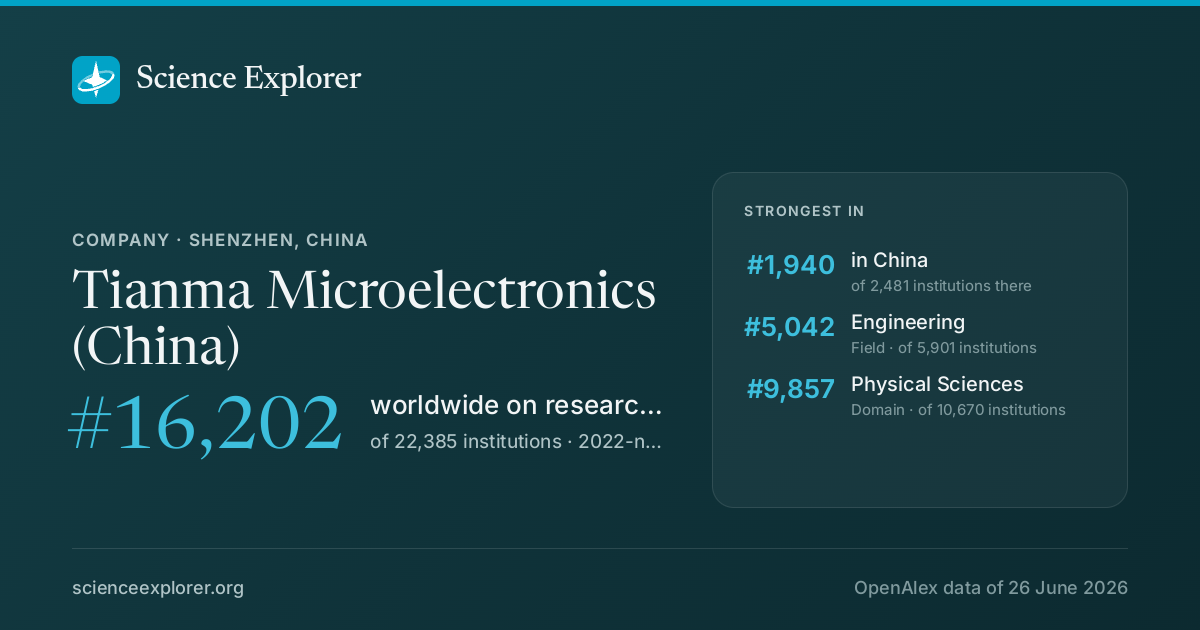
In research, Tianma Microelectronics (China) stands highest in Engineering (#5,042 of 5,901 worldwide) and Physical Sciences (#9,857 of 10,670 worldwide), 2022-now. Relative to its size it is most specialised in Electrical and Electronic Engineering (Electrical and Electronic Engineering is 6.2× its share of world research).
- World rank, 2022-now
- #16,202 of 22,385 · #22,371 all time
- Rank in China
- #1,940 of 2,481
- Research works
- 562 ▲ 53% vs 2018-21
- Citations
- 1.9k 3.5 per fractional work
- Top-10% rate
- 6.3% all institutions 10.0%
- vs its own fields
- 0.90× 1.00× is exactly expected
- Open access
- 22% world 40%
- International
- 7% world 18%
What is Tianma Microelectronics (China) known for in research?
The fields where it stands highest, 2022-now, ranked among every institution above the floor in each field.
| Field | World rank | Where that sits | Top-10% rate | Works | All time |
|---|---|---|---|---|---|
| EngineeringField | #5,042 of 5,901 | 3.7% | 99 | #8780 | |
| Physical SciencesDomain | #9,857 of 10,670 | 4.8% | 147 | #15504 |
Each strip is that field's whole ranked pool, with the notch where Tianma Microelectronics (China) sits in it, in the colour of the band that rank falls in. The track under the rate is the rate itself: it carries no average mark, because the average differs by field (from about 6% in Dentistry to 21% in Economics).
Which fields of science does Tianma Microelectronics (China) work in?
In 2022-now, 77% of research at Tianma Microelectronics (China) is in Physical Sciences, 13% in Life Sciences. Its largest fields are Engineering (52%), Materials Science (7%), Physics and Astronomy (6%). It does 1.9× the world's share of Physical Sciences.
Each ring splits the one inside it: the four domains of science, their fields, their subfields. Size is fractional works in 2022-now. Every slice is a page; the interactive view zooms down to single topics and colours each by how much more of it this institution does than the world.
Its 4 domains and 24 fields, with their numbers
- Physical Sciences15777.0%
- Engineering10652.0%
- Materials Science157.3%
- Physics and Astronomy136.4%
- Computer Science136.2%
- Environmental Science62.8%
- Chemistry31.3%
- Chemical Engineering10.4%
- Energy10.3%
- Mathematics00.2%
- Earth and Planetary Sciences00.1%
- Life Sciences2713.0%
- Health Sciences115.4%
- Medicine104.9%
- Health Professions10.3%
- Nursing00.1%
- Social Sciences94.6%
What does Tianma Microelectronics (China) specialise in?
Where its research is concentrated relative to its size: Electrical and Electronic Engineering takes 6.2× the share of its output that it takes of world research.
- Electrical and Electronic EngineeringSubfield · 44.6 works6.2×
Location quotient, a volume reading rather than an impact one. It surfaces small, lopsided specialities.
Field profile
Location quotient across every field it publishes in: outside the ring is more than an institution of this size would be expected to publish, inside it is less.
Rings at 0.5×, 1× and 2×. Widest outward: Engineering, 3.5×. Every wedge is a field page.
All 24 fields, with their numbers
- Engineering3.47×106 works
- Physics and Astronomy2.86×13 works
- Immunology and Microbiology2.82×6 works
- Materials Science2.09×15 works
- Chemical Engineering1.20×1 works
- Biochemistry, Genetics and Molecular Biology1.18×13 works
- Pharmacology, Toxicology and Pharmaceutics0.97×1 works
- Chemistry0.80×2 works
- Computer Science0.79×13 works
- Neuroscience0.71×2 works
- Environmental Science0.57×6 works
- Psychology0.52×3 works
- Agricultural and Biological Sciences0.50×5 works
- Decision Sciences0.44×1 works
- Energy0.38×1 works
- Medicine0.26×10 works
- Business, Management and Accounting0.23×2 works
- Nursing0.17×0 works
- Economics, Econometrics and Finance0.15×1 works
- Mathematics0.13×0 works
- Health Professions0.13×1 works
- Social Sciences0.12×3 works
- Earth and Planetary Sciences0.09×0 works
- Arts and Humanities0.01×0 works
- Engineering 3.5×
- Physics and Astronomy 2.9×
- Immunology and Microbiology 2.8×
- Materials Science 2.1×
- Chemical Engineering 1.2×
- Biochemistry, Genetics and Molecular Biology 1.2×
- Pharmacology, Toxicology and Pharmaceutics 1.0×
- Chemistry 0.8×
- Computer Science 0.8×
- Neuroscience 0.7×
- Environmental Science 0.6×
- Psychology 0.5×
- Agricultural and Biological Sciences 0.5×
- Decision Sciences 0.4×
- Energy 0.4×
- Medicine 0.3×
- Business, Management and Accounting 0.2×
- Nursing 0.2×
- Economics, Econometrics and Finance 0.1×
- Mathematics 0.1×
- Health Professions 0.1×
- Social Sciences 0.1×
- Earth and Planetary Sciences 0.1×
- Arts and Humanities 0.0×
Who are the top researchers at Tianma Microelectronics (China)?
Ranked on the quality score, Lingyu Meng, Haochi Yu and Zhihua Ling lead among researchers whose main affiliation is Tianma Microelectronics (China).
- 1
Lingyu Meng
 China · #1,708,984 worldwide
505 citations · 21 works
- 2
Haochi Yu
China · #3,280,922 worldwide
174 citations · 20 works
- 3
Zhihua Ling
China · #3,695,108 worldwide
271 citations · 18 works
- 4
Wenjun Dai
China · #3,977,951 worldwide
220 citations · 25 works
- 5
Guozhao Chen
China · #4,111,505 worldwide
84 citations · 21 works
- 6
Zhiyong Xiong
China · #4,297,497 worldwide
197 citations · 20 works
- 7
Rulin Zhou
China · #4,656,542 worldwide
127 citations · 18 works
- 8
Zhenyu Jia
China · #4,814,362 worldwide
123 citations · 15 works
- 9
Yingteng Zhai
China · #4,854,497 worldwide
224 citations · 23 works
- 10
Hailiang Wang
China · #4,959,867 worldwide
117 citations · 27 works
Which keywords describe research at Tianma Microelectronics (China)?
By fractional works in 2022-now, weighted toward what it does more of than the world: Flexible Electronics, Solar Cells, Plasmonics, Amorphous Oxide Semiconductors, Thin-Film Transistors, Organic Light-Emitting Diodes, Phosphorescent Materials and Color Constancy.
- Self-Organization
- Actuators
- AlGaN/GaN HEMTs
- GaN
- Surface Characterization
- Control
- Simulation
- Optical Interconnects
- Stereoscopic Displays
- Innate Immunity
- Compound Eyes
- Nanowires
- Semiconductors
- Aquaculture
- Machine Vision
- Color Constancy
- Organic Light-Emitting Diodes
- Neural Networks
- Amorphous Oxide Semiconductors
- Solar Cells
- Flexible Electronics
- Plasmonics
- Thin-Film Transistors
- Nanoparticles
- Phosphorescent Materials
- Colorimetry
- Visual Fatigue
- Virtual Reality
- Colloidal Crystals
- Light-Emitting Diodes
- Freeform Optics
- Holographic Displays
- Nanostructured Materials
- Semiconductor Lasers
- Field-Effect Transistors
- Roughness Measurement
- Band Parameters
- Solid-State Lighting
- III-Nitrides
- Liquid Crystals
Size is fractional works in 2022-now in the topics tagged with each word; colour is the word's share of this institution's work against its share of the world's. The 40 words are chosen for being large and distinctive. Each links to the topic it comes from most.
All 40 words, with their numbers
- Flexible Electronics14▲ 41×3 topics
- Solar Cells13▲ 32×5 topics
- Plasmonics12▲ 102×2 topics
- Amorphous Oxide Semiconductors12▲ 273×1 topic
- Thin-Film Transistors12▲ 273×1 topic
- Neural Networks10▲ 3.1×11 topics
- Nanoparticles8▲ 3.3×13 topics
- Organic Light-Emitting Diodes8▲ 143×1 topic
- Phosphorescent Materials8▲ 143×1 topic
- Color Constancy7▲ 327×1 topic
- Colorimetry7▲ 327×1 topic
- Machine Vision7▲ 16×4 topics
- Visual Fatigue6▲ 74×2 topics
- Aquaculture6▲ 11×3 topics
- Virtual Reality5▲ 5.5×5 topics
- Semiconductors5▲ 8.8×4 topics
- Colloidal Crystals5▲ 57×2 topics
- Nanowires5▲ 17×5 topics
- Light-Emitting Diodes5▲ 15×3 topics
- Compound Eyes4▲ 264×1 topic
- Freeform Optics4▲ 264×1 topic
- Innate Immunity4▲ 6.7×9 topics
- Holographic Displays4▲ 150×1 topic
- Stereoscopic Displays4▲ 150×1 topic
- Nanostructured Materials4▲ 12×3 topics
- Optical Interconnects4▲ 60×1 topic
- Semiconductor Lasers4▲ 30×1 topic
- Simulation4▲ 7.8×4 topics
- Field-Effect Transistors4▲ 12×2 topics
- Control4▲ 15×4 topics
- Roughness Measurement4▲ 109×1 topic
- Surface Characterization4▲ 88×1 topic
- Band Parameters4▲ 33×2 topics
- GaN4▲ 51×2 topics
- Solid-State Lighting4▲ 24×2 topics
- AlGaN/GaN HEMTs4▲ 58×1 topic
- III-Nitrides4▲ 58×1 topic
- Actuators4▲ 11×3 topics
- Liquid Crystals4▲ 111×1 topic
- Self-Organization4▲ 54×1 topic
Which research topics does Tianma Microelectronics (China) publish most on?
By volume in 2022-now: Thin-Film Transistor Technologies, Organic Light-Emitting Diodes Research, Color Science and Applications and Advanced optical system design.
Area is fractional works; colour is the subfield each topic belongs to.
- 1 Thin-Film Transistor Technologies Electrical and Electronic Engineering 12 works
- 2 Organic Light-Emitting Diodes Research Electrical and Electronic Engineering 8 works
- 3 Color Science and Applications Atomic and Molecular Physics, and Optics 7 works
- 4 Advanced optical system design Biomedical Engineering 4 works
- 5 Advanced Optical Imaging Technologies Media Technology 4 works
- 6 Semiconductor Lasers and Optical Devices Electrical and Electronic Engineering 4 works
- 7 Surface Roughness and Optical Measurements Computational Mechanics 4 works
- 8 GaN-based semiconductor devices and materials Condensed Matter Physics 4 works
- 9 Liquid Crystal Research Advancements Electronic, Optical and Magnetic Materials 4 works
- 10 Aquaculture disease management and microbiota Immunology 3 works
How open and international is its research?
Against the world's own shares: the tick on each track. Both are shares of its output, so they sit on one scale and can be read against each other as well as against the world.
World: 40% of research is openly available.
World: 18% is written across borders.
How has Tianma Microelectronics (China)'s research output changed?
Output in 2022-2025 was 53% higher than in 2018-2021.
The same series as a ribbon: one cell per year, darker for more. The line above answers how much; this answers when.
Its share of all research
Growing output can still be a shrinking share: all of science grows. This is Tianma Microelectronics (China) as a percentage of every work published that year, 0.00098% in 2024.
Fractional works of Tianma Microelectronics (China) over all fractional works that year. How the balance of science has shifted.
How much of it reaches the world top 10%
Year by year, against all institutions in the same year.
Of each year's output, the share that reached the world's 10% most cited for its field and year. Peak 8.0% in 2025.
Other research institutions in Shenzhen
- Shenzhen University
- Southern University of Science and Technology
- Chinese University of Hong Kong, Shenzhen
- Huawei Technologies (China)
- Shenzhen Polytechnic University
- Peng Cheng Laboratory
- University Town of Shenzhen
- Shenzhen Technology University
Share Tianma Microelectronics (China)'s ranking
Badges for a website1Each links back here and updates with every snapshot

Research measures only: rankings here say nothing about teaching, admissions or student experience. Comparable institutions and collaboration partners have tabs of their own, above.
Discussion
Ask a question or share a note about Tianma Microelectronics (China). Posts are plain text and can be reported.