Science Explorer Back to mapMap
Discussion
Company · Narashino · Japan

Toyo Engineering (Japan)

In research, Toyo Engineering (Japan) stands highest in Materials Science (#2,399 of 3,771 worldwide), Engineering (#6,877 of 9,532 worldwide) and Chemistry (#2,526 of 2,902 worldwide), over all time.

World rank, all time
#28,613
of 34,923
Rank in Japan
#1,199
of 1,923
Research works
1.2k
▼ 2% vs 2018-21
Citations
14k
11.7 per fractional work
Top-10% rate
6.8%
all institutions 10.0%
vs its own fields
0.69×
1.00× is exactly expected
Open access
40%
world 40%
International
9%
world 18%

What is Toyo Engineering (Japan) known for in research?

The fields where it stands highest, over all time, ranked among every institution above the floor in each field.

FieldWorld rankWhere that sitsTop-10% rateWorks
Materials ScienceField #2,399 of 3,771 5.1%188
EngineeringField #6,877 of 9,532 4.4%503
ChemistryField #2,526 of 2,902 6.4%139
Physical SciencesDomain #16,457 of 17,446 4.8%1,016

Each strip is that field's whole ranked pool, with the notch where Toyo Engineering (Japan) sits in it, in the colour of the band that rank falls in. The track under the rate is the rate itself: it carries no average mark, because the average differs by field (from about 6% in Dentistry to 21% in Economics).

Which fields of science does Toyo Engineering (Japan) work in?

In 2022-now, 76% of research at Toyo Engineering (Japan) is in Physical Sciences, 11% in Health Sciences. Its largest fields are Engineering (41%), Medicine (10%), Materials Science (9%). It does 1.9× the world's share of Physical Sciences.

Physical Sciences: 49 fractional works · 76.1% of its workEngineering: 27 fractional works · 40.8% of its workElectrical and Electronic Engineering: 7 fractional works · 11.5% of its workCivil and Structural Engineering: 7 fractional works · 10.8% of its workMechanical Engineering: 2 fractional works · 3.7% of its workBiomedical Engineering: 2 fractional works · 3.2% of its workAutomotive Engineering: 1 fractional works · 2.2% of its workBuilding and Construction: 1 fractional works · 2.1% of its workComputational Mechanics: 1 fractional works · 1.9% of its workAerospace Engineering: 1 fractional works · 1.6% of its workMechanics of Materials: 1 fractional works · 1.4% of its workIndustrial and Manufacturing Engineering: 1 fractional works · 1.0% of its workSafety, Risk, Reliability and Quality: 0 fractional works · 0.6% of its workControl and Systems Engineering: 0 fractional works · 0.5% of its workOcean Engineering: 0 fractional works · 0.2% of its workMaterials Science: 6 fractional works · 9.4% of its workMaterials Chemistry: 4 fractional works · 5.7% of its workElectronic, Optical and Magnetic Materials: 1 fractional works · 1.6% of its workPolymers and Plastics: 1 fractional works · 1.0% of its workBiomaterials: 0 fractional works · 0.4% of its workCeramics and Composites: 0 fractional works · 0.3% of its workMetals and Alloys: 0 fractional works · 0.3% of its workSmaller subfields together: 0 fractional works · 0.2% of its workEnvironmental Science: 5 fractional works · 8.2% of its workEnvironmental Chemistry: 2 fractional works · 2.9% of its workEnvironmental Engineering: 1 fractional works · 2.2% of its workEcology: 1 fractional works · 1.4% of its workManagement, Monitoring, Policy and Law: 0 fractional works · 0.6% of its workNature and Landscape Conservation: 0 fractional works · 0.5% of its workEcological Modeling: 0 fractional works · 0.3% of its workSmaller subfields together: 0 fractional works · 0.4% of its workEarth and Planetary Sciences: 3 fractional works · 5.2% of its workEarth-Surface Processes: 1 fractional works · 2.1% of its workAtmospheric Science: 1 fractional works · 1.0% of its workOceanography: 1 fractional works · 0.9% of its workGeophysics: 0 fractional works · 0.7% of its workGeochemistry and Petrology: 0 fractional works · 0.4% of its workSmaller subfields together: 0 fractional works · 0.1% of its workComputer Science: 3 fractional works · 4.8% of its workArtificial Intelligence: 2 fractional works · 2.8% of its workComputational Theory and Mathematics: 1 fractional works · 0.9% of its workComputer Networks and Communications: 0 fractional works · 0.3% of its workSoftware: 0 fractional works · 0.3% of its workSmaller subfields together: 0 fractional works · 0.5% of its workPhysics and Astronomy: 2 fractional works · 3.0% of its workRadiation: 1 fractional works · 1.2% of its workAtomic and Molecular Physics, and Optics: 1 fractional works · 1.0% of its workAstronomy and Astrophysics: 0 fractional works · 0.4% of its workNuclear and High Energy Physics: 0 fractional works · 0.2% of its workSmaller subfields together: 0 fractional works · 0.1% of its workChemical Engineering: 1 fractional works · 1.9% of its workCatalysis: 1 fractional works · 1.2% of its workBioengineering: 0 fractional works · 0.4% of its workSmaller subfields together: 0 fractional works · 0.3% of its workChemistry: 1 fractional works · 1.8% of its workAnalytical Chemistry: 0 fractional works · 0.8% of its workSpectroscopy: 0 fractional works · 0.4% of its workOrganic Chemistry: 0 fractional works · 0.3% of its workSmaller subfields together: 0 fractional works · 0.3% of its workMathematics: 0 fractional works · 0.5% of its workNumerical Analysis: 0 fractional works · 0.3% of its workStatistics and Probability: 0 fractional works · 0.2% of its workEnergy: 0 fractional works · 0.4% of its workRenewable Energy, Sustainability and the Environment: 0 fractional works · 0.4% of its workHealth Sciences: 7 fractional works · 10.6% of its workMedicine: 6 fractional works · 9.6% of its workPulmonary and Respiratory Medicine: 2 fractional works · 2.6% of its workRadiology, Nuclear Medicine and Imaging: 1 fractional works · 2.2% of its workInfectious Diseases: 1 fractional works · 0.9% of its workOphthalmology: 0 fractional works · 0.7% of its workDermatology: 0 fractional works · 0.5% of its workPublic Health, Environmental and Occupational Health: 0 fractional works · 0.5% of its workGeriatrics and Gerontology: 0 fractional works · 0.3% of its workEpidemiology: 0 fractional works · 0.3% of its workHealth Informatics: 0 fractional works · 0.3% of its workNephrology: 0 fractional works · 0.3% of its workPhysiology: 0 fractional works · 0.2% of its workSmaller subfields together: 1 fractional works · 0.9% of its workHealth Professions: 0 fractional works · 0.6% of its workPhysical Therapy, Sports Therapy and Rehabilitation: 0 fractional works · 0.3% of its workSmaller subfields together: 0 fractional works · 0.3% of its workNursing: 0 fractional works · 0.4% of its workNutrition and Dietetics: 0 fractional works · 0.4% of its workLife Sciences: 4 fractional works · 6.9% of its workAgricultural and Biological Sciences: 2 fractional works · 3.4% of its workPlant Science: 1 fractional works · 1.4% of its workInsect Science: 0 fractional works · 0.6% of its workSoil Science: 0 fractional works · 0.6% of its workFood Science: 0 fractional works · 0.5% of its workSmaller subfields together: 0 fractional works · 0.3% of its workBiochemistry, Genetics and Molecular Biology: 1 fractional works · 2.2% of its workMolecular Biology: 1 fractional works · 1.2% of its workGenetics: 0 fractional works · 0.6% of its workBiophysics: 0 fractional works · 0.3% of its workSmaller subfields together: 0 fractional works · 0.2% of its workPharmacology, Toxicology and Pharmaceutics: 1 fractional works · 0.9% of its workPharmaceutical Science: 0 fractional works · 0.4% of its workPharmacology: 0 fractional works · 0.4% of its workSmaller subfields together: 0 fractional works · 0.1% of its workNeuroscience: 0 fractional works · 0.3% of its workSocial Sciences: 4 fractional works · 6.5% of its workSocial Sciences: 2 fractional works · 2.5% of its workPolitical Science and International Relations: 1 fractional works · 1.5% of its workTransportation: 0 fractional works · 0.5% of its workSociology and Political Science: 0 fractional works · 0.4% of its workSmaller subfields together: 0 fractional works · 0.1% of its workBusiness, Management and Accounting: 1 fractional works · 2.0% of its workManagement Information Systems: 0 fractional works · 0.8% of its workOrganizational Behavior and Human Resource Management: 0 fractional works · 0.6% of its workStrategy and Management: 0 fractional works · 0.5% of its workSmaller subfields together: 0 fractional works · 0.1% of its workPsychology: 1 fractional works · 1.0% of its workSocial Psychology: 0 fractional works · 0.5% of its workSmaller subfields together: 0 fractional works · 0.5% of its workDecision Sciences: 0 fractional works · 0.5% of its workManagement Science and Operations Research: 0 fractional works · 0.5% of its workEconomics, Econometrics and Finance: 0 fractional works · 0.3% of its workEconomics and Econometrics: 0 fractional works · 0.3% of its workArts and Humanities: 0 fractional works · 0.2% of its workALL ITS WORKToyo Engineering(Japan)65fractional works, 2022-now
Life Sciences7%Physical Sciences76%Health Sciences11%Social Sciences7%

Each ring splits the one inside it: the four domains of science, their fields, their subfields. Size is fractional works in 2022-now. Every slice is a page; the interactive view zooms down to single topics and colours each by how much more of it this institution does than the world.

Its 4 domains and 23 fields, with their numbers
    1. Engineering2740.8%
    2. Materials Science69.4%
    3. Environmental Science58.2%
    4. Earth and Planetary Sciences35.2%
    5. Computer Science34.8%
    6. Physics and Astronomy23.0%
    7. Chemical Engineering11.9%
    8. Chemistry11.8%
    9. Mathematics00.5%
    10. Energy00.4%
    1. Medicine69.6%
    2. Health Professions00.6%
    3. Nursing00.4%
    1. Agricultural and Biological Sciences23.4%
    2. Biochemistry, Genetics and Molecular Biology12.2%
    3. Pharmacology, Toxicology and Pharmaceutics10.9%
    4. Neuroscience00.3%
    1. Social Sciences22.5%
    2. Business, Management and Accounting12.0%
    3. Psychology11.0%
    4. Decision Sciences00.5%
    5. Economics, Econometrics and Finance00.3%
    6. Arts and Humanities00.2%
All of science, and how each field's share has moved since 1950: the Science domain explorer

Field profile

Location quotient across every field it publishes in: outside the ring is more than an institution of this size would be expected to publish, inside it is less.

Agricultural and Biological Sciences: 0.71× its world share, 2 worksAgricultural and Bio…Biochemistry, Genetics and Molecular Biology: 0.42× its world share, 2 worksBiochemistry, Geneti…Neuroscience: 0.21× its world share, 0 worksNeurosciencePharmacology, Toxicology and Pharmaceutics: 2.55× its world share, 1 worksPharmacology, Toxico…Chemical Engineering: 5.50× its world share, 1 worksChemical EngineeringChemistry: 1.16× its world share, 1 worksChemistryComputer Science: 0.62× its world share, 3 worksComputer ScienceEarth and Planetary Sciences: 3.31× its world share, 3 worksEarth and Planetary …Energy: 0.43× its world share, 0 worksEnergyEngineering: 2.72× its world share, 26 worksEngineeringEnvironmental Science: 1.65× its world share, 5 worksEnvironmental ScienceMaterials Science: 2.69× its world share, 6 worksMaterials ScienceMathematics: 0.41× its world share, 0 worksMathematicsPhysics and Astronomy: 1.33× its world share, 2 worksPhysics and AstronomyHealth Professions: 0.23× its world share, 0 worksHealth ProfessionsMedicine: 0.50× its world share, 6 worksMedicineNursing: 0.76× its world share, 0 worksNursingArts and Humanities: 0.06× its world share, 0 worksArts and HumanitiesBusiness, Management and Accounting: 0.64× its world share, 1 worksBusiness, Management…Decision Sciences: 0.53× its world share, 0 worksDecision SciencesEconomics, Econometrics and Finance: 0.12× its world share, 0 worksEconomics, Econometr…Psychology: 0.32× its world share, 1 worksPsychologySocial Sciences: 0.20× its world share, 2 worksSocial Sciences1×world share
more than its size predictsabout as predictedless

Rings at 0.5×, 1× and 2×. Widest outward: Chemical Engineering, 5.5×. Every wedge is a field page.

All 23 fields, with their numbers
  1. Chemical Engineering5.50×1 works
  2. Earth and Planetary Sciences3.31×3 works
  3. Engineering2.72×26 works
  4. Materials Science2.69×6 works
  5. Pharmacology, Toxicology and Pharmaceutics2.55×1 works
  6. Environmental Science1.65×5 works
  7. Physics and Astronomy1.33×2 works
  8. Chemistry1.16×1 works
  9. Nursing0.76×0 works
  10. Agricultural and Biological Sciences0.71×2 works
  11. Business, Management and Accounting0.64×1 works
  12. Computer Science0.62×3 works
  13. Decision Sciences0.53×0 works
  14. Medicine0.50×6 works
  15. Energy0.43×0 works
  16. Biochemistry, Genetics and Molecular Biology0.42×2 works
  17. Mathematics0.41×0 works
  18. Psychology0.32×1 works
  19. Health Professions0.23×0 works
  20. Neuroscience0.21×0 works
  21. Social Sciences0.20×2 works
  22. Economics, Econometrics and Finance0.12×0 works
  23. Arts and Humanities0.06×0 works

Who are the top researchers at Toyo Engineering (Japan)?

Ranked on the quality score, T. Koga, Akihisa Miyake and Masanobu Morikawa lead among researchers whose main affiliation is Toyo Engineering (Japan).

  1. 1 T. Koga Japan · #2,511,436 worldwide 2k citations · 64 works
  2. 2 Akihisa Miyake Japan · #2,962,641 worldwide 1.4k citations · 60 works
  3. 3 Masanobu Morikawa Japan · #3,482,298 worldwide 1.3k citations · 22 works
  4. 4 Yuichiro Hara Japan · #4,974,614 worldwide 320 citations · 16 works
  5. 5 Sigeo Miyosi Japan · #5,004,040 worldwide 0 citations · 26 works
  6. 6 Ichiro Miyashita Japan · #5,335,608 worldwide 412 citations · 21 works
  7. 7 Tetsu Takeyama Japan · #5,405,963 worldwide 429 citations · 25 works
  8. 8 Katsutoshi Kikuchi Japan · #5,751,292 worldwide 185 citations · 16 works
  9. 9 Koki Seki Japan · #6,022,046 worldwide 77 citations · 29 works
  10. 10 Tatsuhiko Kiuchi Japan · #6,057,256 worldwide 190 citations · 26 works
All ranked researchers at Toyo Engineering (Japan)

What are the most cited papers from Toyo Engineering (Japan)?

The most cited paper from Toyo Engineering (Japan) is "Control Strategy of Active Power Filters Using Multiple Voltage-Source PWM Converters" (Hirofumi Akagi, Akira Nabae, Satoshi Atoh, 1986), with 712 citations. Next come "High-performance direct torque control of an induction motor" (598) and "Organic syntheses by means of noble metal compounds XVII. Reaction of π-allylpalladium chloride with nucleophiles" (539).

Most cited papers
#PaperReleasedCitations
1 Control Strategy of Active Power Filters Using Multiple Voltage-Source PWM Converters Hirofumi Akagi, Akira Nabae, Satoshi Atoh · IEEE Transactions on Industry Applications May 1986 712
2 High-performance direct torque control of an induction motor Isao Takahashi, Yoichi Ohmori · IEEE Transactions on Industry Applications 1989 598
3 Organic syntheses by means of noble metal compounds XVII. Reaction of π-allylpalladium chloride with nucleophiles Jiro Tsuji, Hidetaka Takahashi, Masanobu Morikawa · Tetrahedron Letters 1965 539
4 A Tertiary Phosphine-catalyzed Reaction of Acrylic Compounds with Aldehydes Kenichi Morita, Zennosuke Suzuki, Hiromitsu Hirose · Bulletin of the Chemical Society of Japan Nov 1968 519
5 Characteristics of the Multiple-Input DC–DC Converter Hirofumi Matsuo, Wenbin Lin, Fujio Kurokawa et al. · IEEE Transactions on Industrial Electronics Jun 2004 385
All 61 most cited papers, with filters and sorting

Which keywords describe research at Toyo Engineering (Japan)?

By fractional works in 2022-now, weighted toward what it does more of than the world: Fuel Consumption, Sediment Transport, Biogeochemical Cycling, Nitrogen Leaching, Turfgrass, Fiber Reinforcement, Free-Space Optical Communication and Microwave Photonics.

▲ more of its work than of the world's◆ about the world's share▼ less than the world's

Size is fractional works in 2022-now in the topics tagged with each word; colour is the word's share of this institution's work against its share of the world's. The 36 words are chosen for being large and distinctive. Each links to the topic it comes from most.

All 36 words, with their numbers
  1. Climate Change3▲ 1.74×11 topics
  2. Fuel Consumption2▲ 45×2 topics
  3. Biogeochemical Cycling2▲ 77×2 topics
  4. Sediment Transport2▲ 18×4 topics
  5. Biomedical Applications2▲ 2.3×8 topics
  6. Fiber Reinforcement2▲ 43×2 topics
  7. Nitrogen Leaching2▲ 507×1 topic
  8. Turfgrass2▲ 507×1 topic
  9. Environmental Impact2▲ 1.51×5 topics
  10. Mechanical Properties2▲ 2.6×9 topics
  11. Remote Sensing2▲ 1.86×4 topics
  12. Free-Space Optical Communication1▲ 80×1 topic
  13. Microwave Photonics1▲ 27×1 topic
  14. Nanoparticles1▲ 1.69×8 topics
  15. Photonic Signal Processing1▲ 70×1 topic
  16. Visible Light Communication1▲ 80×1 topic
  17. Optical Fiber1▲ 19×2 topics
  18. Sustainability1▼ 0.81×5 topics
  19. Geosynthetics1▲ 39×1 topic
  20. Machine Learning1▼ 0.54×9 topics
  21. Numerical Simulation1▲ 6.3×5 topics
  22. Self-Assembly1▲ 5.6×2 topics
  23. Soil Reinforcement1▲ 29×1 topic
  24. Concrete1▲ 47×2 topics
  25. Eco-Driving1▲ 35×1 topic
  26. Microstructure1▲ 3.3×3 topics
  27. Monte Carlo Simulation1▲ 8.7×3 topics
  28. Quantum Information1▲ 15×2 topics
  29. Semiconductor Lasers1▲ 25×2 topics
  30. Vehicle Emissions1▲ 35×1 topic
  31. Emissions1▲ 7.8×1 topic
  32. Maritime Transportation1▲ 28×1 topic
  33. Phthalocyanines1▲ 81×1 topic
  34. Political Philosophy1▲ 28×2 topics
  35. Porphyrins1▲ 81×1 topic
  36. Wave Modeling1▲ 31×2 topics

Which research topics does Toyo Engineering (Japan) publish most on?

By volume in 2022-now: Turfgrass Adaptation and Management, Optical Wireless Communication Technologies, Advanced Photonic Communication Systems and Geotechnical Engineering and Soil Stabilization.

  1. 1 Turfgrass Adaptation and Management Environmental Chemistry 2 works
  2. 2 Optical Wireless Communication Technologies Electrical and Electronic Engineering 1 works
  3. 3 Advanced Photonic Communication Systems Electrical and Electronic Engineering 1 works
  4. 4 Geotechnical Engineering and Soil Stabilization Civil and Structural Engineering 1 works
  5. 5 Vehicle emissions and performance Automotive Engineering 1 works
  6. 6 Optical Network Technologies Electrical and Electronic Engineering 1 works
  7. 7 Porphyrin and Phthalocyanine Chemistry Materials Chemistry 1 works
  8. 8 Maritime Transport Emissions and Efficiency Environmental Engineering 1 works
  9. 9 Semiconductor Lasers and Optical Devices Electrical and Electronic Engineering 1 works
  10. 10 Quantum Computing Algorithms and Architecture Artificial Intelligence 1 works

How open and international is its research?

Against the world's own shares: the tick on each track. Both are shares of its output, so they sit on one scale and can be read against each other as well as against the world.

openly available40.3%not open59.7%

World: 40% of research is openly available.

with international co-authors8.8%domestic only91.2%

World: 18% is written across borders.

How has Toyo Engineering (Japan)'s research output changed?

Output in 2022-2025 was 2% lower than in 2018-2021.

still counting1990200020102020
grewheldshrank

The same series as a ribbon: one cell per year, darker for more. The line above answers how much; this answers when.

Its share of all research

Growing output can still be a shrinking share: all of science grows. This is Toyo Engineering (Japan) as a percentage of every work published that year, 0.00032% in 2024.

still counting0.0020%0.0040%Toyo Engineering (Japan)0.00033% in 202519801990200020102020

Fractional works of Toyo Engineering (Japan) over all fractional works that year. How the balance of science has shifted.

How much of it reaches the world top 10%

Year by year, against all institutions in the same year.

5%10%15%all institutions10.0% in 2020Toyo Engineering (Japan)1.5% in 202020102020

Of each year's output, the share that reached the world's 10% most cited for its field and year. Peak 7.0% in 2003.

Other research institutions in Narashino

All research institutions in Narashino

Share Toyo Engineering (Japan)'s ranking
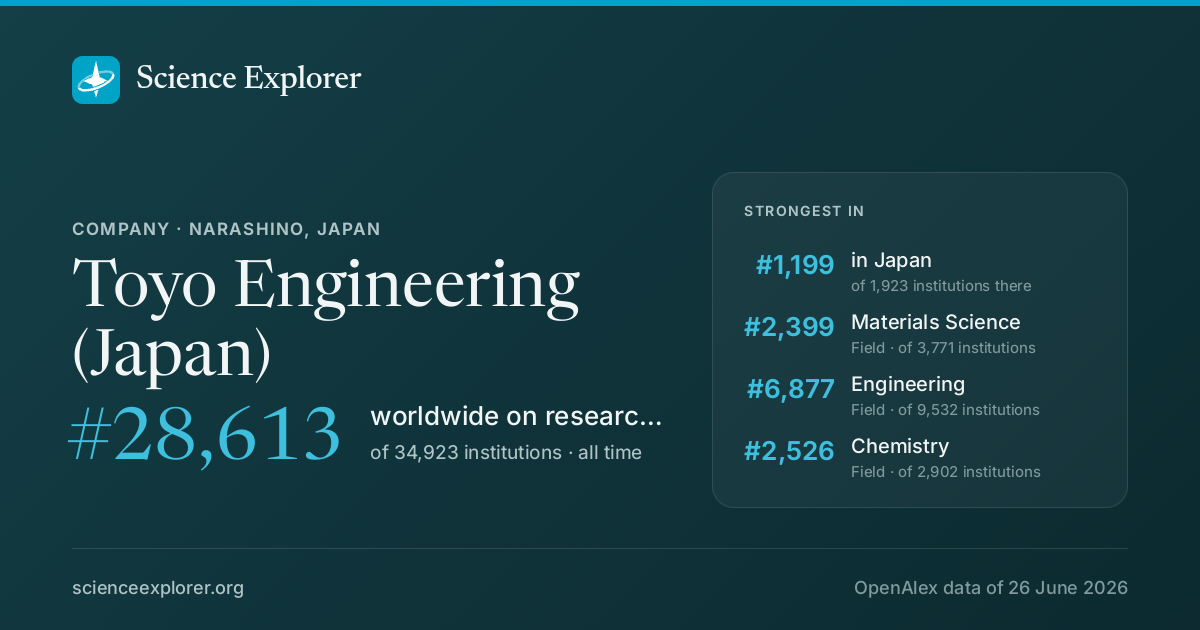
Toyo Engineering (Japan) on Science Explorer

A card with Toyo Engineering (Japan)'s standing and the fields it leads in, for a post or a slide. A link to this page previews as the same card.

Download the card

1200 × 630 PNG, sized for social posts, drawn from the latest snapshot.

Badges for a website1Each links back here and updates with every snapshot

Research measures only: rankings here say nothing about teaching, admissions or student experience. Comparable institutions and collaboration partners have tabs of their own, above.

Discussion

Ask a question or share a note about Toyo Engineering (Japan). Keep it to the research: no personal attacks, advertising or links. Any reader can report a post, which collapses it for everyone until it is opened.
