Science Explorer Back to mapMap
Discussion
Company · Armonk · United States

Underground Systems (United States)

In research, Underground Systems (United States) stands highest in Physical Sciences (#10,009 of 17,446 worldwide) and Engineering (#8,007 of 9,532 worldwide), over all time.

World rank, all time
#24,211
of 34,923
Rank in United States
#5,034
of 7,310
Research works
248
▲ 78% vs 2018-21
Citations
1.6k
6.5 per fractional work
Top-10% rate
8.3%
all institutions 10.0%
vs its own fields
0.86×
1.00× is exactly expected
Open access
30%
world 40%
International
36%
world 18%

What is Underground Systems (United States) known for in research?

The fields where it stands highest, over all time, ranked among every institution above the floor in each field.

FieldWorld rankWhere that sitsTop-10% rateWorks
Physical SciencesDomain #10,009 of 17,446 8.1%193
EngineeringField #8,007 of 9,532 7.8%124

Each strip is that field's whole ranked pool, with the notch where Underground Systems (United States) sits in it, in the colour of the band that rank falls in. The track under the rate is the rate itself: it carries no average mark, because the average differs by field (from about 6% in Dentistry to 21% in Economics).

Which fields of science does Underground Systems (United States) work in?

In 2022-now, 85% of research at Underground Systems (United States) is in Physical Sciences, 7% in Health Sciences. Its largest fields are Engineering (53%), Environmental Science (12%), Materials Science (5%). It does 2.1× the world's share of Physical Sciences.

Physical Sciences: 62 fractional works · 84.8% of its workEngineering: 39 fractional works · 52.8% of its workCivil and Structural Engineering: 13 fractional works · 17.5% of its workMechanics of Materials: 6 fractional works · 8.1% of its workMechanical Engineering: 6 fractional works · 7.9% of its workOcean Engineering: 3 fractional works · 3.9% of its workSafety, Risk, Reliability and Quality: 3 fractional works · 3.9% of its workBuilding and Construction: 3 fractional works · 3.9% of its workElectrical and Electronic Engineering: 2 fractional works · 2.2% of its workBiomedical Engineering: 1 fractional works · 1.6% of its workControl and Systems Engineering: 1 fractional works · 1.0% of its workComputational Mechanics: 1 fractional works · 0.8% of its workIndustrial and Manufacturing Engineering: 0 fractional works · 0.7% of its workAerospace Engineering: 0 fractional works · 0.6% of its workGeneral Engineering: 0 fractional works · 0.2% of its workAutomotive Engineering: 0 fractional works · 0.2% of its workEnvironmental Science: 9 fractional works · 12.2% of its workManagement, Monitoring, Policy and Law: 2 fractional works · 3.2% of its workEnvironmental Engineering: 2 fractional works · 2.6% of its workWater Science and Technology: 2 fractional works · 2.5% of its workGlobal and Planetary Change: 1 fractional works · 1.4% of its workPollution: 1 fractional works · 0.9% of its workEcology: 0 fractional works · 0.7% of its workEnvironmental Chemistry: 0 fractional works · 0.5% of its workEcological Modeling: 0 fractional works · 0.2% of its workSmaller subfields together: 0 fractional works · 0.2% of its workMaterials Science: 4 fractional works · 5.4% of its workMaterials Chemistry: 2 fractional works · 3.4% of its workPolymers and Plastics: 0 fractional works · 0.7% of its workBiomaterials: 0 fractional works · 0.5% of its workElectronic, Optical and Magnetic Materials: 0 fractional works · 0.4% of its workSurfaces, Coatings and Films: 0 fractional works · 0.4% of its workSmaller subfields together: 0 fractional works · 0.1% of its workEarth and Planetary Sciences: 4 fractional works · 5.1% of its workGeophysics: 2 fractional works · 2.8% of its workAtmospheric Science: 1 fractional works · 0.9% of its workGeochemistry and Petrology: 1 fractional works · 0.8% of its workPaleontology: 0 fractional works · 0.2% of its workGeology: 0 fractional works · 0.2% of its workSmaller subfields together: 0 fractional works · 0.1% of its workComputer Science: 3 fractional works · 3.6% of its workArtificial Intelligence: 1 fractional works · 1.5% of its workComputer Networks and Communications: 1 fractional works · 1.2% of its workInformation Systems: 0 fractional works · 0.6% of its workComputer Vision and Pattern Recognition: 0 fractional works · 0.2% of its workSmaller subfields together: 0 fractional works · 0.1% of its workEnergy: 2 fractional works · 2.1% of its workRenewable Energy, Sustainability and the Environment: 1 fractional works · 1.8% of its workFuel Technology: 0 fractional works · 0.2% of its workSmaller subfields together: 0 fractional works · 0.1% of its workPhysics and Astronomy: 1 fractional works · 1.7% of its workNuclear and High Energy Physics: 0 fractional works · 0.6% of its workAstronomy and Astrophysics: 0 fractional works · 0.4% of its workRadiation: 0 fractional works · 0.4% of its workAtomic and Molecular Physics, and Optics: 0 fractional works · 0.2% of its workChemical Engineering: 1 fractional works · 1.2% of its workCatalysis: 1 fractional works · 1.1% of its workSmaller subfields together: 0 fractional works · 0.1% of its workChemistry: 0 fractional works · 0.4% of its workSpectroscopy: 0 fractional works · 0.2% of its workSmaller subfields together: 0 fractional works · 0.2% of its workMathematics: 0 fractional works · 0.1% of its workHealth Sciences: 5 fractional works · 6.7% of its workMedicine: 4 fractional works · 5.4% of its workSurgery: 1 fractional works · 1.1% of its workRadiology, Nuclear Medicine and Imaging: 1 fractional works · 0.7% of its workOrthopedics and Sports Medicine: 0 fractional works · 0.7% of its workOncology: 0 fractional works · 0.6% of its workHepatology: 0 fractional works · 0.4% of its workPathology and Forensic Medicine: 0 fractional works · 0.4% of its workInfectious Diseases: 0 fractional works · 0.2% of its workSmaller subfields together: 1 fractional works · 1.2% of its workDentistry: 0 fractional works · 0.7% of its workOrthodontics: 0 fractional works · 0.3% of its workOral Surgery: 0 fractional works · 0.2% of its workSmaller subfields together: 0 fractional works · 0.1% of its workHealth Professions: 0 fractional works · 0.6% of its workGeneral Health Professions: 0 fractional works · 0.4% of its workSmaller subfields together: 0 fractional works · 0.3% of its workSocial Sciences: 4 fractional works · 5.4% of its workSocial Sciences: 3 fractional works · 3.5% of its workGeography, Planning and Development: 1 fractional works · 0.9% of its workCultural Studies: 1 fractional works · 0.8% of its workUrban Studies: 0 fractional works · 0.4% of its workEducation: 0 fractional works · 0.3% of its workSociology and Political Science: 0 fractional works · 0.3% of its workTransportation: 0 fractional works · 0.2% of its workHealth: 0 fractional works · 0.2% of its workSmaller subfields together: 0 fractional works · 0.4% of its workArts and Humanities: 1 fractional works · 0.9% of its workLanguage and Linguistics: 0 fractional works · 0.3% of its workArcheology: 0 fractional works · 0.3% of its workSmaller subfields together: 0 fractional works · 0.3% of its workPsychology: 0 fractional works · 0.5% of its workClinical Psychology: 0 fractional works · 0.5% of its workBusiness, Management and Accounting: 0 fractional works · 0.2% of its workEconomics, Econometrics and Finance: 0 fractional works · 0.2% of its workDecision Sciences: 0 fractional works · 0.1% of its workLife Sciences: 2 fractional works · 3.1% of its workAgricultural and Biological Sciences: 1 fractional works · 2.0% of its workFood Science: 0 fractional works · 0.7% of its workPlant Science: 0 fractional works · 0.5% of its workInsect Science: 0 fractional works · 0.3% of its workEcology, Evolution, Behavior and Systematics: 0 fractional works · 0.3% of its workSmaller subfields together: 0 fractional works · 0.2% of its workBiochemistry, Genetics and Molecular Biology: 1 fractional works · 0.7% of its workMolecular Biology: 1 fractional works · 0.7% of its workImmunology and Microbiology: 0 fractional works · 0.2% of its workImmunology: 0 fractional works · 0.2% of its workPharmacology, Toxicology and Pharmaceutics: 0 fractional works · 0.1% of its workALL ITS WORKUndergroundSystems (United…73fractional works, 2022-now
Life Sciences3%Physical Sciences85%Health Sciences7%Social Sciences5%

Each ring splits the one inside it: the four domains of science, their fields, their subfields. Size is fractional works in 2022-now. Every slice is a page; the interactive view zooms down to single topics and colours each by how much more of it this institution does than the world.

Its 4 domains and 23 fields, with their numbers
    1. Engineering3952.8%
    2. Environmental Science912.2%
    3. Materials Science45.4%
    4. Earth and Planetary Sciences45.1%
    5. Computer Science33.6%
    6. Energy22.1%
    7. Physics and Astronomy11.7%
    8. Chemical Engineering11.2%
    9. Chemistry00.4%
    10. Mathematics00.1%
    1. Medicine45.4%
    2. Dentistry00.7%
    3. Health Professions00.6%
    1. Social Sciences33.5%
    2. Arts and Humanities10.9%
    3. Psychology00.5%
    4. Business, Management and Accounting00.2%
    5. Economics, Econometrics and Finance00.2%
    6. Decision Sciences00.1%
    1. Agricultural and Biological Sciences12.0%
    2. Biochemistry, Genetics and Molecular Biology10.7%
    3. Immunology and Microbiology00.2%
    4. Pharmacology, Toxicology and Pharmaceutics00.1%
All of science, and how each field's share has moved since 1950: the Science domain explorer

Field profile

Location quotient across every field it publishes in: outside the ring is more than an institution of this size would be expected to publish, inside it is less.

Agricultural and Biological Sciences: 0.43× its world share, 2 worksAgricultural and Bio…Biochemistry, Genetics and Molecular Biology: 0.14× its world share, 0 worksBiochemistry, Geneti…Immunology and Microbiology: 0.23× its world share, 0 worksImmunology and Micro…Pharmacology, Toxicology and Pharmaceutics: 0.32× its world share, 0 worksPharmacology, Toxico…Chemical Engineering: 3.55× its world share, 1 worksChemical EngineeringChemistry: 0.29× its world share, 0 worksChemistryComputer Science: 0.47× its world share, 3 worksComputer ScienceEarth and Planetary Sciences: 3.26× its world share, 4 worksEarth and Planetary …Energy: 2.32× its world share, 2 worksEnergyEngineering: 3.52× its world share, 39 worksEngineeringEnvironmental Science: 2.45× its world share, 9 worksEnvironmental ScienceMaterials Science: 1.56× its world share, 4 worksMaterials ScienceMathematics: 0.11× its world share, 0 worksMathematicsPhysics and Astronomy: 0.76× its world share, 1 worksPhysics and AstronomyDentistry: 1.40× its world share, 0 worksDentistryHealth Professions: 0.24× its world share, 0 worksHealth ProfessionsMedicine: 0.28× its world share, 4 worksMedicineArts and Humanities: 0.33× its world share, 1 worksArts and HumanitiesBusiness, Management and Accounting: 0.07× its world share, 0 worksBusiness, Management…Decision Sciences: 0.07× its world share, 0 worksDecision SciencesEconomics, Econometrics and Finance: 0.09× its world share, 0 worksEconomics, Econometr…Psychology: 0.16× its world share, 0 worksPsychologySocial Sciences: 0.28× its world share, 3 worksSocial Sciences1×world share
more than its size predictsabout as predictedless

Rings at 0.5×, 1× and 2×. Widest outward: Chemical Engineering, 3.5×. Every wedge is a field page.

All 23 fields, with their numbers
  1. Chemical Engineering3.55×1 works
  2. Engineering3.52×39 works
  3. Earth and Planetary Sciences3.26×4 works
  4. Environmental Science2.45×9 works
  5. Energy2.32×2 works
  6. Materials Science1.56×4 works
  7. Dentistry1.40×0 works
  8. Physics and Astronomy0.76×1 works
  9. Computer Science0.47×3 works
  10. Agricultural and Biological Sciences0.43×2 works
  11. Arts and Humanities0.33×1 works
  12. Pharmacology, Toxicology and Pharmaceutics0.32×0 works
  13. Chemistry0.29×0 works
  14. Medicine0.28×4 works
  15. Social Sciences0.28×3 works
  16. Health Professions0.24×0 works
  17. Immunology and Microbiology0.23×0 works
  18. Psychology0.16×0 works
  19. Biochemistry, Genetics and Molecular Biology0.14×0 works
  20. Mathematics0.11×0 works
  21. Economics, Econometrics and Finance0.09×0 works
  22. Business, Management and Accounting0.07×0 works
  23. Decision Sciences0.07×0 works

Who are the top researchers at Underground Systems (United States)?

Ranked on the quality score, Carla Brooks Johnston, Vittorio Manassero and John S. Engelhardt lead among researchers whose main affiliation is Underground Systems (United States).

  1. 1 Carla Brooks Johnston United States · #2,977,055 worldwide 31 citations · 21 works
  2. 2 Vittorio Manassero United States · #4,041,291 worldwide 59 citations · 15 works
  3. 3 John S. Engelhardt United States · #4,114,198 worldwide 135 citations · 23 works
  4. 4 Richard Botteicher United States · #4,611,343 worldwide 21 citations · 16 works
All ranked researchers at Underground Systems (United States)

What are the most cited papers from Underground Systems (United States)?

The most cited paper from Underground Systems (United States) is "Relation Between an Atomic Electronegativity Scale and the Work Function" (Herbert B. Michaelson, 1978), with 225 citations. Next come "Partial discharge: overview and signal generation" (187) and "Double Chooz θ13 measurement via total neutron capture detection" (175).

Most cited papers
#PaperReleasedCitations
1 Relation Between an Atomic Electronegativity Scale and the Work Function Herbert B. Michaelson · IBM Journal of Research and Development 1978 225
2 Partial discharge: overview and signal generation Steven A. Boggs · IEEE Electrical Insulation Magazine Jul 1990 187
3 Double Chooz θ13 measurement via total neutron capture detection H. de Kerret et al. · Nature Physics Open access 20 Apr 2020 175
4 Behaviour of an old masonry tunnel due to tunnelling-induced ground settlement Hisham Mohamad, P.J. Bennett, Kenichi Soga et al. · Géotechnique 30 Oct 2010 148
5 Partial discharge. III. Cavity-induced PD in solid dielectrics Steven A. Boggs · IEEE Electrical Insulation Magazine Nov 1990 134
All 61 most cited papers, with filters and sorting

Which keywords describe research at Underground Systems (United States)?

By fractional works in 2022-now, weighted toward what it does more of than the world: Rock Mechanics, Dynamic Behavior, Liquefaction, Tunnel, Fracture, Acoustic Emission, Numerical Modelling and Finite Element Analysis.

▲ more of its work than of the world's◆ about the world's share▼ less than the world's

Size is fractional works in 2022-now in the topics tagged with each word; colour is the word's share of this institution's work against its share of the world's. The 40 words are chosen for being large and distinctive. Each links to the topic it comes from most.

All 40 words, with their numbers
  1. Rock Mechanics5▲ 69×3 topics
  2. Dynamic Behavior4▲ 44×2 topics
  3. Liquefaction4▲ 57×2 topics
  4. Tunnel4▲ 57×2 topics
  5. Environmental Impact4▲ 2.8×11 topics
  6. Fracture4▲ 49×2 topics
  7. Machine Learning4▲ 1.42×9 topics
  8. Acoustic Emission3▲ 74×1 topic
  9. Numerical Modelling3▲ 78×1 topic
  10. Risk Assessment3▲ 6.6×4 topics
  11. Finite Element Analysis3▲ 19×3 topics
  12. Soil Properties3▲ 25×3 topics
  13. CO2 Sequestration3▲ 21×4 topics
  14. Remote Sensing2▲ 2.8×7 topics
  15. Renewable Energy2▲ 2.3×8 topics
  16. Slope Stability Analysis2▲ 89×1 topic
  17. Spatial Variability2▲ 54×1 topic
  18. Energy Efficiency2▲ 3.3×7 topics
  19. GIS-based Modeling2▲ 34×2 topics
  20. Numerical Simulation2▲ 9.5×5 topics
  21. Analysis2▲ 29×2 topics
  22. Cementitious2▲ 89×1 topic
  23. Grouting2▲ 89×1 topic
  24. Hazard2▲ 35×1 topic
  25. Landslide2▲ 35×1 topic
  26. Water Quality2▲ 5.9×3 topics
  27. Earthquake2▲ 41×1 topic
  28. Hydraulic Fracturing2▲ 22×2 topics
  29. Seismic2▲ 41×1 topic
  30. Vibration Analysis2▲ 8.8×3 topics
  31. Carbon Dioxide2▲ 13×3 topics
  32. Geopolymer2▲ 14×2 topics
  33. Catalytic1▲ 16×2 topics
  34. Fly Ash1▲ 18×2 topics
  35. Geological Conditions1▲ 49×2 topics
  36. Leak Detection1▲ 70×1 topic
  37. Performance Prediction1▲ 26×2 topics
  38. Rheological Properties1▲ 10×2 topics
  39. Shale Gas1▲ 15×2 topics
  40. Water Distribution Networks1▲ 70×1 topic

Which research topics does Underground Systems (United States) publish most on?

By volume in 2022-now: Rock Mechanics and Modeling, Geotechnical Engineering and Analysis, Grouting, Rheology, and Soil Mechanics and Landslides and related hazards.

  1. 1 Rock Mechanics and Modeling Mechanics of Materials 3 works
  2. 2 Geotechnical Engineering and Analysis Safety, Risk, Reliability and Quality 2 works
  3. 3 Grouting, Rheology, and Soil Mechanics Civil and Structural Engineering 2 works
  4. 4 Landslides and related hazards Management, Monitoring, Policy and Law 2 works
  5. 5 Geotechnical Engineering and Underground Structures Civil and Structural Engineering 2 works
  6. 6 Concrete and Cement Materials Research Civil and Structural Engineering 1 works
  7. 7 Mineral Processing and Grinding Mechanical Engineering 1 works
  8. 8 Water Systems and Optimization Civil and Structural Engineering 1 works
  9. 9 Tunneling and Rock Mechanics Civil and Structural Engineering 1 works
  10. 10 Minerals Flotation and Separation Techniques Water Science and Technology 1 works

How open and international is its research?

Against the world's own shares: the tick on each track. Both are shares of its output, so they sit on one scale and can be read against each other as well as against the world.

openly available29.6%not open70.4%

World: 40% of research is openly available.

with international co-authors35.9%domestic only64.1%

World: 18% is written across borders.

How has Underground Systems (United States)'s research output changed?

Output in 2022-2025 was 78% higher than in 2018-2021.

still counting1990200020102020
grewheldshrank

The same series as a ribbon: one cell per year, darker for more. The line above answers how much; this answers when.

Its share of all research

Growing output can still be a shrinking share: all of science grows. This is Underground Systems (United States) as a percentage of every work published that year, 0.00024% in 2024.

still counting0.00050%0.0010%0.0015%Underground Systems (United States)0.00043% in 202519801990200020102020

Fractional works of Underground Systems (United States) over all fractional works that year. How the balance of science has shifted.

Other research institutions in Armonk

All research institutions in Armonk

Share Underground Systems (United States)'s ranking
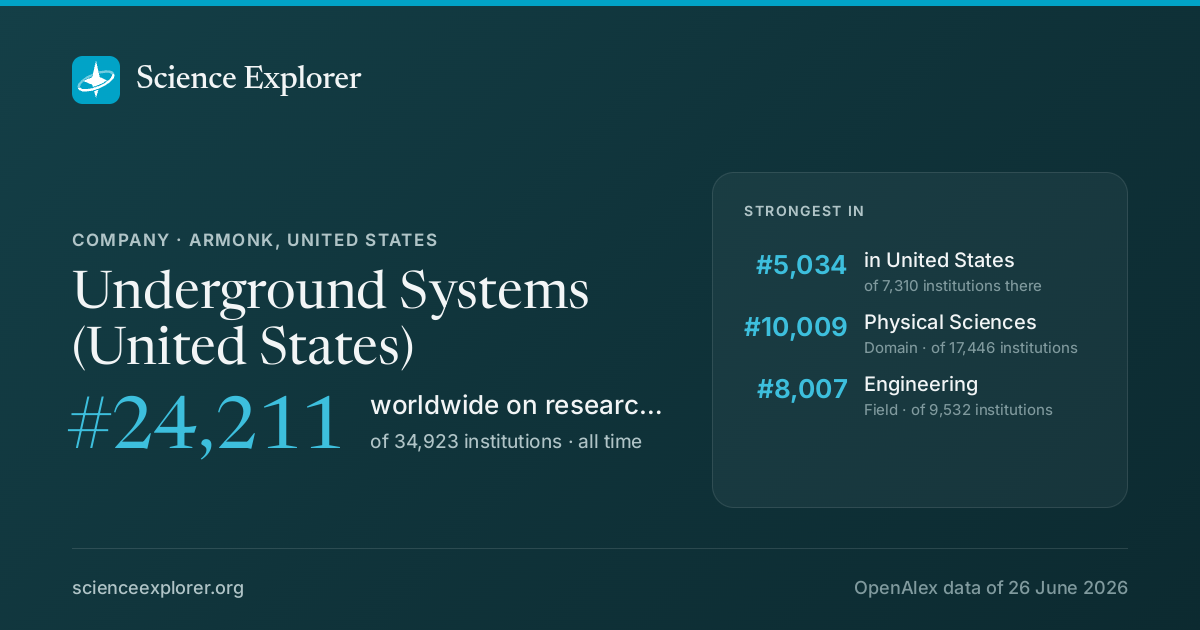
Underground Systems (United States) on Science Explorer

A card with Underground Systems (United States)'s standing and the fields it leads in, for a post or a slide. A link to this page previews as the same card.

Download the card

1200 × 630 PNG, sized for social posts, drawn from the latest snapshot.

Badges for a website1Each links back here and updates with every snapshot

Research measures only: rankings here say nothing about teaching, admissions or student experience. Comparable institutions and collaboration partners have tabs of their own, above.

Discussion

Ask a question or share a note about Underground Systems (United States). Posts are plain text and can be reported.
