Universal Engineering College
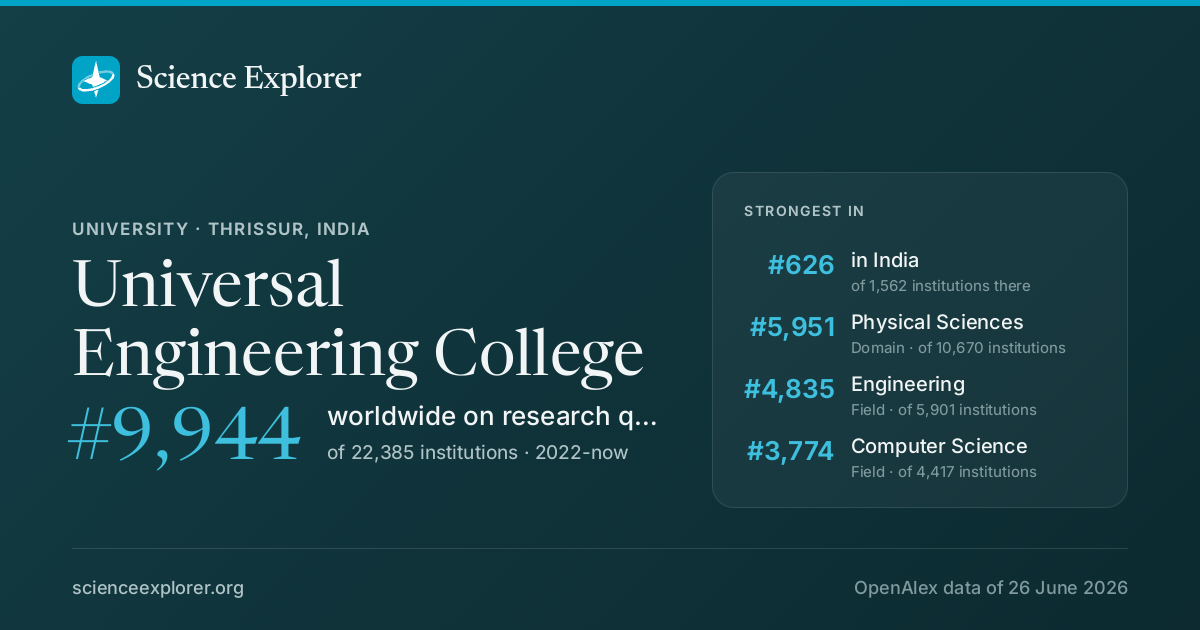
In research, Universal Engineering College stands highest in Physical Sciences (#5,951 of 10,670 worldwide), Engineering (#4,835 of 5,901 worldwide) and Computer Science (#3,774 of 4,417 worldwide), 2022-now.
- World rank, 2022-now
- #9,944 of 22,385 · #20,303 all time
- Rank in India
- #626 of 1,562
- Research works
- 531 ▲ 98% vs 2018-21
- Citations
- 1.7k 3.2 per fractional work
- Top-10% rate
- 5.2% all institutions 10.0%
- vs its own fields
- 0.76× 1.00× is exactly expected
- Open access
- 53% world 40%
- International
- 11% world 18%
What is Universal Engineering College known for in research?
The fields where it stands highest, 2022-now, ranked among every institution above the floor in each field.
| Field | World rank | Where that sits | Top-10% rate | Works | All time |
|---|---|---|---|---|---|
| Physical SciencesDomain | #5,951 of 10,670 | 4.4% | 159 | #12462 | |
| EngineeringField | #4,835 of 5,901 | 4.6% | 74 | #7863 | |
| Computer ScienceField | #3,774 of 4,417 | 3.6% | 61 | #5657 | |
| Social SciencesDomain | #8,672 of 9,585 | 6.6% | 68 | - |
Each strip is that field's whole ranked pool, with the notch where Universal Engineering College sits in it, in the colour of the band that rank falls in. The track under the rate is the rate itself: it carries no average mark, because the average differs by field (from about 6% in Dentistry to 21% in Economics).
Which of those standings moved
The same fields on both windows: where it stood over the whole record, and where it stands in 2022-now. The distance is the story, and it is the one thing the two rank columns above cannot show.
- Physical Sciences#12,462 #5,951
- Engineering#7,863 #4,835
- Computer Science#5,657 #3,774
A dot further right is a better standing. Fields it was not ranked in over the whole record are left out.
Which fields of science does Universal Engineering College work in?
In 2022-now, 60% of research at Universal Engineering College is in Physical Sciences, 25% in Social Sciences. Its largest fields are Engineering (26%), Computer Science (24%), Business, Management and Accounting (8%). It does 1.5× the world's share of Physical Sciences.
Each ring splits the one inside it: the four domains of science, their fields, their subfields. Size is fractional works in 2022-now. Every slice is a page; the interactive view zooms down to single topics and colours each by how much more of it this institution does than the world.
Its 4 domains and 26 fields, with their numbers
- Physical Sciences19960.0%
- Engineering8626.1%
- Computer Science8124.4%
- Environmental Science113.2%
- Materials Science72.2%
- Earth and Planetary Sciences31.0%
- Energy31.0%
- Physics and Astronomy30.9%
- Chemical Engineering20.5%
- Chemistry10.4%
- Mathematics10.4%
- Social Sciences8425.2%
- Business, Management and Accounting267.9%
- Social Sciences236.9%
- Decision Sciences113.4%
- Psychology103.1%
- Economics, Econometrics and Finance82.4%
- Arts and Humanities51.5%
- Life Sciences257.7%
- Health Sciences237.1%
- Medicine164.9%
- Health Professions61.9%
- Dentistry00.1%
- Nursing00.1%
- Veterinary00.0%
Field profile
Location quotient across every field it publishes in: outside the ring is more than an institution of this size would be expected to publish, inside it is less.
Rings at 0.5×, 1× and 2×. Widest outward: Decision Sciences, 3.5×. Every wedge is a field page.
All 26 fields, with their numbers
- Decision Sciences3.52×11 works
- Computer Science3.13×81 works
- Business, Management and Accounting2.46×26 works
- Engineering1.74×86 works
- Chemical Engineering1.49×2 works
- Neuroscience1.34×7 works
- Economics, Econometrics and Finance1.12×8 works
- Energy1.04×3 works
- Psychology1.01×10 works
- Agricultural and Biological Sciences0.87×14 works
- Health Professions0.72×6 works
- Environmental Science0.65×11 works
- Materials Science0.64×7 works
- Earth and Planetary Sciences0.61×3 works
- Pharmacology, Toxicology and Pharmaceutics0.60×1 works
- Social Sciences0.55×23 works
- Arts and Humanities0.53×5 works
- Physics and Astronomy0.41×3 works
- Mathematics0.31×1 works
- Chemistry0.26×1 works
- Medicine0.26×16 works
- Dentistry0.24×0 works
- Biochemistry, Genetics and Molecular Biology0.21×4 works
- Nursing0.21×0 works
- Veterinary0.19×0 works
- Immunology and Microbiology0.03×0 works
- Decision Sciences 3.5×
- Computer Science 3.1×
- Business, Management and Accounting 2.5×
- Engineering 1.7×
- Chemical Engineering 1.5×
- Neuroscience 1.3×
- Economics, Econometrics and Finance 1.1×
- Energy 1.0×
- Psychology 1.0×
- Agricultural and Biological Sciences 0.9×
- Health Professions 0.7×
- Environmental Science 0.7×
- Materials Science 0.6×
- Earth and Planetary Sciences 0.6×
- Pharmacology, Toxicology and Pharmaceutics 0.6×
- Social Sciences 0.6×
- Arts and Humanities 0.5×
- Physics and Astronomy 0.4×
- Mathematics 0.3×
- Chemistry 0.3×
- Medicine 0.3×
- Dentistry 0.2×
- Biochemistry, Genetics and Molecular Biology 0.2×
- Nursing 0.2×
- Veterinary 0.2×
- Immunology and Microbiology 0.0×
Who are the top researchers at Universal Engineering College?
Ranked on the quality score, Asha Bhatia, Vishakha Shelke and Afshan Mulla lead among researchers whose main affiliation is Universal Engineering College.
- 1
Asha Bhatia
 India · #4,368,405 worldwide
14 citations · 17 works
- 2
Vishakha Shelke
India · #5,435,976 worldwide
83 citations · 28 works
- 3
Afshan Mulla
India · #5,598,174 worldwide
317 citations · 37 works
- 4
Amol J. Baviskar
India · #5,812,932 worldwide
226 citations · 32 works
- 5
Jaypal J. Baviskar
India · #5,958,318 worldwide
396 citations · 43 works
Which keywords describe research at Universal Engineering College?
By fractional works in 2022-now, weighted toward what it does more of than the world: Deep Learning, Machine Learning, Convolutional Neural Networks, Internet of Things, Artificial Intelligence, Security, IoT and Feature Extraction.
- Sentiment Analysis
- Human-Computer Interaction
- Plant Disease Detection
- Smart Home
- Convolutional Neural Network
- Predictive Analytics
- Cloud Computing
- Smart Cities
- Support Vector Machines
- Transfer Learning
- Medical Image Analysis
- Data Mining
- Image Processing
- Wireless Sensor Networks
- Healthcare
- IoT
- Security
- Neural Networks
- Convolutional Neural Networks
- Machine Learning
- Deep Learning
- Sustainability
- Artificial Intelligence
- Internet of Things
- Supply Chain Management
- Big Data
- Feature Extraction
- Medical Imaging
- Classification
- RFID Technology
- Big Data Analytics
- Environmental Monitoring
- Cybersecurity
- Risk Management
- IoT Security
- Smart Farming
- Firm Performance
- Internet of Things (IoT)
- Smart Factory
- Image Segmentation
Size is fractional works in 2022-now in the topics tagged with each word; colour is the word's share of this institution's work against its share of the world's. The 40 words are chosen for being large and distinctive. Each links to the topic it comes from most.
All 40 words, with their numbers
- Deep Learning69▲ 6.0×54 topics
- Machine Learning47▲ 4.3×51 topics
- Sustainability21▲ 2.6×32 topics
- Convolutional Neural Networks19▲ 8.0×13 topics
- Artificial Intelligence19▲ 4.0×21 topics
- Neural Networks18▲ 3.5×24 topics
- Internet of Things18▲ 6.3×13 topics
- Security15▲ 6.7×10 topics
- Supply Chain Management15▲ 4.9×11 topics
- IoT14▲ 11×9 topics
- Big Data14▲ 4.3×18 topics
- Healthcare13▲ 3.4×10 topics
- Feature Extraction12▲ 8.4×9 topics
- Wireless Sensor Networks12▲ 8.3×10 topics
- Medical Imaging11▲ 6.1×6 topics
- Image Processing10▲ 7.0×7 topics
- Classification9▲ 5.8×10 topics
- Data Mining8▲ 3.4×10 topics
- RFID Technology8▲ 14×4 topics
- Medical Image Analysis8▲ 13×4 topics
- Big Data Analytics8▲ 11×4 topics
- Transfer Learning7▲ 12×3 topics
- Environmental Monitoring7▲ 5.4×5 topics
- Support Vector Machines7▲ 6.4×7 topics
- Cybersecurity7▲ 8.1×4 topics
- Smart Cities7▲ 7.6×5 topics
- Risk Management6▲ 4.0×10 topics
- Cloud Computing6▲ 6.2×6 topics
- IoT Security6▲ 5.7×3 topics
- Predictive Analytics6▲ 16×2 topics
- Smart Farming6▲ 14×2 topics
- Convolutional Neural Network5▲ 9.8×3 topics
- Firm Performance5▲ 8.5×2 topics
- Smart Home5▲ 9.4×3 topics
- Internet of Things (IoT)5▲ 13×1 topic
- Plant Disease Detection5▲ 14×1 topic
- Smart Factory5▲ 14×3 topics
- Human-Computer Interaction5▲ 7.8×4 topics
- Image Segmentation5▲ 11×2 topics
- Sentiment Analysis4▲ 12×2 topics
Which research topics does Universal Engineering College publish most on?
By volume in 2022-now: Smart Agriculture and AI, Big Data and Business Intelligence, Brain Tumor Detection and Classification and IoT-based Smart Home Systems.
Area is fractional works; colour is the subfield each topic belongs to.
- 1 Smart Agriculture and AI Plant Science 5 works
- 2 Big Data and Business Intelligence Management Information Systems 4 works
- 3 Brain Tumor Detection and Classification Neurology 4 works
- 4 IoT-based Smart Home Systems Electrical and Electronic Engineering 4 works
- 5 IoT and GPS-based Vehicle Safety Systems Mechanical Engineering 4 works
- 6 Stock Market Forecasting Methods Management Science and Operations Research 4 works
- 7 AI in cancer detection Artificial Intelligence 4 works
- 8 FinTech, Crowdfunding, Digital Finance Management Information Systems 4 works
- 9 COVID-19 diagnosis using AI Radiology, Nuclear Medicine and Imaging 3 works
- 10 Internet of Things and AI Information Systems 3 works
How open and international is its research?
Against the world's own shares: the tick on each track. Both are shares of its output, so they sit on one scale and can be read against each other as well as against the world.
World: 40% of research is openly available.
World: 18% is written across borders.
How has Universal Engineering College's research output changed?
Output in 2022-2025 was 98% higher than in 2018-2021.
The same series as a ribbon: one cell per year, darker for more. The line above answers how much; this answers when.
Its share of all research
Growing output can still be a shrinking share: all of science grows. This is Universal Engineering College as a percentage of every work published that year, 0.0012% in 2024.
Fractional works of Universal Engineering College over all fractional works that year. How the balance of science has shifted.
How much of it reaches the world top 10%
Year by year, against all institutions in the same year.
Of each year's output, the share that reached the world's 10% most cited for its field and year. Peak 9.2% in 2021.
Other research institutions in Thrissur
- Kerala Agricultural University
- Mother Hospital
- Amala Institute of Medical Sciences
- Jubilee Mission Medical College and Research Institute
- Kerala University of Health Sciences
- Kerala Forest Research Institute
- Trichur Heart Hospital
- Kerala Kalamandalam
Share Universal Engineering College's ranking
Badges for a website1Each links back here and updates with every snapshot

Research measures only: rankings here say nothing about teaching, admissions or student experience. Comparable institutions and collaboration partners have tabs of their own, above.
Discussion
Ask a question or share a note about Universal Engineering College. Posts are plain text and can be reported.