Science Explorer Back to mapMap
World rank, all time
#33,718
of 34,923
Rank in Bosnia and Herzegovina
#29
of 29
Research works
122
▼ 5% vs 2018-21
Citations
186
1.5 per fractional work
Top-10% rate
5.2%
all institutions 10.0%
vs its own fields
0.90×
1.00× is exactly expected
Open access
82%
world 40%
International
24%
world 18%

Which fields of science does Univerzitet Vitez work in?

In 2022-now, 65% of research at Univerzitet Vitez is in Social Sciences, 17% in Physical Sciences. Its largest fields are Economics, Econometrics and Finance (24%), Social Sciences (23%), Medicine (11%). It does 2.3× the world's share of Social Sciences.

Social Sciences: 27 fractional works · 65.5% of its workEconomics, Econometrics and Finance: 10 fractional works · 23.8% of its workEconomics and Econometrics: 8 fractional works · 20.6% of its workGeneral Economics, Econometrics and Finance: 1 fractional works · 2.0% of its workFinance: 0 fractional works · 1.2% of its workSocial Sciences: 9 fractional works · 22.7% of its workPolitical Science and International Relations: 4 fractional works · 9.0% of its workSociology and Political Science: 3 fractional works · 6.7% of its workEducation: 1 fractional works · 1.7% of its workLaw: 1 fractional works · 1.4% of its workGender Studies: 0 fractional works · 1.1% of its workDemography: 0 fractional works · 0.8% of its workGeography, Planning and Development: 0 fractional works · 0.8% of its workUrban Studies: 0 fractional works · 0.4% of its workTransportation: 0 fractional works · 0.4% of its workHealth: 0 fractional works · 0.4% of its workPsychology: 4 fractional works · 8.6% of its workClinical Psychology: 2 fractional works · 5.8% of its workSocial Psychology: 1 fractional works · 2.4% of its workDevelopmental and Educational Psychology: 0 fractional works · 0.4% of its workBusiness, Management and Accounting: 3 fractional works · 7.2% of its workStrategy and Management: 1 fractional works · 2.0% of its workMarketing: 1 fractional works · 1.6% of its workOrganizational Behavior and Human Resource Management: 1 fractional works · 1.3% of its workAccounting: 0 fractional works · 1.2% of its workManagement of Technology and Innovation: 0 fractional works · 0.6% of its workManagement Information Systems: 0 fractional works · 0.4% of its workArts and Humanities: 1 fractional works · 2.9% of its workArcheology: 0 fractional works · 0.8% of its workPhilosophy: 0 fractional works · 0.8% of its workVisual Arts and Performing Arts: 0 fractional works · 0.8% of its workConservation: 0 fractional works · 0.4% of its workSmaller subfields together: 0 fractional works · 0.0% of its workDecision Sciences: 0 fractional works · 0.3% of its workManagement Science and Operations Research: 0 fractional works · 0.3% of its workPhysical Sciences: 7 fractional works · 16.7% of its workComputer Science: 3 fractional works · 6.2% of its workInformation Systems: 1 fractional works · 2.5% of its workComputer Vision and Pattern Recognition: 0 fractional works · 1.1% of its workComputer Graphics and Computer-Aided Design: 0 fractional works · 0.9% of its workComputer Science Applications: 0 fractional works · 0.8% of its workArtificial Intelligence: 0 fractional works · 0.4% of its workSignal Processing: 0 fractional works · 0.3% of its workSmaller subfields together: 0 fractional works · 0.1% of its workEngineering: 2 fractional works · 5.3% of its workElectrical and Electronic Engineering: 1 fractional works · 2.0% of its workIndustrial and Manufacturing Engineering: 0 fractional works · 1.1% of its workOcean Engineering: 0 fractional works · 0.8% of its workAerospace Engineering: 0 fractional works · 0.4% of its workArchitecture: 0 fractional works · 0.3% of its workBiomedical Engineering: 0 fractional works · 0.3% of its workControl and Systems Engineering: 0 fractional works · 0.3% of its workSmaller subfields together: 0 fractional works · 0.1% of its workEnvironmental Science: 2 fractional works · 4.0% of its workManagement, Monitoring, Policy and Law: 1 fractional works · 1.5% of its workWater Science and Technology: 0 fractional works · 0.8% of its workGlobal and Planetary Change: 0 fractional works · 0.7% of its workEnvironmental Engineering: 0 fractional works · 0.4% of its workIndustrial and Manufacturing Engineering: 0 fractional works · 0.3% of its workHealth, Toxicology and Mutagenesis: 0 fractional works · 0.3% of its workSmaller subfields together: 0 fractional works · 0.0% of its workEarth and Planetary Sciences: 0 fractional works · 1.2% of its workGeology: 0 fractional works · 1.2% of its workHealth Sciences: 6 fractional works · 13.9% of its workMedicine: 4 fractional works · 10.5% of its workPublic Health, Environmental and Occupational Health: 1 fractional works · 2.6% of its workEpidemiology: 1 fractional works · 2.6% of its workOncology: 0 fractional works · 1.1% of its workRadiology, Nuclear Medicine and Imaging: 0 fractional works · 0.8% of its workPharmacology: 0 fractional works · 0.6% of its workPathology and Forensic Medicine: 0 fractional works · 0.6% of its workPsychiatry and Mental health: 0 fractional works · 0.5% of its workInfectious Diseases: 0 fractional works · 0.4% of its workEndocrinology, Diabetes and Metabolism: 0 fractional works · 0.3% of its workOtorhinolaryngology: 0 fractional works · 0.3% of its workSurgery: 0 fractional works · 0.3% of its workNeurology: 0 fractional works · 0.2% of its workObstetrics and Gynecology: 0 fractional works · 0.2% of its workSmaller subfields together: 0 fractional works · 0.1% of its workHealth Professions: 1 fractional works · 2.6% of its workGeneral Health Professions: 0 fractional works · 1.2% of its workHealth Information Management: 0 fractional works · 0.4% of its workMedical Laboratory Technology: 0 fractional works · 0.3% of its workRadiological and Ultrasound Technology: 0 fractional works · 0.3% of its workPhysical Therapy, Sports Therapy and Rehabilitation: 0 fractional works · 0.3% of its workSmaller subfields together: 0 fractional works · 0.1% of its workNursing: 0 fractional works · 0.8% of its workNutrition and Dietetics: 0 fractional works · 0.8% of its workLife Sciences: 2 fractional works · 3.8% of its workAgricultural and Biological Sciences: 1 fractional works · 2.2% of its workAgronomy and Crop Science: 0 fractional works · 0.7% of its workFood Science: 0 fractional works · 0.5% of its workPlant Science: 0 fractional works · 0.5% of its workGeneral Agricultural and Biological Sciences: 0 fractional works · 0.5% of its workBiochemistry, Genetics and Molecular Biology: 0 fractional works · 1.0% of its workEndocrinology: 0 fractional works · 0.4% of its workBiotechnology: 0 fractional works · 0.4% of its workSmaller subfields together: 0 fractional works · 0.1% of its workImmunology and Microbiology: 0 fractional works · 0.4% of its workImmunology: 0 fractional works · 0.4% of its workPharmacology, Toxicology and Pharmaceutics: 0 fractional works · 0.3% of its workPharmacology: 0 fractional works · 0.3% of its workALL ITS WORKUniverzitet Vitez41fractional works, 2022-now
Life Sciences4%Physical Sciences17%Health Sciences14%Social Sciences65%

Each ring splits the one inside it: the four domains of science, their fields, their subfields. Size is fractional works in 2022-now. Every slice is a page; the interactive view zooms down to single topics and colours each by how much more of it this institution does than the world.

Its 4 domains and 17 fields, with their numbers
    1. Economics, Econometrics and Finance1023.8%
    2. Social Sciences922.7%
    3. Psychology48.6%
    4. Business, Management and Accounting37.2%
    5. Arts and Humanities12.9%
    6. Decision Sciences00.3%
    1. Computer Science36.2%
    2. Engineering25.3%
    3. Environmental Science24.0%
    4. Earth and Planetary Sciences01.2%
    1. Medicine410.5%
    2. Health Professions12.6%
    3. Nursing00.8%
    1. Agricultural and Biological Sciences12.2%
    2. Biochemistry, Genetics and Molecular Biology01.0%
    3. Immunology and Microbiology00.4%
    4. Pharmacology, Toxicology and Pharmaceutics00.3%
All of science, and how each field's share has moved since 1950: the Science domain explorer

What does Univerzitet Vitez specialise in?

Where its research is concentrated relative to its size: Social Sciences takes 2.6× the share of its output that it takes of world research.

  1. Social SciencesDomain · 26.7 works2.6×
← less than its size predicts1×more →

Location quotient, a volume reading rather than an impact one. It surfaces small, lopsided specialities.

Field profile

Location quotient across every field it publishes in: outside the ring is more than an institution of this size would be expected to publish, inside it is less.

Agricultural and Biological Sciences: 0.46× its world share, 1 worksAgricultural and Bio…Biochemistry, Genetics and Molecular Biology: 0.19× its world share, 0 worksBiochemistry, Geneti…Immunology and Microbiology: 0.41× its world share, 0 worksImmunology and Micro…Pharmacology, Toxicology and Pharmaceutics: 0.77× its world share, 0 worksPharmacology, Toxico…Computer Science: 0.80× its world share, 2 worksComputer ScienceEarth and Planetary Sciences: 0.78× its world share, 0 worksEarth and Planetary …Engineering: 0.35× its world share, 2 worksEngineeringEnvironmental Science: 0.80× its world share, 2 worksEnvironmental ScienceHealth Professions: 0.98× its world share, 1 worksHealth ProfessionsMedicine: 0.55× its world share, 4 worksMedicineNursing: 1.67× its world share, 0 worksNursingArts and Humanities: 0.99× its world share, 1 worksArts and HumanitiesBusiness, Management and Accounting: 2.24× its world share, 3 worksBusiness, Management…Decision Sciences: 0.28× its world share, 0 worksDecision SciencesEconomics, Econometrics and Finance: 11.14× its world share, 10 worksEconomics, Econometr…Psychology: 2.82× its world share, 4 worksPsychologySocial Sciences: 1.79× its world share, 9 worksSocial Sciences1×world share
more than its size predictsabout as predictedless

Rings at 0.5×, 1× and 2×. Widest outward: Economics, Econometrics and Finance, 11.1×. Every wedge is a field page.

All 17 fields, with their numbers
  1. Economics, Econometrics and Finance11.14×10 works
  2. Psychology2.82×4 works
  3. Business, Management and Accounting2.24×3 works
  4. Social Sciences1.79×9 works
  5. Nursing1.67×0 works
  6. Arts and Humanities0.99×1 works
  7. Health Professions0.98×1 works
  8. Computer Science0.80×2 works
  9. Environmental Science0.80×2 works
  10. Earth and Planetary Sciences0.78×0 works
  11. Pharmacology, Toxicology and Pharmaceutics0.77×0 works
  12. Medicine0.55×4 works
  13. Agricultural and Biological Sciences0.46×1 works
  14. Immunology and Microbiology0.41×0 works
  15. Engineering0.35×2 works
  16. Decision Sciences0.28×0 works
  17. Biochemistry, Genetics and Molecular Biology0.19×0 works

Who are the top researchers at Univerzitet Vitez?

Ranked on the quality score, Jamila Jaganjac lead among researchers whose main affiliation is Univerzitet Vitez.

  1. 1 Jamila Jaganjac Bosnia and Herzegovina · #4,536,515 worldwide 59 citations · 20 works
All ranked researchers at Univerzitet Vitez

What are the most cited papers from Univerzitet Vitez?

The most cited paper from Univerzitet Vitez is "The benefits of GLP1 receptors in cardiovascular diseases" (Lamija Ferhatbegović, Denis Mršić, Amra Macić-Džanković, 2023), with 121 citations. Next come "Environmental DNA in subterranean biology: range extension and taxonomic implications for Proteus" (110) and "Food Behavior Changes during the COVID-19 Pandemic: Statistical Analysis of Consumer Survey Data from Bosnia and Herzegovina" (49).

Most cited papers
#PaperReleasedCitations
1 The benefits of GLP1 receptors in cardiovascular diseases Lamija Ferhatbegović, Denis Mršić, Amra Macić-Džanković · Frontiers in Clinical Diabetes and Healthcare Open access 8 Dec 2023 121
2 Environmental DNA in subterranean biology: range extension and taxonomic implications for Proteus Špela Gorički, David Stanković, Aleš Snoj et al. · Scientific Reports Open access 27 Mar 2017 110
3 Food Behavior Changes during the COVID-19 Pandemic: Statistical Analysis of Consumer Survey Data from Bosnia and Herzegovina Tarek Ben Hassen, Hamid El Bilali, Mohammad Sadegh Allahyari et al. · Sustainability Open access 2 Aug 2021 49
4 Efficient Multimodal Biometric Recognition for Secure Authentication Based on Deep Learning Approach Vani Rajasekar, Muzafer H Saracevic, M. Hassaballah et al. · International Journal of Artificial Intelligence Tools 5 Feb 2023 30
5 High prevalence of CTX-M-15 and first report of CTX-M-3, CTX-M-22, CTX-M-28 and plasmid-mediated AmpC beta-lactamase producing Enterobacteriaceae causing urinary tract infections in Bosnia and Herzegovina in hospital and community settings Amir Ibrahimagić, Branka Bedenić, Farah Kamberović et al. · Journal of Infection and Chemotherapy 9 Jan 2015 29
All 61 most cited papers, with filters and sorting

Which keywords describe research at Univerzitet Vitez?

By fractional works in 2022-now, weighted toward what it does more of than the world: Sustainable Development, Economic Growth, Regional Development, Organizational Culture, Agricultural Sustainability, Rural Tourism, Human Rights and Environmental Management.

▲ more of its work than of the world's◆ about the world's share▼ less than the world's

Size is fractional works in 2022-now in the topics tagged with each word; colour is the word's share of this institution's work against its share of the world's. The 23 words are chosen for being large and distinctive. Each links to the topic it comes from most.

All 23 words, with their numbers
  1. Sustainable Development10▲ 16×10 topics
  2. Economic Growth9▲ 26×5 topics
  3. Regional Development8▲ 61×4 topics
  4. Organizational Culture8▲ 51×3 topics
  5. Agricultural Sustainability7▲ 159×1 topic
  6. Rural Tourism7▲ 576×1 topic
  7. Human Rights3▲ 7.2×10 topics
  8. Mental Health2▲ 3.2×8 topics
  9. Environmental Management2▲ 9.7×5 topics
  10. COVID-192▲ 2.9×6 topics
  11. Energy Efficiency1▲ 3.8×4 topics
  12. Pandemic1▲ 3.4×4 topics
  13. Consumer Behavior1▲ 5.0×4 topics
  14. Criminal Law1▲ 20×3 topics
  15. Psychological Impact1▲ 10×5 topics
  16. Public Health1▲ 2.2×5 topics
  17. Risk Factors1▲ 2.9×4 topics
  18. Innovation1▲ 3.0×4 topics
  19. Interrogation1▲ 173×2 topics
  20. Supply Chain Management1▲ 3.3×5 topics
  21. Artificial Intelligence1▲ 1.91×5 topics
  22. Ethics1▲ 4.8×3 topics
  23. Security Council1▲ 49×2 topics

Which research topics does Univerzitet Vitez publish most on?

By volume in 2022-now: Regional Development and Management Studies, Economic Zones and Regional Development, Advanced Wireless Communication Technologies and Healthcare Systems and Public Health.

  1. 1 Regional Development and Management Studies Economics and Econometrics 7 works
  2. 2 Economic Zones and Regional Development General Economics, Econometrics and Finance 1 works
  3. 3 Advanced Wireless Communication Technologies Electrical and Electronic Engineering 1 works
  4. 4 Healthcare Systems and Public Health Epidemiology 1 works
  5. 5 Torture, Ethics, and Law Sociology and Political Science 1 works
  6. 6 European Criminal Justice and Data Protection Political Science and International Relations 1 works
  7. 7 International Law and Human Rights Political Science and International Relations 1 works
  8. 8 Organizational Leadership and Management Strategies Strategy and Management 0 works
  9. 9 Diverse Aspects of Tourism Research Sociology and Political Science 0 works
  10. 10 Global Financial Crisis and Policies Finance 0 works

How open and international is its research?

Against the world's own shares: the tick on each track. Both are shares of its output, so they sit on one scale and can be read against each other as well as against the world.

openly available82.4%not open17.6%

World: 40% of research is openly available.

with international co-authors23.5%domestic only76.5%

World: 18% is written across borders.

How has Univerzitet Vitez's research output changed?

Output in 2022-2025 was 5% lower than in 2018-2021.

still counting1990200020102020
grewheldshrank

The same series as a ribbon: one cell per year, darker for more. The line above answers how much; this answers when.

Its share of all research

Growing output can still be a shrinking share: all of science grows. This is Univerzitet Vitez as a percentage of every work published that year, 0.00015% in 2024.

still counting0.00020%0.00040%Univerzitet Vitez0.00015% in 202519801990200020102020

Fractional works of Univerzitet Vitez over all fractional works that year. How the balance of science has shifted.

Other research institutions in Travnik

All research institutions in Travnik

Share Univerzitet Vitez's ranking
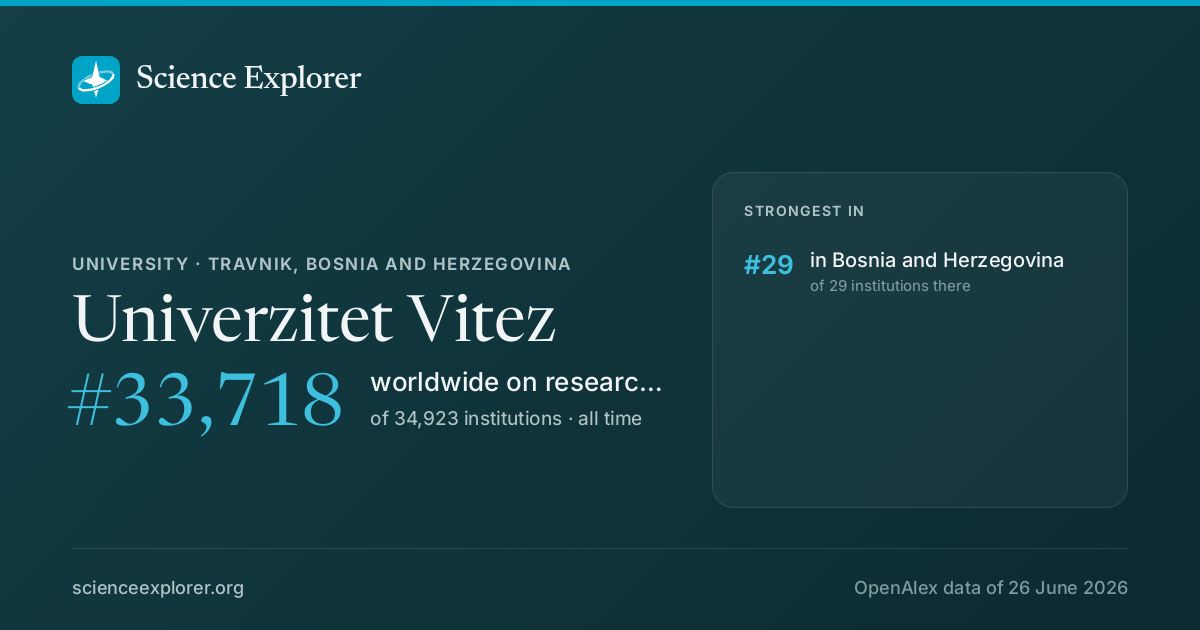
Univerzitet Vitez on Science Explorer

A card with Univerzitet Vitez's standing and the fields it leads in, for a post or a slide. A link to this page previews as the same card.

Download the card

1200 × 630 PNG, sized for social posts, drawn from the latest snapshot.

Badges for a website1Each links back here and updates with every snapshot

Research measures only: rankings here say nothing about teaching, admissions or student experience. Comparable institutions and collaboration partners have tabs of their own, above.

Discussion

Ask a question or share a note about Univerzitet Vitez. Keep it to the research: no personal attacks, advertising or links. Any reader can report a post, which collapses it for everyone until it is opened.