Science Explorer Back to mapMap
Discussion
Institution · Omaha · United States

Visiting Nurse Association

In research, Visiting Nurse Association stands highest in Health Professions (#982 of 3,315 worldwide), Health Sciences (#8,577 of 16,688 worldwide) and Social Sciences (#8,493 of 14,833 worldwide), over all time.

World rank, 2022-now
#19,636
of 22,385 · #9,290 all time
Rank in United States
#2,906
of 3,332
Research works
1.1k
▲ 25% vs 2018-21
Citations
11k
10.4 per fractional work
Top-10% rate
8.1%
all institutions 10.0%
vs its own fields
0.95×
1.00× is exactly expected
Open access
13%
world 40%
International
14%
world 18%

What is Visiting Nurse Association known for in research?

The fields where it stands highest, over all time, ranked among every institution above the floor in each field.

FieldWorld rankWhere that sitsTop-10% rateWorks
Health ProfessionsField #982 of 3,315 2.5%324
Health SciencesDomain #8,577 of 16,688 3.7%649
Social SciencesDomain #8,493 of 14,833 5.9%304
MedicineField #8,390 of 14,558 5.0%254
Social SciencesField #7,074 of 9,330 6.0%143
General Health ProfessionsSubfield #1,509 of 1,886 1.8%221

Each strip is that field's whole ranked pool, with the notch where Visiting Nurse Association sits in it, in the colour of the band that rank falls in. The track under the rate is the rate itself: it carries no average mark, because the average differs by field (from about 6% in Dentistry to 21% in Economics).

Which fields of science does Visiting Nurse Association work in?

In 2022-now, 45% of research at Visiting Nurse Association is in Social Sciences, 35% in Health Sciences. Its largest fields are Social Sciences (25%), Medicine (17%), Health Professions (13%). It does 1.7× the world's share of Social Sciences.

Social Sciences: 34 fractional works · 45.5% of its workSocial Sciences: 19 fractional works · 24.8% of its workSociology and Political Science: 6 fractional works · 8.7% of its workPolitical Science and International Relations: 6 fractional works · 7.4% of its workEducation: 2 fractional works · 2.3% of its workHealth: 1 fractional works · 1.3% of its workGender Studies: 1 fractional works · 1.2% of its workSafety Research: 1 fractional works · 0.8% of its workDemography: 0 fractional works · 0.5% of its workAnthropology: 0 fractional works · 0.4% of its workCultural Studies: 0 fractional works · 0.4% of its workGeography, Planning and Development: 0 fractional works · 0.4% of its workLinguistics and Language: 0 fractional works · 0.4% of its workHuman Factors and Ergonomics: 0 fractional works · 0.2% of its workLife-span and Life-course Studies: 0 fractional works · 0.2% of its workSmaller subfields together: 0 fractional works · 0.3% of its workArts and Humanities: 4 fractional works · 5.6% of its workLiterature and Literary Theory: 1 fractional works · 1.6% of its workLanguage and Linguistics: 0 fractional works · 0.6% of its workArcheology: 0 fractional works · 0.4% of its workGeneral Arts and Humanities: 0 fractional works · 0.4% of its workHistory and Philosophy of Science: 0 fractional works · 0.4% of its workPhilosophy: 0 fractional works · 0.4% of its workReligious studies: 0 fractional works · 0.4% of its workVisual Arts and Performing Arts: 0 fractional works · 0.4% of its workHistory: 0 fractional works · 0.3% of its workMusic: 0 fractional works · 0.2% of its workSmaller subfields together: 0 fractional works · 0.1% of its workPsychology: 4 fractional works · 5.5% of its workClinical Psychology: 2 fractional works · 2.3% of its workSocial Psychology: 2 fractional works · 2.1% of its workDevelopmental and Educational Psychology: 0 fractional works · 0.7% of its workApplied Psychology: 0 fractional works · 0.3% of its workSmaller subfields together: 0 fractional works · 0.1% of its workBusiness, Management and Accounting: 4 fractional works · 4.7% of its workAccounting: 1 fractional works · 1.3% of its workManagement of Technology and Innovation: 1 fractional works · 1.3% of its workStrategy and Management: 1 fractional works · 1.3% of its workManagement Information Systems: 1 fractional works · 0.8% of its workEconomics, Econometrics and Finance: 2 fractional works · 3.1% of its workEconomics and Econometrics: 1 fractional works · 1.7% of its workGeneral Economics, Econometrics and Finance: 1 fractional works · 0.8% of its workFinance: 0 fractional works · 0.6% of its workDecision Sciences: 1 fractional works · 1.8% of its workManagement Science and Operations Research: 1 fractional works · 1.2% of its workInformation Systems and Management: 0 fractional works · 0.6% of its workHealth Sciences: 26 fractional works · 35.1% of its workMedicine: 13 fractional works · 17.4% of its workPublic Health, Environmental and Occupational Health: 2 fractional works · 3.1% of its workSurgery: 2 fractional works · 2.1% of its workPulmonary and Respiratory Medicine: 1 fractional works · 2.0% of its workNeurology: 1 fractional works · 1.1% of its workEpidemiology: 1 fractional works · 0.8% of its workOncology: 1 fractional works · 0.8% of its workCardiology and Cardiovascular Medicine: 1 fractional works · 0.8% of its workOphthalmology: 0 fractional works · 0.7% of its workPediatrics, Perinatology and Child Health: 0 fractional works · 0.7% of its workEndocrinology, Diabetes and Metabolism: 0 fractional works · 0.6% of its workEmergency Medicine: 0 fractional works · 0.5% of its workOrthopedics and Sports Medicine: 0 fractional works · 0.5% of its workPsychiatry and Mental health: 0 fractional works · 0.5% of its workHealth Informatics: 0 fractional works · 0.4% of its workPharmacology: 0 fractional works · 0.4% of its workCritical Care and Intensive Care Medicine: 0 fractional works · 0.4% of its workRehabilitation: 0 fractional works · 0.4% of its workGeriatrics and Gerontology: 0 fractional works · 0.3% of its workRheumatology: 0 fractional works · 0.3% of its workNephrology: 0 fractional works · 0.2% of its workComplementary and alternative medicine: 0 fractional works · 0.2% of its workReproductive Medicine: 0 fractional works · 0.2% of its workSmaller subfields together: 0 fractional works · 0.6% of its workHealth Professions: 10 fractional works · 13.2% of its workGeneral Health Professions: 6 fractional works · 7.7% of its workEmergency Medical Services: 2 fractional works · 2.2% of its workRadiological and Ultrasound Technology: 1 fractional works · 1.5% of its workHealth Information Management: 1 fractional works · 0.8% of its workOccupational Therapy: 0 fractional works · 0.5% of its workPharmacy: 0 fractional works · 0.2% of its workSmaller subfields together: 0 fractional works · 0.3% of its workNursing: 3 fractional works · 4.3% of its workResearch and Theory: 2 fractional works · 2.1% of its workIssues, ethics and legal aspects: 2 fractional works · 2.1% of its workSmaller subfields together: 0 fractional works · 0.1% of its workDentistry: 0 fractional works · 0.2% of its workPhysical Sciences: 10 fractional works · 13.7% of its workComputer Science: 3 fractional works · 3.5% of its workInformation Systems: 2 fractional works · 2.3% of its workArtificial Intelligence: 1 fractional works · 0.7% of its workHuman-Computer Interaction: 0 fractional works · 0.4% of its workPhysics and Astronomy: 2 fractional works · 2.8% of its workAstronomy and Astrophysics: 2 fractional works · 2.7% of its workSmaller subfields together: 0 fractional works · 0.1% of its workEngineering: 2 fractional works · 2.2% of its workArchitecture: 0 fractional works · 0.4% of its workCivil and Structural Engineering: 0 fractional works · 0.4% of its workMedia Technology: 0 fractional works · 0.3% of its workControl and Systems Engineering: 0 fractional works · 0.2% of its workBiomedical Engineering: 0 fractional works · 0.2% of its workSmaller subfields together: 0 fractional works · 0.5% of its workEnvironmental Science: 1 fractional works · 2.0% of its workEcology: 1 fractional works · 0.9% of its workGlobal and Planetary Change: 0 fractional works · 0.6% of its workManagement, Monitoring, Policy and Law: 0 fractional works · 0.3% of its workSmaller subfields together: 0 fractional works · 0.2% of its workMaterials Science: 1 fractional works · 1.9% of its workMaterials Chemistry: 1 fractional works · 1.6% of its workElectronic, Optical and Magnetic Materials: 0 fractional works · 0.3% of its workChemistry: 0 fractional works · 0.5% of its workOrganic Chemistry: 0 fractional works · 0.3% of its workPhysical and Theoretical Chemistry: 0 fractional works · 0.2% of its workEarth and Planetary Sciences: 0 fractional works · 0.5% of its workEarth-Surface Processes: 0 fractional works · 0.5% of its workEnergy: 0 fractional works · 0.2% of its workChemical Engineering: 0 fractional works · 0.1% of its workLife Sciences: 4 fractional works · 5.6% of its workAgricultural and Biological Sciences: 2 fractional works · 3.1% of its workPlant Science: 1 fractional works · 1.6% of its workEcology, Evolution, Behavior and Systematics: 0 fractional works · 0.4% of its workGeneral Agricultural and Biological Sciences: 0 fractional works · 0.4% of its workInsect Science: 0 fractional works · 0.4% of its workAgronomy and Crop Science: 0 fractional works · 0.2% of its workBiochemistry, Genetics and Molecular Biology: 1 fractional works · 1.3% of its workMolecular Biology: 1 fractional works · 1.3% of its workNeuroscience: 1 fractional works · 1.2% of its workCellular and Molecular Neuroscience: 0 fractional works · 0.7% of its workCognitive Neuroscience: 0 fractional works · 0.4% of its workSmaller subfields together: 0 fractional works · 0.1% of its workPharmacology, Toxicology and Pharmaceutics: 0 fractional works · 0.1% of its workALL ITS WORKVisiting NurseAssociation75fractional works, 2022-now
Life Sciences6%Physical Sciences14%Health Sciences35%Social Sciences45%

Each ring splits the one inside it: the four domains of science, their fields, their subfields. Size is fractional works in 2022-now. Every slice is a page; the interactive view zooms down to single topics and colours each by how much more of it this institution does than the world.

Its 4 domains and 23 fields, with their numbers
    1. Social Sciences1924.8%
    2. Arts and Humanities45.6%
    3. Psychology45.5%
    4. Business, Management and Accounting44.7%
    5. Economics, Econometrics and Finance23.1%
    6. Decision Sciences11.8%
    1. Medicine1317.4%
    2. Health Professions1013.2%
    3. Nursing34.3%
    4. Dentistry00.2%
    1. Computer Science33.5%
    2. Physics and Astronomy22.8%
    3. Engineering22.2%
    4. Environmental Science12.0%
    5. Materials Science11.9%
    6. Chemistry00.5%
    7. Earth and Planetary Sciences00.5%
    8. Energy00.2%
    9. Chemical Engineering00.1%
    1. Agricultural and Biological Sciences23.1%
    2. Biochemistry, Genetics and Molecular Biology11.3%
    3. Neuroscience11.2%
    4. Pharmacology, Toxicology and Pharmaceutics00.1%
All of science, and how each field's share has moved since 1950: the Science domain explorer

Field profile

Location quotient across every field it publishes in: outside the ring is more than an institution of this size would be expected to publish, inside it is less.

Agricultural and Biological Sciences: 0.66× its world share, 2 worksAgricultural and Bio…Biochemistry, Genetics and Molecular Biology: 0.24× its world share, 1 worksBiochemistry, Geneti…Neuroscience: 0.72× its world share, 1 worksNeurosciencePharmacology, Toxicology and Pharmaceutics: 0.25× its world share, 0 worksPharmacology, Toxico…Chemical Engineering: 0.32× its world share, 0 worksChemical EngineeringChemistry: 0.34× its world share, 0 worksChemistryComputer Science: 0.45× its world share, 3 worksComputer ScienceEarth and Planetary Sciences: 0.33× its world share, 0 worksEarth and Planetary …Energy: 0.18× its world share, 0 worksEnergyEngineering: 0.15× its world share, 2 worksEngineeringEnvironmental Science: 0.40× its world share, 2 worksEnvironmental ScienceMaterials Science: 0.56× its world share, 1 worksMaterials SciencePhysics and Astronomy: 1.26× its world share, 2 worksPhysics and AstronomyDentistry: 0.50× its world share, 0 worksDentistryHealth Professions: 5.00× its world share, 10 worksHealth ProfessionsMedicine: 0.91× its world share, 13 worksMedicineNursing: 8.75× its world share, 3 worksNursingArts and Humanities: 1.94× its world share, 4 worksArts and HumanitiesBusiness, Management and Accounting: 1.47× its world share, 4 worksBusiness, Management…Decision Sciences: 1.83× its world share, 1 worksDecision SciencesEconomics, Econometrics and Finance: 1.44× its world share, 2 worksEconomics, Econometr…Psychology: 1.79× its world share, 4 worksPsychologySocial Sciences: 1.96× its world share, 18 worksSocial Sciences1×world share
more than its size predictsabout as predictedless

Rings at 0.5×, 1× and 2×. Widest outward: Nursing, 8.8×. Every wedge is a field page.

All 23 fields, with their numbers
  1. Nursing8.75×3 works
  2. Health Professions5.00×10 works
  3. Social Sciences1.96×18 works
  4. Arts and Humanities1.94×4 works
  5. Decision Sciences1.83×1 works
  6. Psychology1.79×4 works
  7. Business, Management and Accounting1.47×4 works
  8. Economics, Econometrics and Finance1.44×2 works
  9. Physics and Astronomy1.26×2 works
  10. Medicine0.91×13 works
  11. Neuroscience0.72×1 works
  12. Agricultural and Biological Sciences0.66×2 works
  13. Materials Science0.56×1 works
  14. Dentistry0.50×0 works
  15. Computer Science0.45×3 works
  16. Environmental Science0.40×2 works
  17. Chemistry0.34×0 works
  18. Earth and Planetary Sciences0.33×0 works
  19. Chemical Engineering0.32×0 works
  20. Pharmacology, Toxicology and Pharmaceutics0.25×0 works
  21. Biochemistry, Genetics and Molecular Biology0.24×1 works
  22. Energy0.18×0 works
  23. Engineering0.15×2 works

Who are the top researchers at Visiting Nurse Association?

Ranked on the quality score, EDNA L. FOLEY, Harry T. Oshima and A. M. CARR lead among researchers whose main affiliation is Visiting Nurse Association.

  1. 1 EDNA L. FOLEY United States · #2,459,627 worldwide 15 citations · 119 works
  2. 2 Harry T. Oshima United States · #3,216,693 worldwide 612 citations · 103 works
  3. 3 A. M. CARR United States · #3,955,618 worldwide 6 citations · 17 works
  4. 4 Donna Ambler Peters United States · #4,115,302 worldwide 239 citations · 26 works
  5. 5 Cynthia Struk United States · #5,002,128 worldwide 101 citations · 15 works
  6. 6 Marianne Clayton United States · #5,085,911 worldwide 22 citations · 15 works
  7. 7 Karen M. Preston United States · #5,094,548 worldwide 69 citations · 18 works
  8. 8 Mary Lou V. Stricklin United States · #5,104,607 worldwide 137 citations · 17 works
  9. 9 Deborah Sherry United States · #5,257,121 worldwide 14 citations · 20 works
  10. 10 Purnima Tanuku United States · #5,601,673 worldwide 1 citations · 25 works
All ranked researchers at Visiting Nurse Association

What are the most cited papers from Visiting Nurse Association?

The most cited paper from Visiting Nurse Association is "Studies of the mediators of the acute inflammatory response induced in rats in different sites by carrageenan and turpentine" (Michelino Di Rosa, J. P. Giroud, D. A. Willoughby, 1971), with 1,410 citations. Next come "Frequent Hypoxemia and Apnea after Sedation with Midazolam and Fentanyl" (656) and "Aneurysmal bone cyst. A clinicopathologic study of 238 cases" (620).

Most cited papers
#PaperReleasedCitations
1 Studies of the mediators of the acute inflammatory response induced in rats in different sites by carrageenan and turpentine Michelino Di Rosa, J. P. Giroud, D. A. Willoughby · The Journal of Pathology May 1971 1,410
2 Frequent Hypoxemia and Apnea after Sedation with Midazolam and Fentanyl Peter Lee Bailey, Nathan Leon Pace, Michael A. Ashburn et al. · Anesthesiology Open access Nov 1990 656
3 Aneurysmal bone cyst. A clinicopathologic study of 238 cases Ariel M. Vergel de Dios, Jeffrey R. Bond, Thomas C. Shives et al. · Cancer 15 Jun 1992 620
4 When to Accentuate the Negative: The Effects of Perceived Efficacy and Message Framing on Intentions to Perform a Health-Related Behavior Lauren Block, Punam Anand Keller · Journal of Marketing Research May 1995 504
5 Bacterial Profiles of Subgingival Plaques in Periodontitis Walter J. Loesche, S. A. Syed, Edgar Schmidt et al. · Journal of Periodontology Open access Aug 1985 437
All 58 most cited papers, with filters and sorting

Which keywords describe research at Visiting Nurse Association?

By fractional works in 2022-now, weighted toward what it does more of than the world: Culture, Primary Care, Feminism, Patient Outcomes, Public Health, Nationalism, Literature and Quality Improvement.

▲ more of its work than of the world's◆ about the world's share▼ less than the world's

Size is fractional works in 2022-now in the topics tagged with each word; colour is the word's share of this institution's work against its share of the world's. The 40 words are chosen for being large and distinctive. Each links to the topic it comes from most.

All 40 words, with their numbers
  1. Public Health4▲ 3.3×11 topics
  2. Climate Change4▲ 1.73×11 topics
  3. Culture3▲ 7.6×7 topics
  4. Quality of Life3▲ 2.7×13 topics
  5. Globalization3▲ 1.89×13 topics
  6. Primary Care3▲ 10×4 topics
  7. Human Rights3▲ 3.6×14 topics
  8. Feminism2▲ 12×5 topics
  9. Mental Health2▲ 2.4×10 topics
  10. Patient Outcomes2▲ 54×2 topics
  11. Literature2▲ 5.7×5 topics
  12. Nationalism2▲ 6.7×8 topics
  13. Identity2▲ 4.0×7 topics
  14. Job Satisfaction2▲ 6.2×4 topics
  15. Quality Improvement2▲ 14×3 topics
  16. History2▲ 3.8×4 topics
  17. Qualitative Research2▲ 3.0×2 topics
  18. Well-being2▲ 6.2×4 topics
  19. Palliative Care2▲ 15×3 topics
  20. Ethical Considerations2▲ 6.3×3 topics
  21. Healthcare Environment2▲ 70×1 topic
  22. Middle East2▲ 34×2 topics
  23. Nursing Staffing2▲ 70×1 topic
  24. End-of-Life2▲ 23×2 topics
  25. Healthcare Quality2▲ 19×3 topics
  26. Patient-Centered Care2▲ 27×3 topics
  27. Collaborative Practice1▲ 45×2 topics
  28. Global Governance1▲ 8.1×8 topics
  29. Medication Errors1▲ 37×2 topics
  30. Patient Satisfaction1▲ 6.1×3 topics
  31. Safety Climate1▲ 22×2 topics
  32. Stress Management1▲ 18×3 topics
  33. Empire1▲ 20×2 topics
  34. Islam1▲ 8.3×2 topics
  35. Medical Errors1▲ 42×2 topics
  36. Politics1▲ 6.8×4 topics
  37. Advance Care Planning1▲ 28×1 topic
  38. Chronic Disease Management1▲ 8.1×3 topics
  39. Islamic reform1▲ 38×1 topic
  40. Ottoman Empire1▲ 23×1 topic

Which research topics does Visiting Nurse Association publish most on?

By volume in 2022-now: Nursing education and management, Patient Safety and Medication Errors, Islamic Studies and History and Palliative Care and End-of-Life Issues.

  1. 1 Nursing education and management Research and Theory 2 works
  2. 2 Patient Safety and Medication Errors Emergency Medical Services 1 works
  3. 3 Islamic Studies and History Political Science and International Relations 1 works
  4. 4 Palliative Care and End-of-Life Issues Public Health, Environmental and Occupational Health 1 works
  5. 5 Health, psychology, and well-being General Health Professions 1 works
  6. 6 Nursing Roles and Practices General Health Professions 1 works
  7. 7 Financial Literacy, Pension, Retirement Analysis Accounting 1 works
  8. 8 Primary Care and Health Outcomes General Health Professions 1 works
  9. 9 Entrepreneurship Studies and Influences Management of Technology and Innovation 1 works
  10. 10 Geriatric Care and Nursing Homes General Health Professions 1 works

How open and international is its research?

Against the world's own shares: the tick on each track. Both are shares of its output, so they sit on one scale and can be read against each other as well as against the world.

openly available12.9%not open87.1%

World: 40% of research is openly available.

with international co-authors14.3%domestic only85.7%

World: 18% is written across borders.

How has Visiting Nurse Association's research output changed?

Output in 2022-2025 was 25% higher than in 2018-2021.

still counting1990200020102020
grewheldshrank

The same series as a ribbon: one cell per year, darker for more. The line above answers how much; this answers when.

Its share of all research

Growing output can still be a shrinking share: all of science grows. This is Visiting Nurse Association as a percentage of every work published that year, 0.00027% in 2024.

still counting0.0020%0.0040%0.0060%Visiting Nurse Association0.00050% in 202519801990200020102020

Fractional works of Visiting Nurse Association over all fractional works that year. How the balance of science has shifted.

How much of it reaches the world top 10%

Year by year, against all institutions in the same year.

still counting5%10%15%all institutions10.0% in 2025Visiting Nurse Association8.0% in 2025200020102020

Of each year's output, the share that reached the world's 10% most cited for its field and year. Peak 8.0% in 2025.

Other research institutions in Omaha

All research institutions in Omaha

Share Visiting Nurse Association's ranking
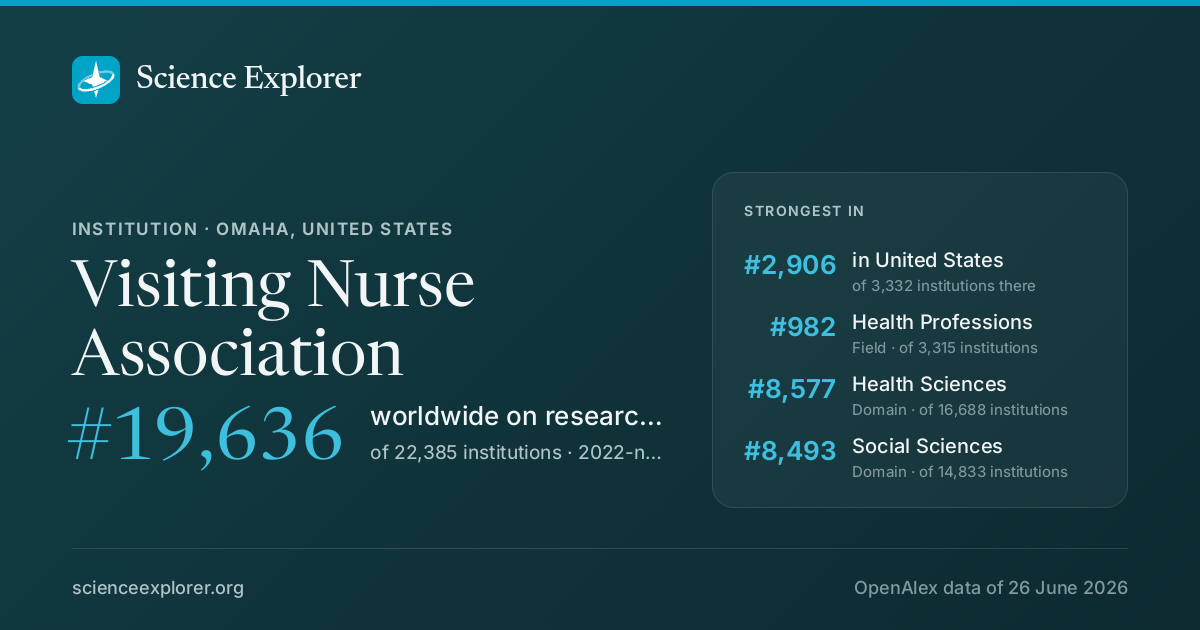
Visiting Nurse Association on Science Explorer

A card with Visiting Nurse Association's standing and the fields it leads in, for a post or a slide. A link to this page previews as the same card.

Download the card

1200 × 630 PNG, sized for social posts, drawn from the latest snapshot.

Badges for a website1Each links back here and updates with every snapshot

Research measures only: rankings here say nothing about teaching, admissions or student experience. Comparable institutions and collaboration partners have tabs of their own, above.

Discussion

Ask a question or share a note about Visiting Nurse Association. Posts are plain text and can be reported.