Science Explorer Back to mapMap
Discussion
Company · Buffalo · United States

ZeptoMetrix (United States)

World rank, all time
#27,348
of 34,923
Rank in United States
#5,718
of 7,310
Research works
142
▲ 98% vs 2018-21
Citations
2.7k
19.4 per fractional work
Top-10% rate
3.2%
all institutions 10.0%
vs its own fields
1.03×
1.00× is exactly expected
Open access
53%
world 40%
International
24%
world 18%

Which fields of science does ZeptoMetrix (United States) work in?

In 2022-now, 71% of research at ZeptoMetrix (United States) is in Physical Sciences, 13% in Health Sciences. Its largest fields are Engineering (41%), Computer Science (14%), Medicine (10%). It does 1.7× the world's share of Physical Sciences.

Physical Sciences: 27 fractional works · 71.3% of its workEngineering: 15 fractional works · 40.7% of its workMechanical Engineering: 4 fractional works · 9.9% of its workCivil and Structural Engineering: 3 fractional works · 8.2% of its workAerospace Engineering: 2 fractional works · 5.4% of its workElectrical and Electronic Engineering: 2 fractional works · 4.4% of its workMechanics of Materials: 1 fractional works · 3.6% of its workBuilding and Construction: 1 fractional works · 2.4% of its workControl and Systems Engineering: 1 fractional works · 2.2% of its workBiomedical Engineering: 1 fractional works · 1.9% of its workComputational Mechanics: 1 fractional works · 1.8% of its workMedia Technology: 0 fractional works · 0.9% of its workComputer Science: 5 fractional works · 14.5% of its workComputer Networks and Communications: 2 fractional works · 6.3% of its workArtificial Intelligence: 2 fractional works · 4.2% of its workInformation Systems: 1 fractional works · 3.3% of its workHardware and Architecture: 0 fractional works · 0.6% of its workSmaller subfields together: 0 fractional works · 0.1% of its workEarth and Planetary Sciences: 2 fractional works · 6.5% of its workGeology: 1 fractional works · 3.6% of its workGeophysics: 1 fractional works · 1.8% of its workAtmospheric Science: 0 fractional works · 0.6% of its workOceanography: 0 fractional works · 0.5% of its workEnvironmental Science: 2 fractional works · 5.8% of its workEcology: 1 fractional works · 2.4% of its workPollution: 1 fractional works · 1.9% of its workGlobal and Planetary Change: 0 fractional works · 0.6% of its workHealth, Toxicology and Mutagenesis: 0 fractional works · 0.6% of its workEnvironmental Engineering: 0 fractional works · 0.3% of its workPhysics and Astronomy: 1 fractional works · 2.0% of its workAstronomy and Astrophysics: 1 fractional works · 1.8% of its workRadiation: 0 fractional works · 0.2% of its workChemical Engineering: 0 fractional works · 0.9% of its workChemical Health and Safety: 0 fractional works · 0.9% of its workMaterials Science: 0 fractional works · 0.9% of its workMaterials Chemistry: 0 fractional works · 0.9% of its workHealth Sciences: 5 fractional works · 13.1% of its workMedicine: 4 fractional works · 10.3% of its workRadiology, Nuclear Medicine and Imaging: 1 fractional works · 3.1% of its workOncology: 0 fractional works · 0.9% of its workPhysiology: 0 fractional works · 0.9% of its workPulmonary and Respiratory Medicine: 0 fractional works · 0.9% of its workPublic Health, Environmental and Occupational Health: 0 fractional works · 0.8% of its workSurgery: 0 fractional works · 0.5% of its workCardiology and Cardiovascular Medicine: 0 fractional works · 0.5% of its workHematology: 0 fractional works · 0.3% of its workEpidemiology: 0 fractional works · 0.3% of its workNeurology: 0 fractional works · 0.3% of its workEndocrinology, Diabetes and Metabolism: 0 fractional works · 0.3% of its workTransplantation: 0 fractional works · 0.3% of its workSmaller subfields together: 0 fractional works · 1.1% of its workVeterinary: 0 fractional works · 1.1% of its workSmall Animals: 0 fractional works · 1.1% of its workHealth Professions: 0 fractional works · 1.0% of its workSpeech and Hearing: 0 fractional works · 0.9% of its workSmaller subfields together: 0 fractional works · 0.1% of its workNursing: 0 fractional works · 0.7% of its workNutrition and Dietetics: 0 fractional works · 0.7% of its workLife Sciences: 3 fractional works · 9.2% of its workBiochemistry, Genetics and Molecular Biology: 2 fractional works · 6.5% of its workGenetics: 1 fractional works · 2.4% of its workMolecular Biology: 1 fractional works · 1.7% of its workCancer Research: 0 fractional works · 1.0% of its workClinical Biochemistry: 0 fractional works · 0.9% of its workCell Biology: 0 fractional works · 0.5% of its workAgricultural and Biological Sciences: 1 fractional works · 1.7% of its workPlant Science: 0 fractional works · 1.0% of its workEcology, Evolution, Behavior and Systematics: 0 fractional works · 0.6% of its workSmaller subfields together: 0 fractional works · 0.1% of its workNeuroscience: 0 fractional works · 0.7% of its workNeurology: 0 fractional works · 0.7% of its workImmunology and Microbiology: 0 fractional works · 0.4% of its workImmunology: 0 fractional works · 0.3% of its workSmaller subfields together: 0 fractional works · 0.1% of its workSocial Sciences: 2 fractional works · 6.5% of its workSocial Sciences: 1 fractional works · 3.9% of its workCultural Studies: 0 fractional works · 0.9% of its workGeneral Social Sciences: 0 fractional works · 0.9% of its workGeography, Planning and Development: 0 fractional works · 0.9% of its workSociology and Political Science: 0 fractional works · 0.6% of its workEducation: 0 fractional works · 0.4% of its workSmaller subfields together: 0 fractional works · 0.2% of its workArts and Humanities: 0 fractional works · 0.9% of its workLiterature and Literary Theory: 0 fractional works · 0.9% of its workDecision Sciences: 0 fractional works · 0.9% of its workInformation Systems and Management: 0 fractional works · 0.7% of its workManagement Science and Operations Research: 0 fractional works · 0.2% of its workEconomics, Econometrics and Finance: 0 fractional works · 0.8% of its workEconomics and Econometrics: 0 fractional works · 0.5% of its workGeneral Economics, Econometrics and Finance: 0 fractional works · 0.3% of its workALL ITS WORKZeptoMetrix(United States)37fractional works, 2022-now
Life Sciences9%Physical Sciences71%Health Sciences13%Social Sciences6%

Each ring splits the one inside it: the four domains of science, their fields, their subfields. Size is fractional works in 2022-now. Every slice is a page; the interactive view zooms down to single topics and colours each by how much more of it this institution does than the world.

Its 4 domains and 19 fields, with their numbers
    1. Engineering1540.7%
    2. Computer Science514.5%
    3. Earth and Planetary Sciences26.5%
    4. Environmental Science25.8%
    5. Physics and Astronomy12.0%
    6. Chemical Engineering00.9%
    7. Materials Science00.9%
    1. Medicine410.3%
    2. Veterinary01.1%
    3. Health Professions01.0%
    4. Nursing00.7%
    1. Biochemistry, Genetics and Molecular Biology26.5%
    2. Agricultural and Biological Sciences11.7%
    3. Neuroscience00.7%
    4. Immunology and Microbiology00.4%
    1. Social Sciences13.9%
    2. Arts and Humanities00.9%
    3. Decision Sciences00.9%
    4. Economics, Econometrics and Finance00.8%
All of science, and how each field's share has moved since 1950: the Science domain explorer

Field profile

Location quotient across every field it publishes in: outside the ring is more than an institution of this size would be expected to publish, inside it is less.

Agricultural and Biological Sciences: 0.36× its world share, 1 worksAgricultural and Bio…Biochemistry, Genetics and Molecular Biology: 1.21× its world share, 2 worksBiochemistry, Geneti…Immunology and Microbiology: 0.40× its world share, 0 worksImmunology and Micro…Neuroscience: 0.41× its world share, 0 worksNeuroscienceChemical Engineering: 2.56× its world share, 0 worksChemical EngineeringComputer Science: 1.86× its world share, 5 worksComputer ScienceEarth and Planetary Sciences: 4.13× its world share, 2 worksEarth and Planetary …Engineering: 2.71× its world share, 15 worksEngineeringEnvironmental Science: 1.17× its world share, 2 worksEnvironmental ScienceMaterials Science: 0.26× its world share, 0 worksMaterials SciencePhysics and Astronomy: 0.91× its world share, 1 worksPhysics and AstronomyHealth Professions: 0.38× its world share, 0 worksHealth ProfessionsMedicine: 0.53× its world share, 4 worksMedicineNursing: 1.37× its world share, 0 worksNursingVeterinary: 8.06× its world share, 0 worksVeterinaryArts and Humanities: 0.31× its world share, 0 worksArts and HumanitiesDecision Sciences: 0.93× its world share, 0 worksDecision SciencesEconomics, Econometrics and Finance: 0.37× its world share, 0 worksEconomics, Econometr…Social Sciences: 0.31× its world share, 2 worksSocial Sciences1×world share
more than its size predictsabout as predictedless

Rings at 0.5×, 1× and 2×. Widest outward: Veterinary, 8.1×. Every wedge is a field page.

All 19 fields, with their numbers
  1. Veterinary8.06×0 works
  2. Earth and Planetary Sciences4.13×2 works
  3. Engineering2.71×15 works
  4. Chemical Engineering2.56×0 works
  5. Computer Science1.86×5 works
  6. Nursing1.37×0 works
  7. Biochemistry, Genetics and Molecular Biology1.21×2 works
  8. Environmental Science1.17×2 works
  9. Decision Sciences0.93×0 works
  10. Physics and Astronomy0.91×1 works
  11. Medicine0.53×4 works
  12. Neuroscience0.41×0 works
  13. Immunology and Microbiology0.40×0 works
  14. Health Professions0.38×0 works
  15. Economics, Econometrics and Finance0.37×0 works
  16. Agricultural and Biological Sciences0.36×1 works
  17. Arts and Humanities0.31×0 works
  18. Social Sciences0.31×2 works
  19. Materials Science0.26×0 works

Who are the top researchers at ZeptoMetrix (United States)?

Ranked on the quality score, Jocelyn Rivers lead among researchers whose main affiliation is ZeptoMetrix (United States).

  1. 1 Jocelyn Rivers United States · #3,098,371 worldwide 10 citations · 45 works
All ranked researchers at ZeptoMetrix (United States)

What are the most cited papers from ZeptoMetrix (United States)?

The most cited paper from ZeptoMetrix (United States) is "Recent advances in terahertz imaging" (Daniel M. Mittleman, Malay Gupta, Ramesh Neelamani et al., 1999), with 707 citations. Next come "Soil nutrient maps of Sub-Saharan Africa: assessment of soil nutrient content at 250 m spatial resolution using machine learning" (331) and "African soil properties and nutrients mapped at 30 m spatial resolution using two-scale ensemble machine learning" (298).

Most cited papers
#PaperReleasedCitations
1 Recent advances in terahertz imaging Daniel M. Mittleman, Malay Gupta, Ramesh Neelamani et al. · Applied Physics B Jun 1999 707
2 Soil nutrient maps of Sub-Saharan Africa: assessment of soil nutrient content at 250 m spatial resolution using machine learning Tomislav Hengl, J.G.B. Leenaars, Keith D. Shepherd et al. · Nutrient Cycling in Agroecosystems Open access 2 Aug 2017 331
3 African soil properties and nutrients mapped at 30 m spatial resolution using two-scale ensemble machine learning Tomislav Hengl et al. · Scientific Reports Open access 17 Mar 2021 298
4 Effects of Nylon Microplastic on Feeding, Lipid Accumulation, and Moulting in a Coldwater Copepod Matthew Cole, Rachel Coppock, Penelope K. Lindeque et al. · Environmental Science & Technology Open access 24 May 2019 260
5 Oxidative stress and endometriosis Leila W. Jackson, Enrique F. Schisterman, Rama Dey-Rao et al. · Human Reproduction 7 Apr 2005 194
All 60 most cited papers, with filters and sorting

Which keywords describe research at ZeptoMetrix (United States)?

By fractional works in 2022-now, weighted toward what it does more of than the world: High-Speed Trains, Ground Vibration, Railway Dynamics, Defect Detection, Deep Learning, Machine Learning, Environmental Monitoring and Infrared Thermography.

▲ more of its work than of the world's◆ about the world's share▼ less than the world's

Size is fractional works in 2022-now in the topics tagged with each word; colour is the word's share of this institution's work against its share of the world's. The 23 words are chosen for being large and distinctive. Each links to the topic it comes from most.

All 23 words, with their numbers
  1. Deep Learning3▲ 2.6×10 topics
  2. Machine Learning3▲ 2.6×11 topics
  3. High-Speed Trains3▲ 124×2 topics
  4. Defect Detection3▲ 56×2 topics
  5. Ground Vibration3▲ 258×1 topic
  6. Railway Dynamics3▲ 258×1 topic
  7. Environmental Monitoring2▲ 12×3 topics
  8. Convolutional Neural Networks2▲ 5.8×3 topics
  9. Environmental Impact1▲ 2.3×4 topics
  10. Infrared Thermography1▲ 92×2 topics
  11. Remote Sensing1▲ 3.2×4 topics
  12. Thermal Imaging1▲ 92×2 topics
  13. Building Diagnostics1▲ 204×1 topic
  14. Crack Detection1▲ 51×1 topic
  15. LEO Satellite Constellation1▲ 125×1 topic
  16. Laser Scanning1▲ 171×2 topics
  17. Non-Destructive Testing1▲ 38×1 topic
  18. Pavement1▲ 51×1 topic
  19. Satellite Communications1▲ 125×1 topic
  20. Quantitative Analysis1▲ 14×3 topics
  21. Big Data1▲ 2.8×2 topics
  22. Data Visualization1▲ 50×2 topics
  23. Wireless Sensor Networks1▲ 6.0×2 topics

Which research topics does ZeptoMetrix (United States) publish most on?

By volume in 2022-now: Railway Engineering and Dynamics, Infrastructure Maintenance and Monitoring, Satellite Communication Systems and Thermography and Photoacoustic Techniques.

  1. 1 Railway Engineering and Dynamics Mechanical Engineering 3 works
  2. 2 Infrastructure Maintenance and Monitoring Civil and Structural Engineering 1 works
  3. 3 Satellite Communication Systems Aerospace Engineering 1 works
  4. 4 Thermography and Photoacoustic Techniques Mechanics of Materials 1 works
  5. 5 Smart Materials for Construction Pollution 1 works
  6. 6 Infrastructure Resilience and Vulnerability Analysis Civil and Structural Engineering 1 works
  7. 7 Astronomical Observations and Instrumentation Computational Mechanics 1 works
  8. 8 Cryptography and Data Security Artificial Intelligence 1 works
  9. 9 Privacy-Preserving Technologies in Data Artificial Intelligence 1 works
  10. 10 Space exploration and regulation Astronomy and Astrophysics 1 works

How open and international is its research?

Against the world's own shares: the tick on each track. Both are shares of its output, so they sit on one scale and can be read against each other as well as against the world.

openly available53.2%not open46.8%

World: 40% of research is openly available.

with international co-authors23.5%domestic only76.5%

World: 18% is written across borders.

How has ZeptoMetrix (United States)'s research output changed?

Output in 2022-2025 was 98% higher than in 2018-2021.

still counting1990200020102020
grewheldshrank

The same series as a ribbon: one cell per year, darker for more. The line above answers how much; this answers when.

Its share of all research

Growing output can still be a shrinking share: all of science grows. This is ZeptoMetrix (United States) as a percentage of every work published that year, 0.00012% in 2024.

still counting0.00050%0.0010%ZeptoMetrix (United States)0.00031% in 202519801990200020102020

Fractional works of ZeptoMetrix (United States) over all fractional works that year. How the balance of science has shifted.

Other research institutions in Buffalo

All research institutions in Buffalo

Share ZeptoMetrix (United States)'s ranking
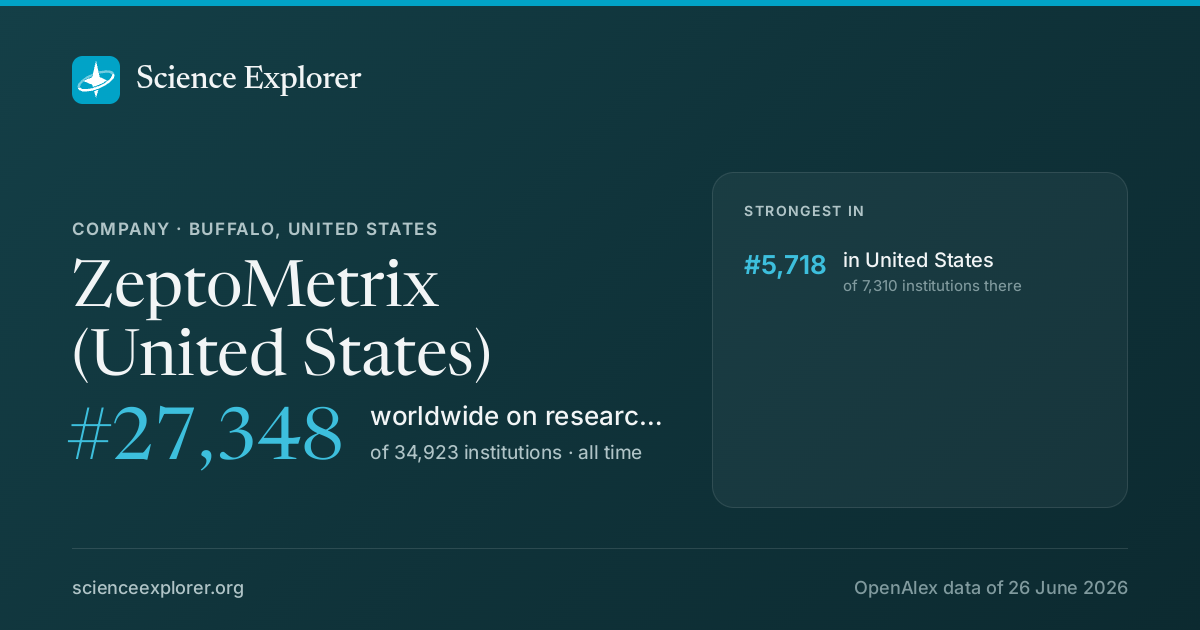
ZeptoMetrix (United States) on Science Explorer

A card with ZeptoMetrix (United States)'s standing and the fields it leads in, for a post or a slide. A link to this page previews as the same card.

Download the card

1200 × 630 PNG, sized for social posts, drawn from the latest snapshot.

Badges for a website1Each links back here and updates with every snapshot

Research measures only: rankings here say nothing about teaching, admissions or student experience. Comparable institutions and collaboration partners have tabs of their own, above.

Discussion

Ask a question or share a note about ZeptoMetrix (United States). Posts are plain text and can be reported.