ZTE (China)
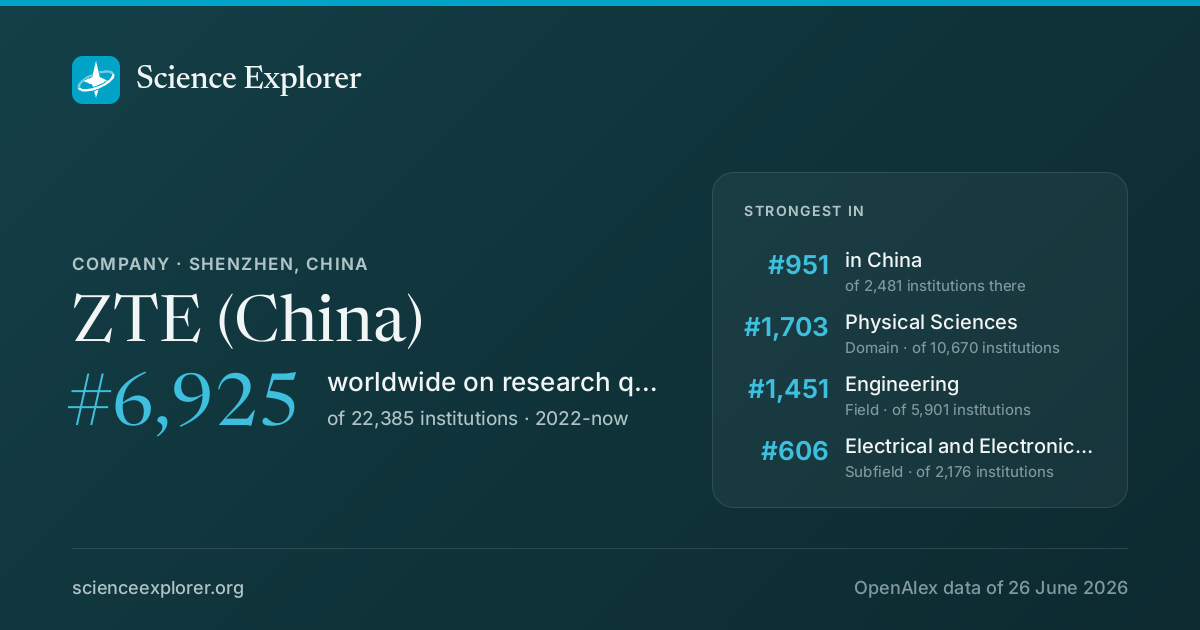
In research, ZTE (China) stands highest in Physical Sciences (#1,703 of 10,670 worldwide), Engineering (#1,451 of 5,901 worldwide) and Electrical and Electronic Engineering (#606 of 2,176 worldwide), 2022-now. Relative to its size it is most specialised in Computer Networks and Communications, Electrical and Electronic Engineering and Aerospace Engineering (Computer Networks and Communications is 10.3× its share of world research).
- World rank, 2022-now
- #6,925 of 22,385 · #8,520 all time
- Rank in China
- #951 of 2,481
- Research works
- 1.3k ▲ 41% vs 2018-21
- Citations
- 8.9k 6.7 per fractional work
- Top-10% rate
- 13.1% all institutions 10.0%
- vs its own fields
- 1.08× 1.00× is exactly expected
- Open access
- 11% world 40%
- International
- 13% world 18%
What is ZTE (China) known for in research?
The fields where it stands highest, 2022-now, ranked among every institution above the floor in each field.
| Field | World rank | Where that sits | Top-10% rate | Works | All time |
|---|---|---|---|---|---|
| Physical SciencesDomain | #1,703 of 10,670 | 13.1% | 316 | #2666 | |
| EngineeringField | #1,451 of 5,901 | 13.9% | 206 | #2642 | |
| Electrical and Electronic EngineeringSubfield | #606 of 2,176 | 12.6% | 125 | #1143 | |
| Computer ScienceField | #1,997 of 4,417 | 11.9% | 90 | #2396 |
Each strip is that field's whole ranked pool, with the notch where ZTE (China) sits in it, in the colour of the band that rank falls in. The track under the rate is the rate itself: it carries no average mark, because the average differs by field (from about 6% in Dentistry to 21% in Economics).
Which of those standings moved
The same fields on both windows: where it stood over the whole record, and where it stands in 2022-now. The distance is the story, and it is the one thing the two rank columns above cannot show.
- Physical Sciences#2,666 #1,703
- Engineering#2,642 #1,451
- Electrical and Electronic Engineering#1,143 #606
- Computer Science#2,396 #1,997
A dot further right is a better standing. Fields it was not ranked in over the whole record are left out.
Which fields of science does ZTE (China) work in?
In 2022-now, 94% of research at ZTE (China) is in Physical Sciences, 3% in Social Sciences. Its largest fields are Engineering (60%), Computer Science (28%), Physics and Astronomy (2%). It does 2.4× the world's share of Physical Sciences.
Each ring splits the one inside it: the four domains of science, their fields, their subfields. Size is fractional works in 2022-now. Every slice is a page; the interactive view zooms down to single topics and colours each by how much more of it this institution does than the world.
Its 4 domains and 23 fields, with their numbers
- Physical Sciences34893.8%
- Engineering22360.0%
- Computer Science10227.5%
- Physics and Astronomy92.4%
- Materials Science71.9%
- Environmental Science41.1%
- Earth and Planetary Sciences10.3%
- Energy10.2%
- Chemistry00.1%
- Mathematics00.1%
- Chemical Engineering00.0%
- Social Sciences92.5%
- Health Sciences71.9%
- Medicine61.7%
- Health Professions10.2%
- Nursing00.0%
- Life Sciences71.8%
What does ZTE (China) specialise in?
Where its research is concentrated relative to its size: Computer Networks and Communications takes 10.3× the share of its output that it takes of world research.
- Computer Networks and CommunicationsSubfield · 34.0 works10×
- Electrical and Electronic EngineeringSubfield · 133.7 works10×
- Aerospace EngineeringSubfield · 36.4 works8.4×
- EngineeringField · 222.7 works4.0×
Location quotient, a volume reading rather than an impact one. It surfaces small, lopsided specialities.
Field profile
Location quotient across every field it publishes in: outside the ring is more than an institution of this size would be expected to publish, inside it is less.
Rings at 0.5×, 1× and 2×. Widest outward: Engineering, 4.0×. Every wedge is a field page.
All 23 fields, with their numbers
- Engineering4.00×223 works
- Computer Science3.54×102 works
- Physics and Astronomy1.09×9 works
- Materials Science0.55×7 works
- Decision Sciences0.37×1 works
- Energy0.24×1 works
- Environmental Science0.22×4 works
- Pharmacology, Toxicology and Pharmaceutics0.21×0 works
- Earth and Planetary Sciences0.20×1 works
- Biochemistry, Genetics and Molecular Biology0.18×4 works
- Neuroscience0.15×1 works
- Business, Management and Accounting0.13×2 works
- Psychology0.13×2 works
- Agricultural and Biological Sciences0.10×2 works
- Chemical Engineering0.09×0 works
- Mathematics0.09×0 works
- Medicine0.09×6 works
- Social Sciences0.09×4 works
- Chemistry0.08×0 works
- Health Professions0.07×1 works
- Economics, Econometrics and Finance0.07×1 works
- Immunology and Microbiology0.05×0 works
- Nursing0.01×0 works
- Engineering 4.0×
- Computer Science 3.5×
- Physics and Astronomy 1.1×
- Materials Science 0.6×
- Decision Sciences 0.4×
- Energy 0.2×
- Environmental Science 0.2×
- Pharmacology, Toxicology and Pharmaceutics 0.2×
- Earth and Planetary Sciences 0.2×
- Biochemistry, Genetics and Molecular Biology 0.2×
- Neuroscience 0.1×
- Business, Management and Accounting 0.1×
- Psychology 0.1×
- Agricultural and Biological Sciences 0.1×
- Chemical Engineering 0.1×
- Mathematics 0.1×
- Medicine 0.1×
- Social Sciences 0.1×
- Chemistry 0.1×
- Health Professions 0.1×
- Economics, Econometrics and Finance 0.1×
- Immunology and Microbiology 0.1×
- Nursing 0.0×
Who are the top researchers at ZTE (China)?
Ranked on the quality score, Ruiqi Liu, Ruiqi Liu and Huahua Xiao lead among researchers whose main affiliation is ZTE (China).
- 1
Ruiqi Liu
 China · #302,244 worldwide
1.4k citations · 78 works
- 2
Ruiqi Liu
China · #657,454 worldwide
2.5k citations · 151 works
- 3
Huahua Xiao
China · #980,315 worldwide
990 citations · 70 works
- 4
Yaofeng Tu
China · #1,336,067 worldwide
671 citations · 82 works
- 5
Mengnan Jian
China · #1,339,636 worldwide
1.1k citations · 53 works
- 6
Jun Yang
China · #1,362,332 worldwide
357 citations · 28 works
- 7
Yajun Zhao
China · #1,504,773 worldwide
913 citations · 88 works
- 8
Guanghui Yu
China · #1,571,527 worldwide
1k citations · 34 works
- 9
Shuqiang Xia
China · #1,655,512 worldwide
573 citations · 65 works
- 10
Peng Hao
China · #1,838,722 worldwide
862 citations · 73 works
Which keywords describe research at ZTE (China)?
By fractional works in 2022-now, weighted toward what it does more of than the world: Energy Efficiency, Deep Learning, Channel Estimation, Wireless Communications, Wireless Communication, MIMO Systems, Massive MIMO and 5G Networks.
- Mobile Edge Computing
- IoT Security
- Optical Access Networks
- Space-Time Coding
- Microwave Photonics
- Antenna
- Thermal Management
- Coherent Detection
- Internet of Things
- Optical Fiber
- Intelligent Reflecting Surfaces
- Resource Allocation
- Cellular Networks
- Heterogeneous Networks
- Wireless Networks
- 5G Networks
- Neural Networks
- MIMO Systems
- Wireless Communications
- Energy Efficiency
- Deep Learning
- Channel Estimation
- Wireless Communication
- Massive MIMO
- Machine Learning
- Spectral Efficiency
- Wireless Sensor Networks
- Beamforming
- Interference Alignment
- Channel Modeling
- Non-Orthogonal Multiple Access
- 5G
- Digital Signal Processing
- Nonlinear Effects
- Integrated Circuits
- Microstrip
- Iterative Decoding
- Security and Privacy
- Photonic Signal Processing
- Particle Swarm Optimization
Size is fractional works in 2022-now in the topics tagged with each word; colour is the word's share of this institution's work against its share of the world's. The 40 words are chosen for being large and distinctive. Each links to the topic it comes from most.
All 40 words, with their numbers
- Deep Learning41▲ 3.2×59 topics
- Energy Efficiency39▲ 11×14 topics
- Channel Estimation22▲ 67×4 topics
- Wireless Communications21▲ 33×5 topics
- Wireless Communication20▲ 37×5 topics
- MIMO Systems19▲ 64×3 topics
- Massive MIMO18▲ 62×3 topics
- Neural Networks18▲ 3.2×28 topics
- Machine Learning16▲ 1.34×42 topics
- 5G Networks16▲ 22×5 topics
- Spectral Efficiency16▲ 66×2 topics
- Wireless Networks14▲ 26×8 topics
- Wireless Sensor Networks14▲ 8.1×13 topics
- Heterogeneous Networks13▲ 36×2 topics
- Beamforming13▲ 34×4 topics
- Cellular Networks13▲ 73×1 topic
- Interference Alignment13▲ 73×1 topic
- Resource Allocation12▲ 19×8 topics
- Channel Modeling12▲ 27×6 topics
- Intelligent Reflecting Surfaces11▲ 76×1 topic
- Non-Orthogonal Multiple Access11▲ 76×1 topic
- Optical Fiber11▲ 29×2 topics
- 5G11▲ 51×3 topics
- Internet of Things10▲ 3.3×19 topics
- Digital Signal Processing10▲ 58×2 topics
- Coherent Detection10▲ 66×1 topic
- Nonlinear Effects10▲ 66×1 topic
- Thermal Management10▲ 8.3×7 topics
- Integrated Circuits10▲ 18×3 topics
- Antenna9▲ 32×1 topic
- Microstrip9▲ 32×1 topic
- Microwave Photonics9▲ 30×2 topics
- Iterative Decoding9▲ 93×2 topics
- Space-Time Coding8▲ 64×2 topics
- Security and Privacy8▲ 11×3 topics
- Optical Access Networks8▲ 66×1 topic
- Photonic Signal Processing8▲ 66×1 topic
- IoT Security8▲ 6.7×3 topics
- Particle Swarm Optimization7▲ 16×3 topics
- Mobile Edge Computing7▲ 11×2 topics
Which research topics does ZTE (China) publish most on?
By volume in 2022-now: Advanced MIMO Systems Optimization, Advanced Wireless Communication Technologies, Optical Network Technologies and Antenna Design and Analysis.
Area is fractional works; colour is the subfield each topic belongs to.
- 1 Advanced MIMO Systems Optimization Electrical and Electronic Engineering 13 works
- 2 Advanced Wireless Communication Technologies Electrical and Electronic Engineering 11 works
- 3 Optical Network Technologies Electrical and Electronic Engineering 10 works
- 4 Antenna Design and Analysis Aerospace Engineering 9 works
- 5 Advanced Photonic Communication Systems Electrical and Electronic Engineering 8 works
- 6 Millimeter-Wave Propagation and Modeling Electrical and Electronic Engineering 6 works
- 7 Advanced Wireless Communication Techniques Electrical and Electronic Engineering 6 works
- 8 Indoor and Outdoor Localization Technologies Electrical and Electronic Engineering 5 works
- 9 Antenna Design and Optimization Aerospace Engineering 5 works
- 10 Advanced Antenna and Metasurface Technologies Aerospace Engineering 5 works
How open and international is its research?
Against the world's own shares: the tick on each track. Both are shares of its output, so they sit on one scale and can be read against each other as well as against the world.
World: 40% of research is openly available.
World: 18% is written across borders.
How has ZTE (China)'s research output changed?
Output in 2022-2025 was 41% higher than in 2018-2021.
The same series as a ribbon: one cell per year, darker for more. The line above answers how much; this answers when.
Its share of all research
Growing output can still be a shrinking share: all of science grows. This is ZTE (China) as a percentage of every work published that year, 0.0016% in 2024.
Fractional works of ZTE (China) over all fractional works that year. How the balance of science has shifted.
How much of it reaches the world top 10%
Year by year, against all institutions in the same year.
Of each year's output, the share that reached the world's 10% most cited for its field and year. Peak 17.5% in 2023.
Other research institutions in Shenzhen
- Shenzhen University
- Southern University of Science and Technology
- Chinese University of Hong Kong, Shenzhen
- Huawei Technologies (China)
- Shenzhen Polytechnic University
- Peng Cheng Laboratory
- University Town of Shenzhen
- Shenzhen Technology University
Share ZTE (China)'s ranking
Badges for a website1Each links back here and updates with every snapshot

Research measures only: rankings here say nothing about teaching, admissions or student experience. Comparable institutions and collaboration partners have tabs of their own, above.
Discussion
Ask a question or share a note about ZTE (China). Posts are plain text and can be reported.