 Science in Angola
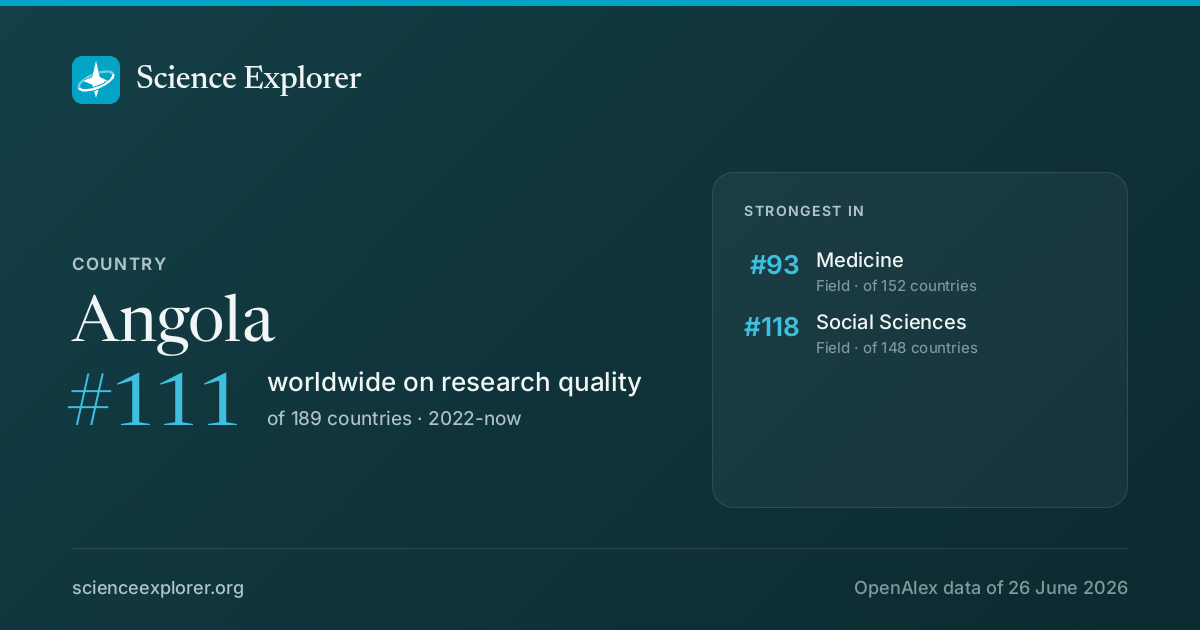
Angola ranks #111 of 189 countries on research quality in 2022-now (#141 all time), with 1.5k research works and 5.3% of them in the world's top 10%.
- World rank, 2022-now
- #111 of 189 · #141 all time
- Works, 2022-now
- 1.5k ▲ 37% vs 2018-21
- Citations
- 15k 3.4 per fractional work, all time
- Top-10% rate
- 5.3% all institutions 10.0%
- vs its own fields
- 0.78× 1.00× is exactly expected
- In the world top 100
- 0 0 in the top 1,000
- Open access
- 77% world 40%
- International
- 41% world 18%
AngolaWhat is Angola strongest at in science?
On research quality in 2022-now, Angola ranks highest in Medicine (#93 of 152) and Social Sciences (#118 of 148). Relative to its size it is most specialised in General Energy, Information Systems and Management and Fuel Technology.
| Field | World rank | Where that sits | Top-10% rate | Works | All time | Institutions |
|---|---|---|---|---|---|---|
| MedicineField | #93 of 152 | 3.6% | 300 | #123 | Institutions | |
| Social SciencesField | #118 of 148 | 6.8% | 436 | #138 | Institutions |
Where its research is concentrated
Location quotient: how much more (or less) of each node it does than its size predicts. Drawn around 1×, where "twice the world share" and "half of it" are the same distance apart in opposite directions. A volume reading, which on a country axis is largely population and industrial structure.
- General EnergySubfield · 9.1 works · #80 of 167 active here20×
- Information Systems and ManagementSubfield · 42.8 works · #88 of 213 active here8.8×
- Fuel TechnologySubfield · 1.2 works · #62 of 113 active here8.4×
- ForestrySubfield · 13.1 works · #97 of 204 active here7.4×
- Health Information ManagementSubfield · 31.7 works · #83 of 202 active here7.3×
- Occupational TherapySubfield · 17.1 works · #86 of 198 active here6.0×
- HealthSubfield · 27.9 works · #103 of 217 active here5.5×
- DevelopmentSubfield · 9.3 works · #113 of 190 active here5.5×
The whole field profile
All 26 fields at once. A specialist and a generalist produce the same ranked list and a completely different shape.
Rings at 0.5×, 1× and 2×. Widest outward: Health Professions, 3.4×. Every wedge is a field page.
All 26 fields, with their numbers
- Health Professions3.36×150 works
- Decision Sciences2.99×49 works
- Social Sciences2.35×504 works
- Dentistry1.48×12 works
- Nursing1.16×10 works
- Medicine1.07×348 works
- Energy1.05×16 works
- Arts and Humanities1.04×51 works
- Environmental Science0.98×83 works
- Psychology0.95×49 works
- Economics, Econometrics and Finance0.94×34 works
- Agricultural and Biological Sciences0.81×65 works
- Immunology and Microbiology0.80×14 works
- Physics and Astronomy0.78×30 works
- Business, Management and Accounting0.76×41 works
- Computer Science0.64×84 works
- Veterinary0.51×1 works
- Mathematics0.40×8 works
- Pharmacology, Toxicology and Pharmaceutics0.38×2 works
- Earth and Planetary Sciences0.36×9 works
- Biochemistry, Genetics and Molecular Biology0.31×28 works
- Neuroscience0.31×9 works
- Engineering0.30×76 works
- Chemistry0.22×6 works
- Materials Science0.22×13 works
- Chemical Engineering0.19×1 works
Which fields of science does Angola work in?
In 2022-now, 43% of research in Angola is in Social Sciences, 31% in Health Sciences. Its largest fields are Social Sciences (30%), Medicine (21%), Health Professions (9%). It does 1.7× the world's share of Social Sciences.
Each ring splits the one inside it: the four domains of science, their fields, their subfields. Size is fractional works in 2022-now. Every slice is a page; the interactive view zooms down to single topics and colours each by how much more of it this country does than the world.
Its 4 domains and 26 fields, with their numbers
- Social Sciences72943.0%
- Social Sciences50429.8%
- Arts and Humanities513.0%
- Psychology492.9%
- Decision Sciences492.9%
- Business, Management and Accounting412.4%
- Economics, Econometrics and Finance342.0%
- Health Sciences52130.7%
- Medicine34820.5%
- Health Professions1508.9%
- Dentistry120.7%
- Nursing100.6%
- Veterinary10.1%
- Physical Sciences32719.3%
- Computer Science845.0%
- Environmental Science834.9%
- Engineering774.5%
- Physics and Astronomy291.7%
- Energy161.0%
- Materials Science130.8%
- Earth and Planetary Sciences90.6%
- Mathematics80.5%
- Chemistry60.3%
- Chemical Engineering10.1%
- Life Sciences1187.0%
Which keywords describe research in Angola?
By fractional works in 2022-now, weighted toward what it does more of than the world: Public Health, Healthcare, Epidemiology, Qualitative Research, Educational Technology, Public Policy, Quality of Life and Teacher Training.
- Legal Philosophy
- Legislation
- Distance Education
- Research Networks
- Educational Policy
- Social Inequality
- Research
- Organizational Management
- Quantitative Research
- Marketing Strategies
- Data Analysis
- Social Determinants
- Health Policy
- Online Learning
- Teacher Training
- Risk Factors
- Globalization
- Qualitative Research
- Quality of Life
- Public Health
- Epidemiology
- Healthcare
- Educational Technology
- Education
- Sustainability
- Public Policy
- Human Rights
- Healthcare Access
- Knowledge Management
- Research Methods
- Innovation Management
- Prevalence
- Case Study
- Inclusion
- Training
- Digital Innovation
- Drug Resistance
- Smart Library
- Legal Theory
- Digital Business
Size is fractional works in 2022-now in the topics tagged with each word; colour is the word's share of this country's work against its share of the world's. The 40 words are chosen for being large and distinctive. Each links to the topic it comes from most.
All 40 words, with their numbers
- Epidemiology138▲ 2.0×10⁷ topics
- Public Health122▲ 4.9×50 topics
- Healthcare96▲ 5.0×21 topics
- Quality of Life86▲ 3.5×50 topics
- Educational Technology84▲ 4.2×28 topics
- Qualitative Research79▲ 5.5×16 topics
- Education75▲ 2.6×58 topics
- Globalization75▲ 2.2×74 topics
- Sustainability73▲ 1.76×64 topics
- Risk Factors64▲ 3.4×28 topics
- Public Policy62▲ 7.8×19 topics
- Teacher Training61▲ 5.9×17 topics
- Human Rights58▲ 3.3×39 topics
- Online Learning56▲ 4.0×15 topics
- Healthcare Access53▲ 11×10 topics
- Health Policy50▲ 19×5 topics
- Knowledge Management43▲ 4.6×14 topics
- Social Determinants42▲ 12×7 topics
- Research Methods41▲ 15×4 topics
- Data Analysis39▲ 8.9×4 topics
- Innovation Management39▲ 15×3 topics
- Marketing Strategies39▲ 25×2 topics
- Prevalence39▲ 5.6×12 topics
- Quantitative Research39▲ 18×2 topics
- Case Study38▲ 36×1 topic
- Organizational Management38▲ 38×1 topic
- Inclusion37▲ 15×6 topics
- Research37▲ 18×5 topics
- Training36▲ 10×6 topics
- Social Inequality36▲ 7.9×13 topics
- Digital Innovation36▲ 37×2 topics
- Educational Policy36▲ 8.4×3 topics
- Drug Resistance35▲ 7.2×8 topics
- Research Networks35▲ 52×1 topic
- Smart Library35▲ 52×1 topic
- Distance Education35▲ 11×2 topics
- Legal Theory35▲ 30×3 topics
- Legislation35▲ 13×3 topics
- Digital Business34▲ 39×1 topic
- Legal Philosophy32▲ 31×2 topics
Which research topics does Angola publish the most in?
Its largest topics in 2022-now are Business and Management Studies, Healthcare during COVID-19 Pandemic, Academic Research in Diverse Fields.
Area is fractional works in 2022-now; colour is the subfield each topic belongs to. Every tile is a topic page.
- 1 Business and Management Studies Information Systems and Management 38 works
- 2 Healthcare during COVID-19 Pandemic Information Systems 35 works
- 3 Academic Research in Diverse Fields Education 34 works
- 4 Brazilian Legal Issues Law 30 works
- 5 Healthcare Regulation Health Information Management 27 works
- 6 Health, Nursing, Elderly Care General Health Professions 20 works
- 7 Youth, Drugs, and Violence Demography 19 works
- 8 Maternal and Neonatal Healthcare General Health Professions 19 works
- 9 Science and Education Research Education 16 works
- 10 Education Pedagogy and Practices Education 16 works
- 11 Occupational Health and Burnout Occupational Therapy 15 works
- 12 Environmental Sustainability and Education Management, Monitoring, Policy and Law 15 works
Which universities in Angola lead research?
Agostinho Neto University, Clínica Sagrada Esperança and Instituto Superior Politécnico Metropolitano de Angola rank highest in Angola on research quality in 2022-now.
One dot per institution in the list below. The upper left is the interesting corner.
- 1Agostinho Neto UniversityUniversity · Luanda · #3,444 worldwide3.7% top 10% · 720 works
- 2Clínica Sagrada EsperançaHospital / health system · Luanda · #11,436 worldwide5.8% top 10% · 164 works
- 3Instituto Superior Politécnico Metropolitano de AngolaUniversity · Luanda · #17,729 worldwide7.0% top 10% · 74 works
- 4Ministério da Ciência e TecnologiaGovernment institution · Luanda · #17,873 worldwide8.1% top 10% · 79 works
- 5Instituto Superior de Ciencias Sociais e Relações InternacionaisUniversity · Luanda · #18,221 worldwide7.2% top 10% · 107 works
The track on each row is its top-10% rate; the tick is the average of all institutions, 10.0% (how it is set): teal above it, red below.
All ranked institutions in AngolaWho are the top researchers in Angola?
Filomeno Fortes, José Franco Martins and Jonatan P. camargo rank highest among researchers based in Angola.
- 1 Filomeno Fortes #744,772 worldwide 1.8k citations · 76 works
- 2 José Franco Martins #1,216,520 worldwide 267 citations · 25 works
- 3 Jonatan P. camargo #1,523,126 worldwide 0 citations · 298 works
- 4 Joana F. M. Morais #1,525,226 worldwide 935 citations · 88 works
- 5 Albano Vicente Lopes Ferreira #1,567,029 worldwide 498 citations · 28 works
- 6 Fernando Cesar Coelho Coutinho #1,932,200 worldwide 0 citations · 101 works
- 7 Anabela A. Leitão #2,051,114 worldwide 704 citations · 50 works
- 8 Mauer Alexandre da Ascensão Gonçalves #2,217,015 worldwide 7.7k citations · 94 works
- 9 Domingos Jandondo #2,246,079 worldwide 403 citations · 37 works
- 10 Ngiambudulu M. Francisco #2,268,377 worldwide 922 citations · 51 works
How open and international is Angola's research?
77% of its research is openly available (world: 40%), and 41% is written with international co-authors (world: 18%).
World: 40% of research is openly available.
World: 18% is written across borders.
In 2022-now, 87% of its research is openly available (world 63%) and 43% is written with co-authors abroad (world 22%). Against what its own mix of topics predicts, that is 1.10× the expected open access and 1.82× the expected international share, which puts it #79 of 173 countries on openness.
How has Angola's research grown?
Output in 2022-2025 was 37% higher than in 2018-2021.
The same series as a ribbon: one cell per year, darker for more. The line above answers how much; this answers when.
Its share of all research
Growing output can still be a shrinking share: all of science grows. This is Angola as a percentage of every work published that year, 0.0055% in 2024.
Fractional works of Angola over all fractional works that year. How the balance of science has shifted.
How much of it reaches the world top 10%
Over the whole record, 5.1% of its 4.5k works since 1950 reached the world top 10% for their field and year.
Of each year's output, the share that reached the world's 10% most cited for its field and year. Peak 7.4% in 2017.
Which countries have research most like Angola's?
Paraguay is Angola's closest research twin: of all countries, its research is spread across the fields most like Angola's, with both strong in Health Professions.
- 1
 ParaguayBoth strong in Health Professions, Social Sciences, Dentistry
0.75 Compare
- 2
 MozambiqueBoth strong in Social Sciences, Decision Sciences, Health Professions
0.74 Compare
- 3
 BoliviaBoth strong in Social Sciences, Health Professions, Dentistry
0.74 Compare
- 4
 PeruBoth strong in Social Sciences, Health Professions, Dentistry
0.72 Compare
- 5
 GuatemalaBoth strong in Health Professions, Social Sciences, Nursing
0.72 Compare
Similarity is the correlation of each side's location quotients across every field it publishes in, on a log scale: 1 is the same shape of research, 0 is unrelated. It ignores size. How it is measured.
Compare Angola with
 Sudan
 Sierra Leone
 Nepal
 Venezuela
 Saint Kitts and Nevis
 El Salvador
Share Angola's ranking
Badges for a website1Each links back here and updates with every snapshot

Research fields in Angola
Discussion
Ask a question or share a note about Angola. Posts are plain text and can be reported.