 Science in Côte d'Ivoire
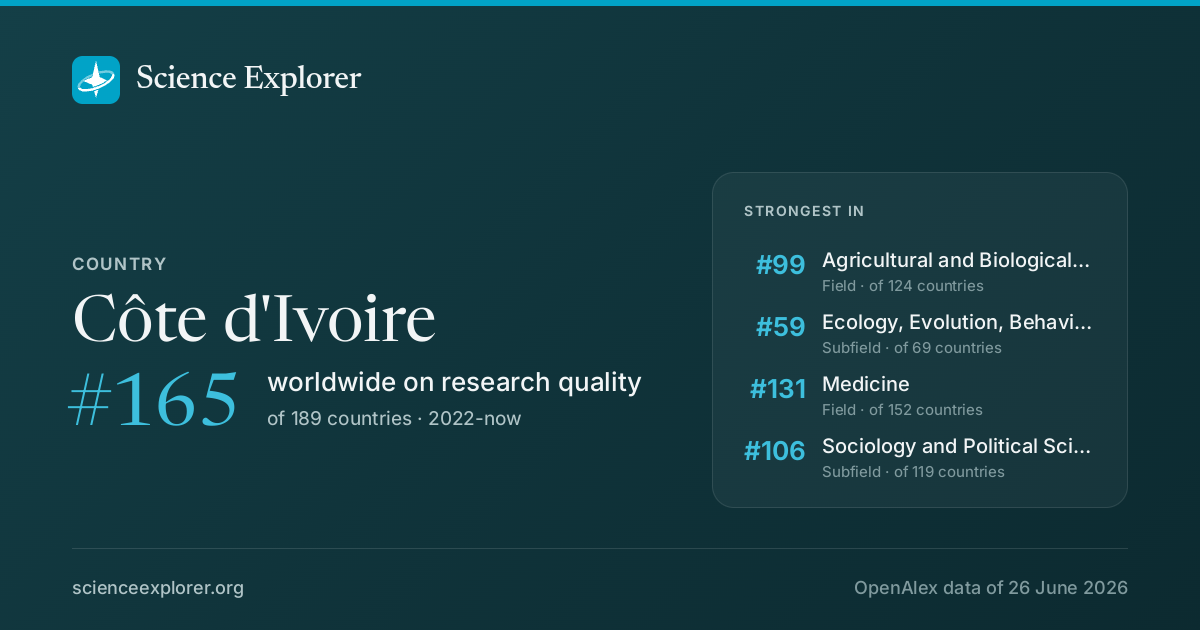
Côte d'Ivoire ranks #165 of 189 countries on research quality in 2022-now (#118 all time), with 6.5k research works and 3.4% of them in the world's top 10%.
- World rank, 2022-now
- #165 of 189 · #118 all time
- Works, 2022-now
- 6.5k ▲ 15% vs 2018-21
- Citations
- 144k 6.0 per fractional work, all time
- Top-10% rate
- 3.4% all institutions 10.0%
- vs its own fields
- 0.36× 1.00× is exactly expected
- In the world top 100
- 0 0 in the top 1,000
- Open access
- 71% world 40%
- International
- 35% world 18%
Côte d'IvoireWhat is Côte d'Ivoire strongest at in science?
On research quality in 2022-now, Côte d'Ivoire ranks highest in Agricultural and Biological Sciences (#99 of 124), Ecology, Evolution, Behavior and Systematics (#59 of 69) and Medicine (#131 of 152). Relative to its size it is most specialised in Horticulture, Forestry and Ecology, Evolution, Behavior and Systematics.
| Field | World rank | Where that sits | Top-10% rate | Works | All time | Institutions |
|---|---|---|---|---|---|---|
| Agricultural and Biological SciencesField | #99 of 124 | 2.7% | 1,690 | #89 | Institutions | |
| Ecology, Evolution, Behavior and SystematicsSubfield | #59 of 69 | 4.7% | 449 | #59 | Institutions | |
| MedicineField | #131 of 152 | 1.9% | 1,183 | #93 | Institutions | |
| Sociology and Political ScienceSubfield | #106 of 119 | 9.5% | 438 | #94 | Institutions | |
| Plant ScienceSubfield | #82 of 90 | 2.0% | 457 | #83 | Institutions | |
| Social SciencesField | #135 of 148 | 7.2% | 877 | #104 | Institutions | |
| Economics, Econometrics and FinanceField | #98 of 107 | 5.3% | 205 | #86 | ||
| Arts and HumanitiesField | #95 of 103 | 3.5% | 252 | #91 | Institutions | |
| Biochemistry, Genetics and Molecular BiologyField | #97 of 105 | 1.7% | 285 | #99 | Institutions | |
| Environmental ScienceField | #114 of 122 | 2.5% | 525 | #116 | Institutions | |
| ForestrySubfield | #15 of 16 | 1.6% | 268 | #28 | Institutions | |
| Health ProfessionsField | #101 of 106 | 6.2% | 219 | #98 | Institutions |
Where its research is concentrated
Location quotient: how much more (or less) of each node it does than its size predicts. Drawn around 1×, where "twice the world share" and "half of it" are the same distance apart in opposite directions. A volume reading, which on a country axis is largely population and industrial structure.
- HorticultureSubfield · 120.7 works · #10 of 178 active here124×
- ForestrySubfield · 294.7 works · #12 of 204 active here39×
- Ecology, Evolution, Behavior and SystematicsSubfield · 473.0 works · #45 of 223 active here14×
- Medical TerminologySubfield · 1.7 works · #47 of 121 active here7.7×
- Linguistics and LanguageSubfield · 59.2 works · #63 of 194 active here7.1×
- Agricultural and Biological SciencesField · 1,893.3 works · #65 of 225 active here5.5×
- Aquatic ScienceSubfield · 60.8 works4.6×
- AnthropologySubfield · 90.5 works · #72 of 213 active here4.4×
The whole field profile
All 26 fields at once. A specialist and a generalist produce the same ranked list and a completely different shape.
Rings at 0.5×, 1× and 2×. Widest outward: Agricultural and Biological Sciences, 5.5×. Every wedge is a field page.
All 26 fields, with their numbers
- Agricultural and Biological Sciences5.48×1,893 works
- Nursing3.22×115 works
- Pharmacology, Toxicology and Pharmaceutics1.97×50 works
- Environmental Science1.64×591 works
- Economics, Econometrics and Finance1.43×222 works
- Veterinary1.32×13 works
- Arts and Humanities1.29×272 works
- Health Professions1.24×237 works
- Earth and Planetary Sciences1.15×132 works
- Immunology and Microbiology1.08×79 works
- Social Sciences1.04×960 works
- Chemistry0.99×113 works
- Medicine0.97×1,352 works
- Mathematics0.95×81 works
- Biochemistry, Genetics and Molecular Biology0.84×324 works
- Business, Management and Accounting0.55×128 works
- Psychology0.45×100 works
- Materials Science0.37×93 works
- Energy0.36×24 works
- Dentistry0.35×12 works
- Computer Science0.31×178 works
- Decision Sciences0.29×20 works
- Neuroscience0.26×31 works
- Chemical Engineering0.22×6 works
- Engineering0.21×232 works
- Physics and Astronomy0.08×13 works
Which fields of science does Côte d'Ivoire work in?
In 2022-now, 33% of research in Côte d'Ivoire is in Life Sciences, 24% in Health Sciences. Its largest fields are Agricultural and Biological Sciences (26%), Medicine (19%), Social Sciences (13%). It does 2.5× the world's share of Life Sciences.
Each ring splits the one inside it: the four domains of science, their fields, their subfields. Size is fractional works in 2022-now. Every slice is a page; the interactive view zooms down to single topics and colours each by how much more of it this country does than the world.
Its 4 domains and 26 fields, with their numbers
- Life Sciences2,37832.7%
- Health Sciences1,72923.8%
- Medicine1,35218.6%
- Health Professions2373.3%
- Nursing1151.6%
- Veterinary130.2%
- Dentistry120.2%
- Social Sciences1,70223.4%
- Social Sciences96013.2%
- Arts and Humanities2723.7%
- Economics, Econometrics and Finance2223.1%
- Business, Management and Accounting1281.8%
- Psychology1001.4%
- Decision Sciences200.3%
- Physical Sciences1,46220.1%
- Environmental Science5918.1%
- Engineering2323.2%
- Computer Science1782.4%
- Earth and Planetary Sciences1321.8%
- Chemistry1131.6%
- Materials Science931.3%
- Mathematics811.1%
- Energy240.3%
- Physics and Astronomy130.2%
- Chemical Engineering60.1%
Which keywords describe research in Côte d'Ivoire?
By fractional works in 2022-now, weighted toward what it does more of than the world: Smallholder Farmers, Climate Change, Biodiversity Conservation, Adaptation, Diversity, Agroecology, Agroforestry and Agricultural Development.
- urban protest
- Youth Employment
- Territorial Governance
- Cocoa Production
- Sociolinguistics
- Disease Resistance
- Climate Change Resilience
- Social Movements
- Water Quality
- Governance
- Antioxidant
- Tree Domestication
- Climate Resilience
- Sustainable Agriculture
- Multifunctionality
- Agricultural Development
- Agroecology
- Adaptation
- Epidemiology
- Climate Change
- Smallholder Farmers
- Sustainability
- Biodiversity Conservation
- Diversity
- Agroforestry
- Livestock Farming
- Work Organization
- Nutritional Value
- Indigenous Fruits
- Genetic Diversity
- Ecosystem Services
- Ethnicity
- Medicinal Plants
- Soil Fertility
- Africa
- Decentralization
- Cacao
- Political Transition
- Local Development
- media pluralism
Size is fractional works in 2022-now in the topics tagged with each word; colour is the word's share of this country's work against its share of the world's. The 40 words are chosen for being large and distinctive. Each links to the topic it comes from most.
All 40 words, with their numbers
- Smallholder Farmers723▲ 47×6 topics
- Climate Change716▲ 3.6×98 topics
- Sustainability552▲ 3.1×84 topics
- Epidemiology437▲ 1.51×128 topics
- Biodiversity Conservation434▲ 16×14 topics
- Adaptation429▲ 20×14 topics
- Diversity413▲ 32×11 topics
- Agroecology408▲ 40×5 topics
- Agroforestry406▲ 84×4 topics
- Agricultural Development406▲ 37×3 topics
- Livestock Farming403▲ 93×3 topics
- Multifunctionality403▲ 119×2 topics
- Work Organization402▲ 143×1 topic
- Sustainable Agriculture327▲ 15×14 topics
- Nutritional Value308▲ 38×4 topics
- Climate Resilience305▲ 70×3 topics
- Indigenous Fruits281▲ 168×1 topic
- Tree Domestication281▲ 168×1 topic
- Genetic Diversity268▲ 8.5×21 topics
- Antioxidant197▲ 3.9×46 topics
- Ecosystem Services170▲ 6.0×11 topics
- Governance168▲ 7.1×12 topics
- Ethnicity161▲ 5.9×11 topics
- Water Quality156▲ 5.3×17 topics
- Medicinal Plants148▲ 5.2×19 topics
- Social Movements145▲ 6.7×17 topics
- Soil Fertility138▲ 8.4×8 topics
- Climate Change Resilience126▲ 29×2 topics
- Africa123▲ 41×3 topics
- Disease Resistance123▲ 32×3 topics
- Decentralization122▲ 8.1×4 topics
- Sociolinguistics122▲ 9.2×7 topics
- Cacao121▲ 119×1 topic
- Cocoa Production121▲ 119×1 topic
- Political Transition121▲ 33×3 topics
- Territorial Governance120▲ 14×4 topics
- Local Development120▲ 16×2 topics
- Youth Employment118▲ 80×2 topics
- media pluralism118▲ 192×1 topic
- urban protest118▲ 192×1 topic
Which research topics does Côte d'Ivoire publish the most in?
Its largest topics in 2022-now are Agriculture and Rural Development Research, African Botany and Ecology Studies, Cocoa and Sweet Potato Agronomy.
Area is fractional works in 2022-now; colour is the subfield each topic belongs to. Every tile is a topic page.
- 1 Agriculture and Rural Development Research Ecology, Evolution, Behavior and Systematics 402 works
- 2 African Botany and Ecology Studies Forestry 281 works
- 3 Cocoa and Sweet Potato Agronomy Horticulture 121 works
- 4 African Studies and Ethnography Sociology and Political Science 118 works
- 5 French Urban and Social Studies Sociology and Political Science 88 works
- 6 Aquatic Ecosystems and Biodiversity Ecology 56 works
- 7 Healthcare Systems and Practices General Health Professions 54 works
- 8 Aging, Elder Care, and Social Issues General Health Professions 53 works
- 9 Linguistics and Discourse Analysis Philosophy 47 works
- 10 Child Nutrition and Water Access Nutrition and Dietetics 47 works
- 11 Banana Cultivation and Research Plant Science 47 works
- 12 Historical and Environmental Studies Sociology and Political Science 45 works
Which universities in Côte d'Ivoire lead research?
Université Alassane Ouattara, Université Félix Houphouët-Boigny and Université Pelefero Gon Coulibaly rank highest in Côte d'Ivoire on research quality in 2022-now.
One dot per institution in the list below. The upper left is the interesting corner.
- 1Université Alassane OuattaraUniversity · Bouaké · #4,748 worldwide1.4% top 10% · 858 works
- 2Université Félix Houphouët-BoignyUniversity · Abidjan · #7,450 worldwide2.9% top 10% · 1.9k works
- 3Université Pelefero Gon CoulibalyUniversity · Korhogo · #9,858 worldwide2.5% top 10% · 424 works
- 4Institut National Polytechnique Félix Houphouët-BoignyUniversity · Yamoussoukro · #10,125 worldwide3.4% top 10% · 310 works
- 5Ministère de l'AgricultureGovernment institution · Abidjan · #11,428 worldwide9.5% top 10% · 173 works
- 6Université Jean Lorougnon GuédéUniversity · Daloa · #12,141 worldwide1.3% top 10% · 569 works
- 7École Normale Supérieure d'AbidjanUniversity · Abidjan · #13,567 worldwide4.1% top 10% · 128 works
- 8Swiss Centre for Scientific ResearchNonprofit · Abidjan · #13,875 worldwide10.3% top 10% · 95 works
- 9Université Nangui AbrogouaUniversity · Abidjan · #14,115 worldwide2.5% top 10% · 703 works
- 10African Development Bank GroupInstitution · Abidjan · #15,259 worldwide14.9% top 10% · 101 works
- 11Centre Hospitalier Universitaire de CocodyHospital / health system · Abidjan · #15,483 worldwide3.3% top 10% · 137 works
- 12Institut National de Santé PubliqueResearch facility · Abidjan · #16,201 worldwide7.2% top 10% · 79 works
- 13Société de Développement des ForêtsGovernment institution · Abidjan · #17,224 worldwide10.5% top 10% · 73 works
- 14University Hospital Medical Center at TreichvilleHospital / health system · Abidjan · #17,916 worldwide1.8% top 10% · 122 works
- 15Institut Universitaire d'AbidjanUniversity · Abidjan · #17,921 worldwide3.0% top 10% · 89 works
The track on each row is its top-10% rate; the tick is the average of all institutions, 10.0% (how it is set): teal above it, red below.
All ranked institutions in Côte d'IvoireWho are the top researchers in Côte d'Ivoire?
Irie Casimir Zo‐Bi, John C. Anyanwu and Kazuki Saito rank highest among researchers based in Côte d'Ivoire.
- 1 Irie Casimir Zo‐Bi #92,500 worldwide 4.1k citations · 70 works
- 2 John C. Anyanwu #136,045 worldwide 3.6k citations · 64 works
- 3 Kazuki Saito #156,363 worldwide 7.7k citations · 253 works
- 4 Anny Estelle N’Guessan #165,662 worldwide 1.4k citations · 35 works
- 5 Jean T. Coulibaly #342,887 worldwide 4.1k citations · 179 works
- 6 Eliezer Kouakou N'Goran #346,009 worldwide 13k citations · 273 works
- 7 Constant Edi #347,380 worldwide 1.2k citations · 40 works
- 8 Emmanuel Couacy‐Hymann #378,251 worldwide 5.9k citations · 139 works
- 9 Mouhamadou Chouaïbou #405,938 worldwide 1.6k citations · 57 works
- 10 Fabrice Tanoh #419,467 worldwide 575 citations · 44 works
Which cities in Côte d'Ivoire are research hubs?
- 1
AbidjanCôte d'Ivoire
18k works
How open and international is Côte d'Ivoire's research?
71% of its research is openly available (world: 40%), and 35% is written with international co-authors (world: 18%).
World: 40% of research is openly available.
World: 18% is written across borders.
In 2022-now, 86% of its research is openly available (world 63%) and 30% is written with co-authors abroad (world 22%). Against what its own mix of topics predicts, that is 1.27× the expected open access and 1.26× the expected international share, which puts it #22 of 173 countries on openness.
How has Côte d'Ivoire's research grown?
Output in 2022-2025 was 15% higher than in 2018-2021.
The same series as a ribbon: one cell per year, darker for more. The line above answers how much; this answers when.
Its share of all research
Growing output can still be a shrinking share: all of science grows. This is Côte d'Ivoire as a percentage of every work published that year, 0.025% in 2024.
Fractional works of Côte d'Ivoire over all fractional works that year. How the balance of science has shifted.
How much of it reaches the world top 10%
Over the whole record, 4.3% of its 24k works since 1950 reached the world top 10% for their field and year.
Of each year's output, the share that reached the world's 10% most cited for its field and year. Peak 8.2% in 2010.
Which countries have research most like Côte d'Ivoire's?
Democratic Republic of the Congo is Côte d'Ivoire's closest research twin: of all countries, its research is spread across the fields most like Côte d'Ivoire's, with both strong in Nursing.
- 1
 Democratic Republic of the CongoBoth strong in Nursing, Agricultural and Biological Sciences, Economics, Econometrics and Finance
0.83 Compare
- 2
 Republic of the CongoBoth strong in Agricultural and Biological Sciences, Nursing, Economics, Econometrics and Finance
0.83 Compare
- 3
 TogoBoth strong in Agricultural and Biological Sciences, Nursing, Pharmacology, Toxicology and Pharmaceutics
0.83 Compare
- 4
 LaosBoth strong in Agricultural and Biological Sciences, Nursing, Pharmacology, Toxicology and Pharmaceutics
0.82 Compare
- 5
 NigerBoth strong in Agricultural and Biological Sciences, Nursing, Environmental Science
0.79 Compare
Similarity is the correlation of each side's location quotients across every field it publishes in, on a log scale: 1 is the same shape of research, 0 is unrelated. It ignores size. How it is measured.
Compare Côte d'Ivoire with
 Lesotho
 Benin
 Guinea-Bissau
 Curaçao
 Timor-Leste
 Chad
Share Côte d'Ivoire's ranking
Badges for a website1Each links back here and updates with every snapshot

Research fields in Côte d'Ivoire
- Agricultural and Biological Sciences
- Life Sciences
- Health Sciences
- Ecology, Evolution, Behavior and Systematics
- Medicine
- Social Sciences
- Sociology and Political Science
- Plant Science
- Social Sciences
- Arts and Humanities
- Biochemistry, Genetics and Molecular Biology
- Environmental Science
- Forestry
- Health Professions
- Physical Sciences
Discussion
Ask a question or share a note about Côte d'Ivoire. Posts are plain text and can be reported.