 Science in Niger
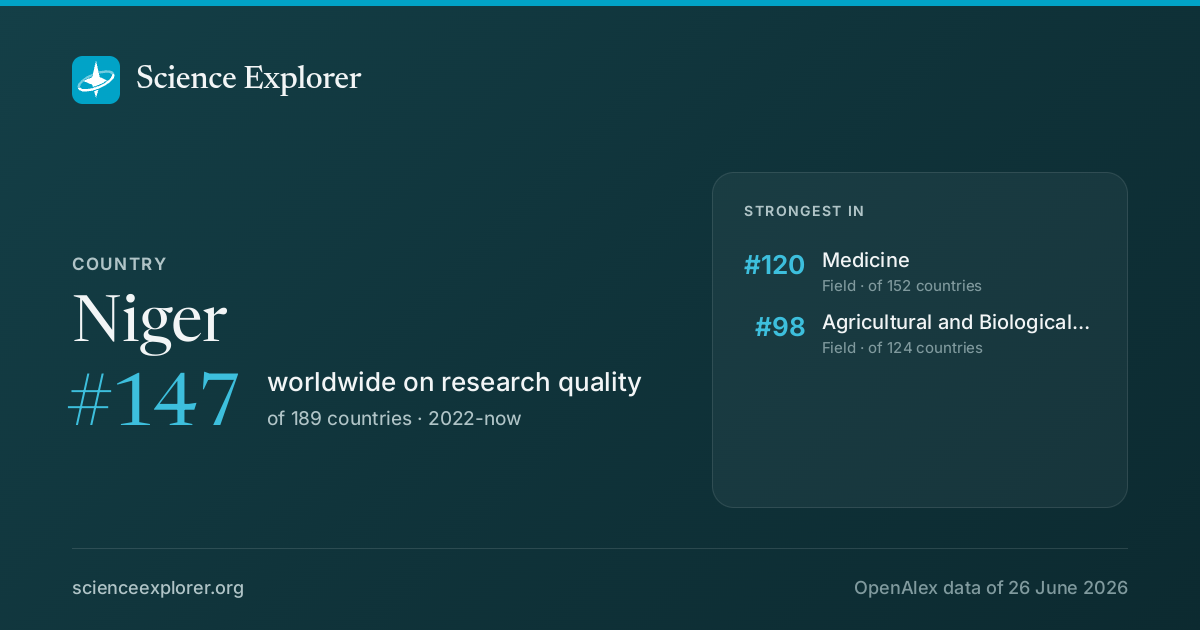
Niger ranks #147 of 189 countries on research quality in 2022-now (#130 all time), with 1.5k research works and 4.0% of them in the world's top 10%.
- World rank, 2022-now
- #147 of 189 · #130 all time
- Works, 2022-now
- 1.5k ▲ 29% vs 2018-21
- Citations
- 68k 10.5 per fractional work, all time
- Top-10% rate
- 4.0% all institutions 10.0%
- vs its own fields
- 0.60× 1.00× is exactly expected
- In the world top 100
- 0 0 in the top 1,000
- Open access
- 47% world 40%
- International
- 36% world 18%
NigerWhat is Niger strongest at in science?
On research quality in 2022-now, Niger ranks highest in Medicine (#120 of 152) and Agricultural and Biological Sciences (#98 of 124). Relative to its size it is most specialised in Forestry, Medical Terminology and Library and Information Sciences.
| Field | World rank | Where that sits | Top-10% rate | Works | All time | Institutions |
|---|---|---|---|---|---|---|
| MedicineField | #120 of 152 | 2.9% | 373 | #111 | Institutions | |
| Agricultural and Biological SciencesField | #98 of 124 | 4.3% | 345 | #87 | Institutions |
Where its research is concentrated
Location quotient: how much more (or less) of each node it does than its size predicts. Drawn around 1×, where "twice the world share" and "half of it" are the same distance apart in opposite directions. A volume reading, which on a country axis is largely population and industrial structure.
- ForestrySubfield · 53.6 works · #59 of 204 active here29×
- Medical TerminologySubfield · 0.9 works · #70 of 121 active here16×
- Library and Information SciencesSubfield · 5.5 works · #63 of 146 active here16×
- Ecology, Evolution, Behavior and SystematicsSubfield · 107.4 works · #90 of 223 active here13×
- HorticultureSubfield · 2.7 works · #85 of 178 active here11×
- Animal Science and ZoologySubfield · 23.3 works · #95 of 205 active here5.9×
- Linguistics and LanguageSubfield · 11.7 works · #115 of 194 active here5.7×
- MicrobiologySubfield · 10.3 works · #96 of 206 active here5.5×
The whole field profile
All 26 fields at once. A specialist and a generalist produce the same ranked list and a completely different shape.
Rings at 0.5×, 1× and 2×. Widest outward: Agricultural and Biological Sciences, 4.7×. Every wedge is a field page.
All 26 fields, with their numbers
- Agricultural and Biological Sciences4.66×396 works
- Nursing3.22×28 works
- Immunology and Microbiology1.57×28 works
- Earth and Planetary Sciences1.53×43 works
- Environmental Science1.53×136 works
- Health Professions1.39×65 works
- Medicine1.32×453 works
- Energy1.19×20 works
- Veterinary0.97×2 works
- Social Sciences0.95×215 works
- Economics, Econometrics and Finance0.90×35 works
- Pharmacology, Toxicology and Pharmaceutics0.89×6 works
- Arts and Humanities0.86×44 works
- Mathematics0.70×15 works
- Biochemistry, Genetics and Molecular Biology0.61×58 works
- Physics and Astronomy0.47×19 works
- Dentistry0.46×4 works
- Business, Management and Accounting0.44×25 works
- Computer Science0.41×58 works
- Psychology0.38×21 works
- Chemistry0.34×10 works
- Engineering0.32×86 works
- Decision Sciences0.29×5 works
- Chemical Engineering0.25×2 works
- Materials Science0.22×14 works
- Neuroscience0.11×3 works
Which fields of science does Niger work in?
In 2022-now, 31% of research in Niger is in Health Sciences, 27% in Life Sciences. Its largest fields are Medicine (25%), Agricultural and Biological Sciences (22%), Social Sciences (12%). It does 2.1× the world's share of Life Sciences.
Each ring splits the one inside it: the four domains of science, their fields, their subfields. Size is fractional works in 2022-now. Every slice is a page; the interactive view zooms down to single topics and colours each by how much more of it this country does than the world.
Its 4 domains and 26 fields, with their numbers
- Health Sciences55330.9%
- Medicine45325.3%
- Health Professions653.7%
- Nursing281.6%
- Dentistry40.2%
- Veterinary20.1%
- Life Sciences49127.5%
- Physical Sciences39922.3%
- Environmental Science1367.6%
- Engineering864.8%
- Computer Science583.2%
- Earth and Planetary Sciences432.4%
- Energy201.1%
- Physics and Astronomy191.0%
- Mathematics150.8%
- Materials Science130.8%
- Chemistry90.5%
- Chemical Engineering20.1%
- Social Sciences34519.3%
- Social Sciences21512.0%
- Arts and Humanities442.5%
- Economics, Econometrics and Finance351.9%
- Business, Management and Accounting251.4%
- Psychology211.2%
- Decision Sciences50.3%
Which keywords describe research in Niger?
By fractional works in 2022-now, weighted toward what it does more of than the world: Smallholder Farmers, Climate Change, Adaptation, Sustainability, Diversity, Livestock Farming, Agroecology and Agricultural Development.
- Phytochemicals
- Health Inequalities
- Maternal and Child Undernutrition
- Agricultural Sustainability
- Maternal Mortality
- Breeding
- Drought Tolerance
- Nutritional Quality
- Remote Sensing
- Tree Domestication
- Rural Livelihoods
- Public Health
- Nutritional Value
- Biodiversity Conservation
- Sustainable Agriculture
- Multifunctionality
- Agroecology
- Diversity
- Smallholder Farmers
- Epidemiology
- Climate Change
- Sustainability
- Adaptation
- Livestock Farming
- Agricultural Development
- Work Organization
- Climate Resilience
- Genetic Diversity
- Agroforestry
- Globalization
- Indigenous Fruits
- Environmental Impact
- Vaccine
- Food Security
- Pathogenesis
- Vaccine Development
- Global Burden of Disease
- Marker Development
- Water Sanitation Hygiene
- Community Health Workers
Size is fractional works in 2022-now in the topics tagged with each word; colour is the word's share of this country's work against its share of the world's. The 40 words are chosen for being large and distinctive. Each links to the topic it comes from most.
All 40 words, with their numbers
- Climate Change186▲ 3.8×72 topics
- Epidemiology162▲ 2.3×10⁹ topics
- Sustainability152▲ 3.5×52 topics
- Smallholder Farmers150▲ 40×6 topics
- Adaptation112▲ 21×7 topics
- Diversity92▲ 29×7 topics
- Livestock Farming91▲ 86×3 topics
- Agroecology91▲ 36×2 topics
- Agricultural Development89▲ 33×2 topics
- Multifunctionality89▲ 106×1 topic
- Work Organization89▲ 129×1 topic
- Sustainable Agriculture72▲ 13×9 topics
- Climate Resilience69▲ 64×3 topics
- Biodiversity Conservation66▲ 9.8×12 topics
- Genetic Diversity58▲ 7.5×19 topics
- Nutritional Value57▲ 28×3 topics
- Agroforestry55▲ 46×4 topics
- Public Health52▲ 2.0×48 topics
- Globalization52▲ 1.48×56 topics
- Rural Livelihoods51▲ 53×2 topics
- Indigenous Fruits50▲ 123×1 topic
- Tree Domestication50▲ 123×1 topic
- Environmental Impact50▲ 1.63×46 topics
- Remote Sensing42▲ 1.94×25 topics
- Vaccine40▲ 5.6×11 topics
- Nutritional Quality36▲ 28×4 topics
- Food Security34▲ 3.5×15 topics
- Drought Tolerance34▲ 14×8 topics
- Pathogenesis34▲ 3.7×19 topics
- Breeding28▲ 21×5 topics
- Vaccine Development28▲ 6.0×10 topics
- Maternal Mortality27▲ 6.8×5 topics
- Global Burden of Disease25▲ 5.5×4 topics
- Agricultural Sustainability22▲ 11×4 topics
- Marker Development22▲ 27×3 topics
- Maternal and Child Undernutrition22▲ 15×1 topic
- Water Sanitation Hygiene22▲ 15×1 topic
- Health Inequalities22▲ 9.9×3 topics
- Community Health Workers21▲ 13×2 topics
- Phytochemicals20▲ 10×5 topics
Which research topics does Niger publish the most in?
Its largest topics in 2022-now are Agriculture and Rural Development Research, African Botany and Ecology Studies, Child Nutrition and Water Access.
Area is fractional works in 2022-now; colour is the subfield each topic belongs to. Every tile is a topic page.
- 1 Agriculture and Rural Development Research Ecology, Evolution, Behavior and Systematics 89 works
- 2 African Botany and Ecology Studies Forestry 50 works
- 3 Child Nutrition and Water Access Nutrition and Dietetics 22 works
- 4 Global Maternal and Child Health Pediatrics, Perinatology and Child Health 19 works
- 5 Agricultural pest management studies Plant Science 18 works
- 6 African Studies and Ethnography Sociology and Political Science 15 works
- 7 Malaria Research and Control Public Health, Environmental and Occupational Health 13 works
- 8 Rangeland Management and Livestock Ecology Management, Monitoring, Policy and Law 13 works
- 9 Moringa oleifera research and applications Plant Science 12 works
- 10 Livestock and Poultry Management Animal Science and Zoology 11 works
- 11 Animal Diversity and Health Studies Food Science 10 works
- 12 Tuberculosis Research and Epidemiology Infectious Diseases 9 works
Which universities in Niger lead research?
Université Abdou Moumouni, Université de Maradi and National Hospital Niamey rank highest in Niger on research quality in 2022-now.
One dot per institution in the list below. The upper left is the interesting corner.
- 1Université Abdou MoumouniUniversity · Niamey · #6,672 worldwide3.2% top 10% · 539 works
- 2Université de MaradiUniversity · Maradi · #15,594 worldwide3.2% top 10% · 135 works
- 3National Hospital NiameyHospital / health system · Niamey · #15,943 worldwide2.5% top 10% · 161 works
- 4Ministère de la Santé PubliqueGovernment institution · Niamey · #16,794 worldwide5.7% top 10% · 91 works
- 5Université André SalifouUniversity · Zinder · #17,615 worldwide2.7% top 10% · 95 works
- 6Institut National de la Recherche Agronomique du NigerGovernment institution · Niamey · #20,305 worldwide6.5% top 10% · 110 works
The track on each row is its top-10% rate; the tick is the average of all institutions, 10.0% (how it is set): teal above it, red below.
All ranked institutions in NigerWho are the top researchers in Niger?
Amadou Garba, Abdou Ali and Amina Amadou Hamidou rank highest among researchers based in Niger.
- 1 Amadou Garba #483,222 worldwide 5.2k citations · 160 works
- 2 Abdou Ali #737,227 worldwide 2.9k citations · 72 works
- 3 Amina Amadou Hamidou #897,228 worldwide 804 citations · 33 works
- 4 Mahamadou Bassirou Souleymane #1,126,005 worldwide 1.2k citations · 28 works
- 5 Ousmane Guindo #1,234,502 worldwide 1.2k citations · 79 works
- 6 Ibrahim Sidi Zakari #1,426,569 worldwide 262 citations · 23 works
- 7 Maman Sani Chaibou #1,485,924 worldwide 624 citations · 16 works
- 8 Benoı̂t Sarr #1,632,384 worldwide 1.4k citations · 42 works
- 9 Bachir Alkali Tanimoun #1,652,115 worldwide 409 citations · 19 works
- 10 Moussa Gagara #1,656,474 worldwide 939 citations · 22 works
How open and international is Niger's research?
47% of its research is openly available (world: 40%), and 36% is written with international co-authors (world: 18%).
World: 40% of research is openly available.
World: 18% is written across borders.
In 2022-now, 87% of its research is openly available (world 63%) and 39% is written with co-authors abroad (world 22%). Against what its own mix of topics predicts, that is 1.24× the expected open access and 1.53× the expected international share, which puts it #21 of 173 countries on openness.
How has Niger's research grown?
Output in 2022-2025 was 29% higher than in 2018-2021.
The same series as a ribbon: one cell per year, darker for more. The line above answers how much; this answers when.
Its share of all research
Growing output can still be a shrinking share: all of science grows. This is Niger as a percentage of every work published that year, 0.0074% in 2024.
Fractional works of Niger over all fractional works that year. How the balance of science has shifted.
How much of it reaches the world top 10%
Over the whole record, 6.7% of its 6.5k works since 1950 reached the world top 10% for their field and year.
Of each year's output, the share that reached the world's 10% most cited for its field and year. Peak 13.9% in 2008.
Which countries have research most like Niger's?
Benin is Niger's closest research twin: of all countries, its research is spread across the fields most like Niger's, with both strong in Agricultural and Biological Sciences.
- 1
 BeninBoth strong in Agricultural and Biological Sciences, Nursing, Environmental Science
0.86 Compare
- 2
 ChadBoth strong in Agricultural and Biological Sciences, Nursing, Immunology and Microbiology
0.86 Compare
- 3
 Burkina FasoBoth strong in Agricultural and Biological Sciences, Nursing, Immunology and Microbiology
0.86 Compare
- 4
 Central African RepublicBoth strong in Nursing, Immunology and Microbiology, Agricultural and Biological Sciences
0.85 Compare
- 5
 CameroonBoth strong in Agricultural and Biological Sciences, Nursing, Earth and Planetary Sciences
0.84 Compare
Similarity is the correlation of each side's location quotients across every field it publishes in, on a log scale: 1 is the same shape of research, 0 is unrelated. It ignores size. How it is measured.
Compare Niger with
 Somalia
 Algeria
 French Guiana
 Turkmenistan
 São Tomé and Príncipe
 Martinique
Share Niger's ranking
Badges for a website1Each links back here and updates with every snapshot

Research fields in Niger
Discussion
Ask a question or share a note about Niger. Posts are plain text and can be reported.