Science Explorer Back to mapMap
Discussion
University · Zinder · Niger

Université André Salifou

World rank, 2022-now
#17,615
of 22,385 · #22,289 all time
Rank in Niger
#5
of 6
Research works
244
▲ 79% vs 2018-21
Citations
494
2.0 per fractional work
Top-10% rate
3.0%
all institutions 10.0%
vs its own fields
0.90×
1.00× is exactly expected
Open access
75%
world 40%
International
30%
world 18%

Which fields of science does Université André Salifou work in?

In 2022-now, 51% of research at Université André Salifou is in Health Sciences, 21% in Life Sciences. Its largest fields are Medicine (46%), Agricultural and Biological Sciences (12%), Environmental Science (7%). It does 2.1× the world's share of Health Sciences.

Health Sciences: 62 fractional works · 50.9% of its workMedicine: 56 fractional works · 45.8% of its workSurgery: 7 fractional works · 5.8% of its workPublic Health, Environmental and Occupational Health: 7 fractional works · 5.7% of its workInfectious Diseases: 5 fractional works · 3.7% of its workEpidemiology: 5 fractional works · 3.7% of its workPediatrics, Perinatology and Child Health: 4 fractional works · 3.0% of its workOphthalmology: 3 fractional works · 2.8% of its workPulmonary and Respiratory Medicine: 2 fractional works · 1.6% of its workNephrology: 2 fractional works · 1.6% of its workObstetrics and Gynecology: 2 fractional works · 1.6% of its workPathology and Forensic Medicine: 2 fractional works · 1.4% of its workGenetics: 2 fractional works · 1.4% of its workRheumatology: 2 fractional works · 1.3% of its workHepatology: 1 fractional works · 1.2% of its workOncology: 1 fractional works · 1.1% of its workPhysiology: 1 fractional works · 1.1% of its workEmergency Medicine: 1 fractional works · 1.0% of its workCardiology and Cardiovascular Medicine: 1 fractional works · 1.0% of its workRadiology, Nuclear Medicine and Imaging: 1 fractional works · 1.0% of its workNeurology: 1 fractional works · 0.9% of its workHematology: 1 fractional works · 0.7% of its workPharmacology: 1 fractional works · 0.7% of its workRehabilitation: 1 fractional works · 0.5% of its workUrology: 1 fractional works · 0.5% of its workOtorhinolaryngology: 0 fractional works · 0.4% of its workReproductive Medicine: 0 fractional works · 0.3% of its workEndocrinology, Diabetes and Metabolism: 0 fractional works · 0.3% of its workComplementary and alternative medicine: 0 fractional works · 0.2% of its workCritical Care and Intensive Care Medicine: 0 fractional works · 0.2% of its workPsychiatry and Mental health: 0 fractional works · 0.2% of its workSmaller subfields together: 1 fractional works · 0.6% of its workHealth Professions: 5 fractional works · 3.8% of its workGeneral Health Professions: 3 fractional works · 2.2% of its workHealth Information Management: 1 fractional works · 1.1% of its workSmaller subfields together: 0 fractional works · 0.4% of its workNursing: 1 fractional works · 1.0% of its workNutrition and Dietetics: 1 fractional works · 1.0% of its workVeterinary: 0 fractional works · 0.3% of its workDentistry: 0 fractional works · 0.1% of its workLife Sciences: 26 fractional works · 21.2% of its workAgricultural and Biological Sciences: 15 fractional works · 12.3% of its workEcology, Evolution, Behavior and Systematics: 5 fractional works · 4.1% of its workPlant Science: 5 fractional works · 3.9% of its workForestry: 3 fractional works · 2.1% of its workAgronomy and Crop Science: 1 fractional works · 0.4% of its workFood Science: 0 fractional works · 0.4% of its workHorticulture: 0 fractional works · 0.4% of its workInsect Science: 0 fractional works · 0.4% of its workSoil Science: 0 fractional works · 0.2% of its workSmaller subfields together: 0 fractional works · 0.3% of its workBiochemistry, Genetics and Molecular Biology: 6 fractional works · 5.3% of its workGenetics: 4 fractional works · 3.2% of its workEndocrinology: 1 fractional works · 0.7% of its workMolecular Biology: 1 fractional works · 0.5% of its workMolecular Medicine: 0 fractional works · 0.3% of its workCell Biology: 0 fractional works · 0.2% of its workSmaller subfields together: 0 fractional works · 0.3% of its workImmunology and Microbiology: 4 fractional works · 3.0% of its workMicrobiology: 1 fractional works · 1.0% of its workParasitology: 1 fractional works · 0.9% of its workImmunology: 1 fractional works · 0.8% of its workApplied Microbiology and Biotechnology: 0 fractional works · 0.3% of its workNeuroscience: 1 fractional works · 0.6% of its workNeurology: 0 fractional works · 0.2% of its workSmaller subfields together: 0 fractional works · 0.3% of its workPharmacology, Toxicology and Pharmaceutics: 0 fractional works · 0.1% of its workPhysical Sciences: 20 fractional works · 16.3% of its workEnvironmental Science: 9 fractional works · 7.4% of its workGlobal and Planetary Change: 3 fractional works · 2.2% of its workEnvironmental Engineering: 2 fractional works · 2.0% of its workEcology: 2 fractional works · 1.3% of its workWater Science and Technology: 1 fractional works · 0.9% of its workIndustrial and Manufacturing Engineering: 0 fractional works · 0.4% of its workSmaller subfields together: 1 fractional works · 0.6% of its workEarth and Planetary Sciences: 4 fractional works · 3.6% of its workGeophysics: 2 fractional works · 1.8% of its workAtmospheric Science: 1 fractional works · 0.6% of its workGeochemistry and Petrology: 1 fractional works · 0.4% of its workGeology: 0 fractional works · 0.3% of its workPaleontology: 0 fractional works · 0.3% of its workSmaller subfields together: 0 fractional works · 0.2% of its workEngineering: 2 fractional works · 1.8% of its workBuilding and Construction: 0 fractional works · 0.4% of its workBiomedical Engineering: 0 fractional works · 0.3% of its workCivil and Structural Engineering: 0 fractional works · 0.3% of its workElectrical and Electronic Engineering: 0 fractional works · 0.3% of its workSmaller subfields together: 1 fractional works · 0.5% of its workComputer Science: 2 fractional works · 1.5% of its workInformation Systems: 1 fractional works · 0.8% of its workArtificial Intelligence: 1 fractional works · 0.5% of its workSmaller subfields together: 0 fractional works · 0.2% of its workMaterials Science: 1 fractional works · 0.8% of its workBiomaterials: 1 fractional works · 0.5% of its workMaterials Chemistry: 0 fractional works · 0.3% of its workMathematics: 1 fractional works · 0.5% of its workApplied Mathematics: 0 fractional works · 0.3% of its workModeling and Simulation: 0 fractional works · 0.2% of its workEnergy: 0 fractional works · 0.4% of its workRenewable Energy, Sustainability and the Environment: 0 fractional works · 0.4% of its workChemistry: 0 fractional works · 0.3% of its workSocial Sciences: 14 fractional works · 11.6% of its workSocial Sciences: 8 fractional works · 6.2% of its workSociology and Political Science: 4 fractional works · 3.5% of its workEducation: 1 fractional works · 0.7% of its workPolitical Science and International Relations: 1 fractional works · 0.6% of its workHealth: 0 fractional works · 0.3% of its workCultural Studies: 0 fractional works · 0.3% of its workGender Studies: 0 fractional works · 0.3% of its workLaw: 0 fractional works · 0.3% of its workSmaller subfields together: 0 fractional works · 0.2% of its workArts and Humanities: 3 fractional works · 2.7% of its workLiterature and Literary Theory: 1 fractional works · 1.1% of its workLanguage and Linguistics: 1 fractional works · 0.6% of its workMusic: 0 fractional works · 0.3% of its workReligious studies: 0 fractional works · 0.3% of its workSmaller subfields together: 1 fractional works · 0.4% of its workPsychology: 2 fractional works · 1.3% of its workClinical Psychology: 1 fractional works · 0.7% of its workDevelopmental and Educational Psychology: 0 fractional works · 0.4% of its workSocial Psychology: 0 fractional works · 0.3% of its workEconomics, Econometrics and Finance: 1 fractional works · 1.0% of its workEconomics and Econometrics: 1 fractional works · 0.8% of its workSmaller subfields together: 0 fractional works · 0.2% of its workBusiness, Management and Accounting: 0 fractional works · 0.3% of its workDecision Sciences: 0 fractional works · 0.1% of its workALL ITS WORKUniversité AndréSalifou122fractional works, 2022-now
Life Sciences21%Physical Sciences16%Health Sciences51%Social Sciences12%

Each ring splits the one inside it: the four domains of science, their fields, their subfields. Size is fractional works in 2022-now. Every slice is a page; the interactive view zooms down to single topics and colours each by how much more of it this institution does than the world.

Its 4 domains and 24 fields, with their numbers
    1. Medicine5645.8%
    2. Health Professions53.8%
    3. Nursing11.0%
    4. Veterinary00.3%
    5. Dentistry00.1%
    1. Agricultural and Biological Sciences1512.3%
    2. Biochemistry, Genetics and Molecular Biology65.3%
    3. Immunology and Microbiology43.0%
    4. Neuroscience10.6%
    5. Pharmacology, Toxicology and Pharmaceutics00.1%
    1. Environmental Science97.4%
    2. Earth and Planetary Sciences43.6%
    3. Engineering21.8%
    4. Computer Science21.5%
    5. Materials Science10.8%
    6. Mathematics10.5%
    7. Energy00.4%
    8. Chemistry00.3%
    1. Social Sciences86.2%
    2. Arts and Humanities32.7%
    3. Psychology21.3%
    4. Economics, Econometrics and Finance11.0%
    5. Business, Management and Accounting00.3%
    6. Decision Sciences00.1%
All of science, and how each field's share has moved since 1950: the Science domain explorer

Field profile

Location quotient across every field it publishes in: outside the ring is more than an institution of this size would be expected to publish, inside it is less.

Agricultural and Biological Sciences: 2.58× its world share, 15 worksAgricultural and Bio…Biochemistry, Genetics and Molecular Biology: 0.99× its world share, 6 worksBiochemistry, Geneti…Immunology and Microbiology: 3.02× its world share, 4 worksImmunology and Micro…Neuroscience: 0.35× its world share, 1 worksNeurosciencePharmacology, Toxicology and Pharmaceutics: 0.15× its world share, 0 worksPharmacology, Toxico…Chemistry: 0.18× its world share, 0 worksChemistryComputer Science: 0.19× its world share, 2 worksComputer ScienceEarth and Planetary Sciences: 2.26× its world share, 4 worksEarth and Planetary …Energy: 0.45× its world share, 0 worksEnergyEngineering: 0.12× its world share, 2 worksEngineeringEnvironmental Science: 1.49× its world share, 9 worksEnvironmental ScienceMaterials Science: 0.23× its world share, 1 worksMaterials ScienceMathematics: 0.42× its world share, 1 worksMathematicsDentistry: 0.11× its world share, 0 worksDentistryHealth Professions: 1.44× its world share, 5 worksHealth ProfessionsMedicine: 2.38× its world share, 56 worksMedicineNursing: 2.03× its world share, 1 worksNursingVeterinary: 1.91× its world share, 0 worksVeterinaryArts and Humanities: 0.95× its world share, 3 worksArts and HumanitiesBusiness, Management and Accounting: 0.09× its world share, 0 worksBusiness, Management…Decision Sciences: 0.09× its world share, 0 worksDecision SciencesEconomics, Econometrics and Finance: 0.47× its world share, 1 worksEconomics, Econometr…Psychology: 0.43× its world share, 2 worksPsychologySocial Sciences: 0.49× its world share, 8 worksSocial Sciences1×world share
more than its size predictsabout as predictedless

Rings at 0.5×, 1× and 2×. Widest outward: Immunology and Microbiology, 3.0×. Every wedge is a field page.

All 24 fields, with their numbers
  1. Immunology and Microbiology3.02×4 works
  2. Agricultural and Biological Sciences2.58×15 works
  3. Medicine2.38×56 works
  4. Earth and Planetary Sciences2.26×4 works
  5. Nursing2.03×1 works
  6. Veterinary1.91×0 works
  7. Environmental Science1.49×9 works
  8. Health Professions1.44×5 works
  9. Biochemistry, Genetics and Molecular Biology0.99×6 works
  10. Arts and Humanities0.95×3 works
  11. Social Sciences0.49×8 works
  12. Economics, Econometrics and Finance0.47×1 works
  13. Energy0.45×0 works
  14. Psychology0.43×2 works
  15. Mathematics0.42×1 works
  16. Neuroscience0.35×1 works
  17. Materials Science0.23×1 works
  18. Computer Science0.19×2 works
  19. Chemistry0.18×0 works
  20. Pharmacology, Toxicology and Pharmaceutics0.15×0 works
  21. Engineering0.12×2 works
  22. Dentistry0.11×0 works
  23. Business, Management and Accounting0.09×0 works
  24. Decision Sciences0.09×0 works

Who are the top researchers at Université André Salifou?

Ranked on the quality score, Maikassoua Mamane, Harissou Adamou and Moussa Malam Abdou lead among researchers whose main affiliation is Université André Salifou.

  1. 1 Maikassoua Mamane Niger · #2,057,639 worldwide 330 citations · 19 works
  2. 2 Harissou Adamou Niger · #2,230,568 worldwide 1.5k citations · 100 works
  3. 3 Moussa Malam Abdou Niger · #2,363,081 worldwide 531 citations · 33 works
  4. 4 Mahamadou Doutchi Niger · #3,622,029 worldwide 376 citations · 92 works
  5. 5 Moussa Tankari Niger · #4,048,991 worldwide 13 citations · 20 works
  6. 6 Hassane Moussa Diongolé Niger · #4,447,594 worldwide 20 citations · 17 works
  7. 7 Djibrilla Moussa Niger · #4,712,404 worldwide 1 citations · 15 works
  8. 8 Ayodele Adebayo Allagbé Niger · #4,723,530 worldwide 18 citations · 14 works
  9. 9 Oumarou Habou Niger · #4,819,644 worldwide 600 citations · 60 works
  10. 10 Ibrahim Amadou Magagi Niger · #5,193,224 worldwide 718 citations · 98 works
All ranked researchers at Université André Salifou

What are the most cited papers from Université André Salifou?

The most cited paper from Université André Salifou is "Evolution of Surface Hydrology in the Sahelo-Sudanian Strip: An Updated Review" (Luc Descroix et al., 2018), with 138 citations. Next come "AMMA‐CATCH, a Critical Zone Observatory in West Africa Monitoring a Region in Transition" (118) and "A P alaearctic migratory raptor species tracks shifting prey availability within its wintering range in the S ahel" (116).

Most cited papers
#PaperReleasedCitations
1 Evolution of Surface Hydrology in the Sahelo-Sudanian Strip: An Updated Review Luc Descroix et al. · Water Open access 8 Jun 2018 138
2 AMMA‐CATCH, a Critical Zone Observatory in West Africa Monitoring a Region in Transition Sylvie Galle et al. · Vadose Zone Journal Open access 2018 118
3 A P alaearctic migratory raptor species tracks shifting prey availability within its wintering range in the S ahel Christiane Trierweiler, Wim C. Mullié, Rudi H. Drent et al. · Journal of Animal Ecology Open access 8 Nov 2012 116
4 Armed conflicts and wildlife decline: Challenges and recommendations for effective conservation policy in the Sahara‐Sahel José Carlos Brito et al. · Conservation Letters Open access 3 Apr 2018 90
5 Lassa fever outcomes and prognostic factors in Nigeria (LASCOPE): a prospective cohort study Alexandre Duvignaud et al. · The Lancet Global Health Open access 18 Mar 2021 88
All 62 most cited papers, with filters and sorting

Which keywords describe research at Université André Salifou?

By fractional works in 2022-now, weighted toward what it does more of than the world: Epidemiology, Smallholder Farmers, Climate Change, Adaptation, Genetic Mutations, Diversity, Agroecology and Public Health.

▲ more of its work than of the world's◆ about the world's share▼ less than the world's

Size is fractional works in 2022-now in the topics tagged with each word; colour is the word's share of this institution's work against its share of the world's. The 40 words are chosen for being large and distinctive. Each links to the topic it comes from most.

All 40 words, with their numbers
  1. Epidemiology20▲ 4.0×65 topics
  2. Climate Change10▲ 2.9×20 topics
  3. Smallholder Farmers7▲ 29×3 topics
  4. Public Health7▲ 3.8×21 topics
  5. Sustainability7▲ 2.2×8 topics
  6. Adaptation5▲ 15×5 topics
  7. Genetic Mutations5▲ 9.5×9 topics
  8. Diversity5▲ 23×3 topics
  9. Agroecology5▲ 28×2 topics
  10. Agricultural Development5▲ 25×1 topic
  11. Livestock Farming5▲ 65×1 topic
  12. Cardiovascular Disease5▲ 3.3×13 topics
  13. Remote Sensing4▲ 2.8×7 topics
  14. Biodiversity Conservation4▲ 8.7×5 topics
  15. Pathogenesis4▲ 6.4×9 topics
  16. Treatment4▲ 2.6×17 topics
  17. Diagnosis3▲ 3.0×15 topics
  18. Global Burden3▲ 5.1×7 topics
  19. Vaccine3▲ 6.9×8 topics
  20. Vaccine Development3▲ 11×6 topics
  21. Climate Resilience3▲ 44×2 topics
  22. Agroforestry3▲ 37×2 topics
  23. Prognostic Factors3▲ 5.8×6 topics
  24. Genetic Diversity3▲ 5.7×9 topics
  25. Sustainable Agriculture3▲ 8.0×4 topics
  26. Management3▲ 3.0×11 topics
  27. Drought Tolerance3▲ 17×5 topics
  28. Maternal Mortality3▲ 10×4 topics
  29. Nutritional Value3▲ 21×2 topics
  30. Indigenous Fruits3▲ 91×1 topic
  31. Tree Domestication3▲ 91×1 topic
  32. Prenatal Diagnosis2▲ 12×5 topics
  33. Breeding2▲ 23×4 topics
  34. GIS2▲ 22×2 topics
  35. Health Inequalities2▲ 14×2 topics
  36. Radiation Therapy2▲ 12×3 topics
  37. Groundwater Potential2▲ 55×1 topic
  38. Machine Learning Models2▲ 55×1 topic
  39. Retinoblastoma2▲ 97×1 topic
  40. Uveal Melanoma2▲ 97×1 topic

Which research topics does Université André Salifou publish most on?

By volume in 2022-now: Agriculture and Rural Development Research, African Botany and Ecology Studies, Groundwater and Watershed Analysis and Ocular Oncology and Treatments.

  1. 1 Agriculture and Rural Development Research Ecology, Evolution, Behavior and Systematics 5 works
  2. 2 African Botany and Ecology Studies Forestry 3 works
  3. 3 Groundwater and Watershed Analysis Environmental Engineering 2 works
  4. 4 Ocular Oncology and Treatments Ophthalmology 2 works
  5. 5 Ocular Disorders and Treatments Genetics 2 works
  6. 6 Malaria Research and Control Public Health, Environmental and Occupational Health 2 works
  7. 7 African Studies and Ethnography Sociology and Political Science 2 works
  8. 8 Geological and Geophysical Studies Worldwide Geophysics 1 works
  9. 9 Global Maternal and Child Health Pediatrics, Perinatology and Child Health 1 works
  10. 10 Liver Disease and Transplantation Hepatology 1 works

How open and international is its research?

Against the world's own shares: the tick on each track. Both are shares of its output, so they sit on one scale and can be read against each other as well as against the world.

openly available75.0%not open25.0%

World: 40% of research is openly available.

with international co-authors29.7%domestic only70.3%

World: 18% is written across borders.

How has Université André Salifou's research output changed?

Output in 2022-2025 was 79% higher than in 2018-2021.

still counting1990200020102020
grewheldshrank

The same series as a ribbon: one cell per year, darker for more. The line above answers how much; this answers when.

Its share of all research

Growing output can still be a shrinking share: all of science grows. This is Université André Salifou as a percentage of every work published that year, 0.00057% in 2024.

still counting0.00025%0.00050%0.00075%Université André Salifou0.00045% in 202519801990200020102020

Fractional works of Université André Salifou over all fractional works that year. How the balance of science has shifted.

Share Université André Salifou's ranking
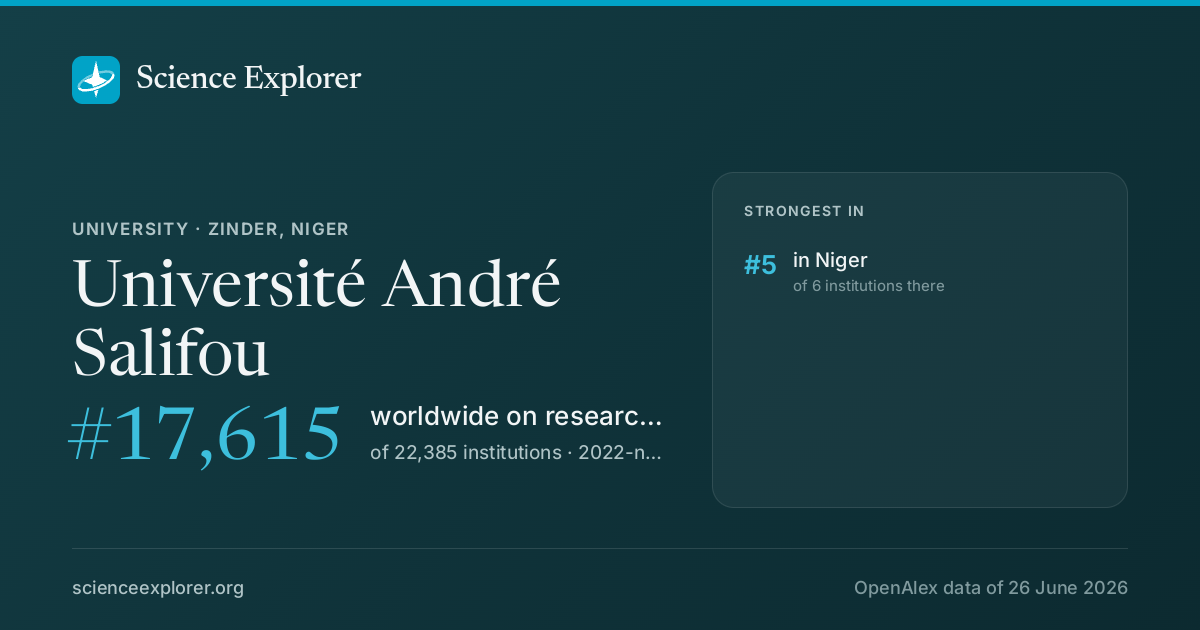
Université André Salifou on Science Explorer

A card with Université André Salifou's standing and the fields it leads in, for a post or a slide. A link to this page previews as the same card.

Download the card

1200 × 630 PNG, sized for social posts, drawn from the latest snapshot.

Badges for a website1Each links back here and updates with every snapshot

Research measures only: rankings here say nothing about teaching, admissions or student experience. Comparable institutions and collaboration partners have tabs of their own, above.

Discussion

Ask a question or share a note about Université André Salifou. Posts are plain text and can be reported.