 Science in Réunion
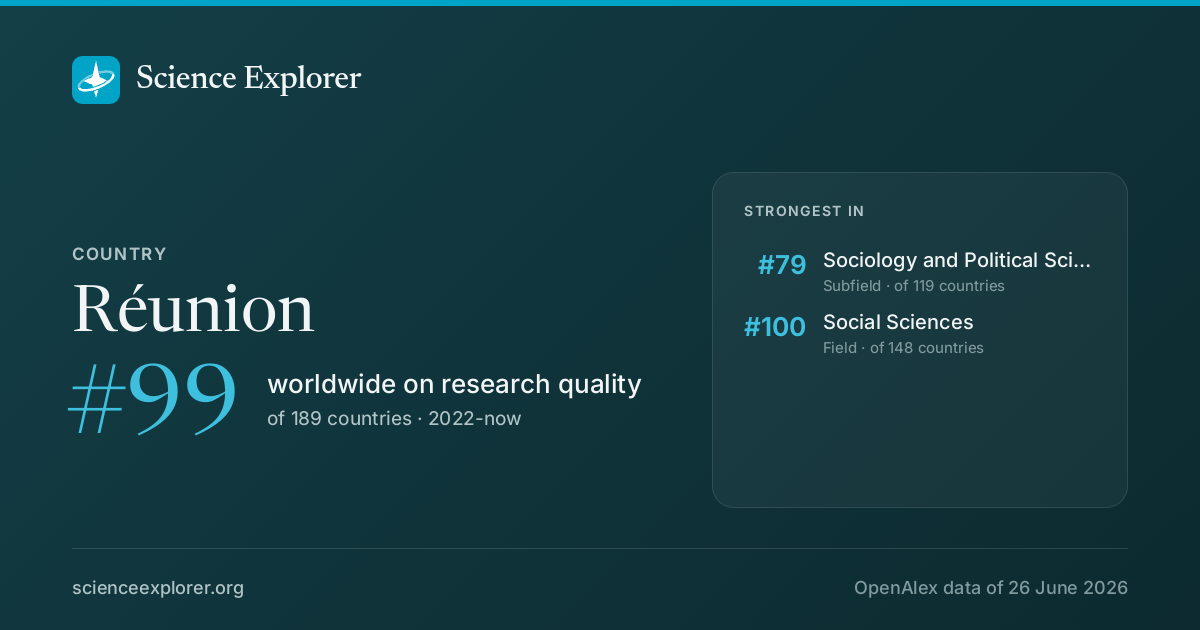
Réunion ranks #99 of 189 countries on research quality in 2022-now (#96 all time), with 1.4k research works and 6.7% of them in the world's top 10%.
- World rank, 2022-now
- #99 of 189 · #96 all time
- Works, 2022-now
- 1.4k ▲ 49% vs 2018-21
- Citations
- 56k 10.5 per fractional work, all time
- Top-10% rate
- 6.7% all institutions 10.0%
- vs its own fields
- 1.00× 1.00× is exactly expected
- In the world top 100
- 0 0 in the top 1,000
- Open access
- 48% world 40%
- International
- 42% world 18%
RéunionWhat is Réunion strongest at in science?
On research quality in 2022-now, Réunion ranks highest in Sociology and Political Science (#79 of 119) and Social Sciences (#100 of 148). Relative to its size it is most specialised in Linguistics and Language, Ecology, Evolution, Behavior and Systematics and Horticulture.
| Field | World rank | Where that sits | Top-10% rate | Works | All time | Institutions |
|---|---|---|---|---|---|---|
| Sociology and Political ScienceSubfield | #79 of 119 | 6.7% | 221 | #76 | ||
| Social SciencesField | #100 of 148 | 5.4% | 478 | #99 | Institutions |
Where its research is concentrated
Location quotient: how much more (or less) of each node it does than its size predicts. Drawn around 1×, where "twice the world share" and "half of it" are the same distance apart in opposite directions. A volume reading, which on a country axis is largely population and industrial structure.
- Linguistics and LanguageSubfield · 53.3 works · #66 of 194 active here28×
- Ecology, Evolution, Behavior and SystematicsSubfield · 91.3 works · #91 of 223 active here12×
- HorticultureSubfield · 2.6 works · #87 of 178 active here12×
- AnthropologySubfield · 43.6 works · #93 of 213 active here9.4×
- History and Philosophy of ScienceSubfield · 17.7 works · #80 of 187 active here7.0×
- HistorySubfield · 33.5 works · #86 of 206 active here6.3×
- ForestrySubfield · 9.4 works · #109 of 204 active here5.5×
- Literature and Literary TheorySubfield · 47.7 works · #107 of 208 active here5.4×
The whole field profile
All 26 fields at once. A specialist and a generalist produce the same ranked list and a completely different shape.
Rings at 0.5×, 1× and 2×. Widest outward: Arts and Humanities, 3.7×. Every wedge is a field page.
All 26 fields, with their numbers
- Arts and Humanities3.73×177 works
- Agricultural and Biological Sciences2.57×201 works
- Social Sciences2.43×505 works
- Earth and Planetary Sciences1.68×43 works
- Environmental Science1.42×116 works
- Immunology and Microbiology1.24×21 works
- Health Professions1.08×47 works
- Pharmacology, Toxicology and Pharmaceutics0.96×6 works
- Biochemistry, Genetics and Molecular Biology0.87×77 works
- Psychology0.84×42 works
- Energy0.77×12 works
- Medicine0.70×220 works
- Neuroscience0.56×15 works
- Nursing0.52×4 works
- Economics, Econometrics and Finance0.51×18 works
- Veterinary0.47×1 works
- Computer Science0.33×43 works
- Decision Sciences0.32×5 works
- Business, Management and Accounting0.31×17 works
- Mathematics0.26×5 works
- Engineering0.21×51 works
- Physics and Astronomy0.19×7 works
- Chemistry0.14×4 works
- Materials Science0.14×8 works
- Chemical Engineering0.13×1 works
- Dentistry0.11×1 works
Which fields of science does Réunion work in?
In 2022-now, 46% of research in Réunion is in Social Sciences, 19% in Life Sciences. Its largest fields are Social Sciences (31%), Medicine (13%), Agricultural and Biological Sciences (12%). It does 1.9× the world's share of Social Sciences.
Each ring splits the one inside it: the four domains of science, their fields, their subfields. Size is fractional works in 2022-now. Every slice is a page; the interactive view zooms down to single topics and colours each by how much more of it this country does than the world.
Its 4 domains and 26 fields, with their numbers
- Social Sciences76346.4%
- Social Sciences50530.7%
- Arts and Humanities17710.8%
- Psychology422.6%
- Economics, Econometrics and Finance181.1%
- Business, Management and Accounting171.0%
- Decision Sciences50.3%
- Life Sciences31919.4%
- Physical Sciences28917.6%
- Environmental Science1167.0%
- Engineering513.1%
- Earth and Planetary Sciences432.6%
- Computer Science432.6%
- Energy120.7%
- Materials Science80.5%
- Physics and Astronomy70.4%
- Mathematics50.3%
- Chemistry40.2%
- Chemical Engineering10.0%
- Health Sciences27316.6%
- Medicine22013.4%
- Health Professions472.8%
- Nursing40.3%
- Veterinary10.1%
- Dentistry10.1%
Which keywords describe research in Réunion?
By fractional works in 2022-now, weighted toward what it does more of than the world: Migration, Identity, Biogeography, Colonialism, Sociolinguistics, Social Justice, Gender and Cultural Diversity.
- Taxonomy
- Intercultural Communication
- French Territories
- Discrimination
- Public Action
- Educational Policies
- Environmental Participation
- Religion
- Culture
- Healthcare Access
- Gender Studies
- Phylogeny
- Sustainable Development
- Multilingualism
- Public Policy
- Gender
- Sociolinguistics
- Biogeography
- Identity
- Globalization
- Climate Change
- Migration
- Epidemiology
- Colonialism
- Social Justice
- Cultural Diversity
- Public Health
- Ethnicity
- Community Engagement
- Territorial Governance
- Local Development
- Politics
- Social Movements
- Citizen Participation
- Nationalism
- Professional Practices
- Sociological Analysis
- Social Inequality
- Migrant Workers
- Language Policy
Size is fractional works in 2022-now in the topics tagged with each word; colour is the word's share of this country's work against its share of the world's. The 40 words are chosen for being large and distinctive. Each links to the topic it comes from most.
All 40 words, with their numbers
- Climate Change100▲ 2.2×81 topics
- Globalization94▲ 2.9×75 topics
- Migration90▲ 16×17 topics
- Identity89▲ 7.5×46 topics
- Epidemiology84▲ 1.29×119 topics
- Biogeography81▲ 18×19 topics
- Colonialism80▲ 10×31 topics
- Sociolinguistics76▲ 25×8 topics
- Social Justice75▲ 7.7×20 topics
- Gender71▲ 8.0×34 topics
- Cultural Diversity70▲ 19×10 topics
- Public Policy62▲ 7.9×17 topics
- Public Health60▲ 2.5×41 topics
- Multilingualism60▲ 23×5 topics
- Ethnicity59▲ 9.6×12 topics
- Sustainable Development58▲ 2.3×32 topics
- Community Engagement58▲ 11×11 topics
- Phylogeny56▲ 20×15 topics
- Territorial Governance55▲ 29×4 topics
- Gender Studies54▲ 22×11 topics
- Local Development54▲ 31×2 topics
- Healthcare Access49▲ 11×10 topics
- Politics48▲ 11×17 topics
- Culture44▲ 5.1×21 topics
- Social Movements43▲ 8.9×21 topics
- Religion40▲ 5.3×20 topics
- Citizen Participation39▲ 21×1 topic
- Environmental Participation39▲ 34×1 topic
- Nationalism38▲ 5.1×19 topics
- Educational Policies37▲ 21×2 topics
- Professional Practices37▲ 63×1 topic
- Public Action37▲ 63×1 topic
- Sociological Analysis37▲ 40×2 topics
- Discrimination35▲ 10×5 topics
- Social Inequality34▲ 7.8×4 topics
- French Territories34▲ 211×1 topic
- Migrant Workers34▲ 211×1 topic
- Intercultural Communication33▲ 44×2 topics
- Language Policy33▲ 14×4 topics
- Taxonomy31▲ 13×13 topics
Which research topics does Réunion publish the most in?
Its largest topics in 2022-now are French Urban and Social Studies, Education, sociology, and vocational training, Migration, Identity, and Health.
Area is fractional works in 2022-now; colour is the subfield each topic belongs to. Every tile is a topic page.
- 1 French Urban and Social Studies Sociology and Political Science 39 works
- 2 Education, sociology, and vocational training Sociology and Political Science 37 works
- 3 Migration, Identity, and Health Sociology and Political Science 33 works
- 4 French Language Learning Methods Linguistics and Language 29 works
- 5 Linguistic and Sociocultural Studies Linguistics and Language 22 works
- 6 Multiculturalism, Politics, Migration, Gender Political Science and International Relations 21 works
- 7 Plant Diversity and Evolution Ecology, Evolution, Behavior and Systematics 21 works
- 8 Bryophyte Studies and Records Ecology, Evolution, Behavior and Systematics 19 works
- 9 Linguistics and Discourse Analysis Philosophy 17 works
- 10 African Studies and Ethnography Sociology and Political Science 17 works
- 11 Mosquito-borne diseases and control Public Health, Environmental and Occupational Health 17 works
- 12 Fern and Epiphyte Biology Ecology, Evolution, Behavior and Systematics 17 works
Which universities in Réunion lead research?
University of Reunion Island and Conseil Régional de La Réunion rank highest in Réunion on research quality in 2022-now.
- 1University of Reunion IslandUniversity · Saint-Denis · #6,627 worldwide6.8% top 10% · 277 works
- 2Conseil Régional de La RéunionGovernment institution · Saint-Denis · #20,322 worldwide9.9% top 10% · 61 works
The track on each row is its top-10% rate; the tick is the average of all institutions, 10.0% (how it is set): teal above it, red below.
All ranked institutions in RéunionWho are the top researchers in Réunion?
Riccardo Rodolfo‐Metalpa, Fanny Houlbrèque and Marie‐Paule Gonthier rank highest among researchers based in Réunion.
- 1 Riccardo Rodolfo‐Metalpa #183,527 worldwide 6.3k citations · 141 works
- 2 Fanny Houlbrèque #324,354 worldwide 4.6k citations · 113 works
- 3 Marie‐Paule Gonthier #329,865 worldwide 4.4k citations · 57 works
- 4 Silvia Iacobelli #550,826 worldwide 6.2k citations · 158 works
- 5 Philippe Lauret #572,523 worldwide 3.9k citations · 103 works
- 6 Marc Bintner #586,948 worldwide 2.7k citations · 55 works
- 7 Mathieu David #595,450 worldwide 3.5k citations · 118 works
- 8 Mohsen Kayal #713,173 worldwide 1.9k citations · 86 works
- 9 Laurent Dufossé #749,688 worldwide 9.4k citations · 346 works
- 10 Françoise Posny #752,733 worldwide 3.3k citations · 79 works
How open and international is Réunion's research?
48% of its research is openly available (world: 40%), and 42% is written with international co-authors (world: 18%).
World: 40% of research is openly available.
World: 18% is written across borders.
In 2022-now, 51% of its research is openly available (world 63%) and 42% is written with co-authors abroad (world 22%). Against what its own mix of topics predicts, that is 0.83× the expected open access and 1.82× the expected international share, which puts it #146 of 173 countries on openness.
How has Réunion's research grown?
Output in 2022-2025 was 49% higher than in 2018-2021.
The same series as a ribbon: one cell per year, darker for more. The line above answers how much; this answers when.
Its share of all research
Growing output can still be a shrinking share: all of science grows. This is Réunion as a percentage of every work published that year, 0.0063% in 2024.
Fractional works of Réunion over all fractional works that year. How the balance of science has shifted.
How much of it reaches the world top 10%
Over the whole record, 7.8% of its 5.4k works since 1950 reached the world top 10% for their field and year.
Of each year's output, the share that reached the world's 10% most cited for its field and year. Peak 11.1% in 2001.
Which countries have research most like Réunion's?
New Caledonia is Réunion's closest research twin: of all countries, its research is spread across the fields most like Réunion's, with both strong in Social Sciences.
- 1
 New CaledoniaBoth strong in Social Sciences, Arts and Humanities, Agricultural and Biological Sciences
0.89 Compare
- 2
 GuadeloupeBoth strong in Agricultural and Biological Sciences, Arts and Humanities, Social Sciences
0.76 Compare
- 3
 HaitiBoth strong in Arts and Humanities, Agricultural and Biological Sciences, Social Sciences
0.74 Compare
- 4
 Republic of the CongoBoth strong in Agricultural and Biological Sciences, Arts and Humanities, Social Sciences
0.74 Compare
- 5
 Costa RicaBoth strong in Arts and Humanities, Social Sciences, Agricultural and Biological Sciences
0.73 Compare
Similarity is the correlation of each side's location quotients across every field it publishes in, on a log scale: 1 is the same shape of research, 0 is unrelated. It ignores size. How it is measured.
Compare Réunion with
 Paraguay
 Malta
 Dominican Republic
 Nigeria
 Sri Lanka
 Fiji
Share Réunion's ranking
Badges for a website1Each links back here and updates with every snapshot

Research fields in Réunion
Discussion
Ask a question or share a note about Réunion. Posts are plain text and can be reported.