Science Explorer Back to mapMap
Discussion
University · Takatsuki · Japan

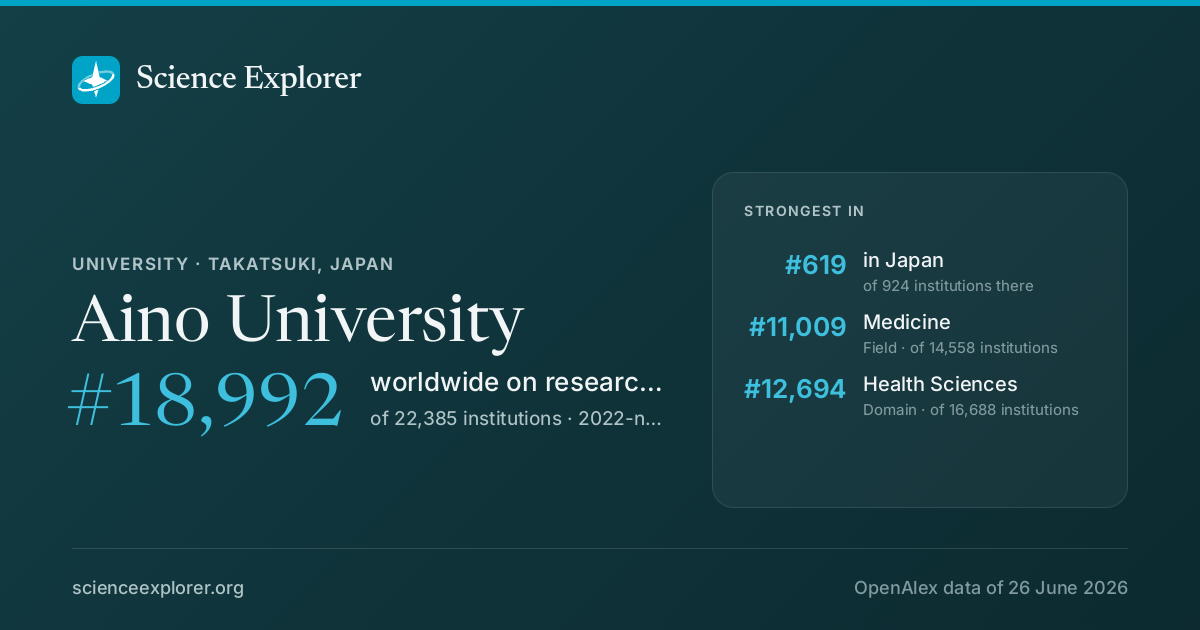
Aino University

In research, Aino University stands highest in Medicine (#11,009 of 14,558 worldwide) and Health Sciences (#12,694 of 16,688 worldwide), over all time.

World rank, 2022-now
#18,992
of 22,385 · #21,540 all time
Rank in Japan
#619
of 924
Research works
379
▼ 20% vs 2018-21
Citations
3.8k
9.9 per fractional work
Top-10% rate
5.2%
all institutions 10.0%
vs its own fields
0.94×
1.00× is exactly expected
Open access
57%
world 40%
International
20%
world 18%

What is Aino University known for in research?

The fields where it stands highest, over all time, ranked among every institution above the floor in each field.

FieldWorld rankWhere that sitsTop-10% rateWorks
MedicineField #11,009 of 14,558 4.2%137
Health SciencesDomain #12,694 of 16,688 4.4%169

Each strip is that field's whole ranked pool, with the notch where Aino University sits in it, in the colour of the band that rank falls in. The track under the rate is the rate itself: it carries no average mark, because the average differs by field (from about 6% in Dentistry to 21% in Economics).

Which fields of science does Aino University work in?

In 2022-now, 43% of research at Aino University is in Health Sciences, 27% in Physical Sciences. Its largest fields are Medicine (33%), Engineering (19%), Social Sciences (11%). It does 1.7× the world's share of Health Sciences.

Health Sciences: 31 fractional works · 43.1% of its workMedicine: 24 fractional works · 33.2% of its workPhysiology: 4 fractional works · 5.2% of its workSurgery: 3 fractional works · 4.3% of its workRehabilitation: 2 fractional works · 3.0% of its workPublic Health, Environmental and Occupational Health: 2 fractional works · 2.4% of its workRadiology, Nuclear Medicine and Imaging: 2 fractional works · 2.3% of its workNeurology: 1 fractional works · 1.9% of its workEndocrinology, Diabetes and Metabolism: 1 fractional works · 1.5% of its workEpidemiology: 1 fractional works · 1.4% of its workPsychiatry and Mental health: 1 fractional works · 1.4% of its workCardiology and Cardiovascular Medicine: 1 fractional works · 1.0% of its workOrthopedics and Sports Medicine: 1 fractional works · 1.0% of its workOncology: 1 fractional works · 1.0% of its workPharmacology: 1 fractional works · 1.0% of its workPathology and Forensic Medicine: 1 fractional works · 0.9% of its workPulmonary and Respiratory Medicine: 1 fractional works · 0.8% of its workGeriatrics and Gerontology: 1 fractional works · 0.7% of its workNephrology: 0 fractional works · 0.6% of its workRheumatology: 0 fractional works · 0.5% of its workInfectious Diseases: 0 fractional works · 0.5% of its workEmergency Medicine: 0 fractional works · 0.5% of its workComplementary and alternative medicine: 0 fractional works · 0.4% of its workGastroenterology: 0 fractional works · 0.3% of its workHealth Informatics: 0 fractional works · 0.3% of its workSmaller subfields together: 0 fractional works · 0.4% of its workHealth Professions: 6 fractional works · 8.4% of its workPhysical Therapy, Sports Therapy and Rehabilitation: 2 fractional works · 2.3% of its workEmergency Medical Services: 1 fractional works · 1.5% of its workGeneral Health Professions: 1 fractional works · 1.4% of its workSpeech and Hearing: 1 fractional works · 1.1% of its workOccupational Therapy: 1 fractional works · 0.9% of its workHealth Information Management: 0 fractional works · 0.7% of its workRadiological and Ultrasound Technology: 0 fractional works · 0.5% of its workNursing: 1 fractional works · 1.5% of its workNutrition and Dietetics: 1 fractional works · 1.2% of its workLeadership and Management: 0 fractional works · 0.2% of its workDentistry: 0 fractional works · 0.1% of its workPhysical Sciences: 19 fractional works · 26.9% of its workEngineering: 13 fractional works · 18.8% of its workBiomedical Engineering: 5 fractional works · 7.7% of its workMechanical Engineering: 2 fractional works · 2.4% of its workAerospace Engineering: 2 fractional works · 2.3% of its workElectrical and Electronic Engineering: 1 fractional works · 1.9% of its workCivil and Structural Engineering: 1 fractional works · 1.2% of its workControl and Systems Engineering: 1 fractional works · 0.9% of its workComputational Mechanics: 0 fractional works · 0.7% of its workAutomotive Engineering: 0 fractional works · 0.5% of its workMechanics of Materials: 0 fractional works · 0.5% of its workIndustrial and Manufacturing Engineering: 0 fractional works · 0.4% of its workOcean Engineering: 0 fractional works · 0.4% of its workGeneral Engineering: 0 fractional works · 0.2% of its workComputer Science: 2 fractional works · 3.3% of its workArtificial Intelligence: 1 fractional works · 1.1% of its workComputer Networks and Communications: 1 fractional works · 0.9% of its workInformation Systems: 0 fractional works · 0.6% of its workHardware and Architecture: 0 fractional works · 0.4% of its workComputer Vision and Pattern Recognition: 0 fractional works · 0.3% of its workSmaller subfields together: 0 fractional works · 0.1% of its workEnvironmental Science: 2 fractional works · 2.2% of its workNature and Landscape Conservation: 0 fractional works · 0.5% of its workHealth, Toxicology and Mutagenesis: 0 fractional works · 0.5% of its workEcology: 0 fractional works · 0.4% of its workIndustrial and Manufacturing Engineering: 0 fractional works · 0.3% of its workPollution: 0 fractional works · 0.3% of its workManagement, Monitoring, Policy and Law: 0 fractional works · 0.2% of its workPhysics and Astronomy: 1 fractional works · 1.6% of its workAstronomy and Astrophysics: 1 fractional works · 1.4% of its workStatistical and Nonlinear Physics: 0 fractional works · 0.2% of its workMathematics: 0 fractional works · 0.5% of its workApplied Mathematics: 0 fractional works · 0.3% of its workGeometry and Topology: 0 fractional works · 0.2% of its workEarth and Planetary Sciences: 0 fractional works · 0.2% of its workChemical Engineering: 0 fractional works · 0.1% of its workMaterials Science: 0 fractional works · 0.1% of its workSocial Sciences: 14 fractional works · 20.1% of its workSocial Sciences: 8 fractional works · 10.9% of its workEducation: 2 fractional works · 3.1% of its workSafety Research: 2 fractional works · 2.2% of its workTransportation: 2 fractional works · 2.2% of its workSociology and Political Science: 1 fractional works · 1.7% of its workLinguistics and Language: 0 fractional works · 0.5% of its workHealth: 0 fractional works · 0.4% of its workDemography: 0 fractional works · 0.3% of its workAnthropology: 0 fractional works · 0.2% of its workSmaller subfields together: 0 fractional works · 0.2% of its workPsychology: 4 fractional works · 6.0% of its workClinical Psychology: 2 fractional works · 2.9% of its workSocial Psychology: 1 fractional works · 1.3% of its workExperimental and Cognitive Psychology: 1 fractional works · 0.9% of its workDevelopmental and Educational Psychology: 0 fractional works · 0.7% of its workSmaller subfields together: 0 fractional works · 0.1% of its workArts and Humanities: 1 fractional works · 1.9% of its workLiterature and Literary Theory: 1 fractional works · 0.8% of its workReligious studies: 0 fractional works · 0.5% of its workHistory: 0 fractional works · 0.2% of its workSmaller subfields together: 0 fractional works · 0.3% of its workBusiness, Management and Accounting: 1 fractional works · 0.9% of its workStrategy and Management: 0 fractional works · 0.6% of its workSmaller subfields together: 0 fractional works · 0.3% of its workDecision Sciences: 0 fractional works · 0.2% of its workGeneral Decision Sciences: 0 fractional works · 0.2% of its workEconomics, Econometrics and Finance: 0 fractional works · 0.2% of its workLife Sciences: 7 fractional works · 9.9% of its workBiochemistry, Genetics and Molecular Biology: 3 fractional works · 4.1% of its workMolecular Biology: 2 fractional works · 2.7% of its workCell Biology: 0 fractional works · 0.6% of its workCancer Research: 0 fractional works · 0.6% of its workSmaller subfields together: 0 fractional works · 0.2% of its workNeuroscience: 2 fractional works · 2.4% of its workCognitive Neuroscience: 1 fractional works · 1.0% of its workNeurology: 0 fractional works · 0.6% of its workSensory Systems: 0 fractional works · 0.3% of its workCellular and Molecular Neuroscience: 0 fractional works · 0.3% of its workSmaller subfields together: 0 fractional works · 0.2% of its workAgricultural and Biological Sciences: 1 fractional works · 1.6% of its workPlant Science: 0 fractional works · 0.7% of its workGeneral Agricultural and Biological Sciences: 0 fractional works · 0.4% of its workAgronomy and Crop Science: 0 fractional works · 0.2% of its workFood Science: 0 fractional works · 0.2% of its workSmaller subfields together: 0 fractional works · 0.1% of its workImmunology and Microbiology: 1 fractional works · 1.4% of its workImmunology: 1 fractional works · 1.0% of its workMicrobiology: 0 fractional works · 0.4% of its workPharmacology, Toxicology and Pharmaceutics: 0 fractional works · 0.4% of its workPharmacology: 0 fractional works · 0.4% of its workALL ITS WORKAino University71fractional works, 2022-now
Life Sciences10%Physical Sciences27%Health Sciences43%Social Sciences20%

Each ring splits the one inside it: the four domains of science, their fields, their subfields. Size is fractional works in 2022-now. Every slice is a page; the interactive view zooms down to single topics and colours each by how much more of it this institution does than the world.

Its 4 domains and 23 fields, with their numbers
    1. Medicine2433.2%
    2. Health Professions68.4%
    3. Nursing11.5%
    4. Dentistry00.1%
    1. Engineering1318.8%
    2. Computer Science23.3%
    3. Environmental Science22.2%
    4. Physics and Astronomy11.6%
    5. Mathematics00.5%
    6. Earth and Planetary Sciences00.2%
    7. Chemical Engineering00.1%
    8. Materials Science00.1%
    1. Social Sciences810.9%
    2. Psychology46.0%
    3. Arts and Humanities11.9%
    4. Business, Management and Accounting10.9%
    5. Decision Sciences00.2%
    6. Economics, Econometrics and Finance00.2%
    1. Biochemistry, Genetics and Molecular Biology34.1%
    2. Neuroscience22.4%
    3. Agricultural and Biological Sciences11.6%
    4. Immunology and Microbiology11.4%
    5. Pharmacology, Toxicology and Pharmaceutics00.4%
All of science, and how each field's share has moved since 1950: the Science domain explorer

Field profile

Location quotient across every field it publishes in: outside the ring is more than an institution of this size would be expected to publish, inside it is less.

Agricultural and Biological Sciences: 0.35× its world share, 1 worksAgricultural and Bio…Biochemistry, Genetics and Molecular Biology: 0.76× its world share, 3 worksBiochemistry, Geneti…Immunology and Microbiology: 1.38× its world share, 1 worksImmunology and Micro…Neuroscience: 1.45× its world share, 2 worksNeurosciencePharmacology, Toxicology and Pharmaceutics: 1.11× its world share, 0 worksPharmacology, Toxico…Chemical Engineering: 0.27× its world share, 0 worksChemical EngineeringComputer Science: 0.43× its world share, 2 worksComputer ScienceEarth and Planetary Sciences: 0.15× its world share, 0 worksEarth and Planetary …Engineering: 1.26× its world share, 13 worksEngineeringEnvironmental Science: 0.44× its world share, 2 worksEnvironmental ScienceMaterials Science: 0.02× its world share, 0 worksMaterials ScienceMathematics: 0.47× its world share, 0 worksMathematicsPhysics and Astronomy: 0.74× its world share, 1 worksPhysics and AstronomyDentistry: 0.24× its world share, 0 worksDentistryHealth Professions: 3.18× its world share, 6 worksHealth ProfessionsMedicine: 1.73× its world share, 24 worksMedicineNursing: 3.02× its world share, 1 worksNursingArts and Humanities: 0.64× its world share, 1 worksArts and HumanitiesBusiness, Management and Accounting: 0.29× its world share, 1 worksBusiness, Management…Decision Sciences: 0.24× its world share, 0 worksDecision SciencesEconomics, Econometrics and Finance: 0.07× its world share, 0 worksEconomics, Econometr…Psychology: 1.96× its world share, 4 worksPsychologySocial Sciences: 0.86× its world share, 8 worksSocial Sciences1×world share
more than its size predictsabout as predictedless

Rings at 0.5×, 1× and 2×. Widest outward: Health Professions, 3.2×. Every wedge is a field page.

All 23 fields, with their numbers
  1. Health Professions3.18×6 works
  2. Nursing3.02×1 works
  3. Psychology1.96×4 works
  4. Medicine1.73×24 works
  5. Neuroscience1.45×2 works
  6. Immunology and Microbiology1.38×1 works
  7. Engineering1.26×13 works
  8. Pharmacology, Toxicology and Pharmaceutics1.11×0 works
  9. Social Sciences0.86×8 works
  10. Biochemistry, Genetics and Molecular Biology0.76×3 works
  11. Physics and Astronomy0.74×1 works
  12. Arts and Humanities0.64×1 works
  13. Mathematics0.47×0 works
  14. Environmental Science0.44×2 works
  15. Computer Science0.43×2 works
  16. Agricultural and Biological Sciences0.35×1 works
  17. Business, Management and Accounting0.29×1 works
  18. Chemical Engineering0.27×0 works
  19. Dentistry0.24×0 works
  20. Decision Sciences0.24×0 works
  21. Earth and Planetary Sciences0.15×0 works
  22. Economics, Econometrics and Finance0.07×0 works
  23. Materials Science0.02×0 works

Who are the top researchers at Aino University?

Ranked on the quality score, 一雄 越後, Masayo Nagai and Kenji Kanekiyo lead among researchers whose main affiliation is Aino University.

  1. 1 一雄 越後 Japan · #3,303,698 worldwide 0 citations · 17 works
  2. 2 Masayo Nagai Japan · #4,275,159 worldwide 41 citations · 17 works
  3. 3 Kenji Kanekiyo Japan · #4,348,641 worldwide 936 citations · 41 works
  4. 4 Masaki Iwamura Japan · #4,653,407 worldwide 135 citations · 22 works
  5. 5 Masahiro GOTO Japan · #4,790,290 worldwide 0 citations · 16 works
  6. 6 Yoko Honda Japan · #4,925,843 worldwide 502 citations · 67 works
  7. 7 Norihiko Nakano Japan · #5,021,704 worldwide 745 citations · 41 works
  8. 8 Hitoshi Kumada Japan · #5,161,317 worldwide 17 citations · 15 works
  9. 9 Nobuko Sekinaga Japan · #5,290,395 worldwide 1 citations · 18 works
  10. 10 Hiroto Honda Japan · #5,313,078 worldwide 254 citations · 39 works
All ranked researchers at Aino University

What are the most cited papers from Aino University?

The most cited paper from Aino University is "Report of the Committee on the classification and diagnostic criteria of diabetes mellitus" (Takeshi Kuzuya, Shoichi Nakagawa, Jo Satoh et al., 2002), with 780 citations. Next come "Prevention of type 2 diabetes by lifestyle intervention: a Japanese trial in IGT males" (661) and "Executive and prefrontal dysfunction in unipolar depression: a review of neuropsychological and imaging evidence" (494).

Most cited papers
#PaperReleasedCitations
1 Report of the Committee on the classification and diagnostic criteria of diabetes mellitus Takeshi Kuzuya, Shoichi Nakagawa, Jo Satoh et al. · Diabetes Research and Clinical Practice 2002 780
2 Prevention of type 2 diabetes by lifestyle intervention: a Japanese trial in IGT males Kinori Kosáka, Mitsuhiko Noda, Takeshi Kuzuya · Diabetes Research and Clinical Practice 29 Sep 2004 661
3 Executive and prefrontal dysfunction in unipolar depression: a review of neuropsychological and imaging evidence Mark A. Rogers, Kiyoto Kasai, Koji Matsuo et al. · Neuroscience Research 25 Jun 2004 494
4 Cilostazol for prevention of secondary stroke (CSPS 2): an aspirin-controlled, double-blind, randomised non-inferiority trial Yukito Shinohara, Yasuo Katayama, Shinichiro Uchiyama et al. · The Lancet Neurology 16 Sep 2010 490
5 Platelet-activating factor receptor antagonist BN 52021 in the treatment of severe sepsis: A randomized, double-blind, placebo-controlled, multicenter clinical trial Jean-François A. Dhainaut, Alain Tenaillon, Yves Le Tulzo et al. · Critical Care Medicine Nov 1994 236
All 61 most cited papers, with filters and sorting

Which keywords describe research at Aino University?

By fractional works in 2022-now, weighted toward what it does more of than the world: Epidemiology, Electromyography, Muscle Fatigue, Parkinson's Disease, Inflammation, Elderly, Quality of Life and Physical Performance.

▲ more of its work than of the world's◆ about the world's share▼ less than the world's

Size is fractional works in 2022-now in the topics tagged with each word; colour is the word's share of this institution's work against its share of the world's. The 40 words are chosen for being large and distinctive. Each links to the topic it comes from most.

All 40 words, with their numbers
  1. Epidemiology6▲ 1.93×30 topics
  2. Inflammation4▲ 2.7×21 topics
  3. Quality of Life3▲ 3.0×14 topics
  4. Artificial Intelligence3▲ 2.7×7 topics
  5. Electromyography2▲ 73×1 topic
  6. Muscle Fatigue2▲ 73×1 topic
  7. Parkinson's Disease2▲ 14×3 topics
  8. Mental Health2▲ 2.2×10 topics
  9. Aging2▲ 5.1×5 topics
  10. Elderly2▲ 12×4 topics
  11. Public Health2▲ 1.98×12 topics
  12. Metabolic Syndrome2▲ 3.3×13 topics
  13. Physical Performance2▲ 28×2 topics
  14. Risk Factors2▲ 2.5×12 topics
  15. Big Data2▲ 2.7×4 topics
  16. Obesity2▲ 3.4×8 topics
  17. Functional Recovery2▲ 16×3 topics
  18. Qualitative Research2▲ 2.8×5 topics
  19. Surveillance2▲ 8.2×3 topics
  20. Well-being2▲ 5.9×4 topics
  21. Muscle Mass2▲ 19×2 topics
  22. Neurological Disorders2▲ 3.7×6 topics
  23. Rehabilitation2▲ 5.4×5 topics
  24. Diabetes1▲ 4.0×8 topics
  25. Fall Risk1▲ 43×1 topic
  26. Gait Speed1▲ 43×1 topic
  27. Mitochondrial Dysfunction1▲ 6.5×4 topics
  28. Motor Recovery1▲ 26×1 topic
  29. Neural Plasticity1▲ 11×1 topic
  30. Prevention1▲ 4.7×5 topics
  31. Diagnostic Criteria1▲ 7.2×2 topics
  32. Fairness1▲ 17×1 topic
  33. Healthcare Workers1▲ 7.1×2 topics
  34. Polymer Nanocomposites1▲ 38×2 topics
  35. Disability1▲ 14×3 topics
  36. Neurodegeneration1▲ 5.2×3 topics
  37. Dopaminergic Neurons1▲ 22×1 topic
  38. Friction1▲ 24×2 topics
  39. Transport Policy1▲ 11×1 topic
  40. a-Synuclein1▲ 27×1 topic

Which research topics does Aino University publish most on?

By volume in 2022-now: Muscle activation and electromyography studies, Stroke Rehabilitation and Recovery, Balance, Gait, and Falls Prevention and Ethics and Social Impacts of AI.

  1. 1 Muscle activation and electromyography studies Biomedical Engineering 2 works
  2. 2 Stroke Rehabilitation and Recovery Rehabilitation 1 works
  3. 3 Balance, Gait, and Falls Prevention Physical Therapy, Sports Therapy and Rehabilitation 1 works
  4. 4 Ethics and Social Impacts of AI Safety Research 1 works
  5. 5 Legal and Regulatory Analysis Transportation 1 works
  6. 6 Parkinson's Disease Mechanisms and Treatments Neurology 1 works
  7. 7 Nutrition and Health in Aging Physiology 1 works
  8. 8 Gut microbiota and health Molecular Biology 1 works
  9. 9 Knee injuries and reconstruction techniques Surgery 1 works
  10. 10 Polymer Science and Applications Mechanical Engineering 1 works

How open and international is its research?

Against the world's own shares: the tick on each track. Both are shares of its output, so they sit on one scale and can be read against each other as well as against the world.

openly available56.8%not open43.2%

World: 40% of research is openly available.

with international co-authors19.6%domestic only80.4%

World: 18% is written across borders.

How has Aino University's research output changed?

Output in 2022-2025 was 20% lower than in 2018-2021.

still counting1990200020102020
grewheldshrank

The same series as a ribbon: one cell per year, darker for more. The line above answers how much; this answers when.

Its share of all research

Growing output can still be a shrinking share: all of science grows. This is Aino University as a percentage of every work published that year, 0.00028% in 2024.

still counting0.00050%0.0010%0.0015%Aino University0.00025% in 202519801990200020102020

Fractional works of Aino University over all fractional works that year. How the balance of science has shifted.

Other research institutions in Takatsuki

All research institutions in Takatsuki

Share Aino University's ranking

Aino University on Science Explorer

A card with Aino University's standing and the fields it leads in, for a post or a slide. A link to this page previews as the same card.

Download the card

1200 × 630 PNG, sized for social posts, drawn from the latest snapshot.

Badges for a website1Each links back here and updates with every snapshot

Research measures only: rankings here say nothing about teaching, admissions or student experience. Comparable institutions and collaboration partners have tabs of their own, above.

Discussion

Ask a question or share a note about Aino University. Posts are plain text and can be reported.