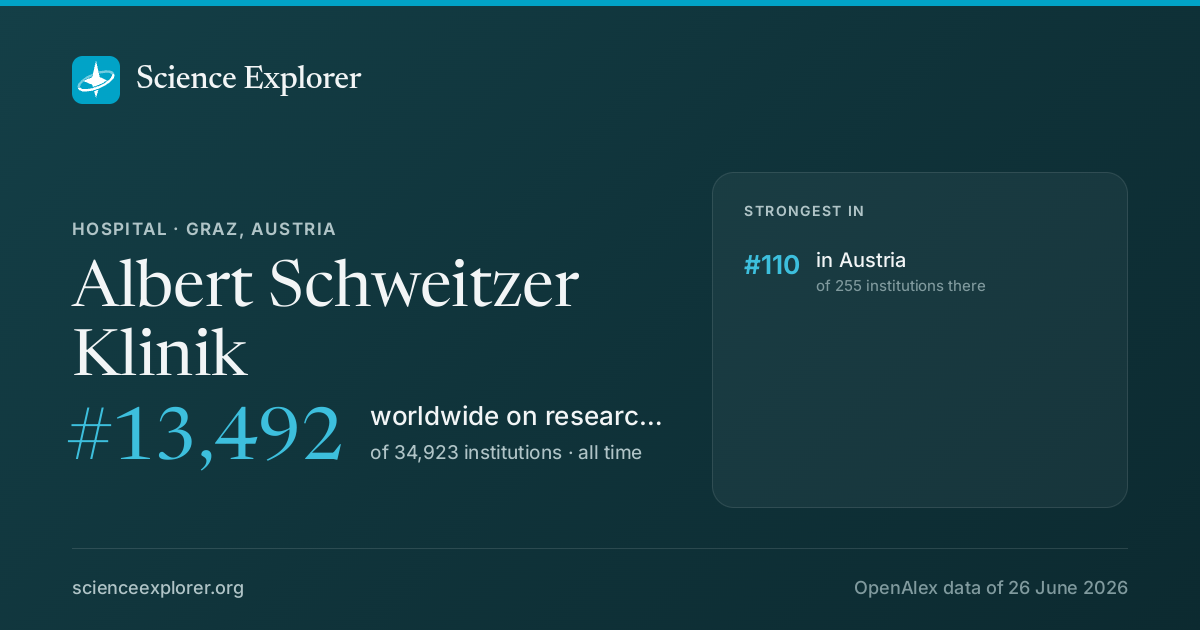
Albert Schweitzer Klinik
- World rank, all time
- #13,492 of 34,923
- Rank in Austria
- #110 of 255
- Research works
- 291 ▼ 28% vs 2018-21
- Citations
- 3.9k 13.5 per fractional work
- Top-10% rate
- 8.3% all institutions 10.0%
- vs its own fields
- 1.06× 1.00× is exactly expected
- Open access
- 25% world 40%
- International
- 33% world 18%
Which fields of science does Albert Schweitzer Klinik work in?
In 2022-now, 38% of research at Albert Schweitzer Klinik is in Health Sciences, 31% in Social Sciences. Its largest fields are Medicine (33%), Social Sciences (23%), Engineering (13%). It does 1.5× the world's share of Health Sciences.
Each ring splits the one inside it: the four domains of science, their fields, their subfields. Size is fractional works in 2022-now. Every slice is a page; the interactive view zooms down to single topics and colours each by how much more of it this institution does than the world.
Its 4 domains and 18 fields, with their numbers
- Health Sciences1438.4%
- Medicine1233.5%
- Health Professions24.9%
- Social Sciences1131.3%
- Physical Sciences924.0%
- Engineering512.6%
- Earth and Planetary Sciences14.0%
- Computer Science13.3%
- Materials Science12.2%
- Environmental Science01.2%
- Physics and Astronomy00.5%
- Chemistry00.2%
- Life Sciences26.3%
Field profile
Location quotient across every field it publishes in: outside the ring is more than an institution of this size would be expected to publish, inside it is less.
Rings at 0.5×, 1× and 2×. Widest outward: Earth and Planetary Sciences, 2.6×. Every wedge is a field page.
All 18 fields, with their numbers
- Earth and Planetary Sciences2.56×1 works
- Health Professions1.85×2 works
- Social Sciences1.82×8 works
- Medicine1.74×12 works
- Business, Management and Accounting1.30×2 works
- Agricultural and Biological Sciences0.97×2 works
- Engineering0.84×4 works
- Psychology0.76×1 works
- Materials Science0.63×1 works
- Pharmacology, Toxicology and Pharmaceutics0.53×0 works
- Economics, Econometrics and Finance0.51×0 works
- Computer Science0.42×1 works
- Biochemistry, Genetics and Molecular Biology0.24×0 works
- Immunology and Microbiology0.24×0 works
- Environmental Science0.24×0 works
- Arts and Humanities0.24×0 works
- Physics and Astronomy0.21×0 works
- Chemistry0.12×0 works
- Earth and Planetary Sciences 2.6×
- Health Professions 1.9×
- Social Sciences 1.8×
- Medicine 1.7×
- Business, Management and Accounting 1.3×
- Agricultural and Biological Sciences 1.0×
- Engineering 0.8×
- Psychology 0.8×
- Materials Science 0.6×
- Pharmacology, Toxicology and Pharmaceutics 0.5×
- Economics, Econometrics and Finance 0.5×
- Computer Science 0.4×
- Biochemistry, Genetics and Molecular Biology 0.2×
- Immunology and Microbiology 0.2×
- Environmental Science 0.2×
- Arts and Humanities 0.2×
- Physics and Astronomy 0.2×
- Chemistry 0.1×
Who are the top researchers at Albert Schweitzer Klinik?
Ranked on the quality score, Johann A. Donis, Gerald Pichler and Monika Scarpatetti lead among researchers whose main affiliation is Albert Schweitzer Klinik.
- 1
Johann A. Donis
 Austria · #1,302,346 worldwide
599 citations · 74 works
- 2
Gerald Pichler
Austria · #1,419,316 worldwide
780 citations · 36 works
- 3
Monika Scarpatetti
Austria · #2,287,283 worldwide
339 citations · 16 works
- 4
Marcella Scalcini
Austria · #3,394,634 worldwide
383 citations · 18 works
- 5
Albert Feuer
Austria · #3,716,204 worldwide
14 citations · 18 works
- 6
RH Heitmann
Austria · #3,906,063 worldwide
240 citations · 28 works
- 7
Jean-Paul Sorg
Austria · #4,496,169 worldwide
1 citations · 19 works
- 8
Lisa Weidinger
Austria · #4,913,344 worldwide
44 citations · 24 works
- 9
Kerstin Löffler
Austria · #5,258,795 worldwide
75 citations · 29 works
Which keywords describe research at Albert Schweitzer Klinik?
By fractional works in 2022-now, weighted toward what it does more of than the world: Elderly Care, Rural Development, Political Economy, Long-Term Care, Social Support, Professional Development, Aging and Global Capitalism.
- Welfare Rights Advice
- Smart Grid
- Postoperative Complications
- Mortality
- Intergenerational Relations
- Family Support
- Prognosis
- Imperialism
- Global Capitalism
- Climate Change
- Social Support
- Long-Term Care
- Inflammation
- Elderly Care
- Epidemiology
- Rural Development
- Aging
- Political Economy
- Professional Development
- Complications
- Guidelines
- Machine Learning
- Digital Transformation
- Global Development Goals
- Legal Education
- Organizational Change
- Property Rights
- Tunisian Revolution
Size is fractional works in 2022-now in the topics tagged with each word; colour is the word's share of this institution's work against its share of the world's. The 28 words are chosen for being large and distinctive. Each links to the topic it comes from most.
All 28 words, with their numbers
- Epidemiology2▲ 1.63×13 topics
- Elderly Care2▲ 34×3 topics
- Rural Development2▲ 15×3 topics
- Inflammation2▲ 2.0×12 topics
- Aging1▲ 6.8×3 topics
- Long-Term Care1▲ 50×2 topics
- Political Economy1▲ 15×3 topics
- Social Support1▲ 7.0×3 topics
- Professional Development1▲ 17×3 topics
- Climate Change1▲ 1.18×5 topics
- Complications1▲ 6.5×5 topics
- Global Capitalism1▲ 56×1 topic
- Guidelines1▲ 6.4×3 topics
- Imperialism1▲ 38×1 topic
- Machine Learning1◆ 0.93×5 topics
- Prognosis1▲ 8.9×3 topics
- Digital Transformation1▲ 5.2×1 topic
- Family Support1▲ 43×1 topic
- Global Development Goals1▲ 231×1 topic
- Intergenerational Relations1▲ 77×1 topic
- Legal Education1▲ 33×1 topic
- Mortality1▲ 4.9×2 topics
- Organizational Change1▲ 35×1 topic
- Postoperative Complications1▲ 22×2 topics
- Property Rights1▲ 43×2 topics
- Smart Grid1▲ 7.8×5 topics
- Tunisian Revolution1▲ 231×1 topic
- Welfare Rights Advice1▲ 184×1 topic
Which research topics does Albert Schweitzer Klinik publish most on?
By volume in 2022-now: Economic and Social Issues, Political and Social Issues, Legal Education and Practice Innovations and Intergenerational Family Dynamics and Caregiving.
Area is fractional works; colour is the subfield each topic belongs to.
- 1 Economic and Social Issues Sociology and Political Science 1 works
- 2 Political and Social Issues Political Science and International Relations 1 works
- 3 Legal Education and Practice Innovations Law 1 works
- 4 Intergenerational Family Dynamics and Caregiving Sociology and Political Science 1 works
- 5 Corporate Management and Leadership Organizational Behavior and Human Resource Management 1 works
- 6 Psychology, Coaching, and Therapy Social Psychology 1 works
- 7 Cardiac, Anesthesia and Surgical Outcomes Cardiology and Cardiovascular Medicine 1 works
- 8 Musculoskeletal synovial abnormalities and treatments Rheumatology 1 works
- 9 Dementia and Cognitive Impairment Research Psychiatry and Mental health 1 works
- 10 Social and Demographic Issues in Germany General Health Professions 1 works
How open and international is its research?
Against the world's own shares: the tick on each track. Both are shares of its output, so they sit on one scale and can be read against each other as well as against the world.
World: 40% of research is openly available.
World: 18% is written across borders.
How has Albert Schweitzer Klinik's research output changed?
Output in 2022-2025 was 28% lower than in 2018-2021.
The same series as a ribbon: one cell per year, darker for more. The line above answers how much; this answers when.
Its share of all research
Growing output can still be a shrinking share: all of science grows. This is Albert Schweitzer Klinik as a percentage of every work published that year, 0.00017% in 2024.
Fractional works of Albert Schweitzer Klinik over all fractional works that year. How the balance of science has shifted.
Other research institutions in Graz
- University of Graz
- Graz University of Technology
- Medical University of Graz
- Universitätsklinik für Frauenheilkunde und Geburtshilfe
- Anstalt für Verbrennungskraftmaschinen List (Austria)
- Joanneum Research
- Computer Algorithms for Medicine
- Austrian Centre for Electron Microscopy and Nanoanalysis


Share Albert Schweitzer Klinik's ranking
Badges for a website1Each links back here and updates with every snapshot

Research measures only: rankings here say nothing about teaching, admissions or student experience. Comparable institutions and collaboration partners have tabs of their own, above.
Discussion
Ask a question or share a note about Albert Schweitzer Klinik. Posts are plain text and can be reported.