Science Explorer Back to mapMap
Discussion
Research facility · Doha · Qatar

Anti-Doping Laboratory

World rank, all time
#29,166
of 34,923
Rank in Qatar
#24
of 28
Research works
144
▼ 54% vs 2018-21
Citations
2.1k
14.5 per fractional work
Top-10% rate
10.7%
all institutions 10.0%
vs its own fields
0.92×
1.00× is exactly expected
Open access
40%
world 40%
International
56%
world 18%

Which fields of science does Anti-Doping Laboratory work in?

In 2022-now, 34% of research at Anti-Doping Laboratory is in Health Sciences, 32% in Life Sciences. Its largest fields are Medicine (34%), Biochemistry, Genetics and Molecular Biology (17%), Social Sciences (15%). It does 1.8× the world's share of Life Sciences.

Health Sciences: 9 fractional works · 34.0% of its workMedicine: 9 fractional works · 33.9% of its workEndocrinology, Diabetes and Metabolism: 3 fractional works · 12.1% of its workHematology: 1 fractional works · 3.9% of its workPhysiology: 1 fractional works · 2.0% of its workNeurology: 0 fractional works · 1.9% of its workOncology: 0 fractional works · 1.7% of its workEpidemiology: 0 fractional works · 1.6% of its workPharmacology: 0 fractional works · 1.6% of its workGenetics: 0 fractional works · 1.4% of its workPulmonary and Respiratory Medicine: 0 fractional works · 1.1% of its workPublic Health, Environmental and Occupational Health: 0 fractional works · 1.1% of its workComplementary and alternative medicine: 0 fractional works · 1.0% of its workRehabilitation: 0 fractional works · 0.8% of its workCardiology and Cardiovascular Medicine: 0 fractional works · 0.7% of its workPsychiatry and Mental health: 0 fractional works · 0.6% of its workOrthopedics and Sports Medicine: 0 fractional works · 0.5% of its workPathology and Forensic Medicine: 0 fractional works · 0.5% of its workInfectious Diseases: 0 fractional works · 0.4% of its workBiochemistry: 0 fractional works · 0.3% of its workGeriatrics and Gerontology: 0 fractional works · 0.2% of its workHepatology: 0 fractional works · 0.2% of its workSmaller subfields together: 0 fractional works · 0.2% of its workHealth Professions: 0 fractional works · 0.2% of its workLife Sciences: 8 fractional works · 31.8% of its workBiochemistry, Genetics and Molecular Biology: 5 fractional works · 17.4% of its workMolecular Biology: 2 fractional works · 8.6% of its workGenetics: 1 fractional works · 3.3% of its workCell Biology: 1 fractional works · 2.2% of its workCancer Research: 0 fractional works · 1.6% of its workBiochemistry: 0 fractional works · 1.1% of its workClinical Biochemistry: 0 fractional works · 0.3% of its workPhysiology: 0 fractional works · 0.2% of its workAgricultural and Biological Sciences: 1 fractional works · 5.6% of its workAnimal Science and Zoology: 1 fractional works · 2.5% of its workFood Science: 1 fractional works · 2.0% of its workInsect Science: 0 fractional works · 0.6% of its workAquatic Science: 0 fractional works · 0.5% of its workPharmacology, Toxicology and Pharmaceutics: 1 fractional works · 4.2% of its workToxicology: 1 fractional works · 3.6% of its workPharmaceutical Science: 0 fractional works · 0.6% of its workImmunology and Microbiology: 1 fractional works · 2.4% of its workImmunology: 1 fractional works · 2.4% of its workNeuroscience: 1 fractional works · 2.1% of its workCellular and Molecular Neuroscience: 0 fractional works · 1.8% of its workSmaller subfields together: 0 fractional works · 0.3% of its workSocial Sciences: 5 fractional works · 19.0% of its workSocial Sciences: 4 fractional works · 14.9% of its workSociology and Political Science: 3 fractional works · 10.3% of its workTransportation: 1 fractional works · 2.6% of its workGender Studies: 0 fractional works · 0.6% of its workLaw: 0 fractional works · 0.6% of its workEducation: 0 fractional works · 0.5% of its workSafety Research: 0 fractional works · 0.3% of its workArts and Humanities: 1 fractional works · 2.0% of its workLiterature and Literary Theory: 0 fractional works · 1.4% of its workPhilosophy: 0 fractional works · 0.6% of its workPsychology: 0 fractional works · 1.5% of its workSocial Psychology: 0 fractional works · 1.1% of its workExperimental and Cognitive Psychology: 0 fractional works · 0.2% of its workSmaller subfields together: 0 fractional works · 0.2% of its workEconomics, Econometrics and Finance: 0 fractional works · 0.4% of its workBusiness, Management and Accounting: 0 fractional works · 0.2% of its workPhysical Sciences: 4 fractional works · 15.1% of its workChemistry: 2 fractional works · 7.6% of its workOrganic Chemistry: 2 fractional works · 6.0% of its workSpectroscopy: 0 fractional works · 1.2% of its workInorganic Chemistry: 0 fractional works · 0.4% of its workSmaller subfields together: 0 fractional works · 0.0% of its workEngineering: 1 fractional works · 4.8% of its workAerospace Engineering: 1 fractional works · 4.2% of its workBiomedical Engineering: 0 fractional works · 0.4% of its workSmaller subfields together: 0 fractional works · 0.2% of its workMaterials Science: 0 fractional works · 1.4% of its workSurfaces, Coatings and Films: 0 fractional works · 0.6% of its workBiomaterials: 0 fractional works · 0.4% of its workMaterials Chemistry: 0 fractional works · 0.4% of its workEnvironmental Science: 0 fractional works · 1.0% of its workPollution: 0 fractional works · 0.6% of its workHealth, Toxicology and Mutagenesis: 0 fractional works · 0.3% of its workPhysics and Astronomy: 0 fractional works · 0.3% of its workALL ITS WORKAnti-DopingLaboratory26fractional works, 2022-now
Life Sciences32%Physical Sciences15%Health Sciences34%Social Sciences19%

Each ring splits the one inside it: the four domains of science, their fields, their subfields. Size is fractional works in 2022-now. Every slice is a page; the interactive view zooms down to single topics and colours each by how much more of it this institution does than the world.

Its 4 domains and 17 fields, with their numbers
    1. Medicine933.9%
    2. Health Professions00.2%
    1. Biochemistry, Genetics and Molecular Biology517.4%
    2. Agricultural and Biological Sciences15.6%
    3. Pharmacology, Toxicology and Pharmaceutics14.2%
    4. Immunology and Microbiology12.4%
    5. Neuroscience12.1%
    1. Social Sciences414.9%
    2. Arts and Humanities12.0%
    3. Psychology01.5%
    4. Economics, Econometrics and Finance00.4%
    5. Business, Management and Accounting00.2%
    1. Chemistry27.6%
    2. Engineering14.8%
    3. Materials Science01.4%
    4. Environmental Science01.0%
    5. Physics and Astronomy00.3%
All of science, and how each field's share has moved since 1950: the Science domain explorer

Field profile

Location quotient across every field it publishes in: outside the ring is more than an institution of this size would be expected to publish, inside it is less.

Agricultural and Biological Sciences: 1.18× its world share, 2 worksAgricultural and Bio…Biochemistry, Genetics and Molecular Biology: 3.27× its world share, 5 worksBiochemistry, Geneti…Immunology and Microbiology: 2.44× its world share, 1 worksImmunology and Micro…Neuroscience: 1.32× its world share, 1 worksNeurosciencePharmacology, Toxicology and Pharmaceutics: 12.02× its world share, 1 worksPharmacology, Toxico…Chemistry: 4.85× its world share, 2 worksChemistryEngineering: 0.32× its world share, 1 worksEngineeringEnvironmental Science: 0.20× its world share, 0 worksEnvironmental ScienceMaterials Science: 0.42× its world share, 0 worksMaterials SciencePhysics and Astronomy: 0.13× its world share, 0 worksPhysics and AstronomyHealth Professions: 0.06× its world share, 0 worksHealth ProfessionsMedicine: 1.76× its world share, 9 worksMedicineArts and Humanities: 0.70× its world share, 0 worksArts and HumanitiesBusiness, Management and Accounting: 0.06× its world share, 0 worksBusiness, Management…Economics, Econometrics and Finance: 0.17× its world share, 0 worksEconomics, Econometr…Psychology: 0.49× its world share, 0 worksPsychologySocial Sciences: 1.18× its world share, 4 worksSocial Sciences1×world share
more than its size predictsabout as predictedless

Rings at 0.5×, 1× and 2×. Widest outward: Pharmacology, Toxicology and Pharmaceutics, 12.0×. Every wedge is a field page.

All 17 fields, with their numbers
  1. Pharmacology, Toxicology and Pharmaceutics12.02×1 works
  2. Chemistry4.85×2 works
  3. Biochemistry, Genetics and Molecular Biology3.27×5 works
  4. Immunology and Microbiology2.44×1 works
  5. Medicine1.76×9 works
  6. Neuroscience1.32×1 works
  7. Agricultural and Biological Sciences1.18×2 works
  8. Social Sciences1.18×4 works
  9. Arts and Humanities0.70×0 works
  10. Psychology0.49×0 works
  11. Materials Science0.42×0 works
  12. Engineering0.32×1 works
  13. Environmental Science0.20×0 works
  14. Economics, Econometrics and Finance0.17×0 works
  15. Physics and Astronomy0.13×0 works
  16. Health Professions0.06×0 works
  17. Business, Management and Accounting0.06×0 works

Who are the top researchers at Anti-Doping Laboratory?

Ranked on the quality score, Thomas Michael Harvey, Fatima Al‐Khelaifi and Abdullah Saleh Al-wajeeh lead among researchers whose main affiliation is Anti-Doping Laboratory.

  1. 1 Thomas Michael Harvey Qatar · #1,079,064 worldwide 2.8k citations · 39 works
  2. 2 Fatima Al‐Khelaifi Qatar · #1,494,824 worldwide 615 citations · 39 works
  3. 3 Abdullah Saleh Al-wajeeh Qatar · #1,789,329 worldwide 496 citations · 18 works
  4. 4 Mohammed Al‐Maadheed Qatar · #2,085,928 worldwide 302 citations · 27 works
  5. 5 Afnan Saleh Al‐Menhali Qatar · #2,708,320 worldwide 752 citations · 17 works
  6. 6 Mohammed Alsayrafi Qatar · #2,746,805 worldwide 891 citations · 40 works
  7. 7 Sofia Salama Qatar · #2,792,563 worldwide 231 citations · 18 works
  8. 8 Sayed Kamel Goda Qatar · #3,371,354 worldwide 815 citations · 44 works
  9. 9 Sven Christian Voss Qatar · #3,718,304 worldwide 1.4k citations · 54 works
  10. 10 V. Syakhovich Qatar · #4,214,429 worldwide 59 citations · 19 works
All ranked researchers at Anti-Doping Laboratory

What are the most cited papers from Anti-Doping Laboratory?

The most cited paper from Anti-Doping Laboratory is "IOC Consensus Statement: Dietary Supplements and the High-Performance Athlete" (Ronald John Maughan et al., 2018), with 537 citations. Next come "α-synuclein oligomers interact with ATP synthase and open the permeability transition pore in Parkinson’s disease" (522) and "Monocyte‐to‐HDL‐cholesterol ratio as a prognostic marker in cardiovascular diseases" (334).

Most cited papers
#PaperReleasedCitations
1 IOC Consensus Statement: Dietary Supplements and the High-Performance Athlete Ronald John Maughan et al. · International Journal of Sport Nutrition and Exercise Metabolism Open access Mar 2018 537
2 α-synuclein oligomers interact with ATP synthase and open the permeability transition pore in Parkinson’s disease Marthe H. R. Ludtmann et al. · Nature Communications Open access 6 Jun 2018 522
3 Monocyte‐to‐HDL‐cholesterol ratio as a prognostic marker in cardiovascular diseases Shiva Ganjali, Antonio M. Gotto, Massimiliano Ruscica et al. · Journal of Cellular Physiology Open access 4 Aug 2018 334
4 Evidence of curcumin and curcumin analogue effects in skin diseases: A narrative review Yunes Panahi, Omid Fazlolahzadeh, Stephen Lawrence Atkin et al. · Journal of Cellular Physiology Review 2 Aug 2018 223
5 The protective role of curcumin in myocardial ischemia–reperfusion injury Amin Mokhtari‐Zaer, Narges Marefati, Stephen Lawrence Atkin et al. · Journal of Cellular Physiology 3 Jul 2018 216
All 60 most cited papers, with filters and sorting

Which keywords describe research at Anti-Doping Laboratory?

By fractional works in 2022-now, weighted toward what it does more of than the world: Metabolic Syndrome, Diabetes, Cardiovascular Risk, Muscle Strength, Hormone Therapy, Aging Men, Testosterone and Doping.

▲ more of its work than of the world's◆ about the world's share▼ less than the world's

Size is fractional works in 2022-now in the topics tagged with each word; colour is the word's share of this institution's work against its share of the world's. The 15 words are chosen for being large and distinctive. Each links to the topic it comes from most.

All 15 words, with their numbers
  1. Metabolic Syndrome3▲ 15×8 topics
  2. Diabetes3▲ 20×4 topics
  3. Cardiovascular Risk2▲ 30×2 topics
  4. Muscle Strength2▲ 85×2 topics
  5. Aging Men2▲ 391×1 topic
  6. Hormone Therapy2▲ 109×2 topics
  7. Testosterone2▲ 213×1 topic
  8. Doping2▲ 73×1 topic
  9. Performance-Enhancing Drugs2▲ 905×1 topic
  10. Metabolism2▲ 11×7 topics
  11. Inflammation1▲ 2.6×14 topics
  12. Mass Spectrometry1▲ 28×3 topics
  13. Method Validation1▲ 77×2 topics
  14. Cardiovascular Disease1▲ 3.5×6 topics
  15. Literature1▲ 7.2×4 topics

Which research topics does Anti-Doping Laboratory publish most on?

By volume in 2022-now: Hormonal and reproductive studies, Doping in Sports, Forensic Toxicology and Drug Analysis and Metabolomics and Mass Spectrometry Studies.

  1. 1 Hormonal and reproductive studies Endocrinology, Diabetes and Metabolism 2 works
  2. 2 Doping in Sports Sociology and Political Science 2 works
  3. 3 Forensic Toxicology and Drug Analysis Toxicology 1 works
  4. 4 Metabolomics and Mass Spectrometry Studies Molecular Biology 1 works
  5. 5 Military Technology and Strategies Aerospace Engineering 1 works
  6. 6 Linguistic, Cultural, and Literary Studies Sociology and Political Science 1 works
  7. 7 Legal and Regulatory Analysis Transportation 1 works
  8. 8 Pharmacological Effects and Assays Animal Science and Zoology 1 works
  9. 9 Muscle metabolism and nutrition Cell Biology 1 works
  10. 10 Genetic Neurodegenerative Diseases Cellular and Molecular Neuroscience 0 works

How open and international is its research?

Against the world's own shares: the tick on each track. Both are shares of its output, so they sit on one scale and can be read against each other as well as against the world.

openly available40.3%not open59.7%

World: 40% of research is openly available.

with international co-authors55.6%domestic only44.4%

World: 18% is written across borders.

How has Anti-Doping Laboratory's research output changed?

Output in 2022-2025 was 54% lower than in 2018-2021.

still counting1990200020102020
grewheldshrank

The same series as a ribbon: one cell per year, darker for more. The line above answers how much; this answers when.

Its share of all research

Growing output can still be a shrinking share: all of science grows. This is Anti-Doping Laboratory as a percentage of every work published that year, 0.000038% in 2024.

still counting0.00020%0.00040%0.00060%Anti-Doping Laboratory0.00016% in 202519801990200020102020

Fractional works of Anti-Doping Laboratory over all fractional works that year. How the balance of science has shifted.

Other research institutions in Doha

All research institutions in Doha

Share Anti-Doping Laboratory's ranking
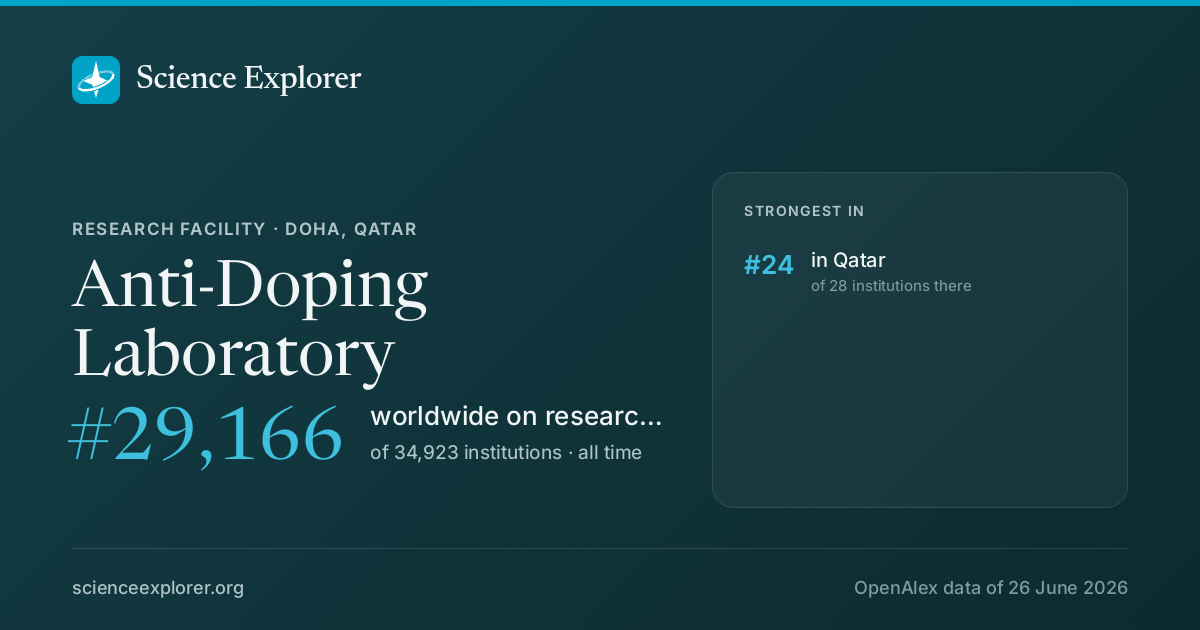
Anti-Doping Laboratory on Science Explorer

A card with Anti-Doping Laboratory's standing and the fields it leads in, for a post or a slide. A link to this page previews as the same card.

Download the card

1200 × 630 PNG, sized for social posts, drawn from the latest snapshot.

Badges for a website1Each links back here and updates with every snapshot

Research measures only: rankings here say nothing about teaching, admissions or student experience. Comparable institutions and collaboration partners have tabs of their own, above.

Discussion

Ask a question or share a note about Anti-Doping Laboratory. Posts are plain text and can be reported.