Science Explorer Back to mapMap
Nonprofit · New Haven · United States

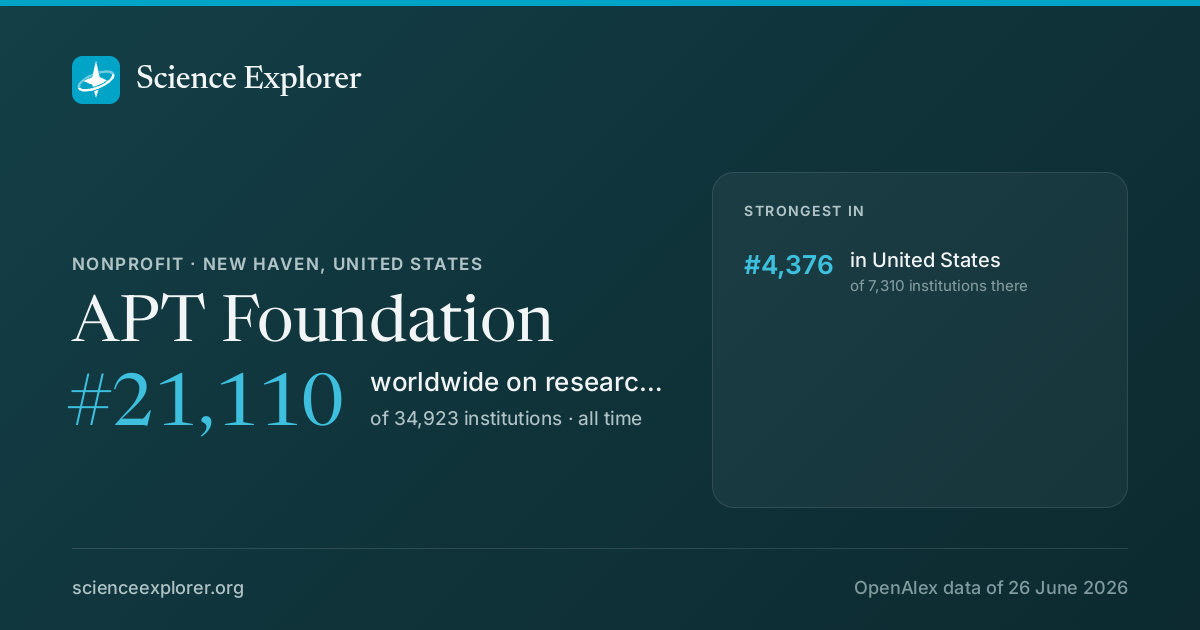
APT Foundation

World rank, all time
#21,110
of 34,923
Rank in United States
#4,376
of 7,310
Research works
207
▼ 6% vs 2018-21
Citations
12k
57.9 per fractional work
Top-10% rate
13.5%
all institutions 10.0%
vs its own fields
1.12×
1.00× is exactly expected
Open access
60%
world 40%
International
31%
world 18%

Which fields of science does APT Foundation work in?

In 2022-now, 63% of research at APT Foundation is in Health Sciences, 25% in Social Sciences. Its largest fields are Medicine (57%), Psychology (10%), Economics, Econometrics and Finance (7%). It does 2.2× the world's share of Health Sciences.

Health Sciences: 22 fractional works · 62.7% of its workMedicine: 20 fractional works · 57.3% of its workEpidemiology: 6 fractional works · 15.9% of its workPublic Health, Environmental and Occupational Health: 5 fractional works · 14.9% of its workInfectious Diseases: 1 fractional works · 4.0% of its workPediatrics, Perinatology and Child Health: 1 fractional works · 3.6% of its workAnesthesiology and Pain Medicine: 1 fractional works · 3.2% of its workGeriatrics and Gerontology: 1 fractional works · 2.6% of its workHepatology: 1 fractional works · 2.1% of its workPharmacology: 1 fractional works · 1.8% of its workCardiology and Cardiovascular Medicine: 0 fractional works · 1.4% of its workPhysiology: 0 fractional works · 1.3% of its workPulmonary and Respiratory Medicine: 0 fractional works · 1.2% of its workSurgery: 0 fractional works · 1.1% of its workNeurology: 0 fractional works · 0.8% of its workPathology and Forensic Medicine: 0 fractional works · 0.7% of its workPsychiatry and Mental health: 0 fractional works · 0.7% of its workEndocrinology, Diabetes and Metabolism: 0 fractional works · 0.5% of its workRehabilitation: 0 fractional works · 0.5% of its workRadiology, Nuclear Medicine and Imaging: 0 fractional works · 0.3% of its workOncology: 0 fractional works · 0.2% of its workSmaller subfields together: 0 fractional works · 0.4% of its workHealth Professions: 2 fractional works · 5.1% of its workGeneral Health Professions: 1 fractional works · 4.1% of its workRadiological and Ultrasound Technology: 0 fractional works · 0.9% of its workVeterinary: 0 fractional works · 0.2% of its workSmall Animals: 0 fractional works · 0.2% of its workNursing: 0 fractional works · 0.1% of its workSocial Sciences: 9 fractional works · 24.8% of its workPsychology: 4 fractional works · 10.2% of its workExperimental and Cognitive Psychology: 1 fractional works · 3.9% of its workClinical Psychology: 1 fractional works · 3.9% of its workSocial Psychology: 1 fractional works · 2.4% of its workEconomics, Econometrics and Finance: 2 fractional works · 7.1% of its workEconomics and Econometrics: 2 fractional works · 5.6% of its workGeneral Economics, Econometrics and Finance: 0 fractional works · 0.9% of its workFinance: 0 fractional works · 0.5% of its workSocial Sciences: 2 fractional works · 4.4% of its workLaw: 1 fractional works · 2.9% of its workSociology and Political Science: 0 fractional works · 0.8% of its workHealth: 0 fractional works · 0.6% of its workSmaller subfields together: 0 fractional works · 0.2% of its workBusiness, Management and Accounting: 1 fractional works · 1.5% of its workAccounting: 0 fractional works · 0.5% of its workManagement Information Systems: 0 fractional works · 0.5% of its workStrategy and Management: 0 fractional works · 0.4% of its workSmaller subfields together: 0 fractional works · 0.1% of its workDecision Sciences: 0 fractional works · 1.2% of its workManagement Science and Operations Research: 0 fractional works · 0.9% of its workStatistics, Probability and Uncertainty: 0 fractional works · 0.3% of its workArts and Humanities: 0 fractional works · 0.4% of its workVisual Arts and Performing Arts: 0 fractional works · 0.2% of its workSmaller subfields together: 0 fractional works · 0.2% of its workPhysical Sciences: 3 fractional works · 8.7% of its workEngineering: 1 fractional works · 3.2% of its workBiomedical Engineering: 0 fractional works · 0.9% of its workIndustrial and Manufacturing Engineering: 0 fractional works · 0.7% of its workMechanics of Materials: 0 fractional works · 0.7% of its workMedia Technology: 0 fractional works · 0.6% of its workMechanical Engineering: 0 fractional works · 0.2% of its workSmaller subfields together: 0 fractional works · 0.0% of its workMathematics: 1 fractional works · 2.4% of its workMathematical Physics: 0 fractional works · 0.8% of its workStatistics and Probability: 0 fractional works · 0.7% of its workNumerical Analysis: 0 fractional works · 0.5% of its workApplied Mathematics: 0 fractional works · 0.2% of its workSmaller subfields together: 0 fractional works · 0.1% of its workComputer Science: 1 fractional works · 1.7% of its workArtificial Intelligence: 1 fractional works · 1.7% of its workPhysics and Astronomy: 0 fractional works · 0.9% of its workStatistical and Nonlinear Physics: 0 fractional works · 0.5% of its workAtomic and Molecular Physics, and Optics: 0 fractional works · 0.3% of its workSmaller subfields together: 0 fractional works · 0.0% of its workMaterials Science: 0 fractional works · 0.5% of its workMaterials Chemistry: 0 fractional works · 0.3% of its workElectronic, Optical and Magnetic Materials: 0 fractional works · 0.2% of its workLife Sciences: 1 fractional works · 3.8% of its workNeuroscience: 0 fractional works · 1.3% of its workCognitive Neuroscience: 0 fractional works · 1.1% of its workSmaller subfields together: 0 fractional works · 0.2% of its workBiochemistry, Genetics and Molecular Biology: 0 fractional works · 1.0% of its workCancer Research: 0 fractional works · 0.3% of its workBiochemistry: 0 fractional works · 0.2% of its workGenetics: 0 fractional works · 0.2% of its workSmaller subfields together: 0 fractional works · 0.2% of its workPharmacology, Toxicology and Pharmaceutics: 0 fractional works · 1.0% of its workPharmacology: 0 fractional works · 0.7% of its workToxicology: 0 fractional works · 0.3% of its workImmunology and Microbiology: 0 fractional works · 0.3% of its workAgricultural and Biological Sciences: 0 fractional works · 0.2% of its workALL ITS WORKAPT Foundation35fractional works, 2022-now
Life Sciences4%Physical Sciences9%Health Sciences63%Social Sciences25%

Each ring splits the one inside it: the four domains of science, their fields, their subfields. Size is fractional works in 2022-now. Every slice is a page; the interactive view zooms down to single topics and colours each by how much more of it this institution does than the world.

Its 4 domains and 20 fields, with their numbers
    1. Medicine2057.3%
    2. Health Professions25.1%
    3. Veterinary00.2%
    4. Nursing00.1%
    1. Psychology410.2%
    2. Economics, Econometrics and Finance27.1%
    3. Social Sciences24.4%
    4. Business, Management and Accounting11.5%
    5. Decision Sciences01.2%
    6. Arts and Humanities00.4%
    1. Engineering13.2%
    2. Mathematics12.4%
    3. Computer Science11.7%
    4. Physics and Astronomy00.9%
    5. Materials Science00.5%
    1. Neuroscience01.3%
    2. Biochemistry, Genetics and Molecular Biology01.0%
    3. Pharmacology, Toxicology and Pharmaceutics01.0%
    4. Immunology and Microbiology00.3%
    5. Agricultural and Biological Sciences00.2%
All of science, and how each field's share has moved since 1950: the Science domain explorer

Field profile

Location quotient across every field it publishes in: outside the ring is more than an institution of this size would be expected to publish, inside it is less.

Agricultural and Biological Sciences: 0.04× its world share, 0 worksAgricultural and Bio…Biochemistry, Genetics and Molecular Biology: 0.19× its world share, 0 worksBiochemistry, Geneti…Immunology and Microbiology: 0.30× its world share, 0 worksImmunology and Micro…Neuroscience: 0.81× its world share, 0 worksNeurosciencePharmacology, Toxicology and Pharmaceutics: 2.77× its world share, 0 worksPharmacology, Toxico…Computer Science: 0.22× its world share, 1 worksComputer ScienceEngineering: 0.21× its world share, 1 worksEngineeringMaterials Science: 0.16× its world share, 0 worksMaterials ScienceMathematics: 2.03× its world share, 1 worksMathematicsPhysics and Astronomy: 0.39× its world share, 0 worksPhysics and AstronomyHealth Professions: 1.92× its world share, 2 worksHealth ProfessionsMedicine: 2.98× its world share, 20 worksMedicineNursing: 0.18× its world share, 0 worksNursingVeterinary: 1.76× its world share, 0 worksVeterinaryArts and Humanities: 0.15× its world share, 0 worksArts and HumanitiesBusiness, Management and Accounting: 0.45× its world share, 0 worksBusiness, Management…Decision Sciences: 1.28× its world share, 0 worksDecision SciencesEconomics, Econometrics and Finance: 3.32× its world share, 2 worksEconomics, Econometr…Psychology: 3.33× its world share, 4 worksPsychologySocial Sciences: 0.35× its world share, 2 worksSocial Sciences1×world share
more than its size predictsabout as predictedless

Rings at 0.5×, 1× and 2×. Widest outward: Psychology, 3.3×. Every wedge is a field page.

All 20 fields, with their numbers
  1. Psychology3.33×4 works
  2. Economics, Econometrics and Finance3.32×2 works
  3. Medicine2.98×20 works
  4. Pharmacology, Toxicology and Pharmaceutics2.77×0 works
  5. Mathematics2.03×1 works
  6. Health Professions1.92×2 works
  7. Veterinary1.76×0 works
  8. Decision Sciences1.28×0 works
  9. Neuroscience0.81×0 works
  10. Business, Management and Accounting0.45×0 works
  11. Physics and Astronomy0.39×0 works
  12. Social Sciences0.35×2 works
  13. Immunology and Microbiology0.30×0 works
  14. Computer Science0.22×1 works
  15. Engineering0.21×1 works
  16. Biochemistry, Genetics and Molecular Biology0.19×0 works
  17. Nursing0.18×0 works
  18. Materials Science0.16×0 works
  19. Arts and Humanities0.15×0 works
  20. Agricultural and Biological Sciences0.04×0 works

Who are the top researchers at APT Foundation?

Ranked on the quality score, Ryota Iijima, Lynn M. Madden and Scott O. Farnum lead among researchers whose main affiliation is APT Foundation.

  1. 1 Ryota Iijima United States · #694,740 worldwide 760 citations · 71 works
  2. 2 Lynn M. Madden United States · #911,274 worldwide 1.9k citations · 125 works
  3. 3 Scott O. Farnum United States · #1,029,385 worldwide 571 citations · 30 works
  4. 4 Timothy B. Armstrong United States · #1,066,660 worldwide 500 citations · 52 works
  5. 5 Kathryn F. Eggert United States · #1,898,954 worldwide 186 citations · 16 works
  6. 6 Aniko Oery United States · #2,809,292 worldwide 83 citations · 17 works
All ranked researchers at APT Foundation

What are the most cited papers from APT Foundation?

The most cited paper from APT Foundation is "Social Value of Public Information" (Stephen Edward Morris, Hyun Song Shin, 2002), with 2,034 citations. Next come "Estimating Marginal Returns to Education" (572) and "Approximately Median-Unbiased Estimation of Autoregressive Models" (429).

Most cited papers
#PaperReleasedCitations
1 Social Value of Public Information Stephen Edward Morris, Hyun Song Shin · American Economic Review Open access Nov 2002 2,034
2 Estimating Marginal Returns to Education Pedro Carneiro, James J. Heckman, Edward Vytlacil · American Economic Review Open access Oct 2011 572
3 Approximately Median-Unbiased Estimation of Autoregressive Models Donald W. K. Andrews, Hongyuan Chen · Journal of Business and Economic Statistics Apr 1994 429
4 Importers, Exporters and Multinationals: A Portrait of Firms in the U.S. That Trade Goods Andrew B. Bernard, J. Bradford Jensen, Peter K. Schott · SSRN Electronic Journal PreprintOpen access 2005 413
5 Vector autoregression and causality: a theoretical overview and simulation study Hiro Y. Toda, Peter C.B. Phillips · Econometric Reviews 1994 403
All 58 most cited papers, with filters and sorting

Which keywords describe research at APT Foundation?

By fractional works in 2022-now, weighted toward what it does more of than the world: Substance Use Disorders, Epidemiology, Mortality Risk, Chronic Pain Management, Opioid Prescribing, Public Health, Substance Abuse and drug use.

▲ more of its work than of the world's◆ about the world's share▼ less than the world's

Size is fractional works in 2022-now in the topics tagged with each word; colour is the word's share of this institution's work against its share of the world's. The 31 words are chosen for being large and distinctive. Each links to the topic it comes from most.

All 31 words, with their numbers
  1. Substance Use Disorders7▲ 261×2 topics
  2. Epidemiology7▲ 4.8×13 topics
  3. Mortality Risk5▲ 57×3 topics
  4. Chronic Pain Management4▲ 390×1 topic
  5. Opioid Prescribing4▲ 390×1 topic
  6. Public Health4▲ 7.8×8 topics
  7. Substance Abuse4▲ 148×2 topics
  8. HIV3▲ 106×1 topic
  9. drug use3▲ 308×1 topic
  10. Global Burden of Disease2▲ 29×2 topics
  11. Impulsivity2▲ 126×2 topics
  12. Alcohol Dependence2▲ 159×1 topic
  13. Motivational Interviewing2▲ 159×1 topic
  14. Mental Health1▲ 2.8×8 topics
  15. Antiretroviral Therapy1▲ 23×3 topics
  16. Quality of Life1▲ 2.6×4 topics
  17. Sustainable Development1▲ 2.5×4 topics
  18. Circadian Rhythms1▲ 33×2 topics
  19. HIV Transmission1▲ 44×1 topic
  20. Human Rights1▲ 3.4×3 topics
  21. Meta-Analysis1▲ 6.0×2 topics
  22. Pain Management1▲ 15×2 topics
  23. Postoperative Pain1▲ 37×2 topics
  24. Preexposure Prophylaxis1▲ 69×1 topic
  25. Psychometric Evaluation1▲ 35×2 topics
  26. Cancer Pain1▲ 116×1 topic
  27. Insomnia1▲ 44×1 topic
  28. Opioid Analgesics1▲ 116×1 topic
  29. Sleep Duration1▲ 47×1 topic
  30. Environmental Law1▲ 14×1 topic
  31. Rights of Nature1▲ 208×1 topic

Which research topics does APT Foundation publish most on?

By volume in 2022-now: Opioid Use Disorder Treatment, HIV, Drug Use, Sexual Risk, Substance Abuse Treatment and Outcomes and HIV/AIDS Research and Interventions.

  1. 1 Opioid Use Disorder Treatment Public Health, Environmental and Occupational Health 4 works
  2. 2 HIV, Drug Use, Sexual Risk Epidemiology 3 works
  3. 3 Substance Abuse Treatment and Outcomes Epidemiology 2 works
  4. 4 HIV/AIDS Research and Interventions Infectious Diseases 1 works
  5. 5 Pain Management and Opioid Use Anesthesiology and Pain Medicine 1 works
  6. 6 Sleep and related disorders Experimental and Cognitive Psychology 1 works
  7. 7 Environmental law and policy Law 1 works
  8. 8 Pharmaceutical Practices and Patient Outcomes Geriatrics and Gerontology 1 works
  9. 9 Migration, Health and Trauma Clinical Psychology 1 works
  10. 10 Hepatitis C virus research Hepatology 1 works

How open and international is its research?

Against the world's own shares: the tick on each track. Both are shares of its output, so they sit on one scale and can be read against each other as well as against the world.

openly available60.4%not open39.6%

World: 40% of research is openly available.

with international co-authors30.7%domestic only69.3%

World: 18% is written across borders.

How has APT Foundation's research output changed?

Output in 2022-2025 was 6% lower than in 2018-2021.

still counting1990200020102020
grewheldshrank

The same series as a ribbon: one cell per year, darker for more. The line above answers how much; this answers when.

Its share of all research

Growing output can still be a shrinking share: all of science grows. This is APT Foundation as a percentage of every work published that year, 0.00013% in 2024.

still counting0.00050%0.0010%APT Foundation0.00012% in 202519801990200020102020

Fractional works of APT Foundation over all fractional works that year. How the balance of science has shifted.

Other research institutions in New Haven

All research institutions in New Haven

Share APT Foundation's ranking

APT Foundation on Science Explorer

A card with APT Foundation's standing and the fields it leads in, for a post or a slide. A link to this page previews as the same card.

Download the card

1200 × 630 PNG, sized for social posts, drawn from the latest snapshot.

Badges for a website1Each links back here and updates with every snapshot

Research measures only: rankings here say nothing about teaching, admissions or student experience. Comparable institutions and collaboration partners have tabs of their own, above.

Discussion

Ask a question or share a note about APT Foundation. Posts are plain text and can be reported.