Science Explorer Back to mapMap

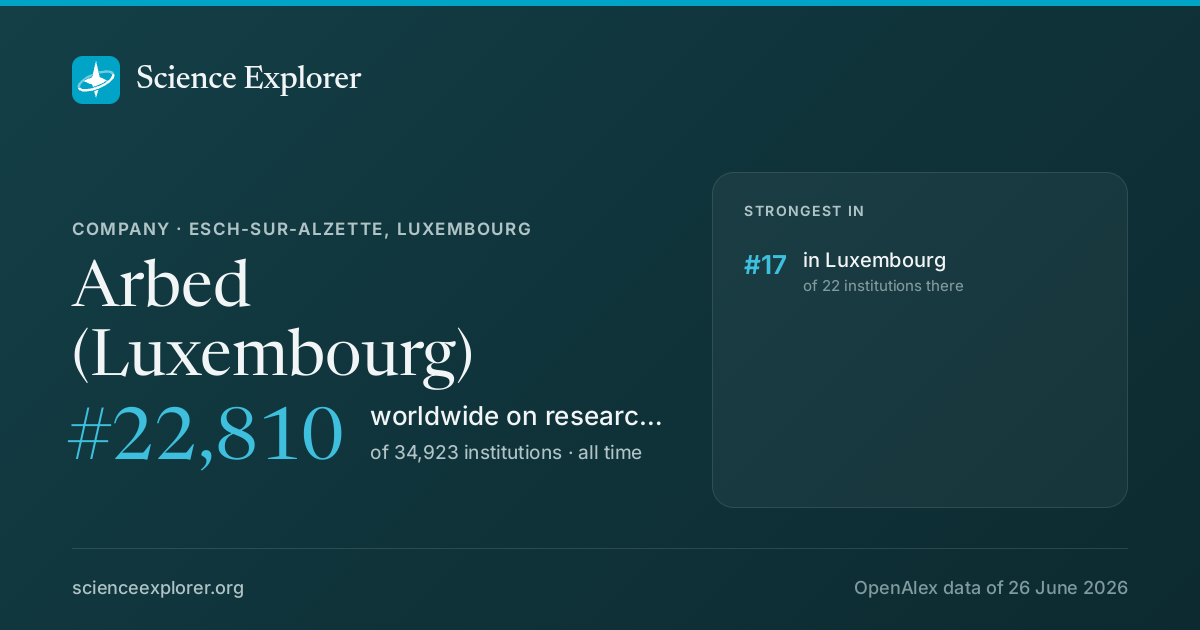
Arbed (Luxembourg)

World rank, all time
#22,810
of 34,923
Rank in Luxembourg
#17
of 22
Research works
132
▲ 144% vs 2018-21
Citations
1.4k
10.8 per fractional work
Top-10% rate
10.3%
all institutions 10.0%
vs its own fields
1.02×
1.00× is exactly expected
Open access
56%
world 40%
International
46%
world 18%

Which fields of science does Arbed (Luxembourg) work in?

In 2022-now, 45% of research at Arbed (Luxembourg) is in Social Sciences, 36% in Physical Sciences. Its largest fields are Social Sciences (22%), Engineering (14%), Computer Science (11%). It does 1.7× the world's share of Social Sciences.

Social Sciences: 28 fractional works · 44.6% of its workSocial Sciences: 14 fractional works · 21.6% of its workSociology and Political Science: 4 fractional works · 6.6% of its workPolitical Science and International Relations: 3 fractional works · 5.4% of its workDemography: 1 fractional works · 1.9% of its workEducation: 1 fractional works · 1.7% of its workGeography, Planning and Development: 1 fractional works · 1.6% of its workTransportation: 1 fractional works · 1.1% of its workLinguistics and Language: 1 fractional works · 1.0% of its workAnthropology: 0 fractional works · 0.5% of its workLaw: 0 fractional works · 0.4% of its workCultural Studies: 0 fractional works · 0.3% of its workHealth: 0 fractional works · 0.3% of its workSafety Research: 0 fractional works · 0.3% of its workSmaller subfields together: 0 fractional works · 0.4% of its workArts and Humanities: 5 fractional works · 7.2% of its workPhilosophy: 2 fractional works · 2.5% of its workHistory: 1 fractional works · 1.6% of its workLanguage and Linguistics: 1 fractional works · 1.1% of its workLiterature and Literary Theory: 1 fractional works · 0.9% of its workVisual Arts and Performing Arts: 0 fractional works · 0.5% of its workClassics: 0 fractional works · 0.3% of its workSmaller subfields together: 0 fractional works · 0.3% of its workEconomics, Econometrics and Finance: 5 fractional works · 7.1% of its workEconomics and Econometrics: 2 fractional works · 3.7% of its workFinance: 1 fractional works · 1.7% of its workGeneral Economics, Econometrics and Finance: 1 fractional works · 1.7% of its workPsychology: 3 fractional works · 5.1% of its workClinical Psychology: 1 fractional works · 1.7% of its workDevelopmental and Educational Psychology: 1 fractional works · 1.6% of its workNeuropsychology and Physiological Psychology: 1 fractional works · 0.9% of its workSocial Psychology: 0 fractional works · 0.6% of its workSmaller subfields together: 0 fractional works · 0.4% of its workBusiness, Management and Accounting: 1 fractional works · 2.1% of its workStrategy and Management: 1 fractional works · 0.8% of its workMarketing: 0 fractional works · 0.6% of its workOrganizational Behavior and Human Resource Management: 0 fractional works · 0.3% of its workAccounting: 0 fractional works · 0.2% of its workSmaller subfields together: 0 fractional works · 0.2% of its workDecision Sciences: 1 fractional works · 1.5% of its workManagement Science and Operations Research: 0 fractional works · 0.7% of its workInformation Systems and Management: 0 fractional works · 0.6% of its workSmaller subfields together: 0 fractional works · 0.2% of its workPhysical Sciences: 23 fractional works · 36.3% of its workEngineering: 9 fractional works · 13.8% of its workBuilding and Construction: 1 fractional works · 2.1% of its workElectrical and Electronic Engineering: 1 fractional works · 2.1% of its workCivil and Structural Engineering: 1 fractional works · 1.7% of its workIndustrial and Manufacturing Engineering: 1 fractional works · 1.6% of its workMechanical Engineering: 1 fractional works · 1.3% of its workAerospace Engineering: 1 fractional works · 1.2% of its workMechanics of Materials: 1 fractional works · 1.0% of its workControl and Systems Engineering: 1 fractional works · 0.8% of its workBiomedical Engineering: 0 fractional works · 0.8% of its workAutomotive Engineering: 0 fractional works · 0.7% of its workSafety, Risk, Reliability and Quality: 0 fractional works · 0.3% of its workSmaller subfields together: 0 fractional works · 0.1% of its workComputer Science: 7 fractional works · 11.5% of its workArtificial Intelligence: 4 fractional works · 6.6% of its workComputer Networks and Communications: 1 fractional works · 1.6% of its workComputer Vision and Pattern Recognition: 1 fractional works · 1.1% of its workSignal Processing: 0 fractional works · 0.5% of its workSoftware: 0 fractional works · 0.5% of its workComputational Theory and Mathematics: 0 fractional works · 0.4% of its workComputer Science Applications: 0 fractional works · 0.4% of its workInformation Systems: 0 fractional works · 0.3% of its workEnvironmental Science: 2 fractional works · 2.6% of its workEnvironmental Engineering: 1 fractional works · 0.9% of its workGlobal and Planetary Change: 0 fractional works · 0.5% of its workWater Science and Technology: 0 fractional works · 0.5% of its workManagement, Monitoring, Policy and Law: 0 fractional works · 0.4% of its workSmaller subfields together: 0 fractional works · 0.3% of its workMathematics: 2 fractional works · 2.5% of its workStatistics and Probability: 1 fractional works · 1.1% of its workGeometry and Topology: 0 fractional works · 0.5% of its workMathematical Physics: 0 fractional works · 0.3% of its workApplied Mathematics: 0 fractional works · 0.3% of its workSmaller subfields together: 0 fractional works · 0.2% of its workPhysics and Astronomy: 1 fractional works · 2.2% of its workAstronomy and Astrophysics: 1 fractional works · 0.9% of its workAtomic and Molecular Physics, and Optics: 0 fractional works · 0.7% of its workNuclear and High Energy Physics: 0 fractional works · 0.5% of its workSmaller subfields together: 0 fractional works · 0.1% of its workEarth and Planetary Sciences: 1 fractional works · 2.0% of its workAtmospheric Science: 1 fractional works · 0.9% of its workGeology: 0 fractional works · 0.3% of its workGeochemistry and Petrology: 0 fractional works · 0.3% of its workGeophysics: 0 fractional works · 0.3% of its workPaleontology: 0 fractional works · 0.3% of its workMaterials Science: 1 fractional works · 1.3% of its workMaterials Chemistry: 1 fractional works · 0.9% of its workPolymers and Plastics: 0 fractional works · 0.2% of its workSmaller subfields together: 0 fractional works · 0.2% of its workChemistry: 0 fractional works · 0.4% of its workSpectroscopy: 0 fractional works · 0.3% of its workSmaller subfields together: 0 fractional works · 0.1% of its workHealth Sciences: 8 fractional works · 11.9% of its workMedicine: 6 fractional works · 9.6% of its workNeurology: 1 fractional works · 1.7% of its workPublic Health, Environmental and Occupational Health: 1 fractional works · 1.1% of its workPulmonary and Respiratory Medicine: 1 fractional works · 0.9% of its workPhysiology: 1 fractional works · 0.9% of its workSurgery: 0 fractional works · 0.8% of its workPathology and Forensic Medicine: 0 fractional works · 0.6% of its workOncology: 0 fractional works · 0.5% of its workPediatrics, Perinatology and Child Health: 0 fractional works · 0.4% of its workRadiology, Nuclear Medicine and Imaging: 0 fractional works · 0.3% of its workPsychiatry and Mental health: 0 fractional works · 0.3% of its workRehabilitation: 0 fractional works · 0.3% of its workComplementary and alternative medicine: 0 fractional works · 0.3% of its workInfectious Diseases: 0 fractional works · 0.3% of its workSmaller subfields together: 1 fractional works · 1.3% of its workHealth Professions: 1 fractional works · 2.3% of its workGeneral Health Professions: 1 fractional works · 1.6% of its workPharmacy: 0 fractional works · 0.3% of its workSpeech and Hearing: 0 fractional works · 0.3% of its workSmaller subfields together: 0 fractional works · 0.2% of its workLife Sciences: 5 fractional works · 7.3% of its workBiochemistry, Genetics and Molecular Biology: 3 fractional works · 5.0% of its workMolecular Biology: 2 fractional works · 3.9% of its workCancer Research: 0 fractional works · 0.4% of its workBiophysics: 0 fractional works · 0.3% of its workGenetics: 0 fractional works · 0.2% of its workSmaller subfields together: 0 fractional works · 0.3% of its workNeuroscience: 1 fractional works · 1.8% of its workCognitive Neuroscience: 1 fractional works · 1.2% of its workSmaller subfields together: 0 fractional works · 0.6% of its workAgricultural and Biological Sciences: 0 fractional works · 0.3% of its workImmunology and Microbiology: 0 fractional works · 0.1% of its workPharmacology, Toxicology and Pharmaceutics: 0 fractional works · 0.0% of its workALL ITS WORKArbed(Luxembourg)63fractional works, 2022-now
Life Sciences7%Physical Sciences36%Health Sciences12%Social Sciences45%

Each ring splits the one inside it: the four domains of science, their fields, their subfields. Size is fractional works in 2022-now. Every slice is a page; the interactive view zooms down to single topics and colours each by how much more of it this institution does than the world.

Its 4 domains and 21 fields, with their numbers
    1. Social Sciences1421.6%
    2. Arts and Humanities57.2%
    3. Economics, Econometrics and Finance57.1%
    4. Psychology35.1%
    5. Business, Management and Accounting12.1%
    6. Decision Sciences11.5%
    1. Engineering913.8%
    2. Computer Science711.5%
    3. Environmental Science22.6%
    4. Mathematics22.5%
    5. Physics and Astronomy12.2%
    6. Earth and Planetary Sciences12.0%
    7. Materials Science11.3%
    8. Chemistry00.4%
    1. Medicine69.6%
    2. Health Professions12.3%
    1. Biochemistry, Genetics and Molecular Biology35.0%
    2. Neuroscience11.8%
    3. Agricultural and Biological Sciences00.3%
    4. Immunology and Microbiology00.1%
    5. Pharmacology, Toxicology and Pharmaceutics00.0%
All of science, and how each field's share has moved since 1950: the Science domain explorer

Field profile

Location quotient across every field it publishes in: outside the ring is more than an institution of this size would be expected to publish, inside it is less.

Agricultural and Biological Sciences: 0.06× its world share, 0 worksAgricultural and Bio…Biochemistry, Genetics and Molecular Biology: 0.95× its world share, 3 worksBiochemistry, Geneti…Immunology and Microbiology: 0.12× its world share, 0 worksImmunology and Micro…Neuroscience: 1.09× its world share, 1 worksNeurosciencePharmacology, Toxicology and Pharmaceutics: 0.15× its world share, 0 worksPharmacology, Toxico…Chemistry: 0.25× its world share, 0 worksChemistryComputer Science: 1.48× its world share, 7 worksComputer ScienceEarth and Planetary Sciences: 1.28× its world share, 1 worksEarth and Planetary …Engineering: 0.92× its world share, 9 worksEngineeringEnvironmental Science: 0.52× its world share, 2 worksEnvironmental ScienceMaterials Science: 0.36× its world share, 1 worksMaterials ScienceMathematics: 2.13× its world share, 2 worksMathematicsPhysics and Astronomy: 1.00× its world share, 1 worksPhysics and AstronomyHealth Professions: 0.88× its world share, 2 worksHealth ProfessionsMedicine: 0.50× its world share, 6 worksMedicineArts and Humanities: 2.49× its world share, 5 worksArts and HumanitiesBusiness, Management and Accounting: 0.64× its world share, 1 worksBusiness, Management…Decision Sciences: 1.55× its world share, 1 worksDecision SciencesEconomics, Econometrics and Finance: 3.32× its world share, 4 worksEconomics, Econometr…Psychology: 1.66× its world share, 3 worksPsychologySocial Sciences: 1.71× its world share, 14 worksSocial Sciences1×world share
more than its size predictsabout as predictedless

Rings at 0.5×, 1× and 2×. Widest outward: Economics, Econometrics and Finance, 3.3×. Every wedge is a field page.

All 21 fields, with their numbers
  1. Economics, Econometrics and Finance3.32×4 works
  2. Arts and Humanities2.49×5 works
  3. Mathematics2.13×2 works
  4. Social Sciences1.71×14 works
  5. Psychology1.66×3 works
  6. Decision Sciences1.55×1 works
  7. Computer Science1.48×7 works
  8. Earth and Planetary Sciences1.28×1 works
  9. Neuroscience1.09×1 works
  10. Physics and Astronomy1.00×1 works
  11. Biochemistry, Genetics and Molecular Biology0.95×3 works
  12. Engineering0.92×9 works
  13. Health Professions0.88×2 works
  14. Business, Management and Accounting0.64×1 works
  15. Environmental Science0.52×2 works
  16. Medicine0.50×6 works
  17. Materials Science0.36×1 works
  18. Chemistry0.25×0 works
  19. Pharmacology, Toxicology and Pharmaceutics0.15×0 works
  20. Immunology and Microbiology0.12×0 works
  21. Agricultural and Biological Sciences0.06×0 works

What are the most cited papers from Arbed (Luxembourg)?

The most cited paper from Arbed (Luxembourg) is "Escalating impacts of climate extremes on critical infrastructures in Europe" (Forzieri Giovanni, Alessandra Bianchi, Filipe Batista e Silva et al., 2017), with 419 citations. Next come "The carnage of substandard research during the COVID-19 pandemic: a call for quality" (186) and "Microglia integration into human midbrain organoids leads to increased neuronal maturation and functionality" (179).

Most cited papers
#PaperReleasedCitations
1 Escalating impacts of climate extremes on critical infrastructures in Europe Forzieri Giovanni, Alessandra Bianchi, Filipe Batista e Silva et al. · Global Environmental Change Open access 25 Nov 2017 419
2 The carnage of substandard research during the COVID-19 pandemic: a call for quality Katrina A. Bramstedt · Journal of Medical Ethics Open access Oct 2020 186
3 Microglia integration into human midbrain organoids leads to increased neuronal maturation and functionality Sònia Sabaté‐Soler, Sarah Nickels, Cláudia Saraiva et al. · Glia Open access 9 Mar 2022 179
4 Localizing signs in positional vertigo due to lateral canal cupulolithiasis Alexandre Bisdorff, D. Debatisse · Neurology 25 Sep 2001 169
5 Cognitive Impairment in people living with HIV in the ART era: A Review Kate A. Alford, Jaime H. Vera · British Medical Bulletin Open access 22 May 2018 168
All 59 most cited papers, with filters and sorting

Which keywords describe research at Arbed (Luxembourg)?

By fractional works in 2022-now, weighted toward what it does more of than the world: Globalization, Fiscal Policy, Territorial Governance, Monetary Policy, Economic Growth, Neural Networks, Tourism and Policy.

▲ more of its work than of the world's◆ about the world's share▼ less than the world's

Size is fractional works in 2022-now in the topics tagged with each word; colour is the word's share of this institution's work against its share of the world's. The 32 words are chosen for being large and distinctive. Each links to the topic it comes from most.

All 32 words, with their numbers
  1. Globalization4▲ 3.5×18 topics
  2. Neural Networks2▲ 2.4×9 topics
  3. Sustainability2▲ 1.28×8 topics
  4. Deep Learning2◆ 0.89×14 topics
  5. Economic Growth2▲ 3.7×8 topics
  6. Climate Change2◆ 1.04×10 topics
  7. Fiscal Policy2▲ 13×6 topics
  8. Machine Learning2▼ 0.75×12 topics
  9. Sustainable Development2▲ 1.59×6 topics
  10. Territorial Governance2▲ 22×2 topics
  11. Economic Development2▲ 3.0×5 topics
  12. Epidemiology2▼ 0.57×13 topics
  13. Monetary Policy2▲ 10×6 topics
  14. Education1▲ 1.21×11 topics
  15. Migration1▲ 5.9×6 topics
  16. Cultural Identity1▲ 3.9×4 topics
  17. Identity1▲ 2.5×7 topics
  18. Knowledge Management1▲ 3.4×2 topics
  19. Policy1▲ 8.5×2 topics
  20. Political Economy1▲ 7.2×5 topics
  21. Tourism1▲ 21×3 topics
  22. Artificial Intelligence1▲ 1.25×7 topics
  23. Colonialism1▲ 3.5×7 topics
  24. Innovation1▲ 1.72×4 topics
  25. Renewable Energy1▲ 1.22×4 topics
  26. Citizen Participation1▲ 14×1 topic
  27. Community Engagement1▲ 5.0×2 topics
  28. Environmental Participation1▲ 22×1 topic
  29. European Union1▲ 7.1×6 topics
  30. Machine Translation1▲ 9.7×2 topics
  31. Regional Disparities1▲ 33×1 topic
  32. Social Impact1▲ 4.0×1 topic

Which research topics does Arbed (Luxembourg) publish most on?

By volume in 2022-now: Hungarian Social, Economic and Educational Studies, French Urban and Social Studies, Reformation and Early Modern Christianity and Topic Modeling.

  1. 1 Hungarian Social, Economic and Educational Studies Geography, Planning and Development 1 works
  2. 2 French Urban and Social Studies Sociology and Political Science 1 works
  3. 3 Reformation and Early Modern Christianity History 1 works
  4. 4 Topic Modeling Artificial Intelligence 1 works
  5. 5 Social Policy and Reform Studies Political Science and International Relations 1 works
  6. 6 Monetary Policy and Economic Impact General Economics, Econometrics and Finance 1 works
  7. 7 Climate Change Policy and Economics Economics and Econometrics 1 works
  8. 8 Cross-Border Cooperation and Integration Political Science and International Relations 1 works
  9. 9 Space Satellite Systems and Control Aerospace Engineering 1 works
  10. 10 Aging and Gerontology Research Neuropsychology and Physiological Psychology 1 works

How open and international is its research?

Against the world's own shares: the tick on each track. Both are shares of its output, so they sit on one scale and can be read against each other as well as against the world.

openly available56.1%not open43.9%

World: 40% of research is openly available.

with international co-authors46.1%domestic only53.9%

World: 18% is written across borders.

How has Arbed (Luxembourg)'s research output changed?

Output in 2022-2025 was 144% higher than in 2018-2021.

still counting1990200020102020
grewheldshrank

The same series as a ribbon: one cell per year, darker for more. The line above answers how much; this answers when.

Its share of all research

Growing output can still be a shrinking share: all of science grows. This is Arbed (Luxembourg) as a percentage of every work published that year, 0.00020% in 2024.

still counting0.00025%0.00050%0.00075%Arbed (Luxembourg)0.00037% in 202519801990200020102020

Fractional works of Arbed (Luxembourg) over all fractional works that year. How the balance of science has shifted.

Other research institutions in Esch-sur-Alzette

All research institutions in Esch-sur-Alzette

Share Arbed (Luxembourg)'s ranking

Arbed (Luxembourg) on Science Explorer

A card with Arbed (Luxembourg)'s standing and the fields it leads in, for a post or a slide. A link to this page previews as the same card.

Download the card

1200 × 630 PNG, sized for social posts, drawn from the latest snapshot.

Badges for a website1Each links back here and updates with every snapshot

Research measures only: rankings here say nothing about teaching, admissions or student experience. Comparable institutions and collaboration partners have tabs of their own, above.

Discussion

Ask a question or share a note about Arbed (Luxembourg). Posts are plain text and can be reported.