 Science in Luxembourg
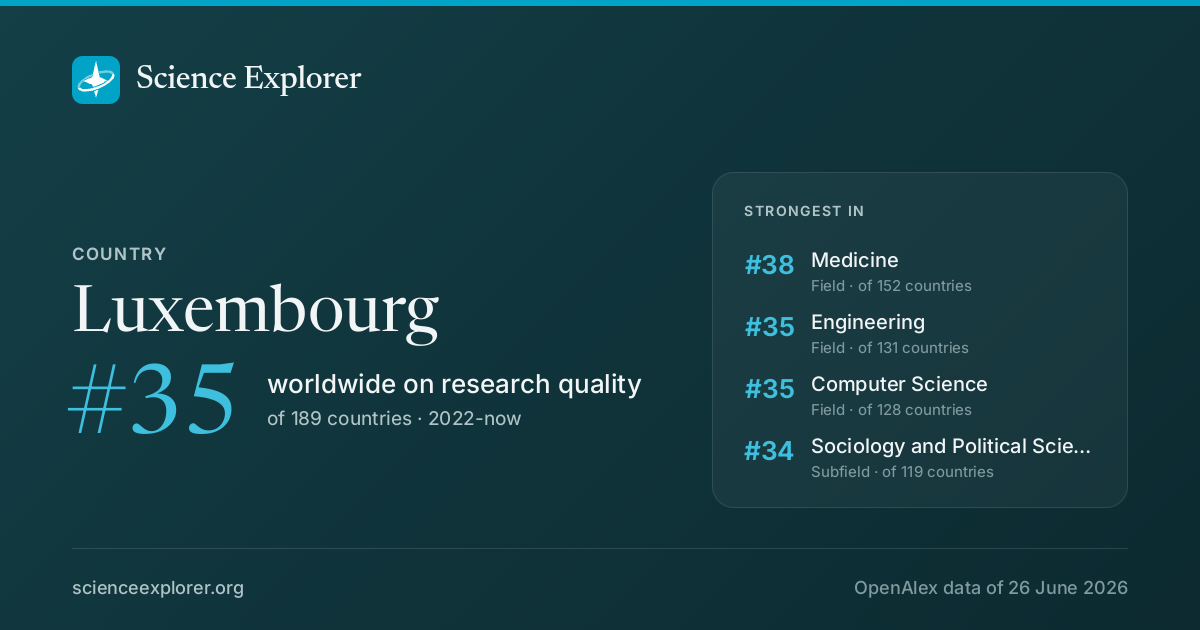
Luxembourg ranks #35 of 189 countries on research quality in 2022-now (#33 all time), with 7.7k research works and 11.9% of them in the world's top 10%.
- World rank, 2022-now
- #35 of 189 · #33 all time
- Works, 2022-now
- 7.7k ▼ 22% vs 2018-21
- Citations
- 486k 10.1 per fractional work, all time
- Top-10% rate
- 11.9% all institutions 10.0%
- vs its own fields
- 1.21× 1.00× is exactly expected
- In the world top 100
- 0 1 in the top 1,000
- Open access
- 55% world 40%
- International
- 29% world 18%
LuxembourgWhat is Luxembourg strongest at in science?
On research quality in 2022-now, Luxembourg ranks highest in Medicine (#38 of 152), Engineering (#35 of 131) and Computer Science (#35 of 128). Relative to its size it is most specialised in Software, Industrial relations and Medical Terminology.
| Field | World rank | Where that sits | Top-10% rate | Works | All time | Institutions |
|---|---|---|---|---|---|---|
| MedicineField | #38 of 152 | 12.0% | 737 | #39 | Institutions | |
| EngineeringField | #35 of 131 | 13.3% | 1,345 | #39 | Institutions | |
| Computer ScienceField | #35 of 128 | 12.6% | 1,139 | #36 | Institutions | |
| Sociology and Political ScienceSubfield | #34 of 119 | 10.7% | 426 | #30 | Institutions | |
| Social SciencesField | #44 of 148 | 11.3% | 1,302 | #36 | Institutions | |
| Computer Networks and CommunicationsSubfield | #22 of 68 | 15.8% | 214 | #24 | Institutions | |
| Electrical and Electronic EngineeringSubfield | #28 of 86 | 14.5% | 384 | #30 | Institutions | |
| Economics, Econometrics and FinanceField | #37 of 107 | 11.9% | 333 | #32 | Institutions | |
| Aerospace EngineeringSubfield | #23 of 64 | 16.7% | 239 | - | Institutions | |
| Artificial IntelligenceSubfield | #32 of 87 | 10.3% | 400 | #33 | Institutions | |
| Biochemistry, Genetics and Molecular BiologyField | #39 of 105 | 12.7% | 281 | #40 | Institutions | |
| Political Science and International RelationsSubfield | #36 of 95 | 12.3% | 310 | #26 | Institutions |
Where its research is concentrated
Location quotient: how much more (or less) of each node it does than its size predicts. Drawn around 1×, where "twice the world share" and "half of it" are the same distance apart in opposite directions. A volume reading, which on a country axis is largely population and industrial structure.
- SoftwareSubfield · 59.3 works · #45 of 160 active here10×
- Industrial relationsSubfield · 2.8 works · #25 of 95 active here10×
- Medical TerminologySubfield · 1.9 works · #43 of 121 active here7.3×
- Chemical Health and SafetySubfield · 3.1 works · #62 of 139 active here5.5×
- FinanceSubfield · 132.6 works · #66 of 210 active here5.0×
- Linguistics and LanguageSubfield · 36.9 works · #78 of 194 active here3.7×
- Neuropsychology and Physiological PsychologySubfield · 10.3 works · #64 of 169 active here3.6×
- Computer Networks and CommunicationsSubfield · 239.0 works · #69 of 206 active here3.0×
The whole field profile
All 26 fields at once. A specialist and a generalist produce the same ranked list and a completely different shape.
Rings at 0.5×, 1× and 2×. Widest outward: Economics, Econometrics and Finance, 1.9×. Every wedge is a field page.
All 26 fields, with their numbers
- Economics, Econometrics and Finance1.94×366 works
- Computer Science1.92×1,314 works
- Arts and Humanities1.64×416 works
- Mathematics1.58×164 works
- Decision Sciences1.42×121 works
- Social Sciences1.30×1,446 works
- Psychology1.23×329 works
- Physics and Astronomy1.19×232 works
- Business, Management and Accounting1.17×331 works
- Engineering1.15×1,511 works
- Neuroscience0.93×133 works
- Materials Science0.82×253 works
- Health Professions0.80×184 works
- Environmental Science0.79×347 works
- Biochemistry, Genetics and Molecular Biology0.70×329 works
- Immunology and Microbiology0.70×62 works
- Earth and Planetary Sciences0.66×91 works
- Energy0.62×50 works
- Chemical Engineering0.60×19 works
- Medicine0.50×846 works
- Nursing0.47×20 works
- Chemistry0.38×53 works
- Agricultural and Biological Sciences0.37×152 works
- Veterinary0.36×4 works
- Pharmacology, Toxicology and Pharmaceutics0.31×10 works
- Dentistry0.25×10 works
Which fields of science does Luxembourg work in?
In 2022-now, 46% of research in Luxembourg is in Physical Sciences, 34% in Social Sciences. Its largest fields are Engineering (17%), Social Sciences (16%), Computer Science (15%). It does 1.4× the world's share of Social Sciences.
Each ring splits the one inside it: the four domains of science, their fields, their subfields. Size is fractional works in 2022-now. Every slice is a page; the interactive view zooms down to single topics and colours each by how much more of it this country does than the world.
Its 4 domains and 26 fields, with their numbers
- Physical Sciences4,03345.9%
- Engineering1,51117.2%
- Computer Science1,31415.0%
- Environmental Science3473.9%
- Materials Science2532.9%
- Physics and Astronomy2322.6%
- Mathematics1641.9%
- Earth and Planetary Sciences911.0%
- Chemistry530.6%
- Energy500.6%
- Chemical Engineering190.2%
- Social Sciences3,00834.2%
- Social Sciences1,44616.4%
- Arts and Humanities4164.7%
- Economics, Econometrics and Finance3664.2%
- Business, Management and Accounting3313.8%
- Psychology3293.7%
- Decision Sciences1211.4%
- Health Sciences1,06612.1%
- Medicine8469.6%
- Health Professions1842.1%
- Nursing200.2%
- Dentistry100.1%
- Veterinary40.0%
- Life Sciences6867.8%
Which keywords describe research in Luxembourg?
By fractional works in 2022-now, weighted toward what it does more of than the world: Machine Learning, Deep Learning, Globalization, European Union, Energy Efficiency, Physical Layer Security, Cognitive Radio and LEO Satellite Constellation.
- MIMO Systems
- European Integration
- Wireless Networks
- Sociolinguistics
- Monetary Policy
- 5G Networks
- Satellite Communications
- Security Analysis
- IoT Security
- Democracy
- Governance
- Ethics
- Security
- Internet of Things
- Human Rights
- Big Data
- Energy Efficiency
- Neural Networks
- Epidemiology
- Deep Learning
- Machine Learning
- Globalization
- Sustainability
- Climate Change
- Artificial Intelligence
- Mental Health
- Public Health
- Healthcare
- European Union
- Gender
- Colonialism
- Physical Layer Security
- Cognitive Radio
- LEO Satellite Constellation
- Territorial Governance
- Labor Market
- Wireless Communication
- Channel Estimation
- Local Development
- Institutionalization
Size is fractional works in 2022-now in the topics tagged with each word; colour is the word's share of this country's work against its share of the world's. The 40 words are chosen for being large and distinctive. Each links to the topic it comes from most.
All 40 words, with their numbers
- Machine Learning428▲ 1.46×87 topics
- Deep Learning407▲ 1.34×75 topics
- Globalization289▲ 1.67×133 topics
- Epidemiology209▼ 0.60×135 topics
- Sustainability208◆ 0.97×10⁴ topics
- Neural Networks188▲ 1.38×39 topics
- Climate Change174▼ 0.73×10³ topics
- Energy Efficiency171▲ 2.1×36 topics
- Artificial Intelligence162▲ 1.29×48 topics
- Big Data158▲ 1.88×27 topics
- Mental Health156▲ 1.24×42 topics
- Human Rights154▲ 1.71×66 topics
- Public Health149▲ 1.16×64 topics
- Internet of Things140▲ 1.86×22 topics
- Healthcare137▲ 1.36×35 topics
- Security134▲ 2.3×26 topics
- European Union120▲ 6.1×25 topics
- Ethics95▲ 2.1×41 topics
- Gender94▲ 1.98×41 topics
- Governance87▲ 3.0×17 topics
- Colonialism86▲ 2.0×44 topics
- Democracy85▲ 2.8×24 topics
- Physical Layer Security84▲ 22×2 topics
- IoT Security78▲ 2.9×3 topics
- Cognitive Radio78▲ 25×2 topics
- Security Analysis78▲ 5.2×4 topics
- LEO Satellite Constellation76▲ 30×1 topic
- Satellite Communications76▲ 30×1 topic
- Territorial Governance73▲ 7.2×3 topics
- 5G Networks73▲ 4.1×5 topics
- Labor Market72▲ 2.9×15 topics
- Monetary Policy72▲ 3.5×12 topics
- Wireless Communication69▲ 5.4×7 topics
- Sociolinguistics62▲ 3.8×9 topics
- Channel Estimation58▲ 7.5×4 topics
- Wireless Networks58▲ 4.4×9 topics
- Local Development53▲ 5.8×2 topics
- European Integration50▲ 10×6 topics
- Institutionalization50▲ 6.2×5 topics
- MIMO Systems50▲ 7.2×3 topics
Which research topics does Luxembourg publish the most in?
Its largest topics in 2022-now are Satellite Communication Systems, Blockchain Technology Applications and Security, Advanced Wireless Communication Technologies.
Area is fractional works in 2022-now; colour is the subfield each topic belongs to. Every tile is a topic page.
- 1 Satellite Communication Systems Aerospace Engineering 77 works
- 2 Blockchain Technology Applications and Security Information Systems 42 works
- 3 Advanced Wireless Communication Technologies Electrical and Electronic Engineering 38 works
- 4 Software Testing and Debugging Techniques Software 32 works
- 5 Advanced MIMO Systems Optimization Electrical and Electronic Engineering 32 works
- 6 Advanced Malware Detection Techniques Signal Processing 30 works
- 7 Topic Modeling Artificial Intelligence 29 works
- 8 French Urban and Social Studies Sociology and Political Science 28 works
- 9 IoT and Edge/Fog Computing Computer Networks and Communications 28 works
- 10 Software Engineering Research Information Systems 27 works
- 11 Privacy-Preserving Technologies in Data Artificial Intelligence 27 works
- 12 Digital Transformation in Industry Industrial and Manufacturing Engineering 27 works
How many world-class institutions does Luxembourg hold?
Average quality and elite capacity disagree by construction, and both are worth knowing: the first is decided by a country's whole institution population, the second counts the institutions it holds at the top. One square per institution.
| Standing among countries | 2022-now | Where that sits | All time |
|---|---|---|---|
| Average qualityits whole institution population | #35 of 189 | #33 of 203 | |
| Elite capacitythe institutions it holds at the top | #38 of 204 | #34 of 216 |
Elite capacity counts a country's institutions by their worldwide rank, weighted so a place at #1 counts for more than one at #480. Countries under 100 fractional works are left out.
Bands are exclusive, so the squares add up to 1 (the institutions it holds in the world top 1,000), not to four times it.
Which universities in Luxembourg lead research?
University of Luxembourg, Luxembourg Institute of Science and Technology and Luxembourg Institute of Health rank highest in Luxembourg on research quality in 2022-now.
One dot per institution in the list below. The upper left is the interesting corner.
- 1University of LuxembourgUniversity · Luxembourg · #299 worldwide12.3% top 10% · 4.9k works
- 2Luxembourg Institute of Science and TechnologyNonprofit · Belvaux · #1,951 worldwide10.5% top 10% · 813 works
- 3Luxembourg Institute of HealthNonprofit · Strassen · #4,109 worldwide13.8% top 10% · 376 works
- 4Eurofins (Luxembourg)Company · Luxembourg · #6,787 worldwide8.7% top 10% · 230 works
- 5Luxembourg Institute of Socio-Economic ResearchNonprofit · Esch-sur-Alzette · #7,569 worldwide20.0% top 10% · 240 works
- 6INTRASOFT International (Luxembourg)Company · Luxembourg · #11,963 worldwide9.9% top 10% · 129 works
- 7Musée National d'Histoire NaturelleArchive · Luxembourg · #12,178 worldwide5.7% top 10% · 155 works
- 8National Research Fund LuxembourgNonprofit · Luxembourg · #14,968 worldwide14.2% top 10% · 94 works
- 9Luxembourg School of BusinessUniversity · Luxembourg · #16,238 worldwide8.1% top 10% · 86 works
- 10Laboratoire National de SantéResearch facility · Dudelange · #17,392 worldwide9.2% top 10% · 83 works
- 11European Investment BankNonprofit · Luxembourg · #17,731 worldwide9.3% top 10% · 109 works
- 12Ministère de la SantéGovernment institution · Luxembourg · #18,674 worldwide8.6% top 10% · 70 works
- 13Centre François BaclesseNonprofit · Esch-sur-Alzette · #20,368 worldwide7.8% top 10% · 65 works
- 14ArcelorMittal (Luxembourg)Company · Luxembourg · #21,352 worldwide5.4% top 10% · 83 works

The track on each row is its top-10% rate; the tick is the average of all institutions, 10.0% (how it is set): teal above it, red below.
All ranked institutions in LuxembourgWho are the top researchers in Luxembourg?
Lionel Briand, Ala’a Alkerwi and Emma Schymanski rank highest among researchers based in Luxembourg.
- 1 Lionel Briand #12,133 worldwide 30k citations · 620 works
- 2 Ala’a Alkerwi #22,987 worldwide 106k citations · 135 works
- 3 Emma Schymanski #23,172 worldwide 19k citations · 552 works
- 4 Mike Papadakis #25,871 worldwide 6.7k citations · 300 works
- 5 Elouise Botes #26,305 worldwide 2.1k citations · 101 works
- 6 Gert Biesta #36,262 worldwide 33k citations · 736 works
- 7 Bassam Janji #37,612 worldwide 23k citations · 210 works
- 8 Alexandre Tkatchenko #40,731 worldwide 42k citations · 521 works
- 9 Patrick May #42,147 worldwide 14k citations · 400 works
- 10 Massimiliano Esposito #42,405 worldwide 14k citations · 279 works
Which cities in Luxembourg are research hubs?
- 1
LuxembourgLuxembourg
42k works
How open and international is Luxembourg's research?
55% of its research is openly available (world: 40%), and 29% is written with international co-authors (world: 18%).
World: 40% of research is openly available.
World: 18% is written across borders.
In 2022-now, 67% of its research is openly available (world 63%) and 47% is written with co-authors abroad (world 22%). Against what its own mix of topics predicts, that is 1.20× the expected open access and 2.05× the expected international share, which puts it #8 of 173 countries on openness.
How has Luxembourg's research grown?
Output in 2022-2025 was 22% lower than in 2018-2021.
The same series as a ribbon: one cell per year, darker for more. The line above answers how much; this answers when.
Its share of all research
Growing output can still be a shrinking share: all of science grows. This is Luxembourg as a percentage of every work published that year, 0.038% in 2024.
Fractional works of Luxembourg over all fractional works that year. How the balance of science has shifted.
How much of it reaches the world top 10%
Over the whole record, 8.3% of its 48k works since 1950 reached the world top 10% for their field and year.
Of each year's output, the share that reached the world's 10% most cited for its field and year. Peak 13.5% in 2022.
Which countries have research most like Luxembourg's?
Burundi is Luxembourg's closest research twin: of all countries, its research is spread across the fields most like Luxembourg's, with both strong in Arts and Humanities.
- 1
 BurundiBoth strong in Arts and Humanities, Mathematics, Economics, Econometrics and Finance
0.61 Compare
- 2
 TurkmenistanBoth strong in Economics, Econometrics and Finance, Arts and Humanities, Social Sciences
0.58 Compare
- 3
 South SudanBoth strong in Economics, Econometrics and Finance, Arts and Humanities, Decision Sciences
0.57 Compare
- 4
 Cayman IslandsBoth strong in Computer Science, Decision Sciences, Psychology
0.56 Compare
- 5
 TajikistanBoth strong in Economics, Econometrics and Finance, Arts and Humanities, Mathematics
0.55 Compare
Similarity is the correlation of each side's location quotients across every field it publishes in, on a log scale: 1 is the same shape of research, 0 is unrelated. It ignores size. How it is measured.
Compare Luxembourg with
 Greece
 Slovenia
 Chile
 United Arab Emirates
 Hungary
 Argentina
Share Luxembourg's ranking
Badges for a website1Each links back here and updates with every snapshot

Research fields in Luxembourg
- Physical Sciences
- Health Sciences
- Medicine
- Social Sciences
- Engineering
- Computer Science
- Life Sciences
- Sociology and Political Science
- Social Sciences
- Computer Networks and Communications
- Electrical and Electronic Engineering
- Economics, Econometrics and Finance
- Aerospace Engineering
- Artificial Intelligence
- Biochemistry, Genetics and Molecular Biology
- Political Science and International Relations
- Psychology
- Business, Management and Accounting
- Physics and Astronomy
- Arts and Humanities
- Environmental Science
- Materials Science
Discussion
Ask a question or share a note about Luxembourg. Posts are plain text and can be reported.