
Science Explorer Back to mapMap
Discussion
Institution · Madrid · Spain

Ayuntamiento de Madrid

In research, Ayuntamiento de Madrid stands highest in Social Sciences (#6,671 of 14,833 worldwide), Health Sciences (#9,742 of 16,688 worldwide) and Social Sciences (#5,941 of 9,330 worldwide), over all time.

World rank, 2022-now
#15,281
of 22,385 · #12,356 all time
Rank in Spain
#293
of 426
Research works
503
▲ 5% vs 2018-21
Citations
3.2k
6.3 per fractional work
Top-10% rate
6.9%
all institutions 10.0%
vs its own fields
0.97×
1.00× is exactly expected
Open access
74%
world 40%
International
15%
world 18%

What is Ayuntamiento de Madrid known for in research?

The fields where it stands highest, over all time, ranked among every institution above the floor in each field.

FieldWorld rankWhere that sitsTop-10% rateWorks
Social SciencesDomain #6,671 of 14,833 10.0%280
Health SciencesDomain #9,742 of 16,688 6.1%143
Social SciencesField #5,941 of 9,330 7.2%161

Each strip is that field's whole ranked pool, with the notch where Ayuntamiento de Madrid sits in it, in the colour of the band that rank falls in. The track under the rate is the rate itself: it carries no average mark, because the average differs by field (from about 6% in Dentistry to 21% in Economics).

Which fields of science does Ayuntamiento de Madrid work in?

In 2022-now, 50% of research at Ayuntamiento de Madrid is in Social Sciences, 31% in Health Sciences. Its largest fields are Social Sciences (30%), Medicine (26%), Arts and Humanities (10%). It does 1.9× the world's share of Social Sciences.

Social Sciences: 56 fractional works · 50.4% of its workSocial Sciences: 34 fractional works · 30.5% of its workPolitical Science and International Relations: 9 fractional works · 8.5% of its workCultural Studies: 4 fractional works · 3.4% of its workEducation: 3 fractional works · 2.5% of its workSociology and Political Science: 3 fractional works · 2.4% of its workDevelopment: 3 fractional works · 2.3% of its workGeneral Social Sciences: 2 fractional works · 2.1% of its workCommunication: 2 fractional works · 1.9% of its workDemography: 2 fractional works · 1.7% of its workLaw: 2 fractional works · 1.5% of its workUrban Studies: 2 fractional works · 1.5% of its workSafety Research: 1 fractional works · 0.8% of its workLife-span and Life-course Studies: 1 fractional works · 0.6% of its workHealth: 1 fractional works · 0.5% of its workTransportation: 0 fractional works · 0.4% of its workGender Studies: 0 fractional works · 0.2% of its workSmaller subfields together: 0 fractional works · 0.2% of its workArts and Humanities: 11 fractional works · 10.2% of its workArcheology: 6 fractional works · 5.4% of its workConservation: 2 fractional works · 1.6% of its workHistory: 1 fractional works · 1.2% of its workMuseology: 0 fractional works · 0.5% of its workVisual Arts and Performing Arts: 0 fractional works · 0.4% of its workClassics: 0 fractional works · 0.3% of its workLiterature and Literary Theory: 0 fractional works · 0.3% of its workLanguage and Linguistics: 0 fractional works · 0.3% of its workSmaller subfields together: 0 fractional works · 0.3% of its workPsychology: 4 fractional works · 4.0% of its workClinical Psychology: 2 fractional works · 1.9% of its workSocial Psychology: 2 fractional works · 1.5% of its workApplied Psychology: 0 fractional works · 0.3% of its workNeuropsychology and Physiological Psychology: 0 fractional works · 0.3% of its workSmaller subfields together: 0 fractional works · 0.1% of its workEconomics, Econometrics and Finance: 4 fractional works · 3.5% of its workEconomics and Econometrics: 4 fractional works · 3.3% of its workFinance: 0 fractional works · 0.2% of its workSmaller subfields together: 0 fractional works · 0.0% of its workBusiness, Management and Accounting: 2 fractional works · 1.8% of its workAccounting: 1 fractional works · 0.7% of its workOrganizational Behavior and Human Resource Management: 0 fractional works · 0.5% of its workManagement of Technology and Innovation: 0 fractional works · 0.3% of its workMarketing: 0 fractional works · 0.3% of its workSmaller subfields together: 0 fractional works · 0.1% of its workDecision Sciences: 0 fractional works · 0.4% of its workStatistics, Probability and Uncertainty: 0 fractional works · 0.3% of its workSmaller subfields together: 0 fractional works · 0.1% of its workHealth Sciences: 35 fractional works · 31.3% of its workMedicine: 29 fractional works · 26.3% of its workDermatology: 4 fractional works · 4.0% of its workEpidemiology: 4 fractional works · 3.6% of its workPhysiology: 3 fractional works · 3.1% of its workSurgery: 3 fractional works · 2.8% of its workPublic Health, Environmental and Occupational Health: 3 fractional works · 2.8% of its workInfectious Diseases: 1 fractional works · 1.0% of its workPathology and Forensic Medicine: 1 fractional works · 0.9% of its workCardiology and Cardiovascular Medicine: 1 fractional works · 0.8% of its workUrology: 1 fractional works · 0.8% of its workNeurology: 1 fractional works · 0.7% of its workHepatology: 1 fractional works · 0.7% of its workRheumatology: 1 fractional works · 0.7% of its workOncology: 1 fractional works · 0.6% of its workPsychiatry and Mental health: 1 fractional works · 0.6% of its workPulmonary and Respiratory Medicine: 1 fractional works · 0.6% of its workEmergency Medicine: 1 fractional works · 0.6% of its workComplementary and alternative medicine: 0 fractional works · 0.4% of its workObstetrics and Gynecology: 0 fractional works · 0.3% of its workEndocrinology, Diabetes and Metabolism: 0 fractional works · 0.2% of its workPharmacology: 0 fractional works · 0.2% of its workGeriatrics and Gerontology: 0 fractional works · 0.2% of its workSmaller subfields together: 1 fractional works · 0.7% of its workHealth Professions: 5 fractional works · 4.3% of its workGeneral Health Professions: 2 fractional works · 2.0% of its workOccupational Therapy: 1 fractional works · 1.2% of its workPhysical Therapy, Sports Therapy and Rehabilitation: 0 fractional works · 0.4% of its workEmergency Medical Services: 0 fractional works · 0.3% of its workSmaller subfields together: 0 fractional works · 0.3% of its workNursing: 1 fractional works · 0.6% of its workNutrition and Dietetics: 0 fractional works · 0.4% of its workIssues, ethics and legal aspects: 0 fractional works · 0.2% of its workVeterinary: 0 fractional works · 0.2% of its workPhysical Sciences: 14 fractional works · 13.0% of its workEnvironmental Science: 8 fractional works · 7.4% of its workManagement, Monitoring, Policy and Law: 5 fractional works · 4.2% of its workHealth, Toxicology and Mutagenesis: 1 fractional works · 0.8% of its workEcology: 1 fractional works · 0.8% of its workEnvironmental Engineering: 1 fractional works · 0.7% of its workGlobal and Planetary Change: 1 fractional works · 0.5% of its workSmaller subfields together: 0 fractional works · 0.4% of its workComputer Science: 3 fractional works · 2.5% of its workComputer Science Applications: 1 fractional works · 1.0% of its workInformation Systems: 1 fractional works · 0.6% of its workComputer Networks and Communications: 1 fractional works · 0.5% of its workHuman-Computer Interaction: 0 fractional works · 0.2% of its workSmaller subfields together: 0 fractional works · 0.2% of its workEngineering: 2 fractional works · 1.4% of its workElectrical and Electronic Engineering: 0 fractional works · 0.3% of its workAerospace Engineering: 0 fractional works · 0.3% of its workMedia Technology: 0 fractional works · 0.3% of its workBiomedical Engineering: 0 fractional works · 0.2% of its workSmaller subfields together: 0 fractional works · 0.2% of its workEarth and Planetary Sciences: 1 fractional works · 1.1% of its workEarth-Surface Processes: 0 fractional works · 0.4% of its workGeology: 0 fractional works · 0.3% of its workSmaller subfields together: 0 fractional works · 0.3% of its workEnergy: 1 fractional works · 0.8% of its workRenewable Energy, Sustainability and the Environment: 1 fractional works · 0.7% of its workLife Sciences: 6 fractional works · 5.3% of its workAgricultural and Biological Sciences: 2 fractional works · 1.9% of its workPlant Science: 1 fractional works · 0.6% of its workFood Science: 0 fractional works · 0.5% of its workEcology, Evolution, Behavior and Systematics: 0 fractional works · 0.4% of its workSmaller subfields together: 1 fractional works · 0.5% of its workBiochemistry, Genetics and Molecular Biology: 2 fractional works · 1.7% of its workGenetics: 1 fractional works · 0.7% of its workMolecular Biology: 0 fractional works · 0.3% of its workCell Biology: 0 fractional works · 0.3% of its workEndocrinology: 0 fractional works · 0.3% of its workSmaller subfields together: 0 fractional works · 0.1% of its workImmunology and Microbiology: 1 fractional works · 1.1% of its workMicrobiology: 1 fractional works · 0.7% of its workImmunology: 0 fractional works · 0.2% of its workSmaller subfields together: 0 fractional works · 0.2% of its workNeuroscience: 1 fractional works · 0.5% of its workCognitive Neuroscience: 1 fractional works · 0.5% of its workPharmacology, Toxicology and Pharmaceutics: 0 fractional works · 0.1% of its workALL ITS WORKAyuntamiento deMadrid110fractional works, 2022-now
Life Sciences5%Physical Sciences13%Health Sciences31%Social Sciences50%

Each ring splits the one inside it: the four domains of science, their fields, their subfields. Size is fractional works in 2022-now. Every slice is a page; the interactive view zooms down to single topics and colours each by how much more of it this institution does than the world.

Its 4 domains and 20 fields, with their numbers
    1. Social Sciences3430.5%
    2. Arts and Humanities1110.2%
    3. Psychology44.0%
    4. Economics, Econometrics and Finance43.5%
    5. Business, Management and Accounting21.8%
    6. Decision Sciences00.4%
    1. Medicine2926.3%
    2. Health Professions54.3%
    3. Nursing10.6%
    4. Veterinary00.2%
    1. Environmental Science87.4%
    2. Computer Science32.5%
    3. Engineering21.4%
    4. Earth and Planetary Sciences11.1%
    5. Energy10.8%
    1. Agricultural and Biological Sciences21.9%
    2. Biochemistry, Genetics and Molecular Biology21.7%
    3. Immunology and Microbiology11.1%
    4. Neuroscience10.5%
    5. Pharmacology, Toxicology and Pharmaceutics00.1%
All of science, and how each field's share has moved since 1950: the Science domain explorer

Field profile

Location quotient across every field it publishes in: outside the ring is more than an institution of this size would be expected to publish, inside it is less.

Agricultural and Biological Sciences: 0.40× its world share, 2 worksAgricultural and Bio…Biochemistry, Genetics and Molecular Biology: 0.32× its world share, 2 worksBiochemistry, Geneti…Immunology and Microbiology: 1.10× its world share, 1 worksImmunology and Micro…Neuroscience: 0.32× its world share, 1 worksNeurosciencePharmacology, Toxicology and Pharmaceutics: 0.17× its world share, 0 worksPharmacology, Toxico…Computer Science: 0.32× its world share, 3 worksComputer ScienceEarth and Planetary Sciences: 0.67× its world share, 1 worksEarth and Planetary …Energy: 0.82× its world share, 1 worksEnergyEngineering: 0.09× its world share, 2 worksEngineeringEnvironmental Science: 1.48× its world share, 8 worksEnvironmental ScienceHealth Professions: 1.63× its world share, 5 worksHealth ProfessionsMedicine: 1.37× its world share, 29 worksMedicineNursing: 1.18× its world share, 1 worksNursingVeterinary: 1.11× its world share, 0 worksVeterinaryArts and Humanities: 3.53× its world share, 11 worksArts and HumanitiesBusiness, Management and Accounting: 0.56× its world share, 2 worksBusiness, Management…Decision Sciences: 0.42× its world share, 0 worksDecision SciencesEconomics, Econometrics and Finance: 1.64× its world share, 4 worksEconomics, Econometr…Psychology: 1.32× its world share, 4 worksPsychologySocial Sciences: 2.41× its world share, 34 worksSocial Sciences1×world share
more than its size predictsabout as predictedless

Rings at 0.5×, 1× and 2×. Widest outward: Arts and Humanities, 3.5×. Every wedge is a field page.

All 20 fields, with their numbers
  1. Arts and Humanities3.53×11 works
  2. Social Sciences2.41×34 works
  3. Economics, Econometrics and Finance1.64×4 works
  4. Health Professions1.63×5 works
  5. Environmental Science1.48×8 works
  6. Medicine1.37×29 works
  7. Psychology1.32×4 works
  8. Nursing1.18×1 works
  9. Veterinary1.11×0 works
  10. Immunology and Microbiology1.10×1 works
  11. Energy0.82×1 works
  12. Earth and Planetary Sciences0.67×1 works
  13. Business, Management and Accounting0.56×2 works
  14. Decision Sciences0.42×0 works
  15. Agricultural and Biological Sciences0.40×2 works
  16. Biochemistry, Genetics and Molecular Biology0.32×2 works
  17. Neuroscience0.32×1 works
  18. Computer Science0.32×3 works
  19. Pharmacology, Toxicology and Pharmaceutics0.17×0 works
  20. Engineering0.09×2 works

Who are the top researchers at Ayuntamiento de Madrid?

Ranked on the quality score, Marcos Llanero Luque, Agustín Lozano Vicente and Ernesto López Méndez lead among researchers whose main affiliation is Ayuntamiento de Madrid.

  1. 1 Marcos Llanero Luque Spain · #3,070,812 worldwide 766 citations · 38 works
  2. 2 Agustín Lozano Vicente Spain · #3,350,116 worldwide 31 citations · 16 works
  3. 3 Ernesto López Méndez Spain · #3,491,077 worldwide 68 citations · 25 works
  4. 4 Juan Carlos Sánchez López Spain · #3,662,417 worldwide 81 citations · 20 works
  5. 5 Carmen Puerta García Spain · #3,888,354 worldwide 593 citations · 35 works
  6. 6 Ana Buñuel Heras Spain · #4,155,239 worldwide 23 citations · 16 works
  7. 7 Luis Salvador Giraldes Gutiérrez Spain · #4,564,075 worldwide 1 citations · 17 works
  8. 8 José Manuel Díaz Olalla Spain · #4,616,207 worldwide 658 citations · 79 works
  9. 9 Rubén Sánchez Guzmán Spain · #4,661,497 worldwide 12 citations · 29 works
  10. 10 Juan Castelló Mora Spain · #4,661,714 worldwide 2 citations · 17 works
All ranked researchers at Ayuntamiento de Madrid

What are the most cited papers from Ayuntamiento de Madrid?

The most cited paper from Ayuntamiento de Madrid is "Use of the water quality index and dissolved oxygen deficit as simple indicators of watersheds pollution" (Enrique Torres Sánchez, M.F. Colmenarejo, Juan de Vicente et al., 2007), with 566 citations. Next come "Levels and risk assessment for humans and ecosystems of platinum-group elements in the airborne particles and road dust of some European cities" (224) and "Canine leishmaniasis: clinical, parasitological and entomological follow-up after chemotherapy" (203).

Most cited papers
#PaperReleasedCitations
1 Use of the water quality index and dissolved oxygen deficit as simple indicators of watersheds pollution Enrique Torres Sánchez, M.F. Colmenarejo, Juan de Vicente et al. · Ecological Indicators 3 Feb 2007 566
2 Levels and risk assessment for humans and ecosystems of platinum-group elements in the airborne particles and road dust of some European cities Belén Gómez, Maria A. Palacios, M. Milagros Gómez-Gómez et al. · The Science of The Total Environment Nov 2002 224
3 Canine leishmaniasis: clinical, parasitological and entomological follow-up after chemotherapy Jorge Alvar, Ricardo Molina, Manuel I. San Andrés et al. · Annals of Tropical Medicine and Parasitology 1994 203
4 Bovine Tuberculosis ( Mycobacterium bovis ) in Wildlife in Spain Alicia Aranaz, Lucía de Juan, Natalia Montero et al. · Journal of Clinical Microbiology Open access Jun 2004 194
5 Platinum and rhodium distribution in airborne particulate matter and road dust Belén Gómez, M. Milagros Gómez-Gómez, José Luis Sánchez et al. · The Science of The Total Environment Mar 2001 148
All 61 most cited papers, with filters and sorting

Which keywords describe research at Ayuntamiento de Madrid?

By fractional works in 2022-now, weighted toward what it does more of than the world: Community Participation, Epidemiology, Cultural Heritage, Judicial Review, European Union, Rural Tourism, Constitutional Law and Latin America.

▲ more of its work than of the world's◆ about the world's share▼ less than the world's

Size is fractional works in 2022-now in the topics tagged with each word; colour is the word's share of this institution's work against its share of the world's. The 40 words are chosen for being large and distinctive. Each links to the topic it comes from most.

All 40 words, with their numbers
  1. Epidemiology12▲ 2.7×49 topics
  2. Climate Change8▲ 2.6×15 topics
  3. Community Participation7▲ 19×4 topics
  4. Cultural Heritage6▲ 11×10 topics
  5. Sustainable Development6▲ 3.7×11 topics
  6. Globalization5▲ 2.5×14 topics
  7. Public Health5▲ 3.4×21 topics
  8. Judicial Review5▲ 57×2 topics
  9. European Union5▲ 21×3 topics
  10. Constitutional Law5▲ 34×2 topics
  11. Rural Tourism5▲ 146×2 topics
  12. Latin America5▲ 23×5 topics
  13. Citizen Participation4▲ 36×3 topics
  14. Environmental Education4▲ 24×5 topics
  15. Knowledge Management4▲ 6.7×7 topics
  16. Legal Studies4▲ 506×1 topic
  17. Public Administration4▲ 46×1 topic
  18. Public Policies4▲ 110×2 topics
  19. Iberian Peninsula4▲ 123×3 topics
  20. Ecotourism4▲ 407×1 topic
  21. Forest Genetic Diversity4▲ 407×1 topic
  22. Welfare State4▲ 44×3 topics
  23. Archaeology4▲ 24×3 topics
  24. Workplace Safety4▲ 23×2 topics
  25. Rural Development3▲ 8.9×4 topics
  26. Settlement Patterns3▲ 161×2 topics
  27. Digital Transformation3▲ 5.4×5 topics
  28. Urban Development3▲ 8.0×6 topics
  29. Gender Equality3▲ 9.4×3 topics
  30. Health Promotion3▲ 8.2×6 topics
  31. Industrial Clusters3▲ 71×2 topics
  32. Social Inequality3▲ 9.4×6 topics
  33. Antibiotic Resistance3▲ 6.1×3 topics
  34. Sustainable Agriculture3▲ 8.0×2 topics
  35. Tourism3▲ 27×2 topics
  36. Local Economic Growth3▲ 162×1 topic
  37. Migrant Integration3▲ 71×2 topics
  38. Territorial Innovation3▲ 162×1 topic
  39. Cultural Exchange2▲ 18×4 topics
  40. Sexually Transmitted Infections2▲ 42×2 topics

Which research topics does Ayuntamiento de Madrid publish most on?

By volume in 2022-now: Administrative Law and Governance, Finance, Taxation, and Governance, Regional Development and Innovation and Social Sciences and Policies.

  1. 1 Administrative Law and Governance Political Science and International Relations 4 works
  2. 2 Finance, Taxation, and Governance Management, Monitoring, Policy and Law 4 works
  3. 3 Regional Development and Innovation Development 3 works
  4. 4 Social Sciences and Policies General Social Sciences 2 works
  5. 5 Syphilis Diagnosis and Treatment Physiology 2 works
  6. 6 Labor Law and Work Dynamics Political Science and International Relations 2 works
  7. 7 Genital Health and Disease Surgery 2 works
  8. 8 Historical Art and Architecture Studies Conservation 2 works
  9. 9 Archaeological and Historical Studies Archeology 2 works
  10. 10 Latin American Urban Studies Urban Studies 2 works

How open and international is its research?

Against the world's own shares: the tick on each track. Both are shares of its output, so they sit on one scale and can be read against each other as well as against the world.

openly available74.2%not open25.8%

World: 40% of research is openly available.

with international co-authors15.0%domestic only85.0%

World: 18% is written across borders.

How has Ayuntamiento de Madrid's research output changed?

Output in 2022-2025 was 5% higher than in 2018-2021.

still counting1990200020102020
grewheldshrank

The same series as a ribbon: one cell per year, darker for more. The line above answers how much; this answers when.

Its share of all research

Growing output can still be a shrinking share: all of science grows. This is Ayuntamiento de Madrid as a percentage of every work published that year, 0.00042% in 2024.

still counting0.0010%0.0020%Ayuntamiento de Madrid0.00039% in 202519801990200020102020

Fractional works of Ayuntamiento de Madrid over all fractional works that year. How the balance of science has shifted.

How much of it reaches the world top 10%

Year by year, against all institutions in the same year.

still counting5%10%15%Ayuntamiento de Madrid10.6% in 2025all institutions10.0% in 20252020

Of each year's output, the share that reached the world's 10% most cited for its field and year. Peak 14.6% in 2015.

Other research institutions in Madrid

All research institutions in Madrid

Share Ayuntamiento de Madrid's ranking
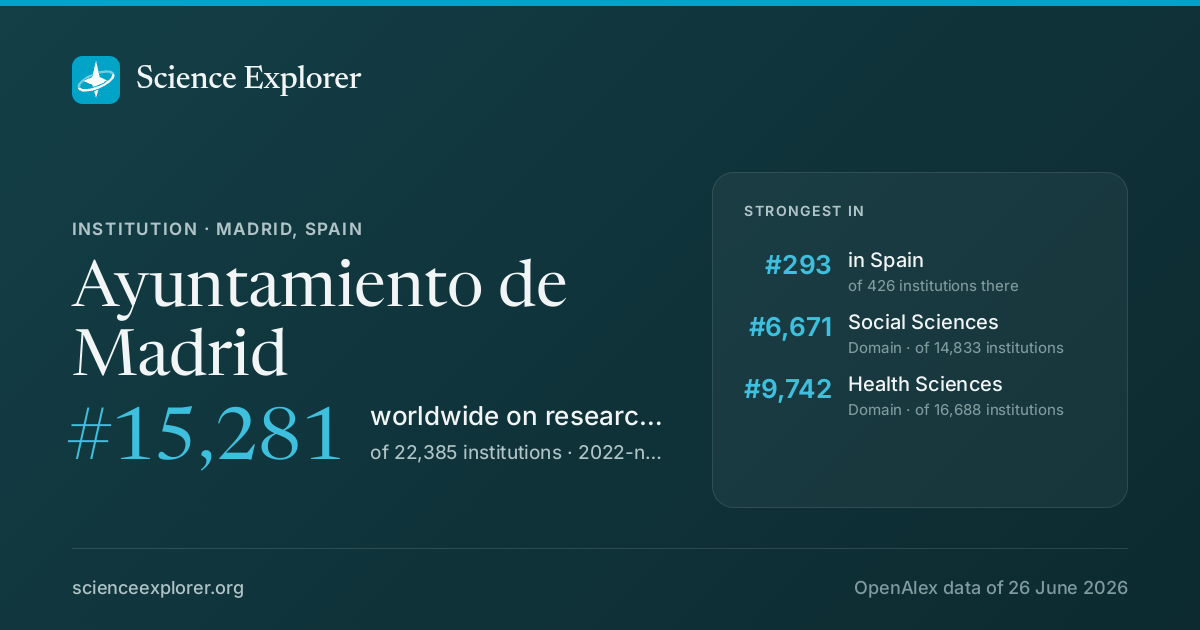
Ayuntamiento de Madrid on Science Explorer

A card with Ayuntamiento de Madrid's standing and the fields it leads in, for a post or a slide. A link to this page previews as the same card.

Download the card

1200 × 630 PNG, sized for social posts, drawn from the latest snapshot.

Badges for a website1Each links back here and updates with every snapshot

Research measures only: rankings here say nothing about teaching, admissions or student experience. Comparable institutions and collaboration partners have tabs of their own, above.

Discussion

Ask a question or share a note about Ayuntamiento de Madrid. Posts are plain text and can be reported.