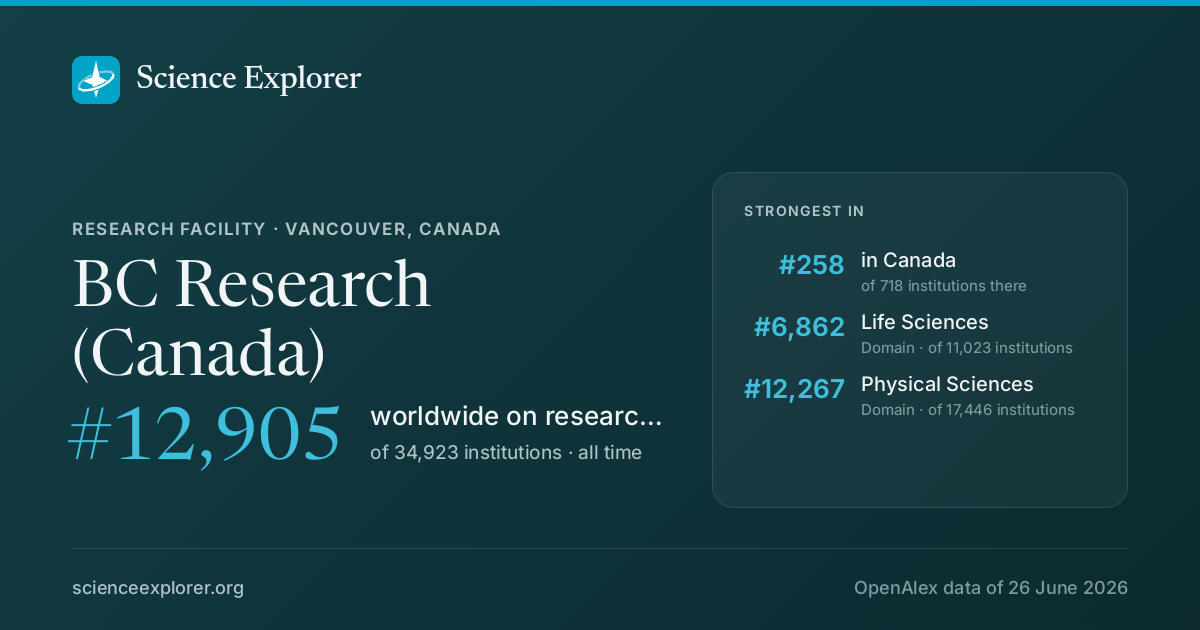
BC Research (Canada)
In research, BC Research (Canada) stands highest in Life Sciences (#6,862 of 11,023 worldwide) and Physical Sciences (#12,267 of 17,446 worldwide), over all time.
- World rank, all time
- #12,905 of 34,923
- Rank in Canada
- #258 of 718
- Research works
- 544 ▲ 8% vs 2018-21
- Citations
- 14k 25.1 per fractional work
- Top-10% rate
- 8.2% all institutions 10.0%
- vs its own fields
- 0.94× 1.00× is exactly expected
- Open access
- 29% world 40%
- International
- 34% world 18%
What is BC Research (Canada) known for in research?
The fields where it stands highest, over all time, ranked among every institution above the floor in each field.
| Field | World rank | Where that sits | Top-10% rate | Works |
|---|---|---|---|---|
| Life SciencesDomain | #6,862 of 11,023 | 9.9% | 124 | |
| Physical SciencesDomain | #12,267 of 17,446 | 6.7% | 248 |
Each strip is that field's whole ranked pool, with the notch where BC Research (Canada) sits in it, in the colour of the band that rank falls in. The track under the rate is the rate itself: it carries no average mark, because the average differs by field (from about 6% in Dentistry to 21% in Economics).
Which fields of science does BC Research (Canada) work in?
In 2022-now, 52% of research at BC Research (Canada) is in Physical Sciences, 30% in Health Sciences. Its largest fields are Medicine (24%), Engineering (21%), Computer Science (18%). It does 1.3× the world's share of Physical Sciences.
Each ring splits the one inside it: the four domains of science, their fields, their subfields. Size is fractional works in 2022-now. Every slice is a page; the interactive view zooms down to single topics and colours each by how much more of it this institution does than the world.
Its 4 domains and 23 fields, with their numbers
- Physical Sciences3051.6%
- Engineering1220.9%
- Computer Science1017.6%
- Environmental Science46.5%
- Materials Science12.3%
- Energy12.0%
- Earth and Planetary Sciences11.0%
- Chemistry00.6%
- Mathematics00.6%
- Physics and Astronomy00.2%
- Health Sciences1729.8%
- Medicine1423.9%
- Health Professions24.3%
- Nursing11.6%
- Life Sciences611.1%
- Social Sciences47.6%
Field profile
Location quotient across every field it publishes in: outside the ring is more than an institution of this size would be expected to publish, inside it is less.
Rings at 0.5×, 1× and 2×. Widest outward: Nursing, 3.3×. Every wedge is a field page.
All 23 fields, with their numbers
- Nursing3.27×1 works
- Computer Science2.26×10 works
- Energy2.18×1 works
- Health Professions1.62×2 works
- Engineering1.39×12 works
- Environmental Science1.32×4 works
- Medicine1.24×14 works
- Biochemistry, Genetics and Molecular Biology1.15×4 works
- Neuroscience1.07×1 works
- Pharmacology, Toxicology and Pharmaceutics0.81×0 works
- Materials Science0.65×1 works
- Earth and Planetary Sciences0.62×1 works
- Agricultural and Biological Sciences0.57×2 works
- Arts and Humanities0.57×1 works
- Economics, Econometrics and Finance0.56×1 works
- Mathematics0.49×0 works
- Business, Management and Accounting0.43×1 works
- Psychology0.43×1 works
- Decision Sciences0.40×0 works
- Chemistry0.37×0 works
- Immunology and Microbiology0.21×0 works
- Social Sciences0.13×1 works
- Physics and Astronomy0.09×0 works
- Nursing 3.3×
- Computer Science 2.3×
- Energy 2.2×
- Health Professions 1.6×
- Engineering 1.4×
- Environmental Science 1.3×
- Medicine 1.2×
- Biochemistry, Genetics and Molecular Biology 1.1×
- Neuroscience 1.1×
- Pharmacology, Toxicology and Pharmaceutics 0.8×
- Materials Science 0.7×
- Earth and Planetary Sciences 0.6×
- Agricultural and Biological Sciences 0.6×
- Arts and Humanities 0.6×
- Economics, Econometrics and Finance 0.6×
- Mathematics 0.5×
- Business, Management and Accounting 0.4×
- Psychology 0.4×
- Decision Sciences 0.4×
- Chemistry 0.4×
- Immunology and Microbiology 0.2×
- Social Sciences 0.1×
- Physics and Astronomy 0.1×
Who are the top researchers at BC Research (Canada)?
Ranked on the quality score, D. J. McLeay, Ben C. S. Sutton and C. C. Walden lead among researchers whose main affiliation is BC Research (Canada).
- 1
D. J. McLeay
 Canada · #1,177,503 worldwide
1.4k citations · 26 works
- 2
Ben C. S. Sutton
Canada · #1,761,450 worldwide
1.4k citations · 41 works
- 3
C. C. Walden
Canada · #1,837,295 worldwide
945 citations · 35 works
- 4
D. W. Duncan
Canada · #2,116,798 worldwide
803 citations · 27 works
- 5
Joseph M. McDermott
Canada · #3,587,660 worldwide
1.5k citations · 44 works
- 6
Peter Moss
Canada · #3,921,630 worldwide
127 citations · 15 works
- 7
Paige E. Axelrood
Canada · #5,226,676 worldwide
626 citations · 20 works
- 8
Raymund S. Folk
Canada · #5,394,589 worldwide
300 citations · 17 works
- 9
D. J. Meares
Canada · #5,414,942 worldwide
21 citations · 16 works
Which keywords describe research at BC Research (Canada)?
By fractional works in 2022-now, weighted toward what it does more of than the world: Deep Learning, Neural Networks, Vibration Control, Artificial Intelligence, Cognitive Impairment, Epidemiology, Recycling and Acoustic Metamaterials.
- Unintentional Injuries
- Child Injury
- Supply Chain Management
- Marine Environment
- Global Burden
- Information Retrieval
- Healthcare
- Renewable Energy
- Nanoparticles
- Digital Fabrication
- Music Generation
- Prenatal Alcohol Exposure
- Fetal Alcohol Syndrome
- Human-Computer Interaction
- Phononic Crystals
- Environmental Impact
- Cognitive Impairment
- Public Health
- Artificial Intelligence
- Epidemiology
- Deep Learning
- Neural Networks
- Machine Learning
- Vibration Control
- Acoustic Metamaterials
- Inflammation
- Recycling
- Brain Development
- Neurodevelopmental Disorders
- Interactive Evolutionary Computation
- Waste Management
- Internet of Things
- Parametricism
- Aging
- Hydrogels
- Biomedical Applications
- Machine Translation
- Microplastics
- Word Representation
- Membrane Distillation
Size is fractional works in 2022-now in the topics tagged with each word; colour is the word's share of this institution's work against its share of the world's. The 40 words are chosen for being large and distinctive. Each links to the topic it comes from most.
All 40 words, with their numbers
- Deep Learning5▲ 2.6×26 topics
- Epidemiology4▲ 1.72×23 topics
- Neural Networks3▲ 3.8×11 topics
- Artificial Intelligence3▲ 3.5×3 topics
- Machine Learning3▲ 1.49×10 topics
- Public Health2▲ 2.4×12 topics
- Vibration Control2▲ 56×2 topics
- Cognitive Impairment2▲ 13×2 topics
- Acoustic Metamaterials2▲ 84×1 topic
- Environmental Impact2▲ 1.82×8 topics
- Inflammation2▲ 1.46×15 topics
- Phononic Crystals2▲ 84×1 topic
- Recycling2▲ 8.0×4 topics
- Human-Computer Interaction2▲ 16×2 topics
- Brain Development2▲ 16×2 topics
- Fetal Alcohol Syndrome2▲ 194×1 topic
- Neurodevelopmental Disorders2▲ 21×2 topics
- Prenatal Alcohol Exposure2▲ 194×1 topic
- Interactive Evolutionary Computation2▲ 119×1 topic
- Music Generation2▲ 119×1 topic
- Waste Management1▲ 6.0×2 topics
- Digital Fabrication1▲ 31×1 topic
- Internet of Things1▲ 2.5×4 topics
- Nanoparticles1▲ 1.83×4 topics
- Parametricism1▲ 102×1 topic
- Renewable Energy1▲ 1.49×3 topics
- Aging1▲ 3.9×5 topics
- Healthcare1▲ 1.75×5 topics
- Hydrogels1▲ 10×2 topics
- Information Retrieval1▲ 9.2×2 topics
- Biomedical Applications1▲ 1.66×6 topics
- Global Burden1▲ 3.6×4 topics
- Machine Translation1▲ 11×1 topic
- Marine Environment1▲ 13×1 topic
- Microplastics1▲ 20×1 topic
- Supply Chain Management1▲ 2.2×3 topics
- Word Representation1▲ 15×1 topic
- Child Injury1▲ 62×1 topic
- Membrane Distillation1▲ 24×2 topics
- Unintentional Injuries1▲ 62×1 topic
Which research topics does BC Research (Canada) publish most on?
By volume in 2022-now: Acoustic Wave Phenomena Research, Prenatal Substance Exposure Effects, Music Technology and Sound Studies and Architecture and Computational Design.
Area is fractional works; colour is the subfield each topic belongs to.
- 1 Acoustic Wave Phenomena Research Biomedical Engineering 2 works
- 2 Prenatal Substance Exposure Effects Pediatrics, Perinatology and Child Health 2 works
- 3 Music Technology and Sound Studies Computer Vision and Pattern Recognition 2 works
- 4 Architecture and Computational Design Architecture 1 works
- 5 Microplastics and Plastic Pollution Pollution 1 works
- 6 Topic Modeling Artificial Intelligence 1 works
- 7 Injury Epidemiology and Prevention Public Health, Environmental and Occupational Health 1 works
- 8 Solar-Powered Water Purification Methods Renewable Energy, Sustainability and the Environment 1 works
- 9 Membrane Separation Technologies Water Science and Technology 1 works
- 10 Structural Engineering and Vibration Analysis Civil and Structural Engineering 1 works
How open and international is its research?
Against the world's own shares: the tick on each track. Both are shares of its output, so they sit on one scale and can be read against each other as well as against the world.
World: 40% of research is openly available.
World: 18% is written across borders.
How has BC Research (Canada)'s research output changed?
Output in 2022-2025 was 8% higher than in 2018-2021.
The same series as a ribbon: one cell per year, darker for more. The line above answers how much; this answers when.
Its share of all research
Growing output can still be a shrinking share: all of science grows. This is BC Research (Canada) as a percentage of every work published that year, 0.00037% in 2024.
Fractional works of BC Research (Canada) over all fractional works that year. How the balance of science has shifted.
Other research institutions in Vancouver
- University of British Columbia
- TRIUMF
- Vancouver Coastal Health
- Columbia College
- Provincial Health Services Authority
- Quest University Canada
- Providence Health Care
- Children's & Women's Health Centre of British Columbia

Share BC Research (Canada)'s ranking
Badges for a website1Each links back here and updates with every snapshot

Research measures only: rankings here say nothing about teaching, admissions or student experience. Comparable institutions and collaboration partners have tabs of their own, above.
Discussion
Ask a question or share a note about BC Research (Canada). Posts are plain text and can be reported.