Science Explorer Back to mapMap
Discussion
University · Kampala · Uganda

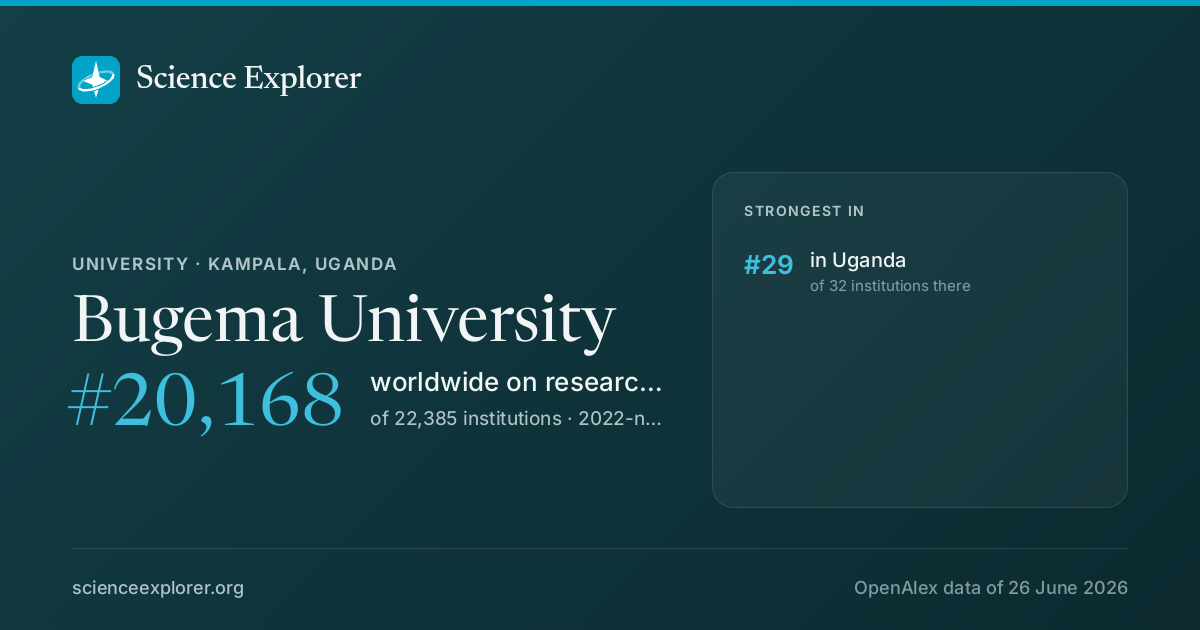
Bugema University

World rank, 2022-now
#20,168
of 22,385
Rank in Uganda
#29
of 32
Research works
113
▲ 275% vs 2018-21
Citations
442
3.9 per fractional work
Top-10% rate
3.4%
all institutions 10.0%
vs its own fields
0.94×
1.00× is exactly expected
Open access
76%
world 40%
International
33%
world 18%

Which fields of science does Bugema University work in?

In 2022-now, 50% of research at Bugema University is in Social Sciences, 29% in Health Sciences. Its largest fields are Social Sciences (35%), Medicine (18%), Health Professions (10%). It does 1.9× the world's share of Social Sciences.

Social Sciences: 36 fractional works · 50.1% of its workSocial Sciences: 25 fractional works · 34.5% of its workEducation: 11 fractional works · 15.7% of its workSociology and Political Science: 4 fractional works · 6.0% of its workSafety Research: 3 fractional works · 3.9% of its workPolitical Science and International Relations: 2 fractional works · 2.3% of its workDemography: 1 fractional works · 1.3% of its workAnthropology: 1 fractional works · 0.9% of its workGender Studies: 1 fractional works · 0.8% of its workCultural Studies: 0 fractional works · 0.7% of its workHuman Factors and Ergonomics: 0 fractional works · 0.7% of its workGeneral Social Sciences: 0 fractional works · 0.5% of its workGeography, Planning and Development: 0 fractional works · 0.5% of its workLaw: 0 fractional works · 0.5% of its workPublic Administration: 0 fractional works · 0.5% of its workHealth: 0 fractional works · 0.2% of its workPsychology: 4 fractional works · 5.4% of its workClinical Psychology: 1 fractional works · 2.0% of its workApplied Psychology: 1 fractional works · 1.4% of its workDevelopmental and Educational Psychology: 1 fractional works · 1.1% of its workSocial Psychology: 1 fractional works · 0.9% of its workBusiness, Management and Accounting: 2 fractional works · 3.2% of its workManagement of Technology and Innovation: 1 fractional works · 1.0% of its workManagement Information Systems: 0 fractional works · 0.7% of its workMarketing: 0 fractional works · 0.7% of its workOrganizational Behavior and Human Resource Management: 0 fractional works · 0.7% of its workSmaller subfields together: 0 fractional works · 0.1% of its workArts and Humanities: 2 fractional works · 3.1% of its workReligious studies: 1 fractional works · 0.9% of its workPhilosophy: 1 fractional works · 0.8% of its workHistory: 0 fractional works · 0.7% of its workLiterature and Literary Theory: 0 fractional works · 0.3% of its workHistory and Philosophy of Science: 0 fractional works · 0.2% of its workSmaller subfields together: 0 fractional works · 0.1% of its workEconomics, Econometrics and Finance: 1 fractional works · 2.0% of its workEconomics and Econometrics: 1 fractional works · 1.3% of its workFinance: 0 fractional works · 0.7% of its workDecision Sciences: 1 fractional works · 1.8% of its workInformation Systems and Management: 1 fractional works · 1.8% of its workHealth Sciences: 21 fractional works · 29.4% of its workMedicine: 13 fractional works · 18.0% of its workPublic Health, Environmental and Occupational Health: 4 fractional works · 6.2% of its workPediatrics, Perinatology and Child Health: 2 fractional works · 2.6% of its workEpidemiology: 1 fractional works · 2.0% of its workInfectious Diseases: 1 fractional works · 1.8% of its workPsychiatry and Mental health: 1 fractional works · 1.0% of its workSurgery: 1 fractional works · 0.8% of its workOncology: 1 fractional works · 0.8% of its workHealth Informatics: 1 fractional works · 0.8% of its workReproductive Medicine: 0 fractional works · 0.3% of its workHematology: 0 fractional works · 0.3% of its workEmergency Medicine: 0 fractional works · 0.2% of its workCardiology and Cardiovascular Medicine: 0 fractional works · 0.2% of its workSmaller subfields together: 1 fractional works · 0.9% of its workHealth Professions: 7 fractional works · 10.1% of its workRadiological and Ultrasound Technology: 4 fractional works · 4.8% of its workGeneral Health Professions: 3 fractional works · 3.5% of its workHealth Information Management: 1 fractional works · 1.5% of its workSmaller subfields together: 0 fractional works · 0.3% of its workNursing: 1 fractional works · 1.0% of its workNutrition and Dietetics: 1 fractional works · 1.0% of its workVeterinary: 0 fractional works · 0.2% of its workDentistry: 0 fractional works · 0.1% of its workLife Sciences: 9 fractional works · 11.7% of its workAgricultural and Biological Sciences: 7 fractional works · 10.1% of its workPlant Science: 2 fractional works · 2.8% of its workSoil Science: 1 fractional works · 1.6% of its workFood Science: 1 fractional works · 1.5% of its workAgronomy and Crop Science: 1 fractional works · 1.3% of its workGeneral Agricultural and Biological Sciences: 1 fractional works · 1.1% of its workEcology, Evolution, Behavior and Systematics: 0 fractional works · 0.7% of its workAnimal Science and Zoology: 0 fractional works · 0.7% of its workSmaller subfields together: 0 fractional works · 0.4% of its workBiochemistry, Genetics and Molecular Biology: 1 fractional works · 0.8% of its workGenetics: 0 fractional works · 0.4% of its workMolecular Biology: 0 fractional works · 0.3% of its workNeuroscience: 0 fractional works · 0.5% of its workCognitive Neuroscience: 0 fractional works · 0.5% of its workImmunology and Microbiology: 0 fractional works · 0.4% of its workParasitology: 0 fractional works · 0.2% of its workSmaller subfields together: 0 fractional works · 0.2% of its workPhysical Sciences: 6 fractional works · 8.8% of its workEnvironmental Science: 5 fractional works · 6.2% of its workIndustrial and Manufacturing Engineering: 2 fractional works · 2.1% of its workGlobal and Planetary Change: 1 fractional works · 1.8% of its workPollution: 1 fractional works · 1.1% of its workEnvironmental Chemistry: 0 fractional works · 0.7% of its workManagement, Monitoring, Policy and Law: 0 fractional works · 0.5% of its workSmaller subfields together: 0 fractional works · 0.1% of its workComputer Science: 1 fractional works · 1.5% of its workArtificial Intelligence: 0 fractional works · 0.6% of its workComputer Science Applications: 0 fractional works · 0.5% of its workInformation Systems: 0 fractional works · 0.4% of its workSmaller subfields together: 0 fractional works · 0.1% of its workEngineering: 0 fractional works · 0.6% of its workMechanical Engineering: 0 fractional works · 0.6% of its workMaterials Science: 0 fractional works · 0.2% of its workPolymers and Plastics: 0 fractional works · 0.2% of its workEarth and Planetary Sciences: 0 fractional works · 0.2% of its workMathematics: 0 fractional works · 0.1% of its workALL ITS WORKBugema University73fractional works, 2022-now
Life Sciences12%Physical Sciences9%Health Sciences29%Social Sciences50%

Each ring splits the one inside it: the four domains of science, their fields, their subfields. Size is fractional works in 2022-now. Every slice is a page; the interactive view zooms down to single topics and colours each by how much more of it this institution does than the world.

Its 4 domains and 21 fields, with their numbers
    1. Social Sciences2534.5%
    2. Psychology45.4%
    3. Business, Management and Accounting23.2%
    4. Arts and Humanities23.1%
    5. Economics, Econometrics and Finance12.0%
    6. Decision Sciences11.8%
    1. Medicine1318.0%
    2. Health Professions710.1%
    3. Nursing11.0%
    4. Veterinary00.2%
    5. Dentistry00.1%
    1. Agricultural and Biological Sciences710.1%
    2. Biochemistry, Genetics and Molecular Biology10.8%
    3. Neuroscience00.5%
    4. Immunology and Microbiology00.4%
    1. Environmental Science56.2%
    2. Computer Science11.5%
    3. Engineering00.6%
    4. Materials Science00.2%
    5. Earth and Planetary Sciences00.2%
    6. Mathematics00.1%
All of science, and how each field's share has moved since 1950: the Science domain explorer

Field profile

Location quotient across every field it publishes in: outside the ring is more than an institution of this size would be expected to publish, inside it is less.

Agricultural and Biological Sciences: 2.12× its world share, 7 worksAgricultural and Bio…Biochemistry, Genetics and Molecular Biology: 0.15× its world share, 1 worksBiochemistry, Geneti…Immunology and Microbiology: 0.41× its world share, 0 worksImmunology and Micro…Neuroscience: 0.28× its world share, 0 worksNeuroscienceComputer Science: 0.19× its world share, 1 worksComputer ScienceEarth and Planetary Sciences: 0.10× its world share, 0 worksEarth and Planetary …Engineering: 0.04× its world share, 0 worksEngineeringEnvironmental Science: 1.26× its world share, 4 worksEnvironmental ScienceMaterials Science: 0.07× its world share, 0 worksMaterials ScienceMathematics: 0.08× its world share, 0 worksMathematicsDentistry: 0.19× its world share, 0 worksDentistryHealth Professions: 3.83× its world share, 7 worksHealth ProfessionsMedicine: 0.93× its world share, 13 worksMedicineNursing: 2.12× its world share, 1 worksNursingVeterinary: 1.24× its world share, 0 worksVeterinaryArts and Humanities: 1.07× its world share, 2 worksArts and HumanitiesBusiness, Management and Accounting: 1.00× its world share, 2 worksBusiness, Management…Decision Sciences: 1.90× its world share, 1 worksDecision SciencesEconomics, Econometrics and Finance: 0.91× its world share, 1 worksEconomics, Econometr…Psychology: 1.78× its world share, 4 worksPsychologySocial Sciences: 2.73× its world share, 25 worksSocial Sciences1×world share
more than its size predictsabout as predictedless

Rings at 0.5×, 1× and 2×. Widest outward: Health Professions, 3.8×. Every wedge is a field page.

All 21 fields, with their numbers
  1. Health Professions3.83×7 works
  2. Social Sciences2.73×25 works
  3. Agricultural and Biological Sciences2.12×7 works
  4. Nursing2.12×1 works
  5. Decision Sciences1.90×1 works
  6. Psychology1.78×4 works
  7. Environmental Science1.26×4 works
  8. Veterinary1.24×0 works
  9. Arts and Humanities1.07×2 works
  10. Business, Management and Accounting1.00×2 works
  11. Medicine0.93×13 works
  12. Economics, Econometrics and Finance0.91×1 works
  13. Immunology and Microbiology0.41×0 works
  14. Neuroscience0.28×0 works
  15. Computer Science0.19×1 works
  16. Dentistry0.19×0 works
  17. Biochemistry, Genetics and Molecular Biology0.15×1 works
  18. Earth and Planetary Sciences0.10×0 works
  19. Mathematics0.08×0 works
  20. Materials Science0.07×0 works
  21. Engineering0.04×0 works

Who are the top researchers at Bugema University?

Ranked on the quality score, Christopher Ddamulira, Andrew Matsiko and David R Mutekanga lead among researchers whose main affiliation is Bugema University.

  1. 1 Christopher Ddamulira Uganda · #2,273,097 worldwide 117 citations · 39 works
  2. 2 Andrew Matsiko Uganda · #2,617,815 worldwide 7 citations · 21 works
  3. 3 David R Mutekanga Uganda · #4,623,358 worldwide 47 citations · 18 works
  4. 4 Zikama M. Faustin Uganda · #4,860,709 worldwide 236 citations · 17 works
All ranked researchers at Bugema University

What are the most cited papers from Bugema University?

The most cited paper from Bugema University is "Understanding sexual and reproductive health needs of adolescents: evidence from a formative evaluation in Wakiso district, Uganda" (Lynn Muhimbuura Atuyambe, Simon P. S. Kibira, Justine Nnakate Bukenya et al., 2015), with 139 citations. Next come "CA-MRSA and HA-MRSA coexist in community and hospital settings in Uganda" (84) and "Facility readiness in low and middle-income countries to address care of high risk/ small and sick newborns" (74).

Most cited papers
#PaperReleasedCitations
1 Understanding sexual and reproductive health needs of adolescents: evidence from a formative evaluation in Wakiso district, Uganda Lynn Muhimbuura Atuyambe, Simon P. S. Kibira, Justine Nnakate Bukenya et al. · Reproductive Health Open access 21 Apr 2015 139
2 CA-MRSA and HA-MRSA coexist in community and hospital settings in Uganda David Patrick Kateete, Freddie Bwanga, Jeremiah Seni et al. · Antimicrobial Resistance and Infection Control Open access 3 Jun 2019 84
3 Facility readiness in low and middle-income countries to address care of high risk/ small and sick newborns Indira Narayanan, Jesca Nsungwa-Sabiti, Setyadewi Lusyati et al. · Maternal Health Neonatology and Perinatology Open access 17 Jun 2019 74
4 Factors affecting adherence to national malaria treatment guidelines in management of malaria among public healthcare workers in Kamuli District, Uganda Charles Bawate, Sylvia T. Callender-Carter, Ben Nsajju et al. · Malaria Journal Open access 24 Feb 2016 57
5 The role of social support on HIV testing and treatment adherence: A qualitative study of HIV-infected refugees in southwestern Uganda Shada A. Rouhani, Kelli N. O’Laughlin, Zikama M. Faustin et al. · Global Public Health Open access 19 Jan 2016 45
All 62 most cited papers, with filters and sorting

Which keywords describe research at Bugema University?

By fractional works in 2022-now, weighted toward what it does more of than the world: Organizational Culture, Education, Risk Perception, Employee Behavior, Safety Climate, Occupational Safety, Safety Culture and Student Achievement.

▲ more of its work than of the world's◆ about the world's share▼ less than the world's

Size is fractional works in 2022-now in the topics tagged with each word; colour is the word's share of this institution's work against its share of the world's. The 40 words are chosen for being large and distinctive. Each links to the topic it comes from most.

All 40 words, with their numbers
  1. Education6▲ 4.8×12 topics
  2. Organizational Culture5▲ 19×5 topics
  3. Risk Perception4▲ 21×2 topics
  4. Employee Behavior4▲ 64×2 topics
  5. Globalization4▲ 2.6×9 topics
  6. Safety Climate4▲ 58×2 topics
  7. Occupational Safety4▲ 51×1 topic
  8. Safety Culture4▲ 71×1 topic
  9. Student Achievement3▲ 49×2 topics
  10. Environmental Impact3▲ 2.3×6 topics
  11. Parental Involvement3▲ 22×3 topics
  12. Academic Performance2▲ 37×2 topics
  13. Socioeconomic Factors2▲ 26×2 topics
  14. Educational Leadership2▲ 24×2 topics
  15. Family Engagement2▲ 73×1 topic
  16. Higher Education2▲ 5.8×5 topics
  17. Homework2▲ 132×1 topic
  18. School Improvement2▲ 37×2 topics
  19. Organizational Commitment2▲ 15×2 topics
  20. Food Security2▲ 4.7×5 topics
  21. Socio-economic Factors2▲ 23×2 topics
  22. Colonialism2▲ 5.2×3 topics
  23. Community Health Workers2▲ 28×2 topics
  24. Learning Outcomes2▲ 6.1×3 topics
  25. Poverty2▲ 26×4 topics
  26. Child Mortality2▲ 33×1 topic
  27. Development2▲ 6.4×4 topics
  28. Global Burden2▲ 4.4×4 topics
  29. Health Systems2▲ 33×1 topic
  30. Maternal Mortality2▲ 11×2 topics
  31. Professional Learning Communities2▲ 45×2 topics
  32. Recycling2▲ 6.0×2 topics
  33. Teacher Performance2▲ 16×1 topic
  34. Work Motivation2▲ 30×1 topic
  35. Municipal Solid Waste2▲ 35×1 topic
  36. Social Determinants of Health2▲ 9.4×2 topics
  37. Vulnerability2▲ 8.9×3 topics
  38. Adolescent Health1▲ 23×1 topic
  39. Sexual Behavior1▲ 52×1 topic
  40. Drought Tolerance1▲ 13×3 topics

Which research topics does Bugema University publish most on?

By volume in 2022-now: Occupational Health and Safety Research, Parental Involvement in Education, Global Maternal and Child Health and School Leadership and Teacher Performance.

  1. 1 Occupational Health and Safety Research Radiological and Ultrasound Technology 4 works
  2. 2 Parental Involvement in Education Education 2 works
  3. 3 Global Maternal and Child Health Pediatrics, Perinatology and Child Health 2 works
  4. 4 School Leadership and Teacher Performance Education 2 works
  5. 5 Municipal Solid Waste Management Industrial and Manufacturing Engineering 2 works
  6. 6 Adolescent Sexual and Reproductive Health General Health Professions 1 works
  7. 7 Conservation, Biodiversity, and Resource Management Global and Planetary Change 1 works
  8. 8 Zoonotic diseases and public health Public Health, Environmental and Occupational Health 1 works
  9. 9 African cultural and philosophical studies Education 1 works
  10. 10 Poverty, Education, and Child Welfare Safety Research 1 works

How open and international is its research?

Against the world's own shares: the tick on each track. Both are shares of its output, so they sit on one scale and can be read against each other as well as against the world.

openly available76.5%not open23.5%

World: 40% of research is openly available.

with international co-authors32.6%domestic only67.4%

World: 18% is written across borders.

How has Bugema University's research output changed?

Output in 2022-2025 was 275% higher than in 2018-2021.

still counting1990200020102020
grewheldshrank

The same series as a ribbon: one cell per year, darker for more. The line above answers how much; this answers when.

Its share of all research

Growing output can still be a shrinking share: all of science grows. This is Bugema University as a percentage of every work published that year, 0.00017% in 2024.

still counting0.00020%0.00040%Bugema University0.00026% in 202519801990200020102020

Fractional works of Bugema University over all fractional works that year. How the balance of science has shifted.

Other research institutions in Kampala

All research institutions in Kampala

Share Bugema University's ranking

Bugema University on Science Explorer

A card with Bugema University's standing and the fields it leads in, for a post or a slide. A link to this page previews as the same card.

Download the card

1200 × 630 PNG, sized for social posts, drawn from the latest snapshot.

Badges for a website1Each links back here and updates with every snapshot

Research measures only: rankings here say nothing about teaching, admissions or student experience. Comparable institutions and collaboration partners have tabs of their own, above.

Discussion

Ask a question or share a note about Bugema University. Posts are plain text and can be reported.