Science Explorer Back to mapMap
Discussion
Institution · San Diego · United States

Building Engineering and Science Talent

In research, Building Engineering and Science Talent stands highest in Social Sciences (#11,078 of 14,833 worldwide), Physical Sciences (#14,660 of 17,446 worldwide) and Social Sciences (#8,092 of 9,330 worldwide), over all time.

World rank, 2022-now
#15,112
of 22,385 · #11,923 all time
Rank in United States
#2,159
of 3,332
Research works
744
▼ 6% vs 2018-21
Citations
7.1k
9.5 per fractional work
Top-10% rate
7.2%
all institutions 10.0%
vs its own fields
0.91×
1.00× is exactly expected
Open access
36%
world 40%
International
27%
world 18%

What is Building Engineering and Science Talent known for in research?

The fields where it stands highest, over all time, ranked among every institution above the floor in each field.

FieldWorld rankWhere that sitsTop-10% rateWorks
Social SciencesDomain #11,078 of 14,833 6.1%284
Physical SciencesDomain #14,660 of 17,446 5.2%156
Social SciencesField #8,092 of 9,330 6.3%128
MedicineField #13,066 of 14,558 7.3%130
Health SciencesDomain #15,596 of 16,688 5.5%223

Each strip is that field's whole ranked pool, with the notch where Building Engineering and Science Talent sits in it, in the colour of the band that rank falls in. The track under the rate is the rate itself: it carries no average mark, because the average differs by field (from about 6% in Dentistry to 21% in Economics).

Which fields of science does Building Engineering and Science Talent work in?

In 2022-now, 45% of research at Building Engineering and Science Talent is in Social Sciences, 31% in Physical Sciences. Its largest fields are Social Sciences (22%), Computer Science (13%), Engineering (12%). It does 1.7× the world's share of Social Sciences.

Social Sciences: 58 fractional works · 44.5% of its workSocial Sciences: 29 fractional works · 22.2% of its workEducation: 11 fractional works · 8.5% of its workSociology and Political Science: 5 fractional works · 4.2% of its workPolitical Science and International Relations: 4 fractional works · 3.2% of its workLaw: 2 fractional works · 1.8% of its workSafety Research: 1 fractional works · 1.0% of its workCultural Studies: 1 fractional works · 0.7% of its workDemography: 1 fractional works · 0.5% of its workTransportation: 1 fractional works · 0.5% of its workHealth: 1 fractional works · 0.5% of its workLife-span and Life-course Studies: 0 fractional works · 0.3% of its workCommunication: 0 fractional works · 0.3% of its workLibrary and Information Sciences: 0 fractional works · 0.3% of its workDevelopment: 0 fractional works · 0.2% of its workSmaller subfields together: 0 fractional works · 0.3% of its workPsychology: 9 fractional works · 6.9% of its workSocial Psychology: 4 fractional works · 2.7% of its workExperimental and Cognitive Psychology: 2 fractional works · 1.6% of its workClinical Psychology: 2 fractional works · 1.4% of its workDevelopmental and Educational Psychology: 1 fractional works · 0.8% of its workApplied Psychology: 1 fractional works · 0.4% of its workSmaller subfields together: 0 fractional works · 0.1% of its workEconomics, Econometrics and Finance: 7 fractional works · 5.3% of its workEconomics and Econometrics: 7 fractional works · 5.1% of its workSmaller subfields together: 0 fractional works · 0.2% of its workArts and Humanities: 6 fractional works · 4.4% of its workArcheology: 1 fractional works · 1.0% of its workReligious studies: 1 fractional works · 1.0% of its workLiterature and Literary Theory: 1 fractional works · 0.7% of its workPhilosophy: 1 fractional works · 0.7% of its workVisual Arts and Performing Arts: 0 fractional works · 0.3% of its workLanguage and Linguistics: 0 fractional works · 0.3% of its workSmaller subfields together: 1 fractional works · 0.4% of its workBusiness, Management and Accounting: 5 fractional works · 4.0% of its workManagement Information Systems: 2 fractional works · 1.6% of its workStrategy and Management: 1 fractional works · 0.9% of its workOrganizational Behavior and Human Resource Management: 1 fractional works · 0.7% of its workManagement of Technology and Innovation: 0 fractional works · 0.3% of its workTourism, Leisure and Hospitality Management: 0 fractional works · 0.3% of its workSmaller subfields together: 0 fractional works · 0.3% of its workDecision Sciences: 2 fractional works · 1.7% of its workManagement Science and Operations Research: 1 fractional works · 1.0% of its workInformation Systems and Management: 0 fractional works · 0.4% of its workStatistics, Probability and Uncertainty: 0 fractional works · 0.3% of its workPhysical Sciences: 41 fractional works · 31.4% of its workComputer Science: 17 fractional works · 13.1% of its workArtificial Intelligence: 5 fractional works · 3.5% of its workInformation Systems: 3 fractional works · 2.5% of its workComputer Networks and Communications: 3 fractional works · 2.3% of its workComputer Vision and Pattern Recognition: 2 fractional works · 1.2% of its workHuman-Computer Interaction: 1 fractional works · 1.0% of its workComputational Theory and Mathematics: 1 fractional works · 0.8% of its workSignal Processing: 1 fractional works · 0.7% of its workComputer Science Applications: 1 fractional works · 0.6% of its workSoftware: 1 fractional works · 0.4% of its workSmaller subfields together: 0 fractional works · 0.1% of its workEngineering: 15 fractional works · 11.7% of its workElectrical and Electronic Engineering: 3 fractional works · 2.3% of its workBiomedical Engineering: 2 fractional works · 1.7% of its workMechanical Engineering: 2 fractional works · 1.4% of its workAerospace Engineering: 1 fractional works · 1.1% of its workCivil and Structural Engineering: 1 fractional works · 0.9% of its workBuilding and Construction: 1 fractional works · 0.8% of its workOcean Engineering: 1 fractional works · 0.8% of its workComputational Mechanics: 1 fractional works · 0.6% of its workAutomotive Engineering: 1 fractional works · 0.6% of its workIndustrial and Manufacturing Engineering: 0 fractional works · 0.4% of its workControl and Systems Engineering: 0 fractional works · 0.3% of its workMechanics of Materials: 0 fractional works · 0.3% of its workSafety, Risk, Reliability and Quality: 0 fractional works · 0.2% of its workSmaller subfields together: 0 fractional works · 0.2% of its workEnvironmental Science: 3 fractional works · 2.3% of its workWater Science and Technology: 1 fractional works · 0.6% of its workHealth, Toxicology and Mutagenesis: 1 fractional works · 0.5% of its workEnvironmental Engineering: 1 fractional works · 0.5% of its workManagement, Monitoring, Policy and Law: 1 fractional works · 0.4% of its workGlobal and Planetary Change: 0 fractional works · 0.3% of its workSmaller subfields together: 0 fractional works · 0.1% of its workPhysics and Astronomy: 2 fractional works · 1.8% of its workAstronomy and Astrophysics: 1 fractional works · 0.7% of its workAtomic and Molecular Physics, and Optics: 1 fractional works · 0.5% of its workInstrumentation: 1 fractional works · 0.4% of its workSmaller subfields together: 0 fractional works · 0.1% of its workMaterials Science: 1 fractional works · 0.8% of its workMaterials Chemistry: 1 fractional works · 0.5% of its workPolymers and Plastics: 0 fractional works · 0.3% of its workEarth and Planetary Sciences: 1 fractional works · 0.6% of its workAtmospheric Science: 0 fractional works · 0.3% of its workGeochemistry and Petrology: 0 fractional works · 0.2% of its workSmaller subfields together: 0 fractional works · 0.1% of its workChemistry: 0 fractional works · 0.4% of its workMathematics: 0 fractional works · 0.4% of its workApplied Mathematics: 0 fractional works · 0.4% of its workChemical Engineering: 0 fractional works · 0.3% of its workChemical Health and Safety: 0 fractional works · 0.3% of its workEnergy: 0 fractional works · 0.2% of its workHealth Sciences: 22 fractional works · 16.9% of its workMedicine: 15 fractional works · 11.4% of its workEpidemiology: 2 fractional works · 1.8% of its workSurgery: 2 fractional works · 1.7% of its workPublic Health, Environmental and Occupational Health: 1 fractional works · 1.1% of its workRadiology, Nuclear Medicine and Imaging: 1 fractional works · 0.7% of its workCardiology and Cardiovascular Medicine: 1 fractional works · 0.7% of its workPediatrics, Perinatology and Child Health: 1 fractional works · 0.6% of its workEndocrinology, Diabetes and Metabolism: 1 fractional works · 0.5% of its workPathology and Forensic Medicine: 0 fractional works · 0.4% of its workOncology: 0 fractional works · 0.3% of its workPhysiology: 0 fractional works · 0.3% of its workPsychiatry and Mental health: 0 fractional works · 0.3% of its workBiochemistry: 0 fractional works · 0.3% of its workNephrology: 0 fractional works · 0.3% of its workReproductive Medicine: 0 fractional works · 0.3% of its workPulmonary and Respiratory Medicine: 0 fractional works · 0.2% of its workInfectious Diseases: 0 fractional works · 0.2% of its workGenetics: 0 fractional works · 0.2% of its workPharmacology: 0 fractional works · 0.2% of its workSmaller subfields together: 2 fractional works · 1.4% of its workHealth Professions: 7 fractional works · 5.2% of its workGeneral Health Professions: 6 fractional works · 4.5% of its workOccupational Therapy: 0 fractional works · 0.3% of its workRadiological and Ultrasound Technology: 0 fractional works · 0.3% of its workSmaller subfields together: 0 fractional works · 0.2% of its workDentistry: 0 fractional works · 0.2% of its workNursing: 0 fractional works · 0.2% of its workLife Sciences: 9 fractional works · 7.2% of its workBiochemistry, Genetics and Molecular Biology: 5 fractional works · 3.5% of its workMolecular Biology: 3 fractional works · 2.4% of its workGenetics: 1 fractional works · 0.8% of its workSmaller subfields together: 0 fractional works · 0.4% of its workAgricultural and Biological Sciences: 3 fractional works · 2.4% of its workAquatic Science: 1 fractional works · 1.0% of its workFood Science: 1 fractional works · 0.6% of its workPlant Science: 1 fractional works · 0.5% of its workSmaller subfields together: 0 fractional works · 0.4% of its workNeuroscience: 1 fractional works · 0.5% of its workImmunology and Microbiology: 0 fractional works · 0.4% of its workImmunology: 0 fractional works · 0.4% of its workSmaller subfields together: 0 fractional works · 0.0% of its workPharmacology, Toxicology and Pharmaceutics: 0 fractional works · 0.3% of its workPharmacology: 0 fractional works · 0.3% of its workALL ITS WORKBuildingEngineering and…130fractional works, 2022-now
Life Sciences7%Physical Sciences31%Health Sciences17%Social Sciences45%

Each ring splits the one inside it: the four domains of science, their fields, their subfields. Size is fractional works in 2022-now. Every slice is a page; the interactive view zooms down to single topics and colours each by how much more of it this institution does than the world.

Its 4 domains and 25 fields, with their numbers
    1. Social Sciences2922.2%
    2. Psychology96.9%
    3. Economics, Econometrics and Finance75.3%
    4. Arts and Humanities64.4%
    5. Business, Management and Accounting54.0%
    6. Decision Sciences21.7%
    1. Computer Science1713.1%
    2. Engineering1511.7%
    3. Environmental Science32.3%
    4. Physics and Astronomy21.8%
    5. Materials Science10.8%
    6. Earth and Planetary Sciences10.6%
    7. Chemistry00.4%
    8. Mathematics00.4%
    9. Chemical Engineering00.3%
    10. Energy00.2%
    1. Medicine1511.4%
    2. Health Professions75.2%
    3. Dentistry00.2%
    4. Nursing00.2%
    1. Biochemistry, Genetics and Molecular Biology53.5%
    2. Agricultural and Biological Sciences32.4%
    3. Neuroscience10.5%
    4. Immunology and Microbiology00.4%
    5. Pharmacology, Toxicology and Pharmaceutics00.3%
All of science, and how each field's share has moved since 1950: the Science domain explorer

Field profile

Location quotient across every field it publishes in: outside the ring is more than an institution of this size would be expected to publish, inside it is less.

Agricultural and Biological Sciences: 0.50× its world share, 3 worksAgricultural and Bio…Biochemistry, Genetics and Molecular Biology: 0.66× its world share, 5 worksBiochemistry, Geneti…Immunology and Microbiology: 0.37× its world share, 0 worksImmunology and Micro…Neuroscience: 0.33× its world share, 1 worksNeurosciencePharmacology, Toxicology and Pharmaceutics: 0.97× its world share, 0 worksPharmacology, Toxico…Chemical Engineering: 0.73× its world share, 0 worksChemical EngineeringChemistry: 0.24× its world share, 0 worksChemistryComputer Science: 1.69× its world share, 17 worksComputer ScienceEarth and Planetary Sciences: 0.35× its world share, 1 worksEarth and Planetary …Energy: 0.20× its world share, 0 worksEnergyEngineering: 0.78× its world share, 15 worksEngineeringEnvironmental Science: 0.46× its world share, 3 worksEnvironmental ScienceMaterials Science: 0.22× its world share, 1 worksMaterials ScienceMathematics: 0.30× its world share, 0 worksMathematicsPhysics and Astronomy: 0.80× its world share, 2 worksPhysics and AstronomyDentistry: 0.40× its world share, 0 worksDentistryHealth Professions: 1.96× its world share, 7 worksHealth ProfessionsMedicine: 0.59× its world share, 15 worksMedicineNursing: 0.37× its world share, 0 worksNursingArts and Humanities: 1.54× its world share, 6 worksArts and HumanitiesBusiness, Management and Accounting: 1.25× its world share, 5 worksBusiness, Management…Decision Sciences: 1.71× its world share, 2 worksDecision SciencesEconomics, Econometrics and Finance: 2.48× its world share, 7 worksEconomics, Econometr…Psychology: 2.28× its world share, 9 worksPsychologySocial Sciences: 1.75× its world share, 29 worksSocial Sciences1×world share
more than its size predictsabout as predictedless

Rings at 0.5×, 1× and 2×. Widest outward: Economics, Econometrics and Finance, 2.5×. Every wedge is a field page.

All 25 fields, with their numbers
  1. Economics, Econometrics and Finance2.48×7 works
  2. Psychology2.28×9 works
  3. Health Professions1.96×7 works
  4. Social Sciences1.75×29 works
  5. Decision Sciences1.71×2 works
  6. Computer Science1.69×17 works
  7. Arts and Humanities1.54×6 works
  8. Business, Management and Accounting1.25×5 works
  9. Pharmacology, Toxicology and Pharmaceutics0.97×0 works
  10. Physics and Astronomy0.80×2 works
  11. Engineering0.78×15 works
  12. Chemical Engineering0.73×0 works
  13. Biochemistry, Genetics and Molecular Biology0.66×5 works
  14. Medicine0.59×15 works
  15. Agricultural and Biological Sciences0.50×3 works
  16. Environmental Science0.46×3 works
  17. Dentistry0.40×0 works
  18. Immunology and Microbiology0.37×0 works
  19. Nursing0.37×0 works
  20. Earth and Planetary Sciences0.35×1 works
  21. Neuroscience0.33×1 works
  22. Mathematics0.30×0 works
  23. Chemistry0.24×0 works
  24. Materials Science0.22×1 works
  25. Energy0.20×0 works

Who are the top researchers at Building Engineering and Science Talent?

Ranked on the quality score, James, William F., Aquatic biologist, Frederick H. Luckmann and Jean François Revel lead among researchers whose main affiliation is Building Engineering and Science Talent.

  1. 1 James, William F., Aquatic biologist United States · #3,178,453 worldwide 0 citations · 26 works

  2. 2 Frederick H. Luckmann United States · #3,376,118 worldwide 317 citations · 16 works
  3. 3 Jean François Revel United States · #3,538,561 worldwide 247 citations · 45 works
  4. 4 Jacques Lassaigne United States · #4,086,410 worldwide 23 citations · 48 works
  5. 5 Søren Svane Hoyer United States · #4,477,950 worldwide 24 citations · 25 works
  6. 6 Sian Marsh United States · #5,192,620 worldwide 2 citations · 15 works
  7. 7 Baxshillayeva Shaxnoza Said qizi United States · #5,208,935 worldwide 0 citations · 15 works
  8. 8 Vangelis Nomikos United States · #5,271,200 worldwide 47 citations · 21 works
  9. 9 Johnson Lj United States · #6,236,064 worldwide 17 citations · 45 works
  10. 10 JD Lee J. Johnson United States · #6,896,296 worldwide 50 citations · 69 works
All ranked researchers at Building Engineering and Science Talent

What are the most cited papers from Building Engineering and Science Talent?

The most cited paper from Building Engineering and Science Talent is "Toward a Comprehensive Atlas of the Physical Interactome of Saccharomyces cerevisiae" (Sean R. Collins, Patrick Kemmeren, Xuechu Zhao et al., 2007), with 811 citations. Next come "Location of high affinity Ca2 +-binding sites within the predicted transmembrahe domain of the sarco-plasmic reticulum Ca2+-ATPase" (571) and "Molecular cloning of cDNAs from human kidney coding for two alternatively spliced products of the cardiac Ca2+-ATPase gene." (378).

Most cited papers
#PaperReleasedCitations
1 Toward a Comprehensive Atlas of the Physical Interactome of Saccharomyces cerevisiae Sean R. Collins, Patrick Kemmeren, Xuechu Zhao et al. · Molecular & Cellular Proteomics Open access 2 Jan 2007 811
2 Location of high affinity Ca2 +-binding sites within the predicted transmembrahe domain of the sarco-plasmic reticulum Ca2+-ATPase David M. Clarke, Tip W. Loo, Giuseppe Inesi et al. · Nature Jun 1989 571
3 Molecular cloning of cDNAs from human kidney coding for two alternatively spliced products of the cardiac Ca2+-ATPase gene. Jonathan Lytton, David H. MacLennan · Journal of Biological Chemistry Open access Oct 1988 378
4 Splicing and transcription-associated proteins PSF and p54nrb/NonO bind to the RNA polymerase II CTD Andrew Emili, Michael Shales, Susan A. McCracken et al. · RNA Open access Sep 2002 218
5 Smg1 is required for embryogenesis and regulates diverse genes via alternative splicing coupled to nonsense-mediated mRNA decay David Robert McIlwain, Qun Pan, Patrick T. Reilly et al. · Proceedings of the National Academy of Sciences Open access 21 Jun 2010 199
All 62 most cited papers, with filters and sorting

Which keywords describe research at Building Engineering and Science Talent?

By fractional works in 2022-now, weighted toward what it does more of than the world: Pedagogy, Digital Economy, Entrepreneurship, Critical Thinking, Digital Education, Tourism Development, Language Teaching and Student Competencies.

▲ more of its work than of the world's◆ about the world's share▼ less than the world's

Size is fractional works in 2022-now in the topics tagged with each word; colour is the word's share of this institution's work against its share of the world's. The 40 words are chosen for being large and distinctive. Each links to the topic it comes from most.

All 40 words, with their numbers
  1. Globalization8▲ 3.2×15 topics
  2. Deep Learning7▲ 1.49×24 topics
  3. Pedagogy6▲ 9.8×3 topics
  4. Sustainability6▲ 2.0×11 topics
  5. Digital Economy6▲ 23×5 topics
  6. Economic Development6▲ 5.3×7 topics
  7. Entrepreneurship6▲ 11×4 topics
  8. Critical Thinking6▲ 37×3 topics
  9. Digital Education5▲ 28×2 topics
  10. Language Teaching5▲ 16×3 topics
  11. Tourism Development5▲ 30×2 topics
  12. Machine Learning5▲ 1.21×22 topics
  13. Student Competencies5▲ 62×1 topic
  14. Teaching Methods5▲ 25×1 topic
  15. Industrial Enterprises5▲ 113×1 topic
  16. Innovation Economics5▲ 113×1 topic
  17. Mental Health4▲ 2.3×16 topics
  18. Collaborative Practice4▲ 68×2 topics
  19. Primary Care4▲ 7.6×2 topics
  20. Education4▲ 1.62×16 topics
  21. Patient Satisfaction4▲ 8.9×5 topics
  22. Artificial Intelligence3▲ 1.85×17 topics
  23. Health Workforce3▲ 62×1 topic
  24. Nurse Practitioners3▲ 192×1 topic
  25. Healthcare3▲ 2.2×10 topics
  26. Cultural Heritage3▲ 4.5×6 topics
  27. Renewable Energy3▲ 1.67×7 topics
  28. Human Rights3▲ 2.3×15 topics
  29. Big Data3▲ 2.2×8 topics
  30. Knowledge Management3▲ 3.8×11 topics
  31. Global Governance2▲ 8.1×5 topics
  32. Migration2▲ 5.6×4 topics
  33. IoT2▲ 4.9×7 topics
  34. Social Exclusion2▲ 20×2 topics
  35. Crisis Management2▲ 28×2 topics
  36. Biopolitics2▲ 17×1 topic
  37. Postcolonialism2▲ 8.9×1 topic
  38. Elderly Care1▲ 7.1×2 topics
  39. Social Work1▲ 16×2 topics
  40. Sufism1▲ 24×2 topics

Which research topics does Building Engineering and Science Talent publish most on?

By volume in 2022-now: Education, Innovation and Language Studies, Economic and Industrial Development, Nursing Roles and Practices and Medical, Sociocultural, and Biopolitical Studies.

  1. 1 Education, Innovation and Language Studies Education 5 works
  2. 2 Economic and Industrial Development Economics and Econometrics 5 works
  3. 3 Nursing Roles and Practices General Health Professions 3 works
  4. 4 Medical, Sociocultural, and Biopolitical Studies Political Science and International Relations 2 works
  5. 5 Healthcare innovation and challenges Education 1 works
  6. 6 Medieval European History and Architecture Archeology 1 works
  7. 7 Engineering and Agricultural Innovations Aquatic Science 1 works
  8. 8 Breastfeeding Practices and Influences Epidemiology 1 works
  9. 9 Business Process Modeling and Analysis Management Information Systems 1 works
  10. 10 Outsourcing and Supply Chain Management Management Information Systems 1 works

How open and international is its research?

Against the world's own shares: the tick on each track. Both are shares of its output, so they sit on one scale and can be read against each other as well as against the world.

openly available36.5%not open63.5%

World: 40% of research is openly available.

with international co-authors27.2%domestic only72.8%

World: 18% is written across borders.

How has Building Engineering and Science Talent's research output changed?

Output in 2022-2025 was 6% lower than in 2018-2021.

still counting1990200020102020
grewheldshrank

The same series as a ribbon: one cell per year, darker for more. The line above answers how much; this answers when.

Its share of all research

Growing output can still be a shrinking share: all of science grows. This is Building Engineering and Science Talent as a percentage of every work published that year, 0.00034% in 2024.

still counting0.0010%0.0020%Building Engineering and Science Talent0.00072% in 202519801990200020102020

Fractional works of Building Engineering and Science Talent over all fractional works that year. How the balance of science has shifted.

How much of it reaches the world top 10%

Year by year, against all institutions in the same year.

still counting5%10%15%all institutions10.0% in 2025Building Engineering and Science Talent7.4% in 202520102020

Of each year's output, the share that reached the world's 10% most cited for its field and year. Peak 9.2% in 2017.

Other research institutions in San Diego

All research institutions in San Diego

Share Building Engineering and Science Talent's ranking
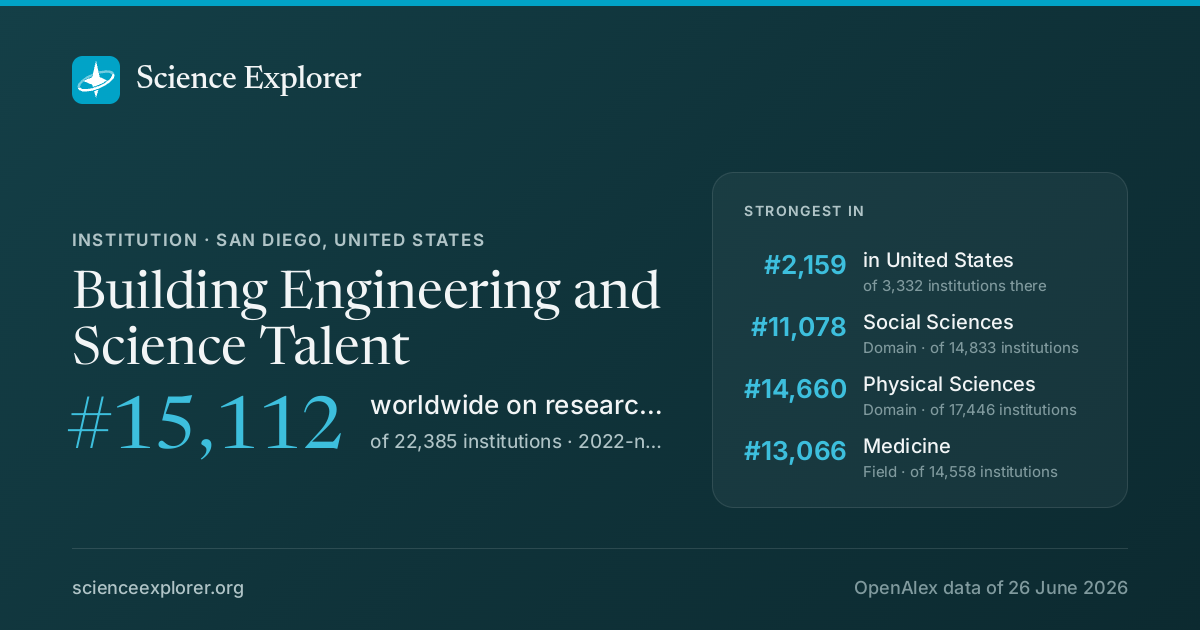
Building Engineering and Science Talent on Science Explorer

A card with Building Engineering and Science Talent's standing and the fields it leads in, for a post or a slide. A link to this page previews as the same card.

Download the card

1200 × 630 PNG, sized for social posts, drawn from the latest snapshot.

Badges for a website1Each links back here and updates with every snapshot

Research measures only: rankings here say nothing about teaching, admissions or student experience. Comparable institutions and collaboration partners have tabs of their own, above.

Discussion

Ask a question or share a note about Building Engineering and Science Talent. Posts are plain text and can be reported.