Science Explorer Back to mapMap
Discussion
Research facility · Phnom Penh · Cambodia

Cambodia Development Resource Institute

World rank, all time
#28,560
of 34,923
Rank in Cambodia
#19
of 19
Research works
138
▲ 77% vs 2018-21
Citations
3.1k
22.7 per fractional work
Top-10% rate
8.1%
all institutions 10.0%
vs its own fields
1.10×
1.00× is exactly expected
Open access
52%
world 40%
International
61%
world 18%

Which fields of science does Cambodia Development Resource Institute work in?

In 2022-now, 64% of research at Cambodia Development Resource Institute is in Social Sciences, 19% in Physical Sciences. Its largest fields are Social Sciences (53%), Agricultural and Biological Sciences (12%), Engineering (7%). It does 2.2× the world's share of Social Sciences.

Social Sciences: 27 fractional works · 63.6% of its workSocial Sciences: 22 fractional works · 52.6% of its workSociology and Political Science: 13 fractional works · 30.0% of its workPolitical Science and International Relations: 3 fractional works · 8.4% of its workEducation: 3 fractional works · 6.3% of its workDemography: 1 fractional works · 1.6% of its workSafety Research: 1 fractional works · 1.6% of its workGender Studies: 0 fractional works · 0.9% of its workCommunication: 0 fractional works · 0.8% of its workLinguistics and Language: 0 fractional works · 0.8% of its workTransportation: 0 fractional works · 0.8% of its workPublic Administration: 0 fractional works · 0.5% of its workGeography, Planning and Development: 0 fractional works · 0.4% of its workHealth: 0 fractional works · 0.3% of its workEconomics, Econometrics and Finance: 2 fractional works · 4.2% of its workEconomics and Econometrics: 1 fractional works · 3.6% of its workGeneral Economics, Econometrics and Finance: 0 fractional works · 0.4% of its workFinance: 0 fractional works · 0.3% of its workArts and Humanities: 1 fractional works · 2.2% of its workLanguage and Linguistics: 1 fractional works · 1.8% of its workLiterature and Literary Theory: 0 fractional works · 0.3% of its workPsychology: 1 fractional works · 1.8% of its workDevelopmental and Educational Psychology: 0 fractional works · 0.8% of its workClinical Psychology: 0 fractional works · 0.4% of its workExperimental and Cognitive Psychology: 0 fractional works · 0.4% of its workSocial Psychology: 0 fractional works · 0.2% of its workDecision Sciences: 1 fractional works · 1.5% of its workManagement Science and Operations Research: 0 fractional works · 0.9% of its workInformation Systems and Management: 0 fractional works · 0.5% of its workBusiness, Management and Accounting: 1 fractional works · 1.3% of its workStrategy and Management: 0 fractional works · 0.7% of its workOrganizational Behavior and Human Resource Management: 0 fractional works · 0.4% of its workSmaller subfields together: 0 fractional works · 0.2% of its workPhysical Sciences: 8 fractional works · 18.6% of its workEngineering: 3 fractional works · 7.2% of its workControl and Systems Engineering: 1 fractional works · 1.8% of its workBuilding and Construction: 1 fractional works · 1.6% of its workElectrical and Electronic Engineering: 1 fractional works · 1.3% of its workAerospace Engineering: 0 fractional works · 0.8% of its workBiomedical Engineering: 0 fractional works · 0.4% of its workCivil and Structural Engineering: 0 fractional works · 0.4% of its workOcean Engineering: 0 fractional works · 0.4% of its workMechanics of Materials: 0 fractional works · 0.3% of its workSmaller subfields together: 0 fractional works · 0.2% of its workEnvironmental Science: 3 fractional works · 6.3% of its workGlobal and Planetary Change: 1 fractional works · 2.1% of its workNature and Landscape Conservation: 1 fractional works · 1.2% of its workManagement, Monitoring, Policy and Law: 0 fractional works · 0.8% of its workPollution: 0 fractional works · 0.7% of its workHealth, Toxicology and Mutagenesis: 0 fractional works · 0.7% of its workEnvironmental Engineering: 0 fractional works · 0.3% of its workEcology: 0 fractional works · 0.2% of its workSmaller subfields together: 0 fractional works · 0.3% of its workComputer Science: 1 fractional works · 2.4% of its workArtificial Intelligence: 1 fractional works · 1.4% of its workInformation Systems: 0 fractional works · 0.8% of its workSmaller subfields together: 0 fractional works · 0.2% of its workEarth and Planetary Sciences: 0 fractional works · 0.8% of its workAtmospheric Science: 0 fractional works · 0.3% of its workEarth-Surface Processes: 0 fractional works · 0.3% of its workSpace and Planetary Science: 0 fractional works · 0.3% of its workMaterials Science: 0 fractional works · 0.7% of its workMaterials Chemistry: 0 fractional works · 0.4% of its workBiomaterials: 0 fractional works · 0.3% of its workMathematics: 0 fractional works · 0.4% of its workModeling and Simulation: 0 fractional works · 0.4% of its workChemistry: 0 fractional works · 0.3% of its workOrganic Chemistry: 0 fractional works · 0.3% of its workEnergy: 0 fractional works · 0.3% of its workEnergy Engineering and Power Technology: 0 fractional works · 0.3% of its workPhysics and Astronomy: 0 fractional works · 0.3% of its workAstronomy and Astrophysics: 0 fractional works · 0.3% of its workLife Sciences: 6 fractional works · 14.8% of its workAgricultural and Biological Sciences: 5 fractional works · 12.2% of its workPlant Science: 1 fractional works · 3.5% of its workEcology, Evolution, Behavior and Systematics: 1 fractional works · 2.8% of its workSoil Science: 1 fractional works · 2.1% of its workGeneral Agricultural and Biological Sciences: 1 fractional works · 1.7% of its workFood Science: 0 fractional works · 1.2% of its workInsect Science: 0 fractional works · 0.4% of its workAquatic Science: 0 fractional works · 0.2% of its workSmaller subfields together: 0 fractional works · 0.3% of its workBiochemistry, Genetics and Molecular Biology: 1 fractional works · 2.1% of its workGenetics: 0 fractional works · 1.2% of its workEndocrinology: 0 fractional works · 0.4% of its workMolecular Biology: 0 fractional works · 0.4% of its workSmaller subfields together: 0 fractional works · 0.2% of its workImmunology and Microbiology: 0 fractional works · 0.3% of its workPharmacology, Toxicology and Pharmaceutics: 0 fractional works · 0.2% of its workPharmacology: 0 fractional works · 0.2% of its workHealth Sciences: 1 fractional works · 2.9% of its workMedicine: 1 fractional works · 2.1% of its workEpidemiology: 0 fractional works · 0.7% of its workPublic Health, Environmental and Occupational Health: 0 fractional works · 0.5% of its workPediatrics, Perinatology and Child Health: 0 fractional works · 0.4% of its workHematology: 0 fractional works · 0.3% of its workInfectious Diseases: 0 fractional works · 0.3% of its workSmaller subfields together: 0 fractional works · 0.0% of its workNursing: 0 fractional works · 0.5% of its workNutrition and Dietetics: 0 fractional works · 0.5% of its workHealth Professions: 0 fractional works · 0.3% of its workALL ITS WORKCambodiaDevelopment…42fractional works, 2022-now
Life Sciences15%Physical Sciences19%Health Sciences3%Social Sciences64%

Each ring splits the one inside it: the four domains of science, their fields, their subfields. Size is fractional works in 2022-now. Every slice is a page; the interactive view zooms down to single topics and colours each by how much more of it this institution does than the world.

Its 4 domains and 22 fields, with their numbers
    1. Social Sciences2252.6%
    2. Economics, Econometrics and Finance24.2%
    3. Arts and Humanities12.2%
    4. Psychology11.8%
    5. Decision Sciences11.5%
    6. Business, Management and Accounting11.3%
    1. Engineering37.2%
    2. Environmental Science36.3%
    3. Computer Science12.4%
    4. Earth and Planetary Sciences00.8%
    5. Materials Science00.7%
    6. Mathematics00.4%
    7. Chemistry00.3%
    8. Energy00.3%
    9. Physics and Astronomy00.3%
    1. Agricultural and Biological Sciences512.2%
    2. Biochemistry, Genetics and Molecular Biology12.1%
    3. Immunology and Microbiology00.3%
    4. Pharmacology, Toxicology and Pharmaceutics00.2%
    1. Medicine12.1%
    2. Nursing00.5%
    3. Health Professions00.3%
All of science, and how each field's share has moved since 1950: the Science domain explorer

What does Cambodia Development Resource Institute specialise in?

Where its research is concentrated relative to its size: Social Sciences takes 4.2× the share of its output that it takes of world research.

  1. Social SciencesField · 21.9 works4.2×
← less than its size predicts1×more →

Location quotient, a volume reading rather than an impact one. It surfaces small, lopsided specialities.

Field profile

Location quotient across every field it publishes in: outside the ring is more than an institution of this size would be expected to publish, inside it is less.

Agricultural and Biological Sciences: 2.56× its world share, 5 worksAgricultural and Bio…Biochemistry, Genetics and Molecular Biology: 0.40× its world share, 1 worksBiochemistry, Geneti…Immunology and Microbiology: 0.32× its world share, 0 worksImmunology and Micro…Pharmacology, Toxicology and Pharmaceutics: 0.63× its world share, 0 worksPharmacology, Toxico…Chemistry: 0.18× its world share, 0 worksChemistryComputer Science: 0.30× its world share, 1 worksComputer ScienceEarth and Planetary Sciences: 0.51× its world share, 0 worksEarth and Planetary …Energy: 0.33× its world share, 0 worksEnergyEngineering: 0.48× its world share, 3 worksEngineeringEnvironmental Science: 1.27× its world share, 3 worksEnvironmental ScienceMaterials Science: 0.21× its world share, 0 worksMaterials ScienceMathematics: 0.36× its world share, 0 worksMathematicsPhysics and Astronomy: 0.12× its world share, 0 worksPhysics and AstronomyHealth Professions: 0.12× its world share, 0 worksHealth ProfessionsMedicine: 0.11× its world share, 1 worksMedicineNursing: 1.05× its world share, 0 worksNursingArts and Humanities: 0.75× its world share, 1 worksArts and HumanitiesBusiness, Management and Accounting: 0.39× its world share, 0 worksBusiness, Management…Decision Sciences: 1.52× its world share, 1 worksDecision SciencesEconomics, Econometrics and Finance: 1.98× its world share, 2 worksEconomics, Econometr…Psychology: 0.60× its world share, 1 worksPsychologySocial Sciences: 4.16× its world share, 22 worksSocial Sciences1×world share
more than its size predictsabout as predictedless

Rings at 0.5×, 1× and 2×. Widest outward: Social Sciences, 4.2×. Every wedge is a field page.

All 22 fields, with their numbers
  1. Social Sciences4.16×22 works
  2. Agricultural and Biological Sciences2.56×5 works
  3. Economics, Econometrics and Finance1.98×2 works
  4. Decision Sciences1.52×1 works
  5. Environmental Science1.27×3 works
  6. Nursing1.05×0 works
  7. Arts and Humanities0.75×1 works
  8. Pharmacology, Toxicology and Pharmaceutics0.63×0 works
  9. Psychology0.60×1 works
  10. Earth and Planetary Sciences0.51×0 works
  11. Engineering0.48×3 works
  12. Biochemistry, Genetics and Molecular Biology0.40×1 works
  13. Business, Management and Accounting0.39×0 works
  14. Mathematics0.36×0 works
  15. Energy0.33×0 works
  16. Immunology and Microbiology0.32×0 works
  17. Computer Science0.30×1 works
  18. Materials Science0.21×0 works
  19. Chemistry0.18×0 works
  20. Physics and Astronomy0.12×0 works
  21. Health Professions0.12×0 works
  22. Medicine0.11×1 works

Who are the top researchers at Cambodia Development Resource Institute?

Ranked on the quality score, Sothy Khieng, Phal Chea and M. Sampson lead among researchers whose main affiliation is Cambodia Development Resource Institute.

  1. 1 Sothy Khieng Cambodia · #1,166,562 worldwide 509 citations · 22 works
  2. 2 Phal Chea Cambodia · #1,428,053 worldwide 172 citations · 22 works
  3. 3 M. Sampson Cambodia · #1,463,856 worldwide 1.6k citations · 23 works
  4. 4 Sokbunthoeun So Cambodia · #1,492,319 worldwide 314 citations · 20 works
  5. 5 Raksmey Ang Cambodia · #1,551,772 worldwide 158 citations · 20 works
  6. 6 Sopheak Song Cambodia · #2,104,164 worldwide 90 citations · 18 works
  7. 7 Sophal Chan Cambodia · #2,315,169 worldwide 236 citations · 21 works
  8. 8 Netra Eng Cambodia · #2,623,914 worldwide 167 citations · 20 works
  9. 9 Chhourn Orn Cambodia · #2,629,951 worldwide 256 citations · 21 works
  10. 10 Sarith Hin Cambodia · #2,977,243 worldwide 307 citations · 33 works
All ranked researchers at Cambodia Development Resource Institute

What are the most cited papers from Cambodia Development Resource Institute?

The most cited paper from Cambodia Development Resource Institute is "Near-surface wetland sediments as a source of arsenic release to ground water in Asia" (Matthew L. Polizzotto, Benjamin D. Kocar, Shawn G. Benner et al., 2008), with 574 citations. Next come "Magnitude of arsenic pollution in the Mekong and Red River Deltas — Cambodia and Vietnam" (529) and "Diversity of Global Rice Markets and the Science Required for Consumer-Targeted Rice Breeding" (336).

Most cited papers
#PaperReleasedCitations
1 Near-surface wetland sediments as a source of arsenic release to ground water in Asia Matthew L. Polizzotto, Benjamin D. Kocar, Shawn G. Benner et al. · Nature Jul 2008 574
2 Magnitude of arsenic pollution in the Mekong and Red River Deltas — Cambodia and Vietnam Michael Berg, Caroline Stengel, Pham K.T. Trang et al. · The Science of The Total Environment 2 Nov 2006 529
3 Diversity of Global Rice Markets and the Science Required for Consumer-Targeted Rice Breeding Mariafe N. Calingacion et al. · PLoS ONE Open access 14 Jan 2014 336
4 Contamination of drinking water resources in the Mekong delta floodplains: Arsenic and other trace metals pose serious health risks to population Johanna Buschmann, Michael Berg, Caroline Stengel et al. · Environment International 6 Mar 2008 312
5 Health effects of radiation and other health problems in the aftermath of nuclear accidents, with an emphasis on Fukushima Arifumi Hasegawa, Koichi Tanigawa, Akira Ohtsuru et al. · The Lancet Open access 30 Jul 2015 285
All 59 most cited papers, with filters and sorting

Which keywords describe research at Cambodia Development Resource Institute?

By fractional works in 2022-now, weighted toward what it does more of than the world: Human Rights, Political Transition, Civil Society, Cambodia, Genocide, Globalization, Climate Change and Sustainability.

▲ more of its work than of the world's◆ about the world's share▼ less than the world's

Size is fractional works in 2022-now in the topics tagged with each word; colour is the word's share of this institution's work against its share of the world's. The 27 words are chosen for being large and distinctive. Each links to the topic it comes from most.

All 27 words, with their numbers
  1. Human Rights8▲ 19×4 topics
  2. Political Transition8▲ 381×2 topics
  3. Civil Society7▲ 160×3 topics
  4. Cambodia7▲ 2530×1 topic
  5. Genocide7▲ 323×1 topic
  6. Climate Change3▲ 2.9×17 topics
  7. Globalization3▲ 3.8×11 topics
  8. Sustainability3▲ 2.9×14 topics
  9. Environmental Impact2▲ 2.7×10 topics
  10. Higher Education2▲ 7.5×2 topics
  11. Resettlement2▲ 47×2 topics
  12. Vulnerability2▲ 18×4 topics
  13. Neoliberalism2▲ 11×3 topics
  14. Economic Development1▲ 4.2×5 topics
  15. Academic Identity1▲ 97×1 topic
  16. Academic Mobility1▲ 77×2 topics
  17. Adaptation1▲ 10×2 topics
  18. Culture1▲ 5.5×4 topics
  19. Development1▲ 7.8×3 topics
  20. Ethnicity1▲ 7.7×2 topics
  21. Internationalization1▲ 47×1 topic
  22. COVID-191▲ 1.99×3 topics
  23. Democracy1▲ 7.6×4 topics
  24. Food Security1▲ 5.1×4 topics
  25. Water Management1▲ 21×2 topics
  26. Parental Involvement1▲ 13×3 topics
  27. Policy1▲ 12×3 topics

Which research topics does Cambodia Development Resource Institute publish most on?

By volume in 2022-now: Cambodian History and Society, Higher Education Governance and Development, Asian Geopolitics and Ethnography and COVID-19 Pandemic Impacts.

  1. 1 Cambodian History and Society Sociology and Political Science 7 works
  2. 2 Higher Education Governance and Development Political Science and International Relations 1 works
  3. 3 Asian Geopolitics and Ethnography Political Science and International Relations 1 works
  4. 4 COVID-19 Pandemic Impacts Economics and Econometrics 1 works
  5. 5 Climate Change, Adaptation, Migration Sociology and Political Science 1 works
  6. 6 Hydropower, Displacement, Environmental Impact Sociology and Political Science 1 works
  7. 7 Southeast Asian Sociopolitical Studies Political Science and International Relations 1 works
  8. 8 Rice Cultivation and Yield Improvement Plant Science 1 works
  9. 9 Child Development and Education Education 0 works
  10. 10 Edcuational Technology Systems Artificial Intelligence 0 works

How open and international is its research?

Against the world's own shares: the tick on each track. Both are shares of its output, so they sit on one scale and can be read against each other as well as against the world.

openly available52.1%not open47.9%

World: 40% of research is openly available.

with international co-authors61.1%domestic only38.9%

World: 18% is written across borders.

How has Cambodia Development Resource Institute's research output changed?

Output in 2022-2025 was 77% higher than in 2018-2021.

still counting200020052010201520202025
grewheldshrank

The same series as a ribbon: one cell per year, darker for more. The line above answers how much; this answers when.

Its share of all research

Growing output can still be a shrinking share: all of science grows. This is Cambodia Development Resource Institute as a percentage of every work published that year, 0.000075% in 2024.

still counting0.00020%0.00040%Cambodia Development Resource Institute0.00024% in 2025200020102020

Fractional works of Cambodia Development Resource Institute over all fractional works that year. How the balance of science has shifted.

Other research institutions in Phnom Penh

All research institutions in Phnom Penh

Share Cambodia Development Resource Institute's ranking
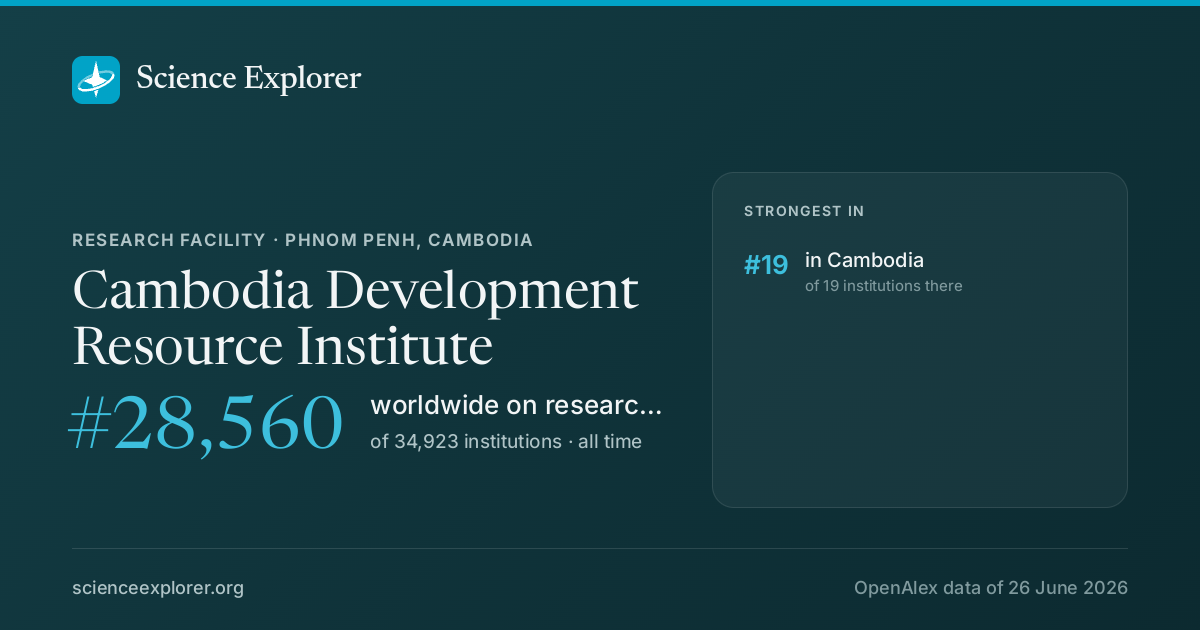
Cambodia Development Resource Institute on Science Explorer

A card with Cambodia Development Resource Institute's standing and the fields it leads in, for a post or a slide. A link to this page previews as the same card.

Download the card

1200 × 630 PNG, sized for social posts, drawn from the latest snapshot.

Badges for a website1Each links back here and updates with every snapshot

Research measures only: rankings here say nothing about teaching, admissions or student experience. Comparable institutions and collaboration partners have tabs of their own, above.

Discussion

Ask a question or share a note about Cambodia Development Resource Institute. Posts are plain text and can be reported.