Central Intelligence Agency

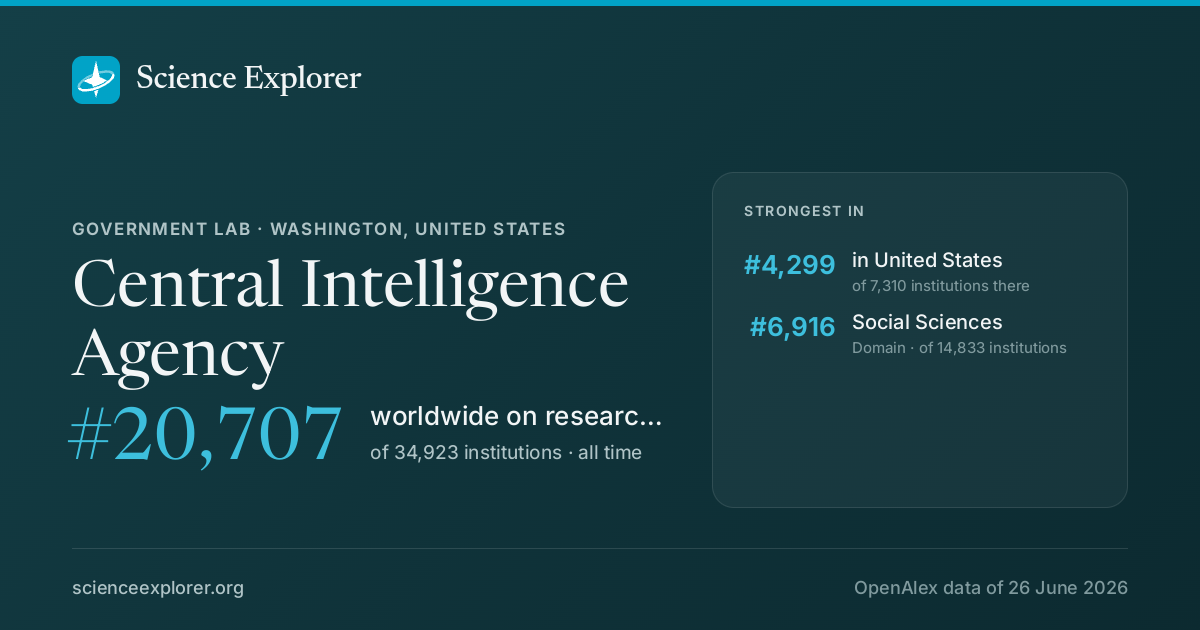
In research, Central Intelligence Agency stands highest in Social Sciences (#6,916 of 14,833 worldwide) and Social Sciences (#6,580 of 9,330 worldwide), over all time. Relative to its size it is most specialised in Cognitive Neuroscience and Neuroscience (Cognitive Neuroscience is 30.5× its share of world research).
- World rank, all time
- #20,707 of 34,923
- Rank in United States
- #4,299 of 7,310
- Research works
- 407 ▲ 238% vs 2018-21
- Citations
- 1.7k 4.3 per fractional work
- Top-10% rate
- 8.0% all institutions 10.0%
- vs its own fields
- 0.81× 1.00× is exactly expected
- Open access
- 50% world 40%
- International
- 5% world 18%
What is Central Intelligence Agency known for in research?
The fields where it stands highest, over all time, ranked among every institution above the floor in each field.
| Field | World rank | Where that sits | Top-10% rate | Works |
|---|---|---|---|---|
| Social SciencesDomain | #6,916 of 14,833 | 8.1% | 222 | |
| Social SciencesField | #6,580 of 9,330 | 8.0% | 146 |
Each strip is that field's whole ranked pool, with the notch where Central Intelligence Agency sits in it, in the colour of the band that rank falls in. The track under the rate is the rate itself: it carries no average mark, because the average differs by field (from about 6% in Dentistry to 21% in Economics).
Which fields of science does Central Intelligence Agency work in?
In 2022-now, 39% of research at Central Intelligence Agency is in Physical Sciences, 29% in Social Sciences. Its largest fields are Neuroscience (22%), Computer Science (19%), Engineering (15%). It does 1.7× the world's share of Life Sciences.
Each ring splits the one inside it: the four domains of science, their fields, their subfields. Size is fractional works in 2022-now. Every slice is a page; the interactive view zooms down to single topics and colours each by how much more of it this institution does than the world.
Its 4 domains and 22 fields, with their numbers
- Physical Sciences6939.4%
- Computer Science3318.7%
- Engineering2614.7%
- Physics and Astronomy84.5%
- Environmental Science10.7%
- Mathematics10.4%
- Energy00.2%
- Materials Science00.1%
- Earth and Planetary Sciences00.0%
- Social Sciences5129.0%
- Psychology2313.5%
- Social Sciences116.4%
- Economics, Econometrics and Finance116.2%
- Decision Sciences21.2%
- Arts and Humanities20.9%
- Business, Management and Accounting10.8%
- Life Sciences4023.2%
- Health Sciences158.3%
- Medicine95.1%
- Health Professions63.2%
- Nursing00.0%
What does Central Intelligence Agency specialise in?
Where its research is concentrated relative to its size: Cognitive Neuroscience takes 30.5× the share of its output that it takes of world research.
- Cognitive NeuroscienceSubfield · 38.7 works30×
- NeuroscienceField · 38.7 works14×
Location quotient, a volume reading rather than an impact one. It surfaces small, lopsided specialities.
Field profile
Location quotient across every field it publishes in: outside the ring is more than an institution of this size would be expected to publish, inside it is less.
Rings at 0.5×, 1× and 2×. Widest outward: Neuroscience, 13.7×. Every wedge is a field page.
All 21 fields, with their numbers
- Neuroscience13.68×39 works
- Psychology4.42×24 works
- Economics, Econometrics and Finance2.91×11 works
- Computer Science2.40×32 works
- Physics and Astronomy2.04×8 works
- Decision Sciences1.28×2 works
- Health Professions1.22×6 works
- Pharmacology, Toxicology and Pharmaceutics1.09×1 works
- Engineering0.98×26 works
- Social Sciences0.50×11 works
- Mathematics0.33×1 works
- Arts and Humanities0.32×2 works
- Medicine0.27×9 works
- Business, Management and Accounting0.24×1 works
- Energy0.21×0 works
- Immunology and Microbiology0.19×0 works
- Environmental Science0.15×1 works
- Agricultural and Biological Sciences0.09×1 works
- Nursing0.04×0 works
- Materials Science0.03×0 works
- Earth and Planetary Sciences0.02×0 works
- Neuroscience 13.7×
- Psychology 4.4×
- Economics, Econometrics and Finance 2.9×
- Computer Science 2.4×
- Physics and Astronomy 2.0×
- Decision Sciences 1.3×
- Health Professions 1.2×
- Pharmacology, Toxicology and Pharmaceutics 1.1×
- Engineering 1.0×
- Social Sciences 0.5×
- Mathematics 0.3×
- Arts and Humanities 0.3×
- Medicine 0.3×
- Business, Management and Accounting 0.2×
- Energy 0.2×
- Immunology and Microbiology 0.2×
- Environmental Science 0.1×
- Agricultural and Biological Sciences 0.1×
- Nursing 0.0×
- Materials Science 0.0×
- Earth and Planetary Sciences 0.0×
Who are the top researchers at Central Intelligence Agency?
Ranked on the quality score, Fritz Ermarth, John Seabury Thomson and Stansfield Turner lead among researchers whose main affiliation is Central Intelligence Agency.
- 1
Fritz Ermarth
 United States · #1,651,273 worldwide
119 citations · 23 works
- 2
John Seabury Thomson
United States · #1,881,732 worldwide
200 citations · 16 works
- 3
Stansfield Turner
United States · #2,182,692 worldwide
479 citations · 40 works
- 4
David E. Murphy
United States · #2,656,118 worldwide
105 citations · 83 works
- 5
Gerald K. Haines
United States · #2,668,149 worldwide
205 citations · 22 works
- 6
Edward F. Mickolus
United States · #2,844,391 worldwide
575 citations · 101 works
- 7
Graham E. Fuller
United States · #2,998,989 worldwide
1.6k citations · 159 works
- 8
Robert Michael Field
United States · #3,041,769 worldwide
214 citations · 40 works
- 9
Tennent H. Bagley
United States · #3,248,422 worldwide
18 citations · 27 works
- 10
Allen Welsh Dulles
United States · #3,532,092 worldwide
248 citations · 48 works
Which keywords describe research at Central Intelligence Agency?
By fractional works in 2022-now, weighted toward what it does more of than the world: Nonlinear Dynamics, Emotions, Cognition, Consciousness, Physics of Mind, Neural Networks, Social Cognition and Automation.
- Agent-Based Modeling
- Performance Analysis
- High-Intensity Interval Training
- Fall Risk
- Decision Making
- Human-Computer Interaction
- Executive Functions
- Emergence
- Adaptation
- Motor Control
- Complex Systems
- Self-Organization
- Education
- Driver Distraction
- Autonomous Vehicles
- Predictive Brain Theory
- Automation
- Physics of Mind
- Cognition
- Emotions
- Nonlinear Dynamics
- Neural Networks
- Consciousness
- Social Cognition
- Embodied Cognition
- Cognitive Load
- Trust
- Mental Workload
- Artificial Intelligence
- Leadership
- Feedback Control
- Sensorimotor Learning
- Complexity Theory
- Electromyography
- Muscle Fatigue
- Synchronization
- Physical Performance
- Gait Speed
- Neural Mechanisms
- Training Load
Size is fractional works in 2022-now in the topics tagged with each word; colour is the word's share of this institution's work against its share of the world's. The 40 words are chosen for being large and distinctive. Each links to the topic it comes from most.
All 40 words, with their numbers
- Nonlinear Dynamics16▲ 42×5 topics
- Emotions16▲ 174×3 topics
- Neural Networks15▲ 5.7×5 topics
- Cognition14▲ 58×2 topics
- Consciousness14▲ 113×1 topic
- Physics of Mind14▲ 1369×1 topic
- Social Cognition12▲ 39×2 topics
- Automation11▲ 92×2 topics
- Embodied Cognition11▲ 431×1 topic
- Predictive Brain Theory11▲ 431×1 topic
- Cognitive Load11▲ 132×2 topics
- Autonomous Vehicles10▲ 29×2 topics
- Trust10▲ 22×3 topics
- Driver Distraction10▲ 150×1 topic
- Mental Workload10▲ 110×1 topic
- Education10▲ 3.3×6 topics
- Artificial Intelligence10▲ 3.9×12 topics
- Self-Organization10▲ 173×3 topics
- Leadership9▲ 11×6 topics
- Complex Systems9▲ 50×4 topics
- Feedback Control9▲ 31×3 topics
- Motor Control8▲ 40×1 topic
- Sensorimotor Learning8▲ 252×1 topic
- Adaptation8▲ 15×2 topics
- Complexity Theory8▲ 75×1 topic
- Emergence8▲ 249×1 topic
- Electromyography7▲ 79×1 topic
- Executive Functions7▲ 63×2 topics
- Muscle Fatigue7▲ 79×1 topic
- Human-Computer Interaction6▲ 20×2 topics
- Synchronization6▲ 29×2 topics
- Decision Making6▲ 11×5 topics
- Physical Performance6▲ 33×2 topics
- Fall Risk5▲ 66×1 topic
- Gait Speed5▲ 66×1 topic
- High-Intensity Interval Training5▲ 28×2 topics
- Neural Mechanisms5▲ 30×3 topics
- Performance Analysis5▲ 14×1 topic
- Training Load5▲ 45×1 topic
- Agent-Based Modeling5▲ 21×2 topics
Which research topics does Central Intelligence Agency publish most on?
By volume in 2022-now: Cognitive Science and Education Research, Embodied and Extended Cognition, Human-Automation Interaction and Safety and Motor Control and Adaptation.
Area is fractional works; colour is the subfield each topic belongs to.
- 1 Cognitive Science and Education Research Cognitive Neuroscience 14 works
- 2 Embodied and Extended Cognition Cognitive Neuroscience 11 works
- 3 Human-Automation Interaction and Safety Social Psychology 10 works
- 4 Motor Control and Adaptation Cognitive Neuroscience 8 works
- 5 Chaos, Complexity, and Education Computational Theory and Mathematics 8 works
- 6 Muscle activation and electromyography studies Biomedical Engineering 7 works
- 7 Balance, Gait, and Falls Prevention Physical Therapy, Sports Therapy and Rehabilitation 5 works
- 8 Sports Performance and Training Orthopedics and Sports Medicine 5 works
- 9 Complex Systems and Time Series Analysis Economics and Econometrics 4 works
- 10 Emotion and Mood Recognition Experimental and Cognitive Psychology 4 works
How open and international is its research?
Against the world's own shares: the tick on each track. Both are shares of its output, so they sit on one scale and can be read against each other as well as against the world.
World: 40% of research is openly available.
World: 18% is written across borders.
How has Central Intelligence Agency's research output changed?
Output in 2022-2025 was 238% higher than in 2018-2021.
The same series as a ribbon: one cell per year, darker for more. The line above answers how much; this answers when.
Its share of all research
Growing output can still be a shrinking share: all of science grows. This is Central Intelligence Agency as a percentage of every work published that year, 0.000063% in 2024.
Fractional works of Central Intelligence Agency over all fractional works that year. How the balance of science has shifted.
Other research institutions in Washington
- United States Department of Defense
- National Aeronautics and Space Administration
- United States Department of Agriculture
- United States Department of Veterans Affairs
- United States Department of Health and Human Services
- Georgetown University
- George Washington University
- National Oceanic and Atmospheric Administration








Share Central Intelligence Agency's ranking
Badges for a website1Each links back here and updates with every snapshot

Research measures only: rankings here say nothing about teaching, admissions or student experience. Comparable institutions and collaboration partners have tabs of their own, above.
Discussion
Ask a question or share a note about Central Intelligence Agency. Posts are plain text and can be reported.