Georgetown University

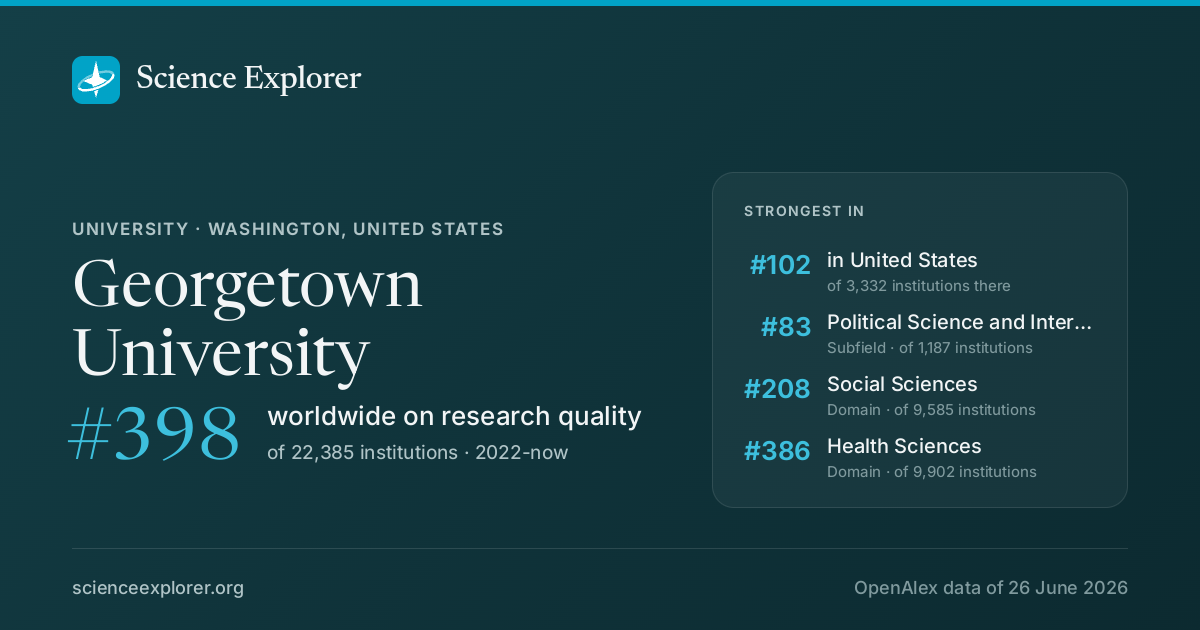
In research, Georgetown University stands highest in Social Sciences (#208 of 9,585 worldwide), Social Sciences (#211 of 5,988 worldwide) and Health Sciences (#386 of 9,902 worldwide), 2022-now. Relative to its size it is most specialised in Transplantation, Political Science and International Relations and History and Philosophy of Science (Transplantation is 4.5× its share of world research).
- World rank, 2022-now
- #398 of 22,385 · #383 all time
- Rank in United States
- #102 of 3,332
- Research works
- 66k ◆ 1% vs 2018-21
- Citations
- 1.8M 27.8 per fractional work
- Top-10% rate
- 10.3% all institutions 10.0%
- vs its own fields
- 0.91× 1.00× is exactly expected
- Open access
- 33% world 40%
- International
- 11% world 18%
What is Georgetown University known for in research?
The fields where it stands highest, 2022-now, ranked among every institution above the floor in each field.
| Field | World rank | Where that sits | Top-10% rate | Works | All time |
|---|---|---|---|---|---|
| Social SciencesDomain | #208 of 9,585 | 11.5% | 3,149 | #130 | |
| Social SciencesField | #211 of 5,988 | 11.9% | 1,716 | #141 | |
| Health SciencesDomain | #386 of 9,902 | 9.8% | 3,965 | #256 | |
| MedicineField | #350 of 8,541 | 9.7% | 3,566 | #249 | |
| Physical SciencesDomain | #695 of 10,670 | 8.1% | 914 | #743 | |
| Political Science and International RelationsSubfield | #83 of 1,187 | 12.4% | 451 | #87 | |
| Life SciencesDomain | #457 of 6,403 | 10.7% | 1,016 | #462 | |
| Sociology and Political ScienceSubfield | #195 of 2,526 | 11.6% | 597 | #196 | |
| Economics, Econometrics and FinanceField | #171 of 1,798 | 11.9% | 322 | #160 | |
| Health ProfessionsField | #221 of 1,895 | 10.7% | 346 | #243 |
Each strip is that field's whole ranked pool, with the notch where Georgetown University sits in it, in the colour of the band that rank falls in. The track under the rate is the rate itself: it carries no average mark, because the average differs by field (from about 6% in Dentistry to 21% in Economics).
Which of those standings moved
The same fields on both windows: where it stood over the whole record, and where it stands in 2022-now. The distance is the story, and it is the one thing the two rank columns above cannot show.
- Social Sciences#130 #208
- Social Sciences#141 #211
- Health Sciences#256 #386
- Medicine#249 #350
- Physical Sciences#743 #695
- Political Science and International Relations#87 #83
- Life Sciences#462 #457
- Sociology and Political Science#196 #195
- Economics, Econometrics and Finance#160 #171
- Health Professions#243 #221
A dot further right is a better standing. Fields it was not ranked in over the whole record are left out.
Which fields of science does Georgetown University work in?
In 2022-now, 44% of research at Georgetown University is in Health Sciences, 34% in Social Sciences. Its largest fields are Medicine (40%), Social Sciences (18%), Biochemistry, Genetics and Molecular Biology (6%). It does 1.9× the world's share of Health Sciences.
Each ring splits the one inside it: the four domains of science, their fields, their subfields. Size is fractional works in 2022-now. Every slice is a page; the interactive view zooms down to single topics and colours each by how much more of it this institution does than the world.
Its 4 domains and 26 fields, with their numbers
- Health Sciences4,57144.5%
- Medicine4,12740.1%
- Health Professions3813.7%
- Nursing470.5%
- Dentistry80.1%
- Veterinary80.1%
- Social Sciences3,49734.0%
- Social Sciences1,89718.4%
- Arts and Humanities4944.8%
- Psychology3863.8%
- Economics, Econometrics and Finance3533.4%
- Business, Management and Accounting2812.7%
- Decision Sciences860.8%
- Life Sciences1,17311.4%
- Physical Sciences1,04110.1%
- Computer Science3263.2%
- Engineering1991.9%
- Environmental Science1631.6%
- Mathematics930.9%
- Physics and Astronomy760.7%
- Chemistry760.7%
- Materials Science590.6%
- Energy230.2%
- Earth and Planetary Sciences210.2%
- Chemical Engineering60.1%
What does Georgetown University specialise in?
Where its research is concentrated relative to its size: Transplantation takes 4.5× the share of its output that it takes of world research.
- TransplantationSubfield · 20.6 works4.5×
- Political Science and International RelationsSubfield · 492.0 works3.2×
- History and Philosophy of ScienceSubfield · 46.5 works2.9×
- DermatologySubfield · 78.0 works2.9×
- OncologySubfield · 330.7 works2.9×
Location quotient, a volume reading rather than an impact one. It surfaces small, lopsided specialities.
Field profile
Location quotient across every field it publishes in: outside the ring is more than an institution of this size would be expected to publish, inside it is less.
Rings at 0.5×, 1× and 2×. Widest outward: Medicine, 2.1×. Every wedge is a field page.
All 26 fields, with their numbers
- Medicine2.09×4,127 works
- Arts and Humanities1.66×494 works
- Economics, Econometrics and Finance1.60×353 works
- Neuroscience1.59×265 works
- Social Sciences1.46×1,897 works
- Health Professions1.40×381 works
- Immunology and Microbiology1.29×133 works
- Psychology1.23×386 works
- Biochemistry, Genetics and Molecular Biology1.20×656 works
- Nursing0.93×47 works
- Pharmacology, Toxicology and Pharmaceutics0.92×33 works
- Decision Sciences0.86×86 works
- Business, Management and Accounting0.85×281 works
- Mathematics0.77×93 works
- Veterinary0.56×8 works
- Chemistry0.47×76 works
- Computer Science0.41×326 works
- Physics and Astronomy0.33×76 works
- Environmental Science0.32×163 works
- Energy0.24×23 works
- Agricultural and Biological Sciences0.17×85 works
- Chemical Engineering0.17×6 works
- Dentistry0.17×8 works
- Materials Science0.16×58 works
- Earth and Planetary Sciences0.13×21 works
- Engineering0.13×199 works
- Medicine 2.1×
- Arts and Humanities 1.7×
- Economics, Econometrics and Finance 1.6×
- Neuroscience 1.6×
- Social Sciences 1.5×
- Health Professions 1.4×
- Immunology and Microbiology 1.3×
- Psychology 1.2×
- Biochemistry, Genetics and Molecular Biology 1.2×
- Nursing 0.9×
- Pharmacology, Toxicology and Pharmaceutics 0.9×
- Decision Sciences 0.9×
- Business, Management and Accounting 0.8×
- Mathematics 0.8×
- Veterinary 0.6×
- Chemistry 0.5×
- Computer Science 0.4×
- Physics and Astronomy 0.3×
- Environmental Science 0.3×
- Energy 0.2×
- Agricultural and Biological Sciences 0.2×
- Chemical Engineering 0.2×
- Dentistry 0.2×
- Materials Science 0.2×
- Earth and Planetary Sciences 0.1×
- Engineering 0.1×
Who are the top researchers at Georgetown University?
Ranked on the quality score, Martin Ravallion, Jishnu Das and Colin J. Carlson lead among researchers whose main affiliation is Georgetown University.
- 1
Martin Ravallion
 United States · #3,245 worldwide
53k citations · 732 works
- 2
Jishnu Das
United States · #7,312 worldwide
11k citations · 258 works
- 3
Colin J. Carlson
United States · #13,632 worldwide
8.4k citations · 262 works
- 4
Leticia Bode
United States · #16,592 worldwide
8.3k citations · 145 works
- 5
Virginia Steen
United States · #17,521 worldwide
41k citations · 362 works
- 6
Hartmut H. Juhl
United States · #17,665 worldwide
57k citations · 221 works
- 7
Laia Balcells
United States · #19,083 worldwide
3.5k citations · 255 works
- 8
Raymond Scott Turner
United States · #20,270 worldwide
25k citations · 347 works
- 9
Cynthia M. Tracy
United States · #23,855 worldwide
61k citations · 181 works
- 10
Rachel Barr
United States · #24,390 worldwide
14k citations · 211 works
Which keywords describe research at Georgetown University?
By fractional works in 2022-now, weighted toward what it does more of than the world: Epidemiology, Globalization, Quality of Life, Human Rights, Nationalism, Public Health, Complications and Treatment.
- Secularism
- Percutaneous Coronary Intervention
- Politics
- International Law
- Feminism
- Heart Failure
- Global Governance
- Democracy
- Gender
- Ethics
- Clinical Trials
- Complications
- Identity
- Nationalism
- Oxidative Stress
- Mental Health
- Risk Factors
- Human Rights
- Quality of Life
- Globalization
- Epidemiology
- Inflammation
- Public Health
- Treatment
- Diagnosis
- Chemotherapy
- Cancer
- Management
- Immunotherapy
- Cardiovascular Disease
- Colonialism
- Religion
- Diabetes
- Guidelines
- Radiotherapy
- Prognostic Factors
- Surgical Management
- Myocardial Infarction
- Public Opinion
- Breast Reconstruction
Size is fractional works in 2022-now in the topics tagged with each word; colour is the word's share of this institution's work against its share of the world's. The 40 words are chosen for being large and distinctive. Each links to the topic it comes from most.
All 40 words, with their numbers
- Epidemiology741▲ 1.81×138 topics
- Globalization394▲ 1.95×131 topics
- Inflammation289▲ 1.32×82 topics
- Quality of Life279▲ 1.88×53 topics
- Public Health262▲ 1.75×66 topics
- Human Rights241▲ 2.3×67 topics
- Treatment238▲ 1.91×50 topics
- Risk Factors224▲ 1.98×36 topics
- Diagnosis210▲ 2.2×41 topics
- Mental Health203▲ 1.38×43 topics
- Chemotherapy193▲ 2.6×24 topics
- Oxidative Stress193◆ 1.14×57 topics
- Cancer180▲ 1.30×50 topics
- Nationalism180▲ 3.9×31 topics
- Management178▲ 2.2×35 topics
- Identity176▲ 2.4×64 topics
- Immunotherapy176▲ 2.4×19 topics
- Complications175▲ 3.4×17 topics
- Cardiovascular Disease165▲ 1.41×38 topics
- Clinical Trials150▲ 2.2×18 topics
- Colonialism147▲ 3.0×44 topics
- Ethics144▲ 2.8×39 topics
- Religion142▲ 3.0×36 topics
- Gender140▲ 2.5×48 topics
- Diabetes135▲ 2.6×19 topics
- Democracy128▲ 3.6×25 topics
- Guidelines128▲ 2.6×13 topics
- Global Governance121▲ 4.9×22 topics
- Radiotherapy119▲ 2.9×13 topics
- Heart Failure114▲ 2.5×13 topics
- Prognostic Factors112▲ 2.5×14 topics
- Feminism112▲ 3.7×23 topics
- Surgical Management112▲ 2.7×20 topics
- International Law111▲ 3.4×25 topics
- Myocardial Infarction94▲ 3.9×7 topics
- Politics94▲ 3.5×20 topics
- Public Opinion86▲ 6.9×7 topics
- Percutaneous Coronary Intervention83▲ 5.9×4 topics
- Breast Reconstruction73▲ 11×2 topics
- Secularism69▲ 6.6×5 topics
Which research topics does Georgetown University publish most on?
By volume in 2022-now: Reconstructive Surgery and Microvascular Techniques, Cardiac Valve Diseases and Treatments, Islamic Studies and History and American Constitutional Law and Politics.
Area is fractional works; colour is the subfield each topic belongs to.
- 1 Reconstructive Surgery and Microvascular Techniques Surgery 54 works
- 2 Cardiac Valve Diseases and Treatments Cardiology and Cardiovascular Medicine 43 works
- 3 Islamic Studies and History Political Science and International Relations 43 works
- 4 American Constitutional Law and Politics Political Science and International Relations 42 works
- 5 Diversity and Career in Medicine Gender Studies 38 works
- 6 Wound Healing and Treatments Rehabilitation 37 works
- 7 Intellectual Property and Patents Management of Technology and Innovation 35 works
- 8 Cardiac Imaging and Diagnostics Radiology, Nuclear Medicine and Imaging 35 works
- 9 Cancer Immunotherapy and Biomarkers Oncology 33 works
- 10 Coronary Interventions and Diagnostics Surgery 33 works
How open and international is its research?
Against the world's own shares: the tick on each track. Both are shares of its output, so they sit on one scale and can be read against each other as well as against the world.
World: 40% of research is openly available.
World: 18% is written across borders.
How has Georgetown University's research output changed?
Output in 2022-2025 was 1% higher than in 2018-2021.
The same series as a ribbon: one cell per year, darker for more. The line above answers how much; this answers when.
Its share of all research
Growing output can still be a shrinking share: all of science grows. This is Georgetown University as a percentage of every work published that year, 0.041% in 2024.
Fractional works of Georgetown University over all fractional works that year. How the balance of science has shifted.
How much of it reaches the world top 10%
Year by year, against all institutions in the same year.
Of each year's output, the share that reached the world's 10% most cited for its field and year. Peak 15.3% in 1999.
Other research institutions in Washington
- United States Department of Defense
- National Aeronautics and Space Administration
- United States Department of Agriculture
- United States Department of Veterans Affairs
- United States Department of Health and Human Services
- George Washington University
- National Oceanic and Atmospheric Administration
- Smithsonian Institution








Which institutions have research most like Georgetown University's?
Among the world's leading institutions, Maastricht University has the research profile closest to Georgetown University's, with both strong in Medicine.
- 1
Maastricht University
 Netherlands · Both strong in Medicine, Neuroscience, Health Professions
0.88 Compare
- 2
Erasmus University RotterdamNetherlands · Both strong in Medicine, Economics, Econometrics and Finance, Neuroscience
0.88 Compare
- 3
Emory UniversityUnited States · Both strong in Medicine, Neuroscience, Health Professions
0.86 Compare
- 4
Yale UniversityUnited States · Both strong in Medicine, Neuroscience, Immunology and Microbiology
0.84 Compare
- 5
Indiana UniversityUnited States · Both strong in Medicine, Neuroscience, Health Professions
0.83 Compare

Similarity is the correlation of each side's location quotients across every field it publishes in, on a log scale: 1 is the same shape of research, 0 is unrelated. It ignores size. How it is measured.
Compare Georgetown University with
- vs
 University of Fribourg
- vs
 Politecnico di Milano
- vs
 University of Manitoba
- vs
 Northeast Normal University
- vs Argonne National Laboratory
- vs University of Trento
Share Georgetown University's ranking



Research measures only: rankings here say nothing about teaching, admissions or student experience. Comparable institutions and collaboration partners have tabs of their own, above.
Discussion
Ask a question or share a note about Georgetown University. Posts are plain text and can be reported.