Indiana University
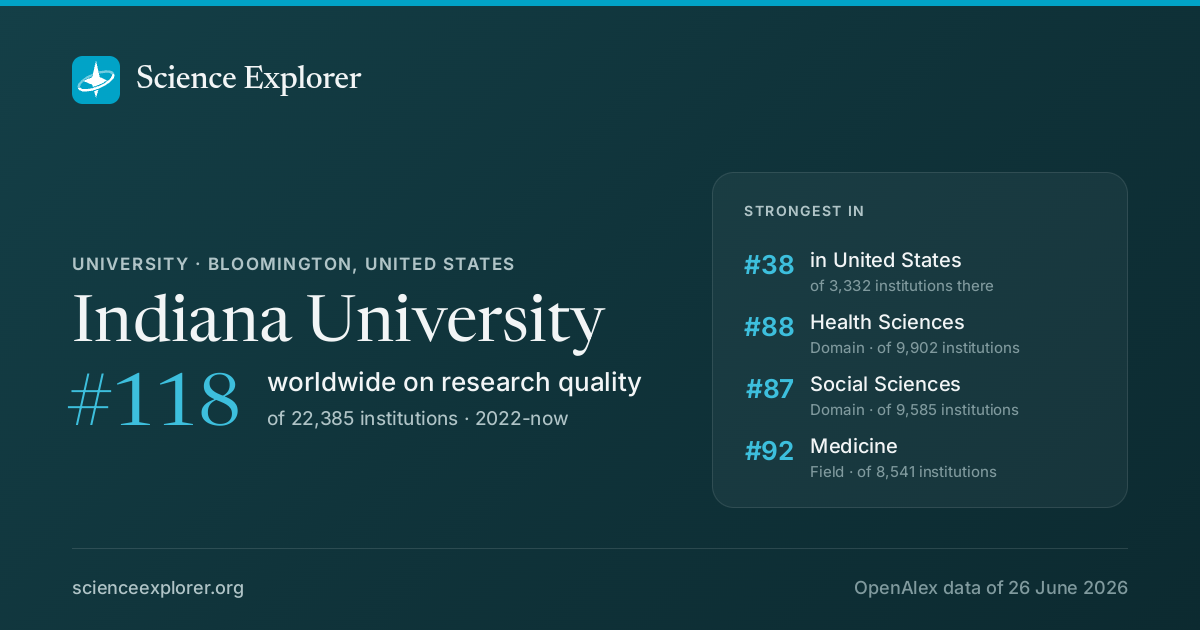
In research, Indiana University stands highest in Health Sciences (#88 of 9,902 worldwide), Social Sciences (#87 of 9,585 worldwide) and Medicine (#92 of 8,541 worldwide), 2022-now. Relative to its size it is most specialised in Transplantation, Public Administration and Music (Transplantation is 4.3× its share of world research).
- World rank, 2022-now
- #118 of 22,385 · #118 all time
- Rank in United States
- #38 of 3,332
- Research works
- 177k ▼ 21% vs 2018-21
- Citations
- 5.5M 31.0 per fractional work
- Top-10% rate
- 10.7% all institutions 10.0%
- vs its own fields
- 0.97× 1.00× is exactly expected
- Open access
- 33% world 40%
- International
- 12% world 18%
What is Indiana University known for in research?
The fields where it stands highest, 2022-now, ranked among every institution above the floor in each field.
| Field | World rank | Where that sits | Top-10% rate | Works | All time |
|---|---|---|---|---|---|
| Health SciencesDomain | #88 of 9,902 | 11.0% | 7,914 | #73 | |
| Social SciencesDomain | #87 of 9,585 | 11.2% | 5,847 | #49 | |
| MedicineField | #92 of 8,541 | 11.2% | 6,840 | #70 | |
| Social SciencesField | #87 of 5,988 | 10.6% | 2,814 | #50 | |
| Business, Management and AccountingField | #42 of 2,581 | 16.9% | 466 | #36 | |
| Physical SciencesDomain | #223 of 10,670 | 9.7% | 3,384 | #212 | |
| Life SciencesDomain | #179 of 6,403 | 9.6% | 2,926 | #161 | |
| Sociology and Political ScienceSubfield | #71 of 2,526 | 11.5% | 941 | #43 | |
| Computer ScienceField | #128 of 4,417 | 10.4% | 1,069 | #140 | |
| Health ProfessionsField | #73 of 1,895 | 9.5% | 814 | #68 |
Each strip is that field's whole ranked pool, with the notch where Indiana University sits in it, in the colour of the band that rank falls in. The track under the rate is the rate itself: it carries no average mark, because the average differs by field (from about 6% in Dentistry to 21% in Economics).
Which of those standings moved
The same fields on both windows: where it stood over the whole record, and where it stands in 2022-now. The distance is the story, and it is the one thing the two rank columns above cannot show.
- Health Sciences#73 #88
- Social Sciences#49 #87
- Medicine#70 #92
- Social Sciences#50 #87
- Business, Management and Accounting#36 #42
- Physical Sciences#212 #223
- Life Sciences#161 #179
- Sociology and Political Science#43 #71
- Computer Science#140 #128
- Health Professions#68 #73
A dot further right is a better standing. Fields it was not ranked in over the whole record are left out.
Which fields of science does Indiana University work in?
In 2022-now, 40% of research at Indiana University is in Health Sciences, 29% in Social Sciences. Its largest fields are Medicine (35%), Social Sciences (14%), Biochemistry, Genetics and Molecular Biology (8%). It does 1.7× the world's share of Health Sciences.
Each ring splits the one inside it: the four domains of science, their fields, their subfields. Size is fractional works in 2022-now. Every slice is a page; the interactive view zooms down to single topics and colours each by how much more of it this institution does than the world.
Its 4 domains and 26 fields, with their numbers
- Health Sciences9,05439.8%
- Medicine7,85634.5%
- Health Professions9044.0%
- Dentistry1380.6%
- Nursing1330.6%
- Veterinary220.1%
- Social Sciences6,48128.5%
- Social Sciences3,12213.7%
- Psychology1,3145.8%
- Arts and Humanities8533.8%
- Business, Management and Accounting5142.3%
- Economics, Econometrics and Finance4502.0%
- Decision Sciences2291.0%
- Physical Sciences3,80916.8%
- Computer Science1,1995.3%
- Engineering7273.2%
- Environmental Science5742.5%
- Physics and Astronomy3471.5%
- Mathematics3131.4%
- Chemistry2451.1%
- Earth and Planetary Sciences1930.8%
- Materials Science1470.6%
- Energy450.2%
- Chemical Engineering180.1%
- Life Sciences3,39414.9%
What does Indiana University specialise in?
Where its research is concentrated relative to its size: Transplantation takes 4.3× the share of its output that it takes of world research.
- TransplantationSubfield · 43.9 works4.3×
- Public AdministrationSubfield · 50.5 works4.1×
- MusicSubfield · 55.9 works3.0×
- NephrologySubfield · 138.8 works2.8×
- Psychiatry and Mental healthSubfield · 316.8 works2.8×
Location quotient, a volume reading rather than an impact one. It surfaces small, lopsided specialities.
Field profile
Location quotient across every field it publishes in: outside the ring is more than an institution of this size would be expected to publish, inside it is less.
Rings at 0.5×, 1× and 2×. Widest outward: Neuroscience, 2.2×. Every wedge is a field page.
All 26 fields, with their numbers
- Neuroscience2.19×809 works
- Psychology1.90×1,314 works
- Medicine1.80×7,856 works
- Biochemistry, Genetics and Molecular Biology1.55×1,882 works
- Health Professions1.51×904 works
- Immunology and Microbiology1.39×318 works
- Arts and Humanities1.30×853 works
- Dentistry1.25×138 works
- Nursing1.20×133 works
- Mathematics1.17×313 works
- Social Sciences1.09×3,122 works
- Decision Sciences1.04×228 works
- Economics, Econometrics and Finance0.93×450 works
- Pharmacology, Toxicology and Pharmaceutics0.90×72 works
- Veterinary0.71×22 works
- Business, Management and Accounting0.70×514 works
- Chemistry0.69×245 works
- Physics and Astronomy0.69×347 works
- Computer Science0.68×1,199 works
- Earth and Planetary Sciences0.54×193 works
- Environmental Science0.51×574 works
- Agricultural and Biological Sciences0.29×313 works
- Chemical Engineering0.22×18 works
- Energy0.21×45 works
- Engineering0.21×728 works
- Materials Science0.19×147 works
- Neuroscience 2.2×
- Psychology 1.9×
- Medicine 1.8×
- Biochemistry, Genetics and Molecular Biology 1.6×
- Health Professions 1.5×
- Immunology and Microbiology 1.4×
- Arts and Humanities 1.3×
- Dentistry 1.2×
- Nursing 1.2×
- Mathematics 1.2×
- Social Sciences 1.1×
- Decision Sciences 1.0×
- Economics, Econometrics and Finance 0.9×
- Pharmacology, Toxicology and Pharmaceutics 0.9×
- Veterinary 0.7×
- Business, Management and Accounting 0.7×
- Chemistry 0.7×
- Physics and Astronomy 0.7×
- Computer Science 0.7×
- Earth and Planetary Sciences 0.5×
- Environmental Science 0.5×
- Agricultural and Biological Sciences 0.3×
- Chemical Engineering 0.2×
- Energy 0.2×
- Engineering 0.2×
- Materials Science 0.2×
Who are the top researchers at Indiana University?
Ranked on the quality score, Philip M. Podsakoff, SCOTT B. MACKENZIE and Gail M. Gerhart lead among researchers whose main affiliation is Indiana University.
- 1
Philip M. Podsakoff
 United States · #6,290 worldwide
164k citations · 135 works
- 2
SCOTT B. MACKENZIE
United States · #8,310 worldwide
147k citations · 236 works
- 3
Gail M. Gerhart
United States · #15,556 worldwide
34k citations · 358 works
- 4
Gregory F. Udell
United States · #28,593 worldwide
23k citations · 179 works
- 5
Marcia Parmerlee Miceli
United States · #32,628 worldwide
11k citations · 74 works
- 6
Kathleen Bardovi‐Harlig
United States · #42,674 worldwide
8.4k citations · 148 works
- 7
Janet P. Near
United States · #44,332 worldwide
18k citations · 134 works
- 8
Barbara Bechler Flynn
United States · #47,909 worldwide
17k citations · 136 works
- 9
Trenton Alma Williams
United States · #49,110 worldwide
5.4k citations · 81 works
- 10
Dennis W. Organ
United States · #52,478 worldwide
51k citations · 123 works
Which keywords describe research at Indiana University?
By fractional works in 2022-now, weighted toward what it does more of than the world: Epidemiology, Inflammation, Mental Health, Oxidative Stress, Risk Factors, Quality of Life, Cardiovascular Disease and Treatment.
- Cognitive Decline
- Mortality Risk
- Alzheimer's Disease
- Heart Failure
- Neuroinflammation
- Complications
- Anxiety
- Gender
- Clinical Trials
- Aging
- Genetics
- Metabolic Syndrome
- Diagnosis
- Biomarkers
- Cancer
- Public Health
- Treatment
- Quality of Life
- Mental Health
- Inflammation
- Epidemiology
- Oxidative Stress
- Machine Learning
- Risk Factors
- Cardiovascular Disease
- Globalization
- Social Media
- Depression
- Chemotherapy
- Immunotherapy
- Neurological Disorders
- Mortality
- Global Burden
- Social Support
- Neurodegeneration
- Guidelines
- Neuroimaging
- Health Disparities
- Chronic Kidney Disease
- Reflective Practice
Size is fractional works in 2022-now in the topics tagged with each word; colour is the word's share of this institution's work against its share of the world's. The 40 words are chosen for being large and distinctive. Each links to the topic it comes from most.
All 40 words, with their numbers
- Epidemiology1,515▲ 1.67×135 topics
- Inflammation778▲ 1.61×82 topics
- Oxidative Stress610▲ 1.63×63 topics
- Mental Health580▲ 1.78×45 topics
- Machine Learning562▼ 0.74×89 topics
- Quality of Life529▲ 1.61×59 topics
- Risk Factors498▲ 1.99×37 topics
- Treatment466▲ 1.68×52 topics
- Cardiovascular Disease459▲ 1.77×39 topics
- Public Health452▲ 1.37×67 topics
- Globalization423◆ 0.95×122 topics
- Cancer386▲ 1.26×55 topics
- Social Media357◆ 1.14×34 topics
- Biomarkers355▲ 2.2×18 topics
- Depression342▲ 1.71×25 topics
- Diagnosis328▲ 1.55×41 topics
- Chemotherapy323▲ 2.0×25 topics
- Metabolic Syndrome317▲ 1.72×24 topics
- Immunotherapy312▲ 1.90×19 topics
- Genetics291▲ 1.81×26 topics
- Neurological Disorders282▲ 2.2×20 topics
- Aging280▲ 2.3×19 topics
- Mortality252▲ 1.95×13 topics
- Clinical Trials250▲ 1.65×19 topics
- Global Burden235▲ 1.90×12 topics
- Gender233▲ 1.91×51 topics
- Social Support224▲ 1.83×19 topics
- Anxiety220▲ 2.0×12 topics
- Neurodegeneration218▲ 3.1×11 topics
- Complications217▲ 1.92×17 topics
- Guidelines216▲ 2.0×13 topics
- Neuroinflammation212▲ 3.2×6 topics
- Neuroimaging210▲ 3.4×11 topics
- Heart Failure209▲ 2.1×14 topics
- Health Disparities199▲ 3.4×9 topics
- Alzheimer's Disease184▲ 2.9×9 topics
- Chronic Kidney Disease179▲ 3.1×9 topics
- Mortality Risk171▲ 3.1×6 topics
- Reflective Practice151▲ 3.5×7 topics
- Cognitive Decline143▲ 5.2×2 topics
Which research topics does Indiana University publish most on?
By volume in 2022-now: Dementia and Cognitive Impairment Research, Alzheimer's disease research and treatments, Innovations in Medical Education and Liver Disease Diagnosis and Treatment.
Area is fractional works; colour is the subfield each topic belongs to.
- 1 Dementia and Cognitive Impairment Research Psychiatry and Mental health 114 works
- 2 Alzheimer's disease research and treatments Physiology 97 works
- 3 Innovations in Medical Education Public Health, Environmental and Occupational Health 65 works
- 4 Liver Disease Diagnosis and Treatment Epidemiology 64 works
- 5 Functional Brain Connectivity Studies Cognitive Neuroscience 63 works
- 6 Substance Abuse Treatment and Outcomes Epidemiology 62 works
- 7 Traumatic Brain Injury Research Epidemiology 57 works
- 8 Artificial Intelligence in Healthcare and Education Health Informatics 56 works
- 9 Neonatal Respiratory Health Research Pulmonary and Respiratory Medicine 53 works
- 10 Asthma and respiratory diseases Physiology 48 works
How open and international is its research?
Against the world's own shares: the tick on each track. Both are shares of its output, so they sit on one scale and can be read against each other as well as against the world.
World: 40% of research is openly available.
World: 18% is written across borders.
How has Indiana University's research output changed?
Output in 2022-2025 was 21% lower than in 2018-2021.
The same series as a ribbon: one cell per year, darker for more. The line above answers how much; this answers when.
Its share of all research
Growing output can still be a shrinking share: all of science grows. This is Indiana University as a percentage of every work published that year, 0.090% in 2024.
Fractional works of Indiana University over all fractional works that year. How the balance of science has shifted.
How much of it reaches the world top 10%
Year by year, against all institutions in the same year.
Of each year's output, the share that reached the world's 10% most cited for its field and year. Peak 15.4% in 2009.
Other research institutions in Bloomington
- Communication Disorders Technology (United States)
- Stone Age Institute
- PDK International
- WisdomTools (United States)
- Bloomington Health Foundation
- Organization of American Historians
- Victor Technologies (United States)
- Aeon Imaging (United States)
Which institutions have research most like Indiana University's?
Among the world's leading institutions, University of Gothenburg has the research profile closest to Indiana University's, with both strong in Neuroscience.
- 1
University of Gothenburg
 Sweden · Both strong in Neuroscience, Medicine, Psychology
0.92 Compare
- 2
Radboud University Nijmegen
 Netherlands · Both strong in Neuroscience, Psychology, Medicine
0.91 Compare
- 3
University of IowaUnited States · Both strong in Neuroscience, Medicine, Psychology
0.91 Compare
- 4
King's College London
 United Kingdom · Both strong in Neuroscience, Psychology, Medicine
0.90 Compare
- 5
Rutgers, The State University of New JerseyUnited States · Both strong in Neuroscience, Medicine, Psychology
0.90 Compare



Similarity is the correlation of each side's location quotients across every field it publishes in, on a log scale: 1 is the same shape of research, 0 is unrelated. It ignores size. How it is measured.
Compare Indiana University with
- vs
 University of Geneva
- vs
 Consejo Superior de Investigaciones Científicas
- vs Queen Mary University of London
- vs
 Southeast University
- vs Carnegie Mellon University
- vs Karolinska Institutet
Share Indiana University's ranking



Research measures only: rankings here say nothing about teaching, admissions or student experience. Comparable institutions and collaboration partners have tabs of their own, above.
Discussion
Ask a question or share a note about Indiana University. Posts are plain text and can be reported.