Centre for Research in Engineering Surface Technology
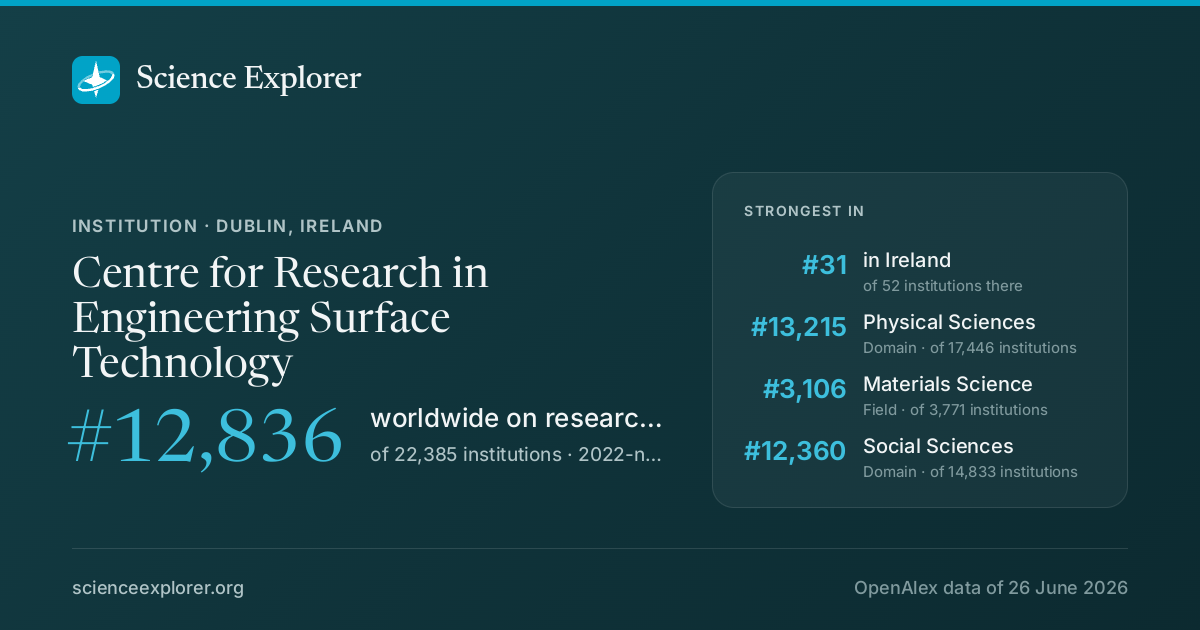
In research, Centre for Research in Engineering Surface Technology stands highest in Physical Sciences (#13,215 of 17,446 worldwide), Materials Science (#3,106 of 3,771 worldwide) and Social Sciences (#12,360 of 14,833 worldwide), over all time.
- World rank, 2022-now
- #12,836 of 22,385 · #20,618 all time
- Rank in Ireland
- #31 of 52
- Research works
- 1.6k ▼ 6% vs 2018-21
- Citations
- 26k 16.6 per fractional work
- Top-10% rate
- 10.8% all institutions 10.0%
- vs its own fields
- 0.99× 1.00× is exactly expected
- Open access
- 67% world 40%
- International
- 68% world 18%
What is Centre for Research in Engineering Surface Technology known for in research?
The fields where it stands highest, over all time, ranked among every institution above the floor in each field.
| Field | World rank | Where that sits | Top-10% rate | Works |
|---|---|---|---|---|
| Physical SciencesDomain | #13,215 of 17,446 | 6.2% | 809 | |
| Materials ScienceField | #3,106 of 3,771 | 9.3% | 152 | |
| Social SciencesDomain | #12,360 of 14,833 | 11.1% | 325 | |
| Biochemistry, Genetics and Molecular BiologyField | #5,132 of 5,801 | 7.2% | 217 | |
| Molecular BiologySubfield | #3,352 of 3,729 | 6.9% | 147 | |
| Social SciencesField | #8,540 of 9,330 | 11.5% | 139 | |
| EngineeringField | #9,005 of 9,532 | 4.5% | 286 | |
| Life SciencesDomain | #10,525 of 11,023 | 7.3% | 300 |
Each strip is that field's whole ranked pool, with the notch where Centre for Research in Engineering Surface Technology sits in it, in the colour of the band that rank falls in. The track under the rate is the rate itself: it carries no average mark, because the average differs by field (from about 6% in Dentistry to 21% in Economics).
Which fields of science does Centre for Research in Engineering Surface Technology work in?
In 2022-now, 46% of research at Centre for Research in Engineering Surface Technology is in Physical Sciences, 44% in Social Sciences. Its largest fields are Social Sciences (18%), Engineering (11%), Arts and Humanities (10%). It does 1.7× the world's share of Social Sciences.
Each ring splits the one inside it: the four domains of science, their fields, their subfields. Size is fractional works in 2022-now. Every slice is a page; the interactive view zooms down to single topics and colours each by how much more of it this institution does than the world.
Its 4 domains and 24 fields, with their numbers
- Physical Sciences5345.6%
- Engineering1311.1%
- Earth and Planetary Sciences108.3%
- Computer Science97.8%
- Materials Science75.7%
- Environmental Science65.4%
- Physics and Astronomy32.8%
- Mathematics32.3%
- Chemistry11.1%
- Energy10.8%
- Chemical Engineering00.4%
- Social Sciences5143.5%
- Social Sciences2117.9%
- Arts and Humanities129.9%
- Economics, Econometrics and Finance98.0%
- Psychology43.6%
- Business, Management and Accounting32.3%
- Decision Sciences21.8%
- Life Sciences75.8%
- Health Sciences65.2%
- Medicine43.5%
- Health Professions11.0%
- Nursing10.7%
Field profile
Location quotient across every field it publishes in: outside the ring is more than an institution of this size would be expected to publish, inside it is less.
Rings at 0.5×, 1× and 2×. Widest outward: Earth and Planetary Sciences, 5.3×. Every wedge is a field page.
All 24 fields, with their numbers
- Earth and Planetary Sciences5.31×10 works
- Economics, Econometrics and Finance3.76×9 works
- Arts and Humanities3.42×12 works
- Mathematics1.96×3 works
- Decision Sciences1.86×2 works
- Materials Science1.63×7 works
- Nursing1.46×1 works
- Social Sciences1.41×21 works
- Physics and Astronomy1.24×3 works
- Psychology1.17×4 works
- Chemical Engineering1.12×0 works
- Environmental Science1.08×6 works
- Computer Science1.00×9 works
- Energy0.84×1 works
- Neuroscience0.77×2 works
- Engineering0.74×13 works
- Business, Management and Accounting0.72×3 works
- Chemistry0.69×1 works
- Agricultural and Biological Sciences0.45×2 works
- Biochemistry, Genetics and Molecular Biology0.39×2 works
- Health Professions0.37×1 works
- Pharmacology, Toxicology and Pharmaceutics0.27×0 works
- Medicine0.18×4 works
- Immunology and Microbiology0.17×0 works
- Earth and Planetary Sciences 5.3×
- Economics, Econometrics and Finance 3.8×
- Arts and Humanities 3.4×
- Mathematics 2.0×
- Decision Sciences 1.9×
- Materials Science 1.6×
- Nursing 1.5×
- Social Sciences 1.4×
- Physics and Astronomy 1.2×
- Psychology 1.2×
- Chemical Engineering 1.1×
- Environmental Science 1.1×
- Computer Science 1.0×
- Energy 0.8×
- Neuroscience 0.8×
- Engineering 0.7×
- Business, Management and Accounting 0.7×
- Chemistry 0.7×
- Agricultural and Biological Sciences 0.5×
- Biochemistry, Genetics and Molecular Biology 0.4×
- Health Professions 0.4×
- Pharmacology, Toxicology and Pharmaceutics 0.3×
- Medicine 0.2×
- Immunology and Microbiology 0.2×
Who are the top researchers at Centre for Research in Engineering Surface Technology?
Ranked on the quality score, Declan E. McCormack, John Colreavy and Brendan Duffy lead among researchers whose main affiliation is Centre for Research in Engineering Surface Technology.
- 1
Declan E. McCormack
 Ireland · #1,765,665 worldwide
3.2k citations · 55 works
- 2
John Colreavy
Ireland · #1,954,786 worldwide
1.3k citations · 17 works
- 3
Brendan Duffy
Ireland · #2,237,002 worldwide
3.7k citations · 83 works
- 4
Sankalp Vinod Agarwal
Ireland · #3,855,666 worldwide
1.2k citations · 19 works
- 5
H. Naiki
Ireland · #3,936,905 worldwide
244 citations · 25 works
- 6
Amaya Garcia
Ireland · #4,342,218 worldwide
631 citations · 15 works
- 7
Michael Spirtas
Ireland · #4,920,983 worldwide
297 citations · 29 works
- 8
Taishi Kimoto
Ireland · #5,233,165 worldwide
5 citations · 27 works
- 9
Seiko Yoshikawa
Ireland · #5,278,452 worldwide
368 citations · 123 works
- 10
M. Yoshida
Ireland · #5,312,628 worldwide
28 citations · 42 works
Which keywords describe research at Centre for Research in Engineering Surface Technology?
By fractional works in 2022-now, weighted toward what it does more of than the world: Cultural Identity, Social Inequality, Intersectionality, African Diaspora, Black Feminist Theory, Agricultural Origins, Radiocarbon Dating and Cultural Heritage.
- Sea-Level Change
- Trauma
- Mediterranean
- Holocene
- Environmental Monitoring
- LiDAR
- Aerial Survey
- Satellite Imagery
- Cultural Sustainability
- Archaeology
- Urban Sustainability
- Community Participation
- Social History
- Biomedical Applications
- Mental Health
- Remote Sensing
- Radiocarbon Dating
- Black Feminist Theory
- Social Inequality
- Cultural Identity
- Machine Learning
- Intersectionality
- African Diaspora
- Agricultural Origins
- Cultural Heritage
- Education
- Sustainable Development
- Cultural History
- Urban Development
- Philosophy of Education
- 19th century
- British architecture
- Resilience
- Adaptive Reuse
- Intangible Heritage
- Risk Management
- Cognitive Therapy
- Monetary Policy
- Posttraumatic Stress Disorder
- Maritime Archaeology
Size is fractional works in 2022-now in the topics tagged with each word; colour is the word's share of this institution's work against its share of the world's. The 40 words are chosen for being large and distinctive. Each links to the topic it comes from most.
All 40 words, with their numbers
- Machine Learning7▲ 1.70×26 topics
- Cultural Identity6▲ 11×3 topics
- Intersectionality6▲ 28×3 topics
- Social Inequality6▲ 20×2 topics
- African Diaspora6▲ 132×1 topic
- Black Feminist Theory6▲ 570×1 topic
- Agricultural Origins6▲ 149×1 topic
- Radiocarbon Dating6▲ 149×1 topic
- Cultural Heritage5▲ 8.3×5 topics
- Remote Sensing4▲ 2.9×10 topics
- Education4▲ 2.0×12 topics
- Mental Health4▲ 2.4×10 topics
- Sustainable Development3▲ 1.73×11 topics
- Biomedical Applications3▲ 2.0×10 topics
- Cultural History3▲ 19×2 topics
- Social History3▲ 28×2 topics
- Urban Development3▲ 6.4×2 topics
- Community Participation2▲ 6.0×4 topics
- Philosophy of Education2▲ 116×2 topics
- Urban Sustainability2▲ 100×2 topics
- 19th century2▲ 246×1 topic
- Archaeology2▲ 16×2 topics
- British architecture2▲ 647×1 topic
- Cultural Sustainability2▲ 36×2 topics
- Resilience2▲ 3.6×2 topics
- Satellite Imagery2▲ 14×2 topics
- Adaptive Reuse2▲ 46×1 topic
- Aerial Survey2▲ 88×1 topic
- Intangible Heritage2▲ 46×1 topic
- LiDAR2▲ 40×1 topic
- Risk Management2▲ 3.6×9 topics
- Environmental Monitoring2▲ 4.3×5 topics
- Cognitive Therapy2▲ 13×2 topics
- Holocene2▲ 13×3 topics
- Monetary Policy2▲ 6.1×10 topics
- Mediterranean2▲ 15×2 topics
- Posttraumatic Stress Disorder2▲ 46×1 topic
- Trauma2▲ 6.8×1 topic
- Maritime Archaeology2▲ 70×1 topic
- Sea-Level Change2▲ 70×1 topic
Which research topics does Centre for Research in Engineering Surface Technology publish most on?
By volume in 2022-now: Historical and Cultural Archaeology Studies, Archaeology and ancient environmental studies, Historical Architecture and Urbanism and Archaeological Research and Protection.
Area is fractional works; colour is the subfield each topic belongs to.
- 1 Historical and Cultural Archaeology Studies Anthropology 6 works
- 2 Archaeology and ancient environmental studies Paleontology 6 works
- 3 Historical Architecture and Urbanism History 2 works
- 4 Archaeological Research and Protection Space and Planetary Science 2 works
- 5 Cultural Heritage Management and Preservation Archeology 2 works
- 6 Posttraumatic Stress Disorder Research Clinical Psychology 2 works
- 7 Maritime and Coastal Archaeology Archeology 2 works
- 8 Conservation Techniques and Studies Conservation 1 works
- 9 Landscape and Cultural Studies Archeology 1 works
- 10 Nanocomposite Films for Food Packaging Biomaterials 1 works
How open and international is its research?
Against the world's own shares: the tick on each track. Both are shares of its output, so they sit on one scale and can be read against each other as well as against the world.
World: 40% of research is openly available.
World: 18% is written across borders.
How has Centre for Research in Engineering Surface Technology's research output changed?
Output in 2022-2025 was 6% lower than in 2018-2021.
The same series as a ribbon: one cell per year, darker for more. The line above answers how much; this answers when.
Its share of all research
Growing output can still be a shrinking share: all of science grows. This is Centre for Research in Engineering Surface Technology as a percentage of every work published that year, 0.00054% in 2024.
Fractional works of Centre for Research in Engineering Surface Technology over all fractional works that year. How the balance of science has shifted.
How much of it reaches the world top 10%
Year by year, against all institutions in the same year.
Of each year's output, the share that reached the world's 10% most cited for its field and year. Peak 17.7% in 2020.
Other research institutions in Dublin
- University College Dublin
- Trinity College Dublin
- Dublin City University
- Royal College of Surgeons in Ireland
- Technological University Dublin
- National University of Ireland
- Health Service Executive
- Beaumont Hospital



Share Centre for Research in Engineering Surface Technology's ranking
Badges for a website1Each links back here and updates with every snapshot

Research measures only: rankings here say nothing about teaching, admissions or student experience. Comparable institutions and collaboration partners have tabs of their own, above.
Discussion
Ask a question or share a note about Centre for Research in Engineering Surface Technology. Posts are plain text and can be reported.