Centro Universitário FEI
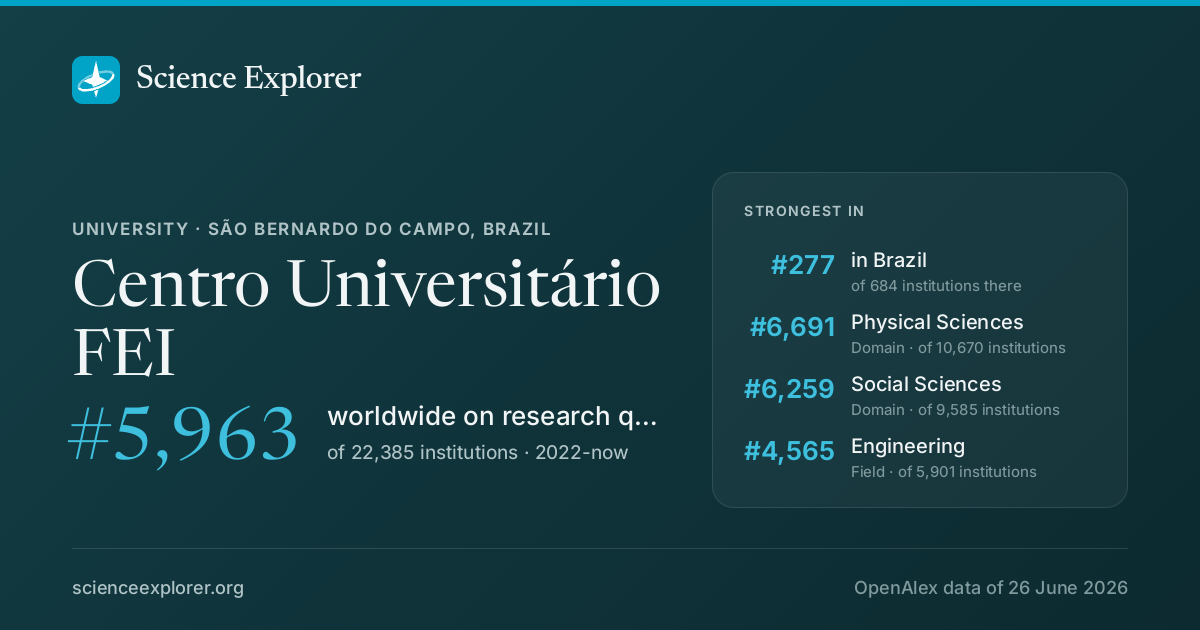
In research, Centro Universitário FEI stands highest in Physical Sciences (#6,691 of 10,670 worldwide), Social Sciences (#6,259 of 9,585 worldwide) and Engineering (#4,565 of 5,901 worldwide), 2022-now.
- World rank, 2022-now
- #5,963 of 22,385 · #9,333 all time
- Rank in Brazil
- #277 of 684
- Research works
- 2k ▼ 15% vs 2018-21
- Citations
- 15k 7.8 per fractional work
- Top-10% rate
- 6.2% all institutions 10.0%
- vs its own fields
- 0.86× 1.00× is exactly expected
- Open access
- 50% world 40%
- International
- 16% world 18%
What is Centro Universitário FEI known for in research?
The fields where it stands highest, 2022-now, ranked among every institution above the floor in each field.
| Field | World rank | Where that sits | Top-10% rate | Works | All time |
|---|---|---|---|---|---|
| Physical SciencesDomain | #6,691 of 10,670 | 3.8% | 257 | #10708 | |
| Social SciencesDomain | #6,259 of 9,585 | 8.1% | 125 | #4946 | |
| EngineeringField | #4,565 of 5,901 | 3.1% | 152 | #5582 | |
| Electrical and Electronic EngineeringSubfield | #2,023 of 2,176 | 0.6% | 63 | #3232 |
Each strip is that field's whole ranked pool, with the notch where Centro Universitário FEI sits in it, in the colour of the band that rank falls in. The track under the rate is the rate itself: it carries no average mark, because the average differs by field (from about 6% in Dentistry to 21% in Economics).
Which of those standings moved
The same fields on both windows: where it stood over the whole record, and where it stands in 2022-now. The distance is the story, and it is the one thing the two rank columns above cannot show.
- Physical Sciences#10,708 #6,691
- Social Sciences#4,946 #6,259
- Engineering#5,582 #4,565
- Electrical and Electronic Engineering#3,232 #2,023
A dot further right is a better standing. Fields it was not ranked in over the whole record are left out.
Which fields of science does Centro Universitário FEI work in?
In 2022-now, 56% of research at Centro Universitário FEI is in Physical Sciences, 29% in Social Sciences. Its largest fields are Engineering (33%), Social Sciences (12%), Business, Management and Accounting (9%). It does 1.4× the world's share of Physical Sciences.
Each ring splits the one inside it: the four domains of science, their fields, their subfields. Size is fractional works in 2022-now. Every slice is a page; the interactive view zooms down to single topics and colours each by how much more of it this institution does than the world.
Its 4 domains and 25 fields, with their numbers
- Physical Sciences28256.2%
- Engineering16633.2%
- Computer Science428.3%
- Environmental Science214.1%
- Materials Science214.1%
- Chemistry91.7%
- Physics and Astronomy71.4%
- Chemical Engineering71.4%
- Energy61.3%
- Earth and Planetary Sciences20.4%
- Mathematics20.3%
- Social Sciences14328.6%
- Social Sciences6212.4%
- Business, Management and Accounting469.1%
- Decision Sciences183.5%
- Psychology102.0%
- Economics, Econometrics and Finance61.3%
- Arts and Humanities20.3%
- Health Sciences5210.4%
- Medicine418.2%
- Health Professions101.9%
- Nursing10.2%
- Dentistry10.1%
- Life Sciences244.8%
Field profile
Location quotient across every field it publishes in: outside the ring is more than an institution of this size would be expected to publish, inside it is less.
Rings at 0.5×, 1× and 2×. Widest outward: Chemical Engineering, 3.9×. Every wedge is a field page.
All 25 fields, with their numbers
- Chemical Engineering3.87×7 works
- Decision Sciences3.62×18 works
- Business, Management and Accounting2.84×46 works
- Engineering2.21×166 works
- Energy1.40×6 works
- Materials Science1.18×21 works
- Chemistry1.09×9 works
- Computer Science1.06×42 works
- Social Sciences0.98×62 works
- Environmental Science0.83×21 works
- Health Professions0.74×10 works
- Neuroscience0.64×5 works
- Psychology0.64×10 works
- Physics and Astronomy0.62×7 works
- Economics, Econometrics and Finance0.60×6 works
- Agricultural and Biological Sciences0.52×12 works
- Medicine0.43×41 works
- Nursing0.40×1 works
- Mathematics0.28×2 works
- Earth and Planetary Sciences0.27×2 works
- Biochemistry, Genetics and Molecular Biology0.21×6 works
- Dentistry0.21×0 works
- Pharmacology, Toxicology and Pharmaceutics0.14×0 works
- Arts and Humanities0.11×2 works
- Immunology and Microbiology0.05×0 works
- Chemical Engineering 3.9×
- Decision Sciences 3.6×
- Business, Management and Accounting 2.8×
- Engineering 2.2×
- Energy 1.4×
- Materials Science 1.2×
- Chemistry 1.1×
- Computer Science 1.1×
- Social Sciences 1.0×
- Environmental Science 0.8×
- Health Professions 0.7×
- Neuroscience 0.6×
- Psychology 0.6×
- Physics and Astronomy 0.6×
- Economics, Econometrics and Finance 0.6×
- Agricultural and Biological Sciences 0.5×
- Medicine 0.4×
- Nursing 0.4×
- Mathematics 0.3×
- Earth and Planetary Sciences 0.3×
- Biochemistry, Genetics and Molecular Biology 0.2×
- Dentistry 0.2×
- Pharmacology, Toxicology and Pharmaceutics 0.1×
- Arts and Humanities 0.1×
- Immunology and Microbiology 0.1×
Who are the top researchers at Centro Universitário FEI?
Ranked on the quality score, Mauro José de Oliveira, Dennys Eduardo Rossetto and CLAUDIA APARECIDA MATTOS lead among researchers whose main affiliation is Centro Universitário FEI.
- 1
Mauro José de Oliveira
 Brazil · #858,149 worldwide
733 citations · 29 works
- 2
Dennys Eduardo Rossetto
Brazil · #1,405,033 worldwide
568 citations · 39 works
- 3
CLAUDIA APARECIDA MATTOS
Brazil · #1,419,136 worldwide
1.3k citations · 80 works
- 4
Rodrigo Filev Maia
Brazil · #1,898,835 worldwide
1.5k citations · 75 works
- 5
Tatiany Marcondes Heiderich
Brazil · #2,331,143 worldwide
249 citations · 34 works
- 6
Fernanda Ribeiro Cahen
Brazil · #2,419,425 worldwide
335 citations · 36 works
- 7
Dafne Oliveira Carlos de Morais
Brazil · #2,423,767 worldwide
295 citations · 24 works
- 8
José Mauro da Costa Hernandez
Brazil · #2,445,732 worldwide
1.6k citations · 77 works
- 9
Fábio Gerab
Brazil · #2,503,761 worldwide
433 citations · 24 works
- 10
Roberto Carlos Bernardes
Brazil · #2,577,811 worldwide
844 citations · 91 works
Which keywords describe research at Centro Universitário FEI?
By fractional works in 2022-now, weighted toward what it does more of than the world: Nanoelectronics, Process Variation, Nanowire Transistors, Tunnel Field-Effect Transistors, Semiconductor Devices, Atomic Layer Deposition, High-k Dielectrics and Data Analysis.
- Sustainable Supply Chain Management
- Product Design
- Research
- Training
- Semiconductor
- Solar Cells
- Constitutional Law
- Environmental Law
- Environmental Management
- Legal Theory
- Research Methods
- Innovation Management
- Human Rights
- Data Analysis
- Atomic Layer Deposition
- Qualitative Research
- Healthcare
- Nanowire Transistors
- Process Variation
- Deep Learning
- Sustainability
- Nanoelectronics
- Environmental Impact
- Tunnel Field-Effect Transistors
- Supply Chain Management
- Semiconductor Devices
- High-k Dielectrics
- Online Learning
- Marketing Strategies
- Organizational Management
- Internet of Things
- Legal Philosophy
- Ionic Liquids
- Civil Rights
- Legislation
- Circular Economy
- CMOS Technology
- Inclusion
- Value-Added Products
- Green Practices
Size is fractional works in 2022-now in the topics tagged with each word; colour is the word's share of this institution's work against its share of the world's. The 40 words are chosen for being large and distinctive. Each links to the topic it comes from most.
All 40 words, with their numbers
- Sustainability26▲ 2.1×32 topics
- Deep Learning22▲ 1.25×45 topics
- Nanoelectronics20▲ 49×2 topics
- Process Variation19▲ 66×2 topics
- Environmental Impact18▲ 2.1×26 topics
- Nanowire Transistors18▲ 93×1 topic
- Tunnel Field-Effect Transistors18▲ 93×1 topic
- Healthcare17▲ 3.0×11 topics
- Supply Chain Management17▲ 3.8×12 topics
- Qualitative Research17▲ 4.0×8 topics
- Semiconductor Devices15▲ 44×2 topics
- Atomic Layer Deposition14▲ 45×1 topic
- High-k Dielectrics14▲ 45×1 topic
- Data Analysis14▲ 10×5 topics
- Online Learning13▲ 3.1×6 topics
- Human Rights13▲ 2.5×10 topics
- Marketing Strategies12▲ 27×2 topics
- Innovation Management12▲ 16×2 topics
- Organizational Management12▲ 41×1 topic
- Research Methods12▲ 16×1 topic
- Internet of Things12▲ 2.7×6 topics
- Legal Theory11▲ 33×3 topics
- Legal Philosophy11▲ 35×2 topics
- Environmental Management11▲ 5.2×7 topics
- Ionic Liquids9▲ 6.6×8 topics
- Environmental Law9▲ 8.5×2 topics
- Civil Rights9▲ 26×1 topic
- Constitutional Law9▲ 13×1 topic
- Legislation9▲ 11×2 topics
- Solar Cells9▲ 8.7×4 topics
- Circular Economy9▲ 6.3×5 topics
- Semiconductor8▲ 5.2×4 topics
- CMOS Technology8▲ 21×4 topics
- Training8▲ 7.5×2 topics
- Inclusion7▲ 9.9×3 topics
- Research7▲ 11×1 topic
- Value-Added Products7▲ 21×2 topics
- Product Design7▲ 10.0×2 topics
- Green Practices7▲ 16×1 topic
- Sustainable Supply Chain Management7▲ 16×1 topic
Which research topics does Centro Universitário FEI publish most on?
By volume in 2022-now: Advancements in Semiconductor Devices and Circuit Design, Semiconductor materials and devices, Business and Management Studies and Brazilian Legal Issues.
Area is fractional works; colour is the subfield each topic belongs to.
- 1 Advancements in Semiconductor Devices and Circuit Design Electrical and Electronic Engineering 18 works
- 2 Semiconductor materials and devices Electrical and Electronic Engineering 14 works
- 3 Business and Management Studies Information Systems and Management 12 works
- 4 Brazilian Legal Issues Law 9 works
- 5 Academic Research in Diverse Fields Education 7 works
- 6 Sustainable Supply Chain Management Strategy and Management 7 works
- 7 Nanowire Synthesis and Applications Biomedical Engineering 6 works
- 8 Radiation Effects in Electronics Electrical and Electronic Engineering 6 works
- 9 Quality and Supply Management Management Information Systems 5 works
- 10 Agricultural and Food Sciences Forestry 5 works
How open and international is its research?
Against the world's own shares: the tick on each track. Both are shares of its output, so they sit on one scale and can be read against each other as well as against the world.
World: 40% of research is openly available.
World: 18% is written across borders.
How has Centro Universitário FEI's research output changed?
Output in 2022-2025 was 15% lower than in 2018-2021.
The same series as a ribbon: one cell per year, darker for more. The line above answers how much; this answers when.
Its share of all research
Growing output can still be a shrinking share: all of science grows. This is Centro Universitário FEI as a percentage of every work published that year, 0.0020% in 2024.
Fractional works of Centro Universitário FEI over all fractional works that year. How the balance of science has shifted.
How much of it reaches the world top 10%
Year by year, against all institutions in the same year.
Of each year's output, the share that reached the world's 10% most cited for its field and year. Peak 9.7% in 2013.
Other research institutions in São Bernardo do Campo
- Universidade Metodista de São Paulo
- Waelzholz (Brasil)
- Urbem Tecnologia Ambiental (Brazil)
- Misque (Brazil)

Share Centro Universitário FEI's ranking
Badges for a website1Each links back here and updates with every snapshot

Research measures only: rankings here say nothing about teaching, admissions or student experience. Comparable institutions and collaboration partners have tabs of their own, above.
Discussion
Ask a question or share a note about Centro Universitário FEI. Posts are plain text and can be reported.