CGIAR
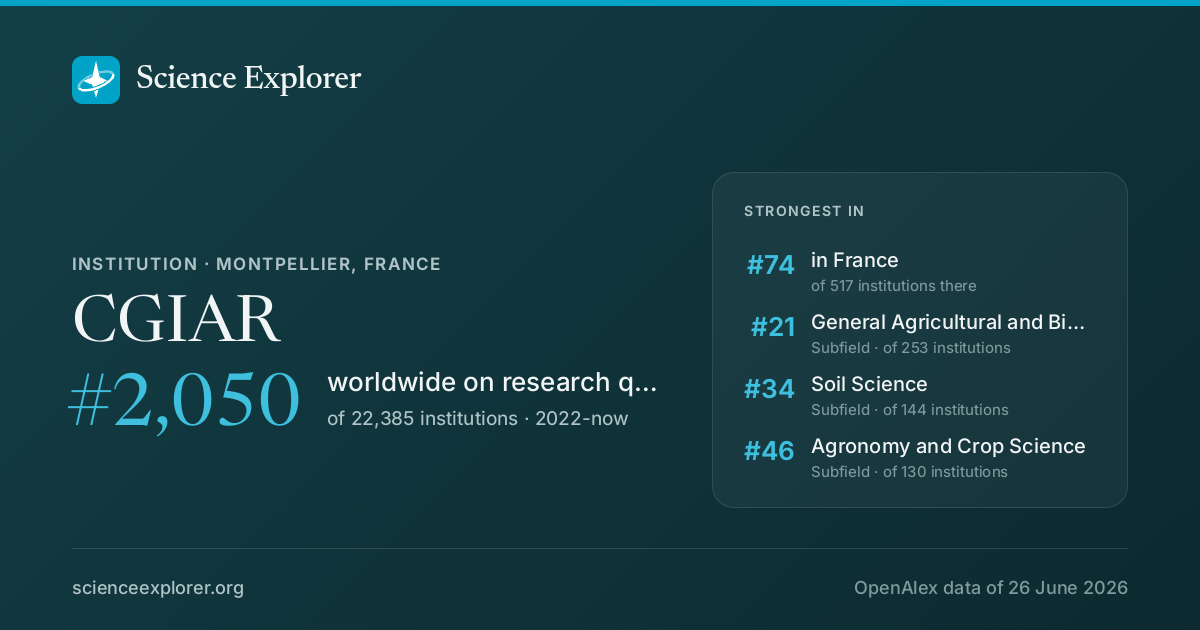
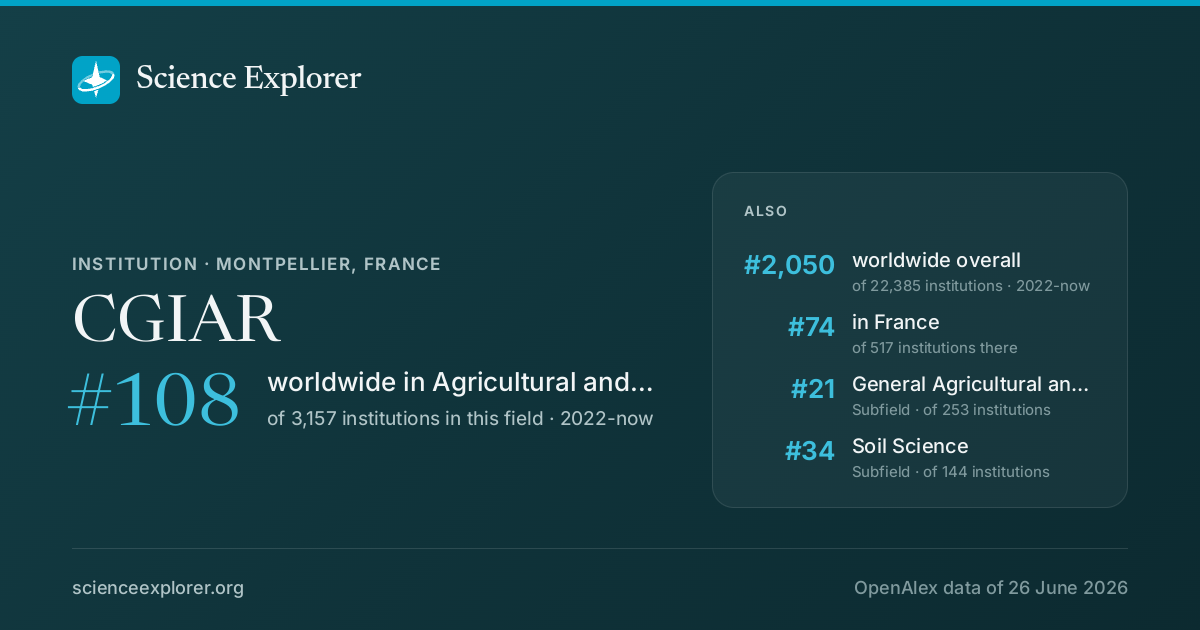
In research, CGIAR stands highest in Agricultural and Biological Sciences (#108 of 3,157 worldwide), Plant Science (#109 of 1,317 worldwide) and General Agricultural and Biological Sciences (#21 of 253 worldwide), 2022-now. Relative to its size it is most specialised in Agronomy and Crop Science, General Agricultural and Biological Sciences and Plant Science (Agronomy and Crop Science is 16.2× its share of world research).
- World rank, 2022-now
- #2,050 of 22,385 · #1,658 all time
- Rank in France
- #74 of 517
- Research works
- 15k ◆ 2% vs 2018-21
- Citations
- 546k 35.7 per fractional work
- Top-10% rate
- 15.6% all institutions 10.0%
- vs its own fields
- 1.09× 1.00× is exactly expected
- Open access
- 50% world 40%
- International
- 58% world 18%
What is CGIAR known for in research?
The fields where it stands highest, 2022-now, ranked among every institution above the floor in each field.
| Field | World rank | Where that sits | Top-10% rate | Works | All time |
|---|---|---|---|---|---|
| Agricultural and Biological SciencesField | #108 of 3,157 | 17.7% | 1,216 | #103 | |
| Plant ScienceSubfield | #109 of 1,317 | 16.1% | 530 | #100 | |
| General Agricultural and Biological SciencesSubfield | #21 of 253 | 21.7% | 168 | #9 | |
| Life SciencesDomain | #825 of 6,403 | 17.1% | 1,455 | #809 | |
| Social SciencesDomain | #2,260 of 9,585 | 18.5% | 338 | #1662 | |
| Soil ScienceSubfield | #34 of 144 | 21.5% | 90 | #40 | |
| Environmental ScienceField | #814 of 3,334 | 14.9% | 323 | #713 | |
| Agronomy and Crop ScienceSubfield | #46 of 130 | 16.2% | 105 | #42 | |
| Social SciencesField | #2,160 of 5,988 | 19.5% | 165 | #1734 | |
| Food ScienceSubfield | #203 of 517 | 14.1% | 78 | #236 |
Each strip is that field's whole ranked pool, with the notch where CGIAR sits in it, in the colour of the band that rank falls in. The track under the rate is the rate itself: it carries no average mark, because the average differs by field (from about 6% in Dentistry to 21% in Economics).
Which of those standings moved
The same fields on both windows: where it stood over the whole record, and where it stands in 2022-now. The distance is the story, and it is the one thing the two rank columns above cannot show.
- Agricultural and Biological Sciences#103 #108
- Plant Science#100 #109
- General Agricultural and Biological Sciences#9 #21
- Life Sciences#809 #825
- Social Sciences#1,662 #2,260
- Soil Science#40 #34
- Environmental Science#713 #814
- Agronomy and Crop Science#42 #46
- Social Sciences#1,734 #2,160
- Food Science#236 #203
A dot further right is a better standing. Fields it was not ranked in over the whole record are left out.
Which fields of science does CGIAR work in?
In 2022-now, 55% of research at CGIAR is in Life Sciences, 21% in Physical Sciences. Its largest fields are Agricultural and Biological Sciences (46%), Environmental Science (12%), Biochemistry, Genetics and Molecular Biology (8%). It does 4.1× the world's share of Life Sciences.
Each ring splits the one inside it: the four domains of science, their fields, their subfields. Size is fractional works in 2022-now. Every slice is a page; the interactive view zooms down to single topics and colours each by how much more of it this institution does than the world.
Its 4 domains and 26 fields, with their numbers
- Life Sciences1,68155.0%
- Physical Sciences64321.0%
- Environmental Science38212.5%
- Engineering862.8%
- Computer Science551.8%
- Materials Science411.3%
- Earth and Planetary Sciences270.9%
- Chemistry220.7%
- Energy120.4%
- Mathematics80.3%
- Physics and Astronomy70.2%
- Chemical Engineering30.1%
- Social Sciences42313.8%
- Social Sciences2167.1%
- Economics, Econometrics and Finance792.6%
- Business, Management and Accounting662.2%
- Arts and Humanities220.7%
- Psychology210.7%
- Decision Sciences180.6%
- Health Sciences31010.1%
- Medicine1956.4%
- Nursing531.7%
- Health Professions491.6%
- Veterinary100.3%
- Dentistry20.1%
What does CGIAR specialise in?
Where its research is concentrated relative to its size: Agronomy and Crop Science takes 16.2× the share of its output that it takes of world research.
- Agronomy and Crop ScienceSubfield · 117.1 works16×
- General Agricultural and Biological SciencesSubfield · 191.0 works14×
- Plant ScienceSubfield · 609.0 works11×
- Soil ScienceSubfield · 102.0 works11×
- Ecology, Evolution, Behavior and SystematicsSubfield · 143.5 works10×
- Agricultural and Biological SciencesField · 1,398.9 works9.6×
Location quotient, a volume reading rather than an impact one. It surfaces small, lopsided specialities.
Field profile
Location quotient across every field it publishes in: outside the ring is more than an institution of this size would be expected to publish, inside it is less.
Rings at 0.5×, 1× and 2×. Widest outward: Agricultural and Biological Sciences, 9.6×. Every wedge is a field page.
All 26 fields, with their numbers
- Agricultural and Biological Sciences9.63×1,399 works
- Nursing3.57×54 works
- Environmental Science2.52×382 works
- Veterinary2.39×10 works
- Biochemistry, Genetics and Molecular Biology1.47×239 works
- Economics, Econometrics and Finance1.21×79 works
- Immunology and Microbiology1.06×33 works
- Business, Management and Accounting0.67×66 works
- Decision Sciences0.62×18 works
- Health Professions0.61×49 works
- Earth and Planetary Sciences0.56×27 works
- Social Sciences0.56×216 works
- Chemistry0.46×22 works
- Energy0.43×12 works
- Materials Science0.38×41 works
- Pharmacology, Toxicology and Pharmaceutics0.37×4 works
- Medicine0.33×195 works
- Arts and Humanities0.25×22 works
- Chemical Engineering0.24×3 works
- Computer Science0.23×55 works
- Mathematics0.23×8 works
- Psychology0.23×21 works
- Engineering0.19×86 works
- Dentistry0.16×2 works
- Neuroscience0.13×7 works
- Physics and Astronomy0.11×7 works
- Agricultural and Biological Sciences 9.6×
- Nursing 3.6×
- Environmental Science 2.5×
- Veterinary 2.4×
- Biochemistry, Genetics and Molecular Biology 1.5×
- Economics, Econometrics and Finance 1.2×
- Immunology and Microbiology 1.1×
- Business, Management and Accounting 0.7×
- Decision Sciences 0.6×
- Health Professions 0.6×
- Earth and Planetary Sciences 0.6×
- Social Sciences 0.6×
- Chemistry 0.5×
- Energy 0.4×
- Materials Science 0.4×
- Pharmacology, Toxicology and Pharmaceutics 0.4×
- Medicine 0.3×
- Arts and Humanities 0.2×
- Chemical Engineering 0.2×
- Computer Science 0.2×
- Mathematics 0.2×
- Psychology 0.2×
- Engineering 0.2×
- Dentistry 0.2×
- Neuroscience 0.1×
- Physics and Astronomy 0.1×
Who are the top researchers at CGIAR?
Ranked on the quality score, Prem Kumar Sholapurapu, Ismahane A. Elouafi and Land and Ecosystems CGIAR Research Program on Water lead among researchers whose main affiliation is CGIAR.
- 1
Prem Kumar Sholapurapu
 France · #1,590,497 worldwide
94 citations · 16 works
- 2
Ismahane A. Elouafi
France · #1,689,119 worldwide
1.5k citations · 49 works
- 3
Land and Ecosystems CGIAR Research Program on Water
France · #5,158,238 worldwide
0 citations · 19 works
Which keywords describe research at CGIAR?
By fractional works in 2022-now, weighted toward what it does more of than the world: Climate Change, Sustainable Agriculture, Sustainability, Food Security, Smallholder Farmers, Drought Tolerance, Social Networks and Genetic Diversity.
- Extreme Weather
- Disease Resistance
- Genetic Mapping
- Biodiversity Conservation
- Cultivar Evaluation
- Quantitative Trait Loci
- Yield Potential
- Marker-Assisted Selection
- Crop Improvement
- Breeding
- Biodiversity
- Agricultural Innovation
- Genetic Improvement
- Genetics
- Agriculture
- Rural Development
- Social Networks
- Drought Tolerance
- Food Security
- Sustainability
- Climate Change
- Sustainable Agriculture
- Smallholder Farmers
- Environmental Impact
- Genetic Diversity
- QTL Mapping
- Adaptation
- Technology Adoption
- Vulnerability
- Livelihood Diversification
- Plant Breeding
- Water Management
- Ecosystem Services
- Global Warming
- Genome Sequencing
- Stability Analysis
- Genotype-by-Environment Interaction
- Agroecology
- Crop Production
- Soil Fertility
Size is fractional works in 2022-now in the topics tagged with each word; colour is the word's share of this institution's work against its share of the world's. The 40 words are chosen for being large and distinctive. Each links to the topic it comes from most.
All 40 words, with their numbers
- Climate Change395▲ 4.8×99 topics
- Sustainability306▲ 4.1×86 topics
- Sustainable Agriculture230▲ 24×15 topics
- Food Security215▲ 13×22 topics
- Smallholder Farmers191▲ 30×5 topics
- Drought Tolerance169▲ 40×9 topics
- Environmental Impact166▲ 3.2×57 topics
- Social Networks164▲ 20×12 topics
- Genetic Diversity157▲ 12×20 topics
- Rural Development148▲ 14×19 topics
- QTL Mapping143▲ 40×6 topics
- Agriculture136▲ 12×15 topics
- Adaptation133▲ 15×12 topics
- Genetics126▲ 5.8×18 topics
- Technology Adoption124▲ 22×5 topics
- Genetic Improvement122▲ 46×4 topics
- Vulnerability120▲ 17×8 topics
- Agricultural Innovation118▲ 83×1 topic
- Livelihood Diversification118▲ 123×1 topic
- Biodiversity116▲ 5.0×35 topics
- Plant Breeding110▲ 39×4 topics
- Breeding104▲ 45×5 topics
- Water Management100▲ 26×8 topics
- Crop Improvement95▲ 64×2 topics
- Ecosystem Services86▲ 7.3×12 topics
- Marker-Assisted Selection85▲ 36×3 topics
- Global Warming82▲ 6.3×13 topics
- Yield Potential80▲ 48×2 topics
- Genome Sequencing80▲ 17×9 topics
- Quantitative Trait Loci75▲ 44×3 topics
- Stability Analysis71▲ 15×3 topics
- Cultivar Evaluation70▲ 105×1 topic
- Genotype-by-Environment Interaction70▲ 105×1 topic
- Biodiversity Conservation70▲ 6.1×18 topics
- Agroecology68▲ 16×5 topics
- Genetic Mapping67▲ 28×6 topics
- Crop Production65▲ 19×3 topics
- Disease Resistance63▲ 39×3 topics
- Soil Fertility62▲ 9.0×9 topics
- Extreme Weather60▲ 59×1 topic
Which research topics does CGIAR publish most on?
By volume in 2022-now: Agricultural Innovations and Practices, Genetics and Plant Breeding, Climate change impacts on agriculture and Genetic Mapping and Diversity in Plants and Animals.
Area is fractional works; colour is the subfield each topic belongs to.
- 1 Agricultural Innovations and Practices General Agricultural and Biological Sciences 118 works
- 2 Genetics and Plant Breeding Plant Science 70 works
- 3 Climate change impacts on agriculture Ecology, Evolution, Behavior and Systematics 60 works
- 4 Genetic Mapping and Diversity in Plants and Animals Genetics 48 works
- 5 Wheat and Barley Genetics and Pathology Plant Science 47 works
- 6 Crop Yield and Soil Fertility Agronomy and Crop Science 43 works
- 7 Agricultural risk and resilience Soil Science 41 works
- 8 Agriculture Sustainability and Environmental Impact Ecology 38 works
- 9 Child Nutrition and Water Access Nutrition and Dietetics 37 works
- 10 Banana Cultivation and Research Plant Science 35 works
How open and international is its research?
Against the world's own shares: the tick on each track. Both are shares of its output, so they sit on one scale and can be read against each other as well as against the world.
World: 40% of research is openly available.
World: 18% is written across borders.
How has CGIAR's research output changed?
Output in 2022-2025 was 2% higher than in 2018-2021.
The same series as a ribbon: one cell per year, darker for more. The line above answers how much; this answers when.
Its share of all research
Growing output can still be a shrinking share: all of science grows. This is CGIAR as a percentage of every work published that year, 0.011% in 2024.
Fractional works of CGIAR over all fractional works that year. How the balance of science has shifted.
How much of it reaches the world top 10%
Year by year, against all institutions in the same year.
Of each year's output, the share that reached the world's 10% most cited for its field and year. Peak 24.5% in 2012.
Other research institutions in Montpellier
- Université de Montpellier
- Université Paul-Valéry Montpellier
- École Nationale Supérieure de Chimie de Montpellier
- Hôpital Arnaud de Villeneuve
- Institut Agro Montpellier
- Agropolis International
- Hôpital Gui de Chauliac
- Montpellier Business School


Share CGIAR's ranking


Research measures only: rankings here say nothing about teaching, admissions or student experience. Comparable institutions and collaboration partners have tabs of their own, above.
Discussion
Ask a question or share a note about CGIAR. Posts are plain text and can be reported.