Institut Agro Montpellier
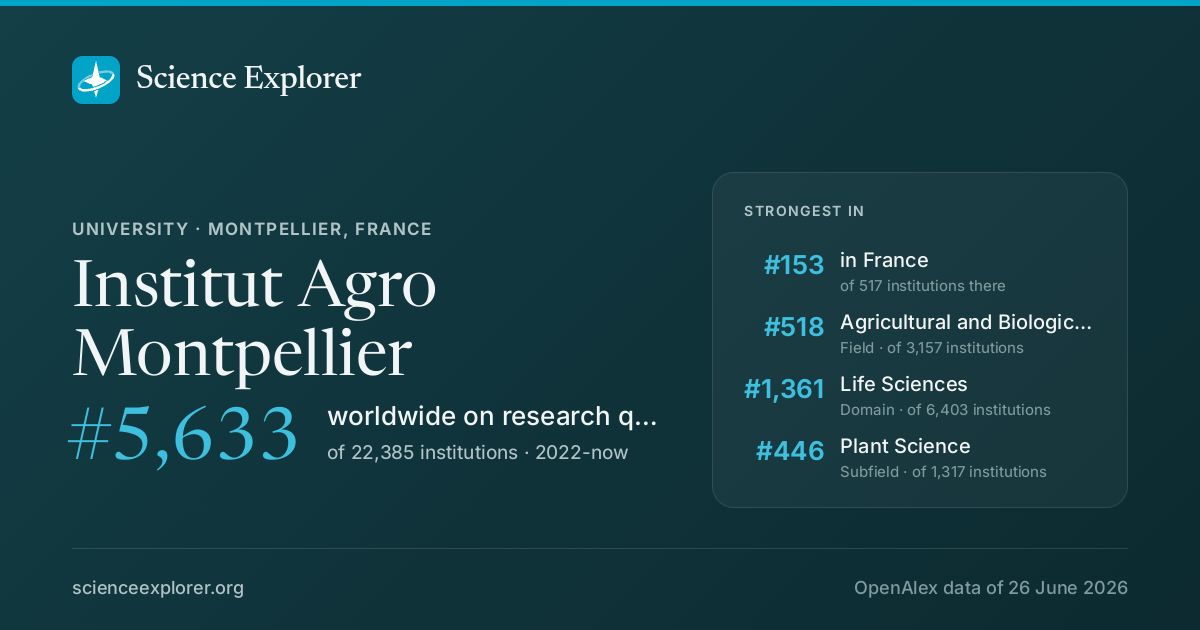
In research, Institut Agro Montpellier stands highest in Agricultural and Biological Sciences (#518 of 3,157 worldwide), Life Sciences (#1,361 of 6,403 worldwide) and Plant Science (#446 of 1,317 worldwide), 2022-now. Relative to its size it is most specialised in Ecology, Evolution, Behavior and Systematics, Plant Science and Agricultural and Biological Sciences (Ecology, Evolution, Behavior and Systematics is 17.7× its share of world research).
- World rank, 2022-now
- #5,633 of 22,385 · #2,755 all time
- Rank in France
- #153 of 517
- Research works
- 1.8k ▼ 13% vs 2018-21
- Citations
- 58k 32.6 per fractional work
- Top-10% rate
- 11.0% all institutions 10.0%
- vs its own fields
- 1.04× 1.00× is exactly expected
- Open access
- 54% world 40%
- International
- 44% world 18%
What is Institut Agro Montpellier known for in research?
The fields where it stands highest, 2022-now, ranked among every institution above the floor in each field.
| Field | World rank | Where that sits | Top-10% rate | Works | All time |
|---|---|---|---|---|---|
| Agricultural and Biological SciencesField | #518 of 3,157 | 12.0% | 179 | #411 | |
| Life SciencesDomain | #1,361 of 6,403 | 11.9% | 216 | #1144 | |
| Plant ScienceSubfield | #446 of 1,317 | 11.5% | 76 | #396 | |
| Environmental ScienceField | #1,378 of 3,334 | 9.0% | 67 | #1261 | |
| Physical SciencesDomain | #5,757 of 10,670 | 9.3% | 110 | #3421 |
Each strip is that field's whole ranked pool, with the notch where Institut Agro Montpellier sits in it, in the colour of the band that rank falls in. The track under the rate is the rate itself: it carries no average mark, because the average differs by field (from about 6% in Dentistry to 21% in Economics).
Which of those standings moved
The same fields on both windows: where it stood over the whole record, and where it stands in 2022-now. The distance is the story, and it is the one thing the two rank columns above cannot show.
- Agricultural and Biological Sciences#411 #518
- Life Sciences#1,144 #1,361
- Plant Science#396 #446
- Environmental Science#1,261 #1,378
- Physical Sciences#3,421 #5,757
A dot further right is a better standing. Fields it was not ranked in over the whole record are left out.
Which fields of science does Institut Agro Montpellier work in?
In 2022-now, 53% of research at Institut Agro Montpellier is in Life Sciences, 27% in Physical Sciences. Its largest fields are Agricultural and Biological Sciences (44%), Environmental Science (17%), Biochemistry, Genetics and Molecular Biology (9%). It does 3.9× the world's share of Life Sciences.
Each ring splits the one inside it: the four domains of science, their fields, their subfields. Size is fractional works in 2022-now. Every slice is a page; the interactive view zooms down to single topics and colours each by how much more of it this institution does than the world.
Its 4 domains and 26 fields, with their numbers
- Life Sciences22753.4%
- Physical Sciences11727.4%
- Environmental Science7116.7%
- Engineering174.0%
- Earth and Planetary Sciences71.6%
- Computer Science71.6%
- Materials Science51.2%
- Chemistry51.1%
- Energy20.6%
- Mathematics20.4%
- Physics and Astronomy10.2%
- Chemical Engineering00.1%
- Social Sciences5412.6%
- Health Sciences286.5%
- Medicine163.7%
- Nursing71.6%
- Health Professions40.9%
- Veterinary10.3%
- Dentistry00.0%
What does Institut Agro Montpellier specialise in?
Where its research is concentrated relative to its size: Ecology, Evolution, Behavior and Systematics takes 17.7× the share of its output that it takes of world research.
- Ecology, Evolution, Behavior and SystematicsSubfield · 35.3 works18×
- Plant ScienceSubfield · 79.7 works11×
- Agricultural and Biological SciencesField · 187.8 works9.3×
Location quotient, a volume reading rather than an impact one. It surfaces small, lopsided specialities.
Field profile
Location quotient across every field it publishes in: outside the ring is more than an institution of this size would be expected to publish, inside it is less.
Rings at 0.5×, 1× and 2×. Widest outward: Agricultural and Biological Sciences, 9.3×. Every wedge is a field page.
All 26 fields, with their numbers
- Agricultural and Biological Sciences9.29×188 works
- Environmental Science3.37×71 works
- Nursing3.21×7 works
- Veterinary2.51×2 works
- Biochemistry, Genetics and Molecular Biology1.62×37 works
- Earth and Planetary Sciences1.04×7 works
- Business, Management and Accounting0.82×11 works
- Decision Sciences0.76×3 works
- Chemistry0.73×5 works
- Energy0.60×2 works
- Economics, Econometrics and Finance0.59×5 works
- Social Sciences0.55×30 works
- Immunology and Microbiology0.34×1 works
- Materials Science0.33×5 works
- Mathematics0.33×2 works
- Health Professions0.33×4 works
- Chemical Engineering0.26×0 works
- Engineering0.26×17 works
- Computer Science0.20×7 works
- Medicine0.19×16 works
- Arts and Humanities0.19×2 works
- Neuroscience0.16×1 works
- Pharmacology, Toxicology and Pharmaceutics0.15×0 works
- Psychology0.13×2 works
- Physics and Astronomy0.09×1 works
- Dentistry0.01×0 works
- Agricultural and Biological Sciences 9.3×
- Environmental Science 3.4×
- Nursing 3.2×
- Veterinary 2.5×
- Biochemistry, Genetics and Molecular Biology 1.6×
- Earth and Planetary Sciences 1.0×
- Business, Management and Accounting 0.8×
- Decision Sciences 0.8×
- Chemistry 0.7×
- Energy 0.6×
- Economics, Econometrics and Finance 0.6×
- Social Sciences 0.6×
- Immunology and Microbiology 0.3×
- Materials Science 0.3×
- Mathematics 0.3×
- Health Professions 0.3×
- Chemical Engineering 0.3×
- Engineering 0.3×
- Computer Science 0.2×
- Medicine 0.2×
- Arts and Humanities 0.2×
- Neuroscience 0.2×
- Pharmacology, Toxicology and Pharmaceutics 0.1×
- Psychology 0.1×
- Physics and Astronomy 0.1×
- Dentistry 0.0×
Who are the top researchers at Institut Agro Montpellier?
Ranked on the quality score, Hélène Marrou, Clément Rigal and Léo Garcia lead among researchers whose main affiliation is Institut Agro Montpellier.
- 1
Hélène Marrou
 France · #923,033 worldwide
3.5k citations · 71 works
- 2
Clément Rigal
France · #1,097,967 worldwide
421 citations · 43 works
- 3
Léo Garcia
France · #1,880,129 worldwide
513 citations · 52 works
- 4
Yassin Elamri
France · #1,893,409 worldwide
593 citations · 16 works
- 5
T. Lacombe
France · #2,561,667 worldwide
485 citations · 22 works
- 6
Max Ruas
France · #2,848,269 worldwide
76 citations · 18 works
- 7
Esther Fouillet
France · #3,057,042 worldwide
111 citations · 21 works
- 8
Patrick Avato
France · #3,115,994 worldwide
176 citations · 15 works
- 9
Jean Michel Boursiquot
France · #3,236,214 worldwide
415 citations · 30 works
- 10
Victor Coulon
France · #3,269,917 worldwide
18 citations · 25 works
Which keywords describe research at Institut Agro Montpellier?
By fractional works in 2022-now, weighted toward what it does more of than the world: Climate Change, Smallholder Farmers, Sustainability, Biodiversity, Adaptation, Agroecology, Diversity and Sustainable Agriculture.
- Proximity and Innovation
- Citizen Participation
- Drought Tolerance
- Soil Fertility
- Territorial Governance
- Biological Control
- Community Engagement
- Global Change
- Polyphenols
- Wine Quality
- Grapevine
- Transcriptome Analysis
- Invasive Species
- Work Organization
- Agricultural Development
- Livestock Farming
- Genetics
- Adaptation
- Biodiversity
- Sustainability
- Climate Change
- Smallholder Farmers
- Environmental Impact
- Agroecology
- Diversity
- Sustainable Agriculture
- Multifunctionality
- Ecosystem Services
- Biodiversity Conservation
- Anthocyanins
- Water Deficit
- Genetic Diversity
- Agroforestry
- Land Use Change
- Greenhouse Gas Emissions
- Local Development
- Fermentation
- Aroma Compounds
- Climate Change Resilience
- Environmental Participation
Size is fractional works in 2022-now in the topics tagged with each word; colour is the word's share of this institution's work against its share of the world's. The 40 words are chosen for being large and distinctive. Each links to the topic it comes from most.
All 40 words, with their numbers
- Climate Change81▲ 7.0×81 topics
- Sustainability43▲ 4.1×57 topics
- Smallholder Farmers35▲ 38×5 topics
- Biodiversity27▲ 8.3×29 topics
- Environmental Impact26▲ 3.6×39 topics
- Adaptation24▲ 19×10 topics
- Agroecology22▲ 37×5 topics
- Genetics20▲ 6.8×11 topics
- Diversity20▲ 27×5 topics
- Livestock Farming20▲ 78×2 topics
- Sustainable Agriculture20▲ 15×11 topics
- Agricultural Development18▲ 28×4 topics
- Multifunctionality18▲ 92×2 topics
- Work Organization18▲ 110×1 topic
- Ecosystem Services18▲ 11×11 topics
- Invasive Species17▲ 9.4×20 topics
- Biodiversity Conservation17▲ 10×14 topics
- Transcriptome Analysis14▲ 56×3 topics
- Anthocyanins14▲ 48×3 topics
- Grapevine14▲ 84×2 topics
- Water Deficit14▲ 96×1 topic
- Wine Quality14▲ 96×1 topic
- Genetic Diversity13▲ 6.9×19 topics
- Polyphenols13▲ 17×6 topics
- Agroforestry12▲ 43×3 topics
- Global Change12▲ 11×6 topics
- Land Use Change12▲ 9.2×6 topics
- Community Engagement11▲ 7.8×7 topics
- Greenhouse Gas Emissions11▲ 9.2×6 topics
- Biological Control10▲ 16×9 topics
- Local Development10▲ 23×2 topics
- Territorial Governance10▲ 21×2 topics
- Fermentation10▲ 18×5 topics
- Soil Fertility10▲ 11×7 topics
- Aroma Compounds10▲ 26×3 topics
- Drought Tolerance9▲ 16×8 topics
- Climate Change Resilience9▲ 35×2 topics
- Citizen Participation9▲ 18×2 topics
- Environmental Participation9▲ 29×1 topic
- Proximity and Innovation9▲ 29×1 topic
Which research topics does Institut Agro Montpellier publish most on?
By volume in 2022-now: Agriculture and Rural Development Research, Horticultural and Viticultural Research, French Urban and Social Studies and Fermentation and Sensory Analysis.
Area is fractional works; colour is the subfield each topic belongs to.
- 1 Agriculture and Rural Development Research Ecology, Evolution, Behavior and Systematics 18 works
- 2 Horticultural and Viticultural Research Plant Science 14 works
- 3 French Urban and Social Studies Sociology and Political Science 9 works
- 4 Fermentation and Sensory Analysis Food Science 8 works
- 5 Cocoa and Sweet Potato Agronomy Horticulture 5 works
- 6 Agricultural Innovations and Practices General Agricultural and Biological Sciences 5 works
- 7 Soil Carbon and Nitrogen Dynamics Soil Science 4 works
- 8 Plant Water Relations and Carbon Dynamics Global and Planetary Change 4 works
- 9 Plant and animal studies Ecology, Evolution, Behavior and Systematics 4 works
- 10 Insect-Plant Interactions and Control Insect Science 4 works
How open and international is its research?
Against the world's own shares: the tick on each track. Both are shares of its output, so they sit on one scale and can be read against each other as well as against the world.
World: 40% of research is openly available.
World: 18% is written across borders.
How has Institut Agro Montpellier's research output changed?
Output in 2022-2025 was 13% lower than in 2018-2021.
The same series as a ribbon: one cell per year, darker for more. The line above answers how much; this answers when.
Its share of all research
Growing output can still be a shrinking share: all of science grows. This is Institut Agro Montpellier as a percentage of every work published that year, 0.0018% in 2024.
Fractional works of Institut Agro Montpellier over all fractional works that year. How the balance of science has shifted.
How much of it reaches the world top 10%
Year by year, against all institutions in the same year.
Of each year's output, the share that reached the world's 10% most cited for its field and year. Peak 19.8% in 2008.
Other research institutions in Montpellier
- Université de Montpellier
- CGIAR
- Université Paul-Valéry Montpellier
- École Nationale Supérieure de Chimie de Montpellier
- Hôpital Arnaud de Villeneuve
- Agropolis International
- Hôpital Gui de Chauliac
- Montpellier Business School

Share Institut Agro Montpellier's ranking
Badges for a website1Each links back here and updates with every snapshot

Research measures only: rankings here say nothing about teaching, admissions or student experience. Comparable institutions and collaboration partners have tabs of their own, above.
Discussion
Ask a question or share a note about Institut Agro Montpellier. Posts are plain text and can be reported.