Chengdu University
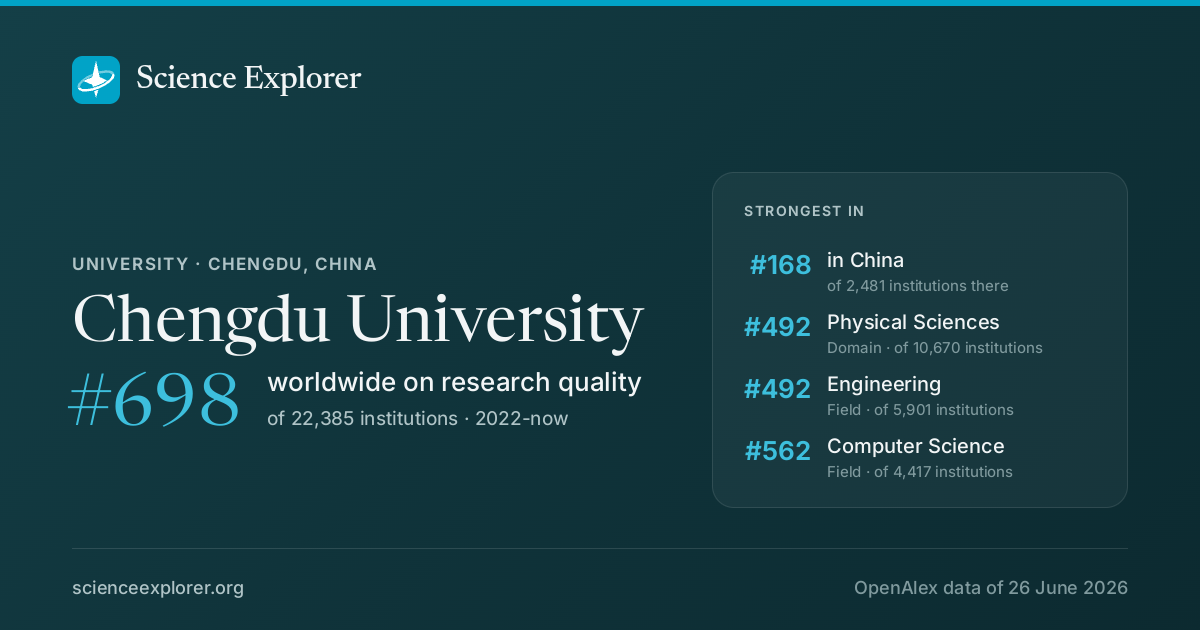
In research, Chengdu University stands highest in Physical Sciences (#492 of 10,670 worldwide), Engineering (#492 of 5,901 worldwide) and Computer Science (#562 of 4,417 worldwide), 2022-now. Relative to its size it is most specialised in Statistical and Nonlinear Physics, Animal Science and Zoology and Catalysis (Statistical and Nonlinear Physics is 4.6× its share of world research).
- World rank, 2022-now
- #698 of 22,385 · #460 all time
- Rank in China
- #168 of 2,481
- Research works
- 13k ▲ 79% vs 2018-21
- Citations
- 161k 12.7 per fractional work
- Top-10% rate
- 15.3% all institutions 10.0%
- vs its own fields
- 1.37× 1.00× is exactly expected
- Open access
- 31% world 40%
- International
- 15% world 18%
What is Chengdu University known for in research?
The fields where it stands highest, 2022-now, ranked among every institution above the floor in each field.
| Field | World rank | Where that sits | Top-10% rate | Works | All time |
|---|---|---|---|---|---|
| Physical SciencesDomain | #492 of 10,670 | 14.9% | 2,541 | #306 | |
| EngineeringField | #492 of 5,901 | 15.1% | 954 | #374 | |
| Computer ScienceField | #562 of 4,417 | 13.8% | 527 | #394 | |
| Health SciencesDomain | #1,314 of 9,902 | 19.0% | 562 | #1050 | |
| Life SciencesDomain | #862 of 6,403 | 18.2% | 647 | #720 | |
| MedicineField | #1,286 of 8,541 | 18.4% | 485 | #1081 | |
| Agricultural and Biological SciencesField | #533 of 3,157 | 19.7% | 241 | #371 | |
| Materials ScienceField | #401 of 2,276 | 14.1% | 357 | #247 | |
| Food ScienceSubfield | #111 of 517 | 23.4% | 89 | #94 | |
| Electrical and Electronic EngineeringSubfield | #477 of 2,176 | 13.7% | 288 | #347 |
Each strip is that field's whole ranked pool, with the notch where Chengdu University sits in it, in the colour of the band that rank falls in. The track under the rate is the rate itself: it carries no average mark, because the average differs by field (from about 6% in Dentistry to 21% in Economics).
Which of those standings moved
The same fields on both windows: where it stood over the whole record, and where it stands in 2022-now. The distance is the story, and it is the one thing the two rank columns above cannot show.
- Physical Sciences#306 #492
- Engineering#374 #492
- Computer Science#394 #562
- Health Sciences#1,050 #1,314
- Life Sciences#720 #862
- Medicine#1,081 #1,286
- Agricultural and Biological Sciences#371 #533
- Materials Science#247 #401
- Food Science#94 #111
- Electrical and Electronic Engineering#347 #477
A dot further right is a better standing. Fields it was not ranked in over the whole record are left out.
Which fields of science does Chengdu University work in?
In 2022-now, 60% of research at Chengdu University is in Physical Sciences, 15% in Life Sciences. Its largest fields are Engineering (22%), Computer Science (13%), Medicine (12%). It does 1.5× the world's share of Physical Sciences.
Each ring splits the one inside it: the four domains of science, their fields, their subfields. Size is fractional works in 2022-now. Every slice is a page; the interactive view zooms down to single topics and colours each by how much more of it this institution does than the world.
Its 4 domains and 26 fields, with their numbers
- Physical Sciences2,88159.7%
- Engineering1,07622.3%
- Computer Science61912.8%
- Materials Science3958.2%
- Environmental Science2164.5%
- Chemistry1743.6%
- Physics and Astronomy1292.7%
- Energy1232.5%
- Mathematics711.5%
- Earth and Planetary Sciences430.9%
- Chemical Engineering360.8%
- Life Sciences73715.3%
- Health Sciences64513.4%
- Medicine56211.6%
- Nursing440.9%
- Health Professions270.6%
- Dentistry120.2%
- Veterinary10.0%
- Social Sciences56211.6%
- Social Sciences2124.4%
- Business, Management and Accounting1182.4%
- Psychology851.8%
- Economics, Econometrics and Finance591.2%
- Decision Sciences511.1%
- Arts and Humanities370.8%
What does Chengdu University specialise in?
Where its research is concentrated relative to its size: Statistical and Nonlinear Physics takes 4.6× the share of its output that it takes of world research.
- Statistical and Nonlinear PhysicsSubfield · 69.7 works4.6×
- Animal Science and ZoologySubfield · 43.0 works4.0×
- CatalysisSubfield · 25.7 works3.6×
- Complementary and alternative medicineSubfield · 47.6 works3.4×
- Modeling and SimulationSubfield · 22.3 works3.3×
- Organic ChemistrySubfield · 117.7 works3.2×
Location quotient, a volume reading rather than an impact one. It surfaces small, lopsided specialities.
Field profile
Location quotient across every field it publishes in: outside the ring is more than an institution of this size would be expected to publish, inside it is less.
Rings at 0.5×, 1× and 2×. Widest outward: Energy, 2.8×. Every wedge is a field page.
All 26 fields, with their numbers
- Energy2.76×122 works
- Materials Science2.34×395 works
- Chemistry2.30×174 works
- Chemical Engineering2.16×36 works
- Pharmacology, Toxicology and Pharmaceutics1.89×32 works
- Nursing1.85×44 works
- Computer Science1.65×619 works
- Engineering1.49×1,076 works
- Biochemistry, Genetics and Molecular Biology1.31×336 works
- Mathematics1.26×71 works
- Agricultural and Biological Sciences1.20×276 works
- Physics and Astronomy1.20×129 works
- Decision Sciences1.10×51 works
- Environmental Science0.90×216 works
- Neuroscience0.79×62 works
- Business, Management and Accounting0.76×118 works
- Immunology and Microbiology0.64×31 works
- Medicine0.61×562 works
- Psychology0.58×85 works
- Earth and Planetary Sciences0.57×43 works
- Economics, Econometrics and Finance0.57×59 works
- Dentistry0.50×12 works
- Social Sciences0.35×212 works
- Arts and Humanities0.27×38 works
- Health Professions0.21×27 works
- Veterinary0.18×1 works
- Energy 2.8×
- Materials Science 2.3×
- Chemistry 2.3×
- Chemical Engineering 2.2×
- Pharmacology, Toxicology and Pharmaceutics 1.9×
- Nursing 1.9×
- Computer Science 1.6×
- Engineering 1.5×
- Biochemistry, Genetics and Molecular Biology 1.3×
- Mathematics 1.3×
- Agricultural and Biological Sciences 1.2×
- Physics and Astronomy 1.2×
- Decision Sciences 1.1×
- Environmental Science 0.9×
- Neuroscience 0.8×
- Business, Management and Accounting 0.8×
- Immunology and Microbiology 0.6×
- Medicine 0.6×
- Psychology 0.6×
- Earth and Planetary Sciences 0.6×
- Economics, Econometrics and Finance 0.6×
- Dentistry 0.5×
- Social Sciences 0.3×
- Arts and Humanities 0.3×
- Health Professions 0.2×
- Veterinary 0.2×
Who are the top researchers at Chengdu University?
Ranked on the quality score, Qian Liu, Lisi Xie and Sudong Yang lead among researchers whose main affiliation is Chengdu University.
- 1
Qian Liu
 China · #10,595 worldwide
15k citations · 294 works
- 2
Lisi Xie
China · #31,432 worldwide
8.6k citations · 124 works
- 3
Sudong Yang
China · #59,139 worldwide
5k citations · 104 works
- 4
Qingquan Kong
China · #59,706 worldwide
8.8k citations · 211 works
- 5
Junshan Li
China · #60,200 worldwide
8.9k citations · 271 works
- 6
Liang Zou
China · #70,865 worldwide
13k citations · 409 works
- 7
Yichen Hu
China · #82,741 worldwide
4.5k citations · 117 works
- 8
Ling Mei
China · #85,685 worldwide
7.2k citations · 149 works
- 9
Weitang Yao
China · #92,731 worldwide
9.9k citations · 170 works
- 10
Yin Zhang
China · #96,357 worldwide
5.2k citations · 156 works
Which keywords describe research at Chengdu University?
By fractional works in 2022-now, weighted toward what it does more of than the world: Deep Learning, Energy Storage, Cathode Materials, Nanomaterials, Neural Networks, Machine Learning, Biomedical Applications and Graphene.
- Nonlinear Schrödinger Equation
- Lithium-Sulfur Batteries
- Photocatalyst
- Nanostructured Anodes
- Nonlinear Equations
- Lipid Oxidation
- Battery Technology
- Visible Light
- Electrocatalysis
- Tissue Engineering
- Lithium-ion Batteries
- Catalysis
- Metal-Organic Frameworks
- Convolutional Neural Networks
- Water Splitting
- Mechanical Properties
- Cathode Materials
- Energy Storage
- Nanomaterials
- Machine Learning
- Deep Learning
- Neural Networks
- Biomedical Applications
- Nanoparticles
- Graphene
- Artificial Intelligence
- Nanocomposites
- Antioxidant Activity
- Rechargeable Batteries
- Microstructure
- Antioxidant
- Antioxidants
- Semiconductor
- CO2 Reduction
- Solar Energy
- Hydrogen Production
- Battery Materials
- Catalysts
- Plasmonic
- Modified Atmosphere Packaging
Size is fractional works in 2022-now in the topics tagged with each word; colour is the word's share of this institution's work against its share of the world's. The 40 words are chosen for being large and distinctive. Each links to the topic it comes from most.
All 40 words, with their numbers
- Deep Learning389▲ 2.3×83 topics
- Machine Learning231▲ 1.44×86 topics
- Neural Networks176▲ 2.4×38 topics
- Nanomaterials164▲ 3.2×20 topics
- Biomedical Applications143▲ 2.5×35 topics
- Energy Storage142▲ 4.5×12 topics
- Nanoparticles124▲ 2.0×42 topics
- Cathode Materials120▲ 6.4×3 topics
- Graphene117▲ 3.6×12 topics
- Mechanical Properties109▲ 2.3×38 topics
- Artificial Intelligence106▲ 1.55×43 topics
- Water Splitting91▲ 5.1×4 topics
- Nanocomposites90▲ 2.4×22 topics
- Convolutional Neural Networks86▲ 2.5×14 topics
- Antioxidant Activity85▲ 2.8×28 topics
- Metal-Organic Frameworks84▲ 4.2×6 topics
- Rechargeable Batteries83▲ 6.5×2 topics
- Catalysis79▲ 2.5×26 topics
- Microstructure74▲ 3.0×18 topics
- Lithium-ion Batteries70▲ 3.5×3 topics
- Antioxidant70▲ 2.1×43 topics
- Tissue Engineering70▲ 2.4×13 topics
- Antioxidants68▲ 3.2×14 topics
- Electrocatalysis65▲ 4.7×5 topics
- Semiconductor57▲ 3.6×7 topics
- Visible Light56▲ 4.9×3 topics
- CO2 Reduction55▲ 5.3×2 topics
- Battery Technology54▲ 4.0×3 topics
- Solar Energy54▲ 3.5×5 topics
- Lipid Oxidation52▲ 11×2 topics
- Hydrogen Production52▲ 4.0×5 topics
- Nonlinear Equations50▲ 8.2×6 topics
- Battery Materials49▲ 6.1×1 topic
- Nanostructured Anodes49▲ 6.1×1 topic
- Catalysts48▲ 4.9×3 topics
- Photocatalyst48▲ 5.7×1 topic
- Plasmonic48▲ 5.7×1 topic
- Lithium-Sulfur Batteries41▲ 6.0×2 topics
- Modified Atmosphere Packaging37▲ 8.9×2 topics
- Nonlinear Schrödinger Equation36▲ 14×2 topics
Which research topics does Chengdu University publish most on?
By volume in 2022-now: Advancements in Battery Materials, Advanced Photocatalysis Techniques, Advanced Battery Materials and Technologies and Electrocatalysts for Energy Conversion.
Area is fractional works; colour is the subfield each topic belongs to.
- 1 Advancements in Battery Materials Electrical and Electronic Engineering 49 works
- 2 Advanced Photocatalysis Techniques Renewable Energy, Sustainability and the Environment 48 works
- 3 Advanced Battery Materials and Technologies Electrical and Electronic Engineering 38 works
- 4 Electrocatalysts for Energy Conversion Renewable Energy, Sustainability and the Environment 35 works
- 5 Advanced battery technologies research Electrical and Electronic Engineering 34 works
- 6 Meat and Animal Product Quality Animal Science and Zoology 32 works
- 7 Nonlinear Waves and Solitons Statistical and Nonlinear Physics 31 works
- 8 Advanced Neural Network Applications Computer Vision and Pattern Recognition 27 works
- 9 Educational Reforms and Innovations Health, Toxicology and Mutagenesis 25 works
- 10 Supercapacitor Materials and Fabrication Electronic, Optical and Magnetic Materials 24 works
How open and international is its research?
Against the world's own shares: the tick on each track. Both are shares of its output, so they sit on one scale and can be read against each other as well as against the world.
World: 40% of research is openly available.
World: 18% is written across borders.
How has Chengdu University's research output changed?
Output in 2022-2025 was 79% higher than in 2018-2021.
The same series as a ribbon: one cell per year, darker for more. The line above answers how much; this answers when.
Its share of all research
Growing output can still be a shrinking share: all of science grows. This is Chengdu University as a percentage of every work published that year, 0.020% in 2024.
Fractional works of Chengdu University over all fractional works that year. How the balance of science has shifted.
How much of it reaches the world top 10%
Year by year, against all institutions in the same year.
Of each year's output, the share that reached the world's 10% most cited for its field and year. Peak 17.6% in 2022.
Other research institutions in Chengdu
- Sichuan University
- University of Electronic Science and Technology of China
- Southwest Jiaotong University
- Chengdu University of Technology
- Southwest Petroleum University
- Chengdu University of Traditional Chinese Medicine
- Xihua University
- Sichuan Normal University
Compare Chengdu University with
- vs
 Novartis (Switzerland)
- vs
 Western Sydney University
- vs Beijing Jiaotong University
- vs Southwestern University of Finance and Economics
- vs
 Johnson & Johnson (United States)
- vs Tianjin Medical University
Share Chengdu University's ranking



Research measures only: rankings here say nothing about teaching, admissions or student experience. Comparable institutions and collaboration partners have tabs of their own, above.
Discussion
Ask a question or share a note about Chengdu University. Posts are plain text and can be reported.