CIRCE - Centro Tecnológico
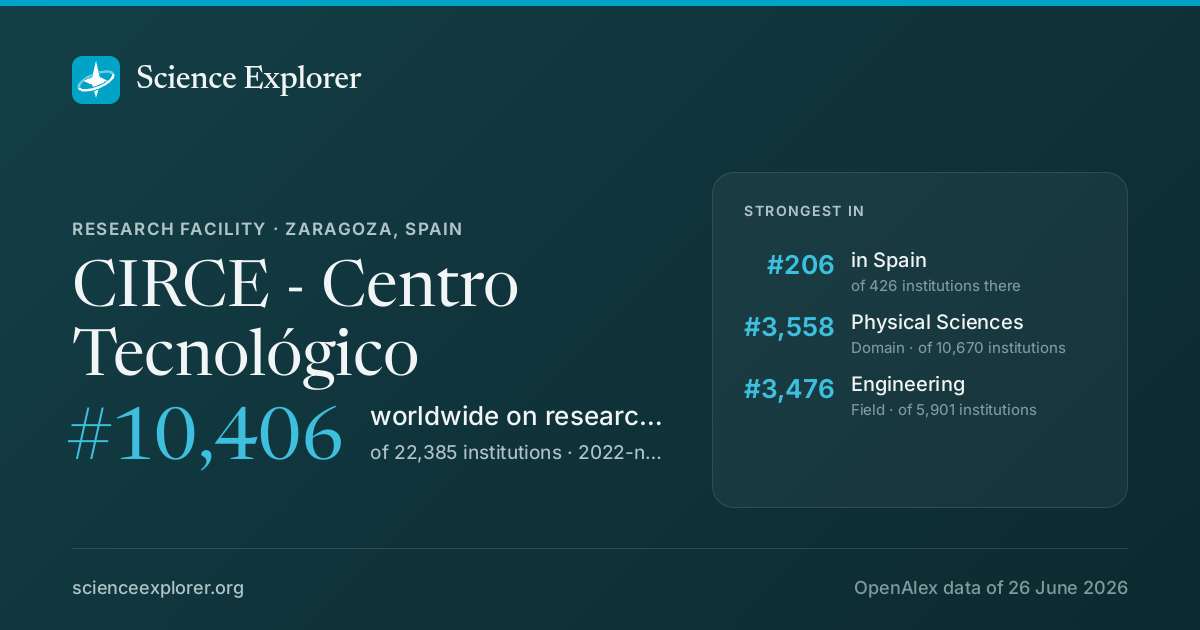
In research, CIRCE - Centro Tecnológico stands highest in Physical Sciences (#3,558 of 10,670 worldwide) and Engineering (#3,476 of 5,901 worldwide), 2022-now.
- World rank, 2022-now
- #10,406 of 22,385 · #7,061 all time
- Rank in Spain
- #206 of 426
- Research works
- 540 ▲ 62% vs 2018-21
- Citations
- 15k 28.5 per fractional work
- Top-10% rate
- 9.8% all institutions 10.0%
- vs its own fields
- 1.05× 1.00× is exactly expected
- Open access
- 53% world 40%
- International
- 23% world 18%
What is CIRCE - Centro Tecnológico known for in research?
The fields where it stands highest, 2022-now, ranked among every institution above the floor in each field.
| Field | World rank | Where that sits | Top-10% rate | Works | All time |
|---|---|---|---|---|---|
| Physical SciencesDomain | #3,558 of 10,670 | 8.4% | 131 | #2466 | |
| EngineeringField | #3,476 of 5,901 | 8.4% | 79 | #1988 |
Each strip is that field's whole ranked pool, with the notch where CIRCE - Centro Tecnológico sits in it, in the colour of the band that rank falls in. The track under the rate is the rate itself: it carries no average mark, because the average differs by field (from about 6% in Dentistry to 21% in Economics).
Which fields of science does CIRCE - Centro Tecnológico work in?
In 2022-now, 80% of research at CIRCE - Centro Tecnológico is in Physical Sciences, 14% in Social Sciences. Its largest fields are Engineering (48%), Environmental Science (11%), Energy (8%). It does 2.0× the world's share of Physical Sciences.
Each ring splits the one inside it: the four domains of science, their fields, their subfields. Size is fractional works in 2022-now. Every slice is a page; the interactive view zooms down to single topics and colours each by how much more of it this institution does than the world.
Its 4 domains and 23 fields, with their numbers
- Physical Sciences14180.5%
- Engineering8548.4%
- Environmental Science1911.1%
- Energy137.7%
- Computer Science84.7%
- Materials Science52.6%
- Chemistry42.1%
- Physics and Astronomy31.6%
- Chemical Engineering31.4%
- Earth and Planetary Sciences10.8%
- Social Sciences2514.3%
- Life Sciences74.1%
- Health Sciences21.1%
- Health Professions10.5%
- Medicine10.4%
- Nursing00.1%
- Veterinary00.1%
Field profile
Location quotient across every field it publishes in: outside the ring is more than an institution of this size would be expected to publish, inside it is less.
Rings at 0.5×, 1× and 2×. Widest outward: Energy, 8.3×. Every wedge is a field page.
All 23 fields, with their numbers
- Energy8.35×13 works
- Chemical Engineering4.14×2 works
- Engineering3.23×85 works
- Decision Sciences2.76×5 works
- Environmental Science2.24×20 works
- Business, Management and Accounting1.51×8 works
- Chemistry1.33×4 works
- Materials Science0.74×4 works
- Physics and Astronomy0.73×3 works
- Agricultural and Biological Sciences0.69×6 works
- Computer Science0.60×8 works
- Pharmacology, Toxicology and Pharmaceutics0.54×0 works
- Earth and Planetary Sciences0.49×1 works
- Veterinary0.47×0 works
- Social Sciences0.42×9 works
- Nursing0.29×0 works
- Arts and Humanities0.26×1 works
- Health Professions0.18×1 works
- Economics, Econometrics and Finance0.15×1 works
- Psychology0.13×1 works
- Biochemistry, Genetics and Molecular Biology0.11×1 works
- Neuroscience0.02×0 works
- Medicine0.02×1 works
- Energy 8.3×
- Chemical Engineering 4.1×
- Engineering 3.2×
- Decision Sciences 2.8×
- Environmental Science 2.2×
- Business, Management and Accounting 1.5×
- Chemistry 1.3×
- Materials Science 0.7×
- Physics and Astronomy 0.7×
- Agricultural and Biological Sciences 0.7×
- Computer Science 0.6×
- Pharmacology, Toxicology and Pharmaceutics 0.5×
- Earth and Planetary Sciences 0.5×
- Veterinary 0.5×
- Social Sciences 0.4×
- Nursing 0.3×
- Arts and Humanities 0.3×
- Health Professions 0.2×
- Economics, Econometrics and Finance 0.1×
- Psychology 0.1×
- Biochemistry, Genetics and Molecular Biology 0.1×
- Neuroscience 0.0×
- Medicine 0.0×
Who are the top researchers at CIRCE - Centro Tecnológico?
Ranked on the quality score, Alessandro A. Carmona-Martínez, Renaud de Stephanis and Yolanda Lara lead among researchers whose main affiliation is CIRCE - Centro Tecnológico.
- 1
Alessandro A. Carmona-Martínez
 Spain · #394,307 worldwide
2.5k citations · 39 works
- 2
Renaud de Stephanis
Spain · #687,818 worldwide
3.9k citations · 95 works
- 3
Yolanda Lara
Spain · #727,226 worldwide
1.4k citations · 33 works
- 4
Víctor J. Ferreira
Spain · #759,807 worldwide
1.5k citations · 40 works
- 5
Ana M. López-Sabirón
Spain · #920,429 worldwide
1.8k citations · 37 works
- 6
Irene Bolea
Spain · #920,731 worldwide
1.1k citations · 20 works
- 7
Ana Martínez
Spain · #966,489 worldwide
1k citations · 24 works
- 8
Germán Ferreira
Spain · #1,048,521 worldwide
1.9k citations · 47 works
- 9
Andrei Briones-Hidrovo
Spain · #1,246,858 worldwide
373 citations · 20 works
- 10
Antonia Gil
Spain · #1,360,537 worldwide
959 citations · 42 works
Which keywords describe research at CIRCE - Centro Tecnológico?
By fractional works in 2022-now, weighted toward what it does more of than the world: Renewable Energy, Sustainability, Energy Efficiency, Smart Grid, Environmental Impact, Circular Economy, Energy Management and Waste Management.
- Bioenergy
- False Data Injection Attacks
- Communication Networks
- Fault Detection
- Energy Storage Systems
- Cyber-Physical Systems
- Energy Transition
- Decentralized Control
- Hazardous Substances
- Environmental Impacts
- Life Cycle Assessment
- Policy
- Demand Response
- Smart Home
- Renewable Energy Integration
- Metal Recovery
- Energy Management
- Circular Economy
- Energy Efficiency
- Sustainability
- Renewable Energy
- Environmental Impact
- Smart Grid
- Climate Change
- Waste Management
- Recycling
- Power Electronics
- Biomass
- Electricity Markets
- Smart Grid Applications
- Renewable Fuels
- E-Waste
- Wavelet Transform
- Pyrolysis
- Environmental Management
- Distributed Generation
- Biochar
- Greenhouse Gas Emissions
- Distributed Power Generation
- Microgrid Control
Size is fractional works in 2022-now in the topics tagged with each word; colour is the word's share of this institution's work against its share of the world's. The 40 words are chosen for being large and distinctive. Each links to the topic it comes from most.
All 40 words, with their numbers
- Renewable Energy30▲ 12×32 topics
- Sustainability23▲ 5.5×33 topics
- Environmental Impact16▲ 5.4×25 topics
- Energy Efficiency15▲ 9.2×18 topics
- Smart Grid14▲ 22×8 topics
- Circular Economy10▲ 22×5 topics
- Climate Change9▲ 1.91×22 topics
- Energy Management8▲ 28×2 topics
- Waste Management8▲ 11×5 topics
- Metal Recovery8▲ 23×3 topics
- Recycling7▲ 11×6 topics
- Renewable Energy Integration7▲ 13×6 topics
- Power Electronics7▲ 12×7 topics
- Smart Home7▲ 24×2 topics
- Biomass7▲ 34×5 topics
- Demand Response6▲ 40×1 topic
- Electricity Markets6▲ 40×1 topic
- Policy6▲ 17×4 topics
- Smart Grid Applications6▲ 27×2 topics
- Life Cycle Assessment5▲ 11×6 topics
- Renewable Fuels5▲ 23×3 topics
- Environmental Impacts5▲ 10×2 topics
- E-Waste5▲ 32×1 topic
- Hazardous Substances5▲ 32×1 topic
- Wavelet Transform5▲ 12×4 topics
- Decentralized Control4▲ 22×2 topics
- Pyrolysis4▲ 36×2 topics
- Energy Transition4▲ 17×3 topics
- Environmental Management4▲ 6.2×3 topics
- Cyber-Physical Systems4▲ 9.1×3 topics
- Distributed Generation4▲ 30×3 topics
- Energy Storage Systems4▲ 17×2 topics
- Biochar4▲ 14×3 topics
- Fault Detection4▲ 17×3 topics
- Greenhouse Gas Emissions4▲ 8.5×5 topics
- Communication Networks4▲ 42×1 topic
- Distributed Power Generation4▲ 23×1 topic
- False Data Injection Attacks4▲ 42×1 topic
- Microgrid Control4▲ 23×1 topic
- Bioenergy4▲ 40×3 topics
Which research topics does CIRCE - Centro Tecnológico publish most on?
By volume in 2022-now: Smart Grid Energy Management, Recycling and Waste Management Techniques, Microgrid Control and Optimization and Smart Grid Security and Resilience.
Area is fractional works; colour is the subfield each topic belongs to.
- 1 Smart Grid Energy Management Electrical and Electronic Engineering 6 works
- 2 Recycling and Waste Management Techniques Industrial and Manufacturing Engineering 5 works
- 3 Microgrid Control and Optimization Control and Systems Engineering 4 works
- 4 Smart Grid Security and Resilience Control and Systems Engineering 4 works
- 5 Thermochemical Biomass Conversion Processes Biomedical Engineering 3 works
- 6 Sustainable Supply Chain Management Strategy and Management 3 works
- 7 Energy Efficiency and Management Renewable Energy, Sustainability and the Environment 3 works
- 8 Bioeconomy and Sustainability Development General Agricultural and Biological Sciences 3 works
- 9 Power Systems Fault Detection Control and Systems Engineering 2 works
- 10 Building Energy and Comfort Optimization Building and Construction 2 works
How open and international is its research?
Against the world's own shares: the tick on each track. Both are shares of its output, so they sit on one scale and can be read against each other as well as against the world.
World: 40% of research is openly available.
World: 18% is written across borders.
How has CIRCE - Centro Tecnológico's research output changed?
Output in 2022-2025 was 62% higher than in 2018-2021.
The same series as a ribbon: one cell per year, darker for more. The line above answers how much; this answers when.
Its share of all research
Growing output can still be a shrinking share: all of science grows. This is CIRCE - Centro Tecnológico as a percentage of every work published that year, 0.00057% in 2024.
Fractional works of CIRCE - Centro Tecnológico over all fractional works that year. How the balance of science has shifted.
How much of it reaches the world top 10%
Year by year, against all institutions in the same year.
Of each year's output, the share that reached the world's 10% most cited for its field and year. Peak 17.3% in 2019.
Other research institutions in Zaragoza
- Universidad de Zaragoza
- Centro de Investigación y Tecnología Agroalimentaria de Aragón
- Instituto de Investigación Sanitaria Aragón
- Universidad San Jorge
- Servicio Aragonés de Salud
- Gobierno de Aragón
- Instituto Aragonés de Ciencias de la Salud
- Fundacion Agencia Aragonesa para la Investigacion y el Desarrollo

Share CIRCE - Centro Tecnológico's ranking
Badges for a website1Each links back here and updates with every snapshot

Research measures only: rankings here say nothing about teaching, admissions or student experience. Comparable institutions and collaboration partners have tabs of their own, above.
Discussion
Ask a question or share a note about CIRCE - Centro Tecnológico. Posts are plain text and can be reported.