Science Explorer Back to mapMap
Discussion
University · Debark’ · Ethiopia

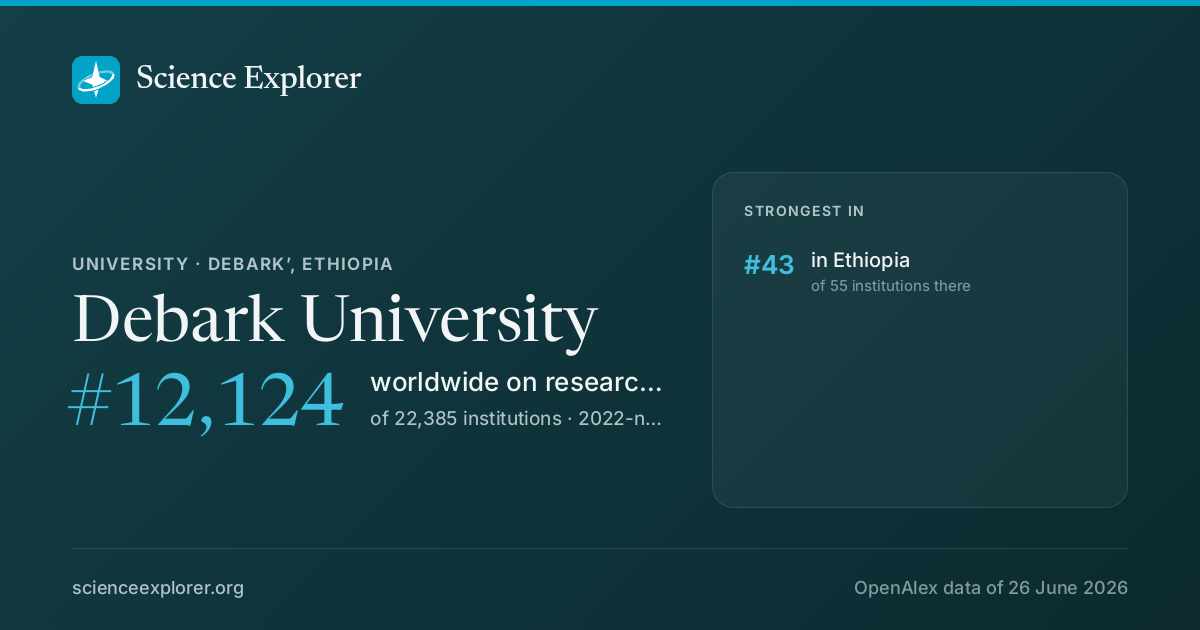
Debark University

World rank, 2022-now
#12,124
of 22,385 · #21,109 all time
Rank in Ethiopia
#43
of 55
Research works
238
▲ 222% vs 2018-21
Citations
1.1k
4.8 per fractional work
Top-10% rate
13.7%
all institutions 10.0%
vs its own fields
1.00×
1.00× is exactly expected
Open access
86%
world 40%
International
13%
world 18%

Which fields of science does Debark University work in?

In 2022-now, 30% of research at Debark University is in Life Sciences, 29% in Health Sciences. Its largest fields are Agricultural and Biological Sciences (25%), Medicine (23%), Environmental Science (9%). It does 2.1× the world's share of Life Sciences.

Life Sciences: 56 fractional works · 30.1% of its workAgricultural and Biological Sciences: 47 fractional works · 24.9% of its workPlant Science: 22 fractional works · 12.0% of its workSoil Science: 4 fractional works · 2.3% of its workFood Science: 4 fractional works · 1.9% of its workAgronomy and Crop Science: 3 fractional works · 1.8% of its workGeneral Agricultural and Biological Sciences: 3 fractional works · 1.8% of its workForestry: 3 fractional works · 1.7% of its workAnimal Science and Zoology: 3 fractional works · 1.6% of its workEcology, Evolution, Behavior and Systematics: 1 fractional works · 0.8% of its workInsect Science: 1 fractional works · 0.5% of its workAquatic Science: 0 fractional works · 0.3% of its workHorticulture: 0 fractional works · 0.3% of its workImmunology and Microbiology: 5 fractional works · 2.5% of its workParasitology: 2 fractional works · 1.2% of its workMicrobiology: 1 fractional works · 0.5% of its workVirology: 1 fractional works · 0.4% of its workImmunology: 1 fractional works · 0.3% of its workSmaller subfields together: 0 fractional works · 0.1% of its workBiochemistry, Genetics and Molecular Biology: 4 fractional works · 2.2% of its workMolecular Biology: 2 fractional works · 0.9% of its workGenetics: 2 fractional works · 0.8% of its workSmaller subfields together: 1 fractional works · 0.4% of its workNeuroscience: 1 fractional works · 0.4% of its workPharmacology, Toxicology and Pharmaceutics: 0 fractional works · 0.2% of its workHealth Sciences: 54 fractional works · 29.0% of its workMedicine: 43 fractional works · 23.0% of its workPediatrics, Perinatology and Child Health: 9 fractional works · 4.6% of its workPublic Health, Environmental and Occupational Health: 5 fractional works · 2.9% of its workEpidemiology: 4 fractional works · 2.1% of its workObstetrics and Gynecology: 4 fractional works · 2.1% of its workInfectious Diseases: 4 fractional works · 2.0% of its workEndocrinology, Diabetes and Metabolism: 3 fractional works · 1.4% of its workHematology: 2 fractional works · 0.9% of its workHepatology: 1 fractional works · 0.7% of its workOncology: 1 fractional works · 0.7% of its workPharmacology: 1 fractional works · 0.6% of its workCardiology and Cardiovascular Medicine: 1 fractional works · 0.6% of its workRadiology, Nuclear Medicine and Imaging: 1 fractional works · 0.5% of its workComplementary and alternative medicine: 1 fractional works · 0.5% of its workPsychiatry and Mental health: 1 fractional works · 0.5% of its workEmergency Medicine: 1 fractional works · 0.4% of its workSurgery: 1 fractional works · 0.3% of its workPhysiology: 1 fractional works · 0.3% of its workAnesthesiology and Pain Medicine: 0 fractional works · 0.3% of its workNeurology: 0 fractional works · 0.2% of its workGeriatrics and Gerontology: 0 fractional works · 0.2% of its workSmaller subfields together: 2 fractional works · 1.2% of its workHealth Professions: 6 fractional works · 3.4% of its workGeneral Health Professions: 4 fractional works · 1.9% of its workHealth Information Management: 2 fractional works · 0.9% of its workEmergency Medical Services: 1 fractional works · 0.4% of its workOccupational Therapy: 0 fractional works · 0.2% of its workSmaller subfields together: 0 fractional works · 0.1% of its workNursing: 4 fractional works · 2.3% of its workNutrition and Dietetics: 4 fractional works · 1.9% of its workResearch and Theory: 1 fractional works · 0.4% of its workDentistry: 0 fractional works · 0.2% of its workPeriodontics: 0 fractional works · 0.2% of its workVeterinary: 0 fractional works · 0.1% of its workPhysical Sciences: 44 fractional works · 23.7% of its workEnvironmental Science: 17 fractional works · 8.9% of its workManagement, Monitoring, Policy and Law: 4 fractional works · 2.1% of its workGlobal and Planetary Change: 3 fractional works · 1.6% of its workEcology: 3 fractional works · 1.4% of its workNature and Landscape Conservation: 2 fractional works · 1.1% of its workEnvironmental Engineering: 2 fractional works · 0.9% of its workIndustrial and Manufacturing Engineering: 1 fractional works · 0.5% of its workPollution: 1 fractional works · 0.5% of its workHealth, Toxicology and Mutagenesis: 1 fractional works · 0.3% of its workWater Science and Technology: 1 fractional works · 0.3% of its workSmaller subfields together: 0 fractional works · 0.3% of its workMaterials Science: 8 fractional works · 4.4% of its workMaterials Chemistry: 4 fractional works · 2.3% of its workElectronic, Optical and Magnetic Materials: 2 fractional works · 1.2% of its workBiomaterials: 2 fractional works · 0.9% of its workComputer Science: 8 fractional works · 4.3% of its workArtificial Intelligence: 5 fractional works · 2.7% of its workComputer Networks and Communications: 1 fractional works · 0.7% of its workComputer Vision and Pattern Recognition: 1 fractional works · 0.3% of its workComputational Theory and Mathematics: 0 fractional works · 0.3% of its workInformation Systems: 0 fractional works · 0.2% of its workSmaller subfields together: 0 fractional works · 0.2% of its workEngineering: 3 fractional works · 1.7% of its workControl and Systems Engineering: 1 fractional works · 0.4% of its workElectrical and Electronic Engineering: 1 fractional works · 0.3% of its workMechanics of Materials: 0 fractional works · 0.2% of its workBuilding and Construction: 0 fractional works · 0.2% of its workSmaller subfields together: 1 fractional works · 0.6% of its workPhysics and Astronomy: 2 fractional works · 1.1% of its workCondensed Matter Physics: 1 fractional works · 0.5% of its workAtomic and Molecular Physics, and Optics: 1 fractional works · 0.4% of its workStatistical and Nonlinear Physics: 0 fractional works · 0.2% of its workMathematics: 2 fractional works · 1.0% of its workStatistics and Probability: 1 fractional works · 0.6% of its workSmaller subfields together: 1 fractional works · 0.4% of its workEarth and Planetary Sciences: 2 fractional works · 0.8% of its workAtmospheric Science: 1 fractional works · 0.4% of its workGeochemistry and Petrology: 0 fractional works · 0.2% of its workGeophysics: 0 fractional works · 0.2% of its workSmaller subfields together: 0 fractional works · 0.1% of its workChemistry: 2 fractional works · 0.8% of its workOrganic Chemistry: 1 fractional works · 0.4% of its workAnalytical Chemistry: 0 fractional works · 0.2% of its workSmaller subfields together: 0 fractional works · 0.2% of its workEnergy: 1 fractional works · 0.6% of its workRenewable Energy, Sustainability and the Environment: 1 fractional works · 0.6% of its workChemical Engineering: 0 fractional works · 0.1% of its workSocial Sciences: 32 fractional works · 17.2% of its workSocial Sciences: 16 fractional works · 8.4% of its workPolitical Science and International Relations: 5 fractional works · 2.6% of its workSociology and Political Science: 4 fractional works · 2.3% of its workEducation: 2 fractional works · 1.2% of its workHealth: 1 fractional works · 0.8% of its workSafety Research: 1 fractional works · 0.5% of its workGender Studies: 1 fractional works · 0.3% of its workSmaller subfields together: 1 fractional works · 0.7% of its workBusiness, Management and Accounting: 5 fractional works · 2.8% of its workAccounting: 2 fractional works · 0.8% of its workStrategy and Management: 2 fractional works · 0.8% of its workManagement of Technology and Innovation: 1 fractional works · 0.4% of its workManagement Information Systems: 0 fractional works · 0.3% of its workOrganizational Behavior and Human Resource Management: 0 fractional works · 0.3% of its workSmaller subfields together: 0 fractional works · 0.3% of its workArts and Humanities: 4 fractional works · 2.0% of its workLiterature and Literary Theory: 1 fractional works · 0.7% of its workLanguage and Linguistics: 1 fractional works · 0.6% of its workHistory and Philosophy of Science: 1 fractional works · 0.4% of its workSmaller subfields together: 1 fractional works · 0.4% of its workEconomics, Econometrics and Finance: 3 fractional works · 1.8% of its workEconomics and Econometrics: 3 fractional works · 1.4% of its workFinance: 1 fractional works · 0.4% of its workSmaller subfields together: 0 fractional works · 0.1% of its workPsychology: 3 fractional works · 1.5% of its workClinical Psychology: 2 fractional works · 0.8% of its workSocial Psychology: 1 fractional works · 0.4% of its workSmaller subfields together: 0 fractional works · 0.3% of its workDecision Sciences: 1 fractional works · 0.7% of its workManagement Science and Operations Research: 1 fractional works · 0.3% of its workSmaller subfields together: 1 fractional works · 0.4% of its workALL ITS WORKDebark University187fractional works, 2022-now
Life Sciences30%Physical Sciences24%Health Sciences29%Social Sciences17%

Each ring splits the one inside it: the four domains of science, their fields, their subfields. Size is fractional works in 2022-now. Every slice is a page; the interactive view zooms down to single topics and colours each by how much more of it this institution does than the world.

Its 4 domains and 26 fields, with their numbers
    1. Agricultural and Biological Sciences4724.9%
    2. Immunology and Microbiology52.5%
    3. Biochemistry, Genetics and Molecular Biology42.2%
    4. Neuroscience10.4%
    5. Pharmacology, Toxicology and Pharmaceutics00.2%
    1. Medicine4323.0%
    2. Health Professions63.4%
    3. Nursing42.3%
    4. Dentistry00.2%
    5. Veterinary00.1%
    1. Environmental Science178.9%
    2. Materials Science84.4%
    3. Computer Science84.3%
    4. Engineering31.7%
    5. Physics and Astronomy21.1%
    6. Mathematics21.0%
    7. Earth and Planetary Sciences20.8%
    8. Chemistry20.8%
    9. Energy10.6%
    10. Chemical Engineering00.1%
    1. Social Sciences168.4%
    2. Business, Management and Accounting52.8%
    3. Arts and Humanities42.0%
    4. Economics, Econometrics and Finance31.8%
    5. Psychology31.5%
    6. Decision Sciences10.7%
All of science, and how each field's share has moved since 1950: the Science domain explorer

What does Debark University specialise in?

Where its research is concentrated relative to its size: Plant Science takes 6.9× the share of its output that it takes of world research.

  1. Plant ScienceSubfield · 22.5 works6.9×
← less than its size predicts1×more →

Location quotient, a volume reading rather than an impact one. It surfaces small, lopsided specialities.

Field profile

Location quotient across every field it publishes in: outside the ring is more than an institution of this size would be expected to publish, inside it is less.

Agricultural and Biological Sciences: 5.24× its world share, 46 worksAgricultural and Bio…Biochemistry, Genetics and Molecular Biology: 0.40× its world share, 4 worksBiochemistry, Geneti…Immunology and Microbiology: 2.48× its world share, 5 worksImmunology and Micro…Neuroscience: 0.23× its world share, 1 worksNeurosciencePharmacology, Toxicology and Pharmaceutics: 0.44× its world share, 0 worksPharmacology, Toxico…Chemical Engineering: 0.19× its world share, 0 worksChemical EngineeringChemistry: 0.52× its world share, 2 worksChemistryComputer Science: 0.56× its world share, 8 worksComputer ScienceEarth and Planetary Sciences: 0.54× its world share, 2 worksEarth and Planetary …Energy: 0.60× its world share, 1 worksEnergyEngineering: 0.11× its world share, 3 worksEngineeringEnvironmental Science: 1.78× its world share, 17 worksEnvironmental ScienceMaterials Science: 1.26× its world share, 8 worksMaterials ScienceMathematics: 0.83× its world share, 2 worksMathematicsPhysics and Astronomy: 0.50× its world share, 2 worksPhysics and AstronomyDentistry: 0.49× its world share, 0 worksDentistryHealth Professions: 1.31× its world share, 6 worksHealth ProfessionsMedicine: 1.20× its world share, 43 worksMedicineNursing: 4.68× its world share, 4 worksNursingVeterinary: 0.66× its world share, 0 worksVeterinaryArts and Humanities: 0.69× its world share, 4 worksArts and HumanitiesBusiness, Management and Accounting: 0.87× its world share, 5 worksBusiness, Management…Decision Sciences: 0.68× its world share, 1 worksDecision SciencesEconomics, Econometrics and Finance: 0.86× its world share, 3 worksEconomics, Econometr…Psychology: 0.49× its world share, 3 worksPsychologySocial Sciences: 0.66× its world share, 16 worksSocial Sciences1×world share
more than its size predictsabout as predictedless

Rings at 0.5×, 1× and 2×. Widest outward: Agricultural and Biological Sciences, 5.2×. Every wedge is a field page.

All 26 fields, with their numbers
  1. Agricultural and Biological Sciences5.24×46 works
  2. Nursing4.68×4 works
  3. Immunology and Microbiology2.48×5 works
  4. Environmental Science1.78×17 works
  5. Health Professions1.31×6 works
  6. Materials Science1.26×8 works
  7. Medicine1.20×43 works
  8. Business, Management and Accounting0.87×5 works
  9. Economics, Econometrics and Finance0.86×3 works
  10. Mathematics0.83×2 works
  11. Arts and Humanities0.69×4 works
  12. Decision Sciences0.68×1 works
  13. Veterinary0.66×0 works
  14. Social Sciences0.66×16 works
  15. Energy0.60×1 works
  16. Computer Science0.56×8 works
  17. Earth and Planetary Sciences0.54×2 works
  18. Chemistry0.52×2 works
  19. Physics and Astronomy0.50×2 works
  20. Dentistry0.49×0 works
  21. Psychology0.49×3 works
  22. Pharmacology, Toxicology and Pharmaceutics0.44×0 works
  23. Biochemistry, Genetics and Molecular Biology0.40×4 works
  24. Neuroscience0.23×1 works
  25. Chemical Engineering0.19×0 works
  26. Engineering0.11×3 works

Who are the top researchers at Debark University?

Ranked on the quality score, Jenberu Mekurianew Kelkay, Tadele Kassahun Wudu and Tadios Lidetu lead among researchers whose main affiliation is Debark University.

  1. 1 Jenberu Mekurianew Kelkay Ethiopia · #1,837,282 worldwide 52 citations · 36 works
  2. 2 Tadele Kassahun Wudu Ethiopia · #1,887,893 worldwide 36 citations · 22 works
  3. 3 Tadios Lidetu Ethiopia · #2,629,386 worldwide 71 citations · 16 works
  4. 4 Amare Assefa Bogale Ethiopia · #3,452,746 worldwide 132 citations · 16 works
  5. 5 Moges Tadesse Abebe Ethiopia · #4,135,258 worldwide 268 citations · 31 works
  6. 6 Addisu Simachew Asgai Ethiopia · #4,537,514 worldwide 1 citations · 15 works
All ranked researchers at Debark University

What are the most cited papers from Debark University?

The most cited paper from Debark University is "Global, regional, and national burden of chronic kidney disease in adults, 1990–2023, and its attributable risk factors: a systematic analysis for the Global Burden of Disease Study 2023" (Patrick B Mark et al., 2025), with 366 citations. Next come "Microbes used as a tool for bioremediation of heavy metal from the environment" (361) and "Motivation of health workers and associated factors in public hospitals of West Amhara, Northwest Ethiopia" (94).

Most cited papers
#PaperReleasedCitations
1 Global, regional, and national burden of chronic kidney disease in adults, 1990–2023, and its attributable risk factors: a systematic analysis for the Global Burden of Disease Study 2023 Patrick B Mark et al. · The Lancet Open access597 authors Nov 2025 366
2 Microbes used as a tool for bioremediation of heavy metal from the environment Molalign Medfu Tarekegn, Fikirte Zewdu Salilih, Alemitu Iniyehu Ishetu · Cogent Food & Agriculture Open access 2020 361
3 Motivation of health workers and associated factors in public hospitals of West Amhara, Northwest Ethiopia Zemichael Weldegebriel, Yohannes Ejigu, Fitsum Weldegebreal et al. · Patient Preference and Adherence Open access Feb 2016 94
4 Suicidal Ideation, Attempt, and Determining Factors among HIV/AIDS Patients, Ethiopia Huluagresh Bitew, Gashaw Andargie, Agitu Tadesse et al. · Depression Research and Treatment Open access 2016 78
5 Indigenous agricultural knowledge: A neglected human based resource for sustainable crop protection and production Anteneh Agezew Melash, Amare Assefa Bogale, Abeje Tafere Migbaru et al. · Heliyon Open access 2023 73
All 60 most cited papers, with filters and sorting

Which keywords describe research at Debark University?

By fractional works in 2022-now, weighted toward what it does more of than the world: Sustainable Agriculture, Biodiversity Conservation, Maternal Mortality, Climate Change, Smallholder Farmers, Health Inequalities, Sustainability and Community Health Workers.

▲ more of its work than of the world's◆ about the world's share▼ less than the world's

Size is fractional works in 2022-now in the topics tagged with each word; colour is the word's share of this institution's work against its share of the world's. The 40 words are chosen for being large and distinctive. Each links to the topic it comes from most.

All 40 words, with their numbers
  1. Climate Change12▲ 2.3×26 topics
  2. Epidemiology11▲ 1.44×38 topics
  3. Sustainability11▲ 2.3×17 topics
  4. Sustainable Agriculture9▲ 15×7 topics
  5. Biodiversity Conservation8▲ 11×8 topics
  6. Maternal Mortality8▲ 18×5 topics
  7. Smallholder Farmers6▲ 15×4 topics
  8. Health Inequalities6▲ 25×2 topics
  9. Community Health Workers6▲ 34×2 topics
  10. Child Mortality6▲ 41×1 topic
  11. Health Systems6▲ 41×1 topic
  12. Food Security5▲ 4.5×9 topics
  13. Climate Resilience4▲ 40×2 topics
  14. Drought Tolerance4▲ 17×5 topics
  15. Conflict4▲ 14×4 topics
  16. Ecosystem Services4▲ 6.0×8 topics
  17. Soil Fertility4▲ 10×6 topics
  18. Adaptation4▲ 7.5×5 topics
  19. Child Development4▲ 5.4×4 topics
  20. Culture4▲ 4.1×4 topics
  21. Nutritional Value4▲ 19×2 topics
  22. Agroforestry4▲ 30×3 topics
  23. Antimicrobial4▲ 7.3×4 topics
  24. Nitrogen Fixation4▲ 29×2 topics
  25. Nutritional Quality4▲ 28×4 topics
  26. Livelihoods4▲ 56×2 topics
  27. Politics3▲ 6.9×2 topics
  28. Society3▲ 9.4×2 topics
  29. Antiretroviral Therapy3▲ 11×5 topics
  30. Pastoralists3▲ 69×1 topic
  31. Rangeland Degradation3▲ 69×1 topic
  32. Breeding3▲ 22×4 topics
  33. Global Burden of Disease3▲ 6.7×3 topics
  34. Eritrea3▲ 122×1 topic
  35. Ethiopia3▲ 122×1 topic
  36. Indigenous Fruits3▲ 68×1 topic
  37. Maternal and Child Undernutrition3▲ 19×1 topic
  38. Rhizosphere Interactions3▲ 18×2 topics
  39. Tree Domestication3▲ 68×1 topic
  40. Water Sanitation Hygiene3▲ 19×1 topic

Which research topics does Debark University publish most on?

By volume in 2022-now: Global Maternal and Child Health, Rangeland Management and Livestock Ecology, African history and culture analysis and African Botany and Ecology Studies.

  1. 1 Global Maternal and Child Health Pediatrics, Perinatology and Child Health 6 works
  2. 2 Rangeland Management and Livestock Ecology Management, Monitoring, Policy and Law 3 works
  3. 3 African history and culture analysis Political Science and International Relations 3 works
  4. 4 African Botany and Ecology Studies Forestry 3 works
  5. 5 Child Nutrition and Water Access Nutrition and Dietetics 3 works
  6. 6 Agricultural Innovations and Practices General Agricultural and Biological Sciences 3 works
  7. 7 Nanoparticles: synthesis and applications Materials Chemistry 2 works
  8. 8 Legume Nitrogen Fixing Symbiosis Plant Science 2 works
  9. 9 Agronomic Practices and Intercropping Systems Agronomy and Crop Science 2 works
  10. 10 Maternal and Perinatal Health Interventions Obstetrics and Gynecology 2 works

How open and international is its research?

Against the world's own shares: the tick on each track. Both are shares of its output, so they sit on one scale and can be read against each other as well as against the world.

openly available86.1%not open13.9%

World: 40% of research is openly available.

with international co-authors13.3%domestic only86.7%

World: 18% is written across borders.

How has Debark University's research output changed?

Output in 2022-2025 was 222% higher than in 2018-2021.

still counting200020102020
grewheldshrank

The same series as a ribbon: one cell per year, darker for more. The line above answers how much; this answers when.

Its share of all research

Growing output can still be a shrinking share: all of science grows. This is Debark University as a percentage of every work published that year, 0.00070% in 2024.

still counting0.00050%0.0010%0.0015%Debark University0.0013% in 202519801990200020102020

Fractional works of Debark University over all fractional works that year. How the balance of science has shifted.

Share Debark University's ranking

Debark University on Science Explorer

A card with Debark University's standing and the fields it leads in, for a post or a slide. A link to this page previews as the same card.

Download the card

1200 × 630 PNG, sized for social posts, drawn from the latest snapshot.

Badges for a website1Each links back here and updates with every snapshot

Research measures only: rankings here say nothing about teaching, admissions or student experience. Comparable institutions and collaboration partners have tabs of their own, above.

Discussion

Ask a question or share a note about Debark University. Posts are plain text and can be reported.