Science Explorer Back to mapMap
Discussion
University · Doylestown · United States

Delaware Valley College

World rank, all time
#21,471
of 34,923
Rank in United States
#4,452
of 7,310
Research works
212
▼ 23% vs 2018-21
Citations
2.4k
11.3 per fractional work
Top-10% rate
8.8%
all institutions 10.0%
vs its own fields
0.86×
1.00× is exactly expected
Open access
28%
world 40%
International
13%
world 18%

Which fields of science does Delaware Valley College work in?

In 2022-now, 37% of research at Delaware Valley College is in Social Sciences, 25% in Health Sciences. Its largest fields are Social Sciences (21%), Medicine (14%), Agricultural and Biological Sciences (9%). It does 1.4× the world's share of Social Sciences.

Social Sciences: 12 fractional works · 36.7% of its workSocial Sciences: 7 fractional works · 20.6% of its workPolitical Science and International Relations: 2 fractional works · 6.8% of its workSociology and Political Science: 2 fractional works · 4.7% of its workEducation: 1 fractional works · 4.3% of its workSafety Research: 0 fractional works · 1.2% of its workGeography, Planning and Development: 0 fractional works · 1.0% of its workLaw: 0 fractional works · 1.0% of its workLibrary and Information Sciences: 0 fractional works · 1.0% of its workTransportation: 0 fractional works · 0.5% of its workArts and Humanities: 3 fractional works · 8.3% of its workHistory: 1 fractional works · 4.2% of its workVisual Arts and Performing Arts: 1 fractional works · 3.1% of its workLiterature and Literary Theory: 0 fractional works · 1.0% of its workEconomics, Econometrics and Finance: 1 fractional works · 3.1% of its workEconomics and Econometrics: 1 fractional works · 3.1% of its workPsychology: 1 fractional works · 2.6% of its workSocial Psychology: 0 fractional works · 1.0% of its workClinical Psychology: 0 fractional works · 1.0% of its workApplied Psychology: 0 fractional works · 0.2% of its workExperimental and Cognitive Psychology: 0 fractional works · 0.2% of its workSmaller subfields together: 0 fractional works · 0.0% of its workBusiness, Management and Accounting: 0 fractional works · 1.0% of its workAccounting: 0 fractional works · 1.0% of its workDecision Sciences: 0 fractional works · 1.0% of its workInformation Systems and Management: 0 fractional works · 1.0% of its workHealth Sciences: 8 fractional works · 24.7% of its workMedicine: 4 fractional works · 14.0% of its workPhysiology: 1 fractional works · 2.6% of its workAnesthesiology and Pain Medicine: 1 fractional works · 1.9% of its workPublic Health, Environmental and Occupational Health: 0 fractional works · 1.4% of its workPulmonary and Respiratory Medicine: 0 fractional works · 1.2% of its workPathology and Forensic Medicine: 0 fractional works · 1.0% of its workEndocrinology, Diabetes and Metabolism: 0 fractional works · 0.9% of its workSurgery: 0 fractional works · 0.7% of its workRadiology, Nuclear Medicine and Imaging: 0 fractional works · 0.6% of its workHematology: 0 fractional works · 0.5% of its workOrthopedics and Sports Medicine: 0 fractional works · 0.5% of its workPsychiatry and Mental health: 0 fractional works · 0.4% of its workNeurology: 0 fractional works · 0.4% of its workPharmacology: 0 fractional works · 0.4% of its workEpidemiology: 0 fractional works · 0.3% of its workCardiology and Cardiovascular Medicine: 0 fractional works · 0.3% of its workUrology: 0 fractional works · 0.3% of its workOncology: 0 fractional works · 0.2% of its workPediatrics, Perinatology and Child Health: 0 fractional works · 0.2% of its workSmaller subfields together: 0 fractional works · 0.1% of its workHealth Professions: 3 fractional works · 8.9% of its workGeneral Health Professions: 2 fractional works · 5.8% of its workSpeech and Hearing: 1 fractional works · 2.2% of its workRadiological and Ultrasound Technology: 0 fractional works · 0.5% of its workEmergency Medical Services: 0 fractional works · 0.3% of its workVeterinary: 0 fractional works · 1.0% of its workEquine: 0 fractional works · 0.5% of its workSmall Animals: 0 fractional works · 0.5% of its workNursing: 0 fractional works · 0.7% of its workLeadership and Management: 0 fractional works · 0.5% of its workResearch and Theory: 0 fractional works · 0.2% of its workPhysical Sciences: 8 fractional works · 23.4% of its workEnvironmental Science: 2 fractional works · 6.6% of its workNature and Landscape Conservation: 1 fractional works · 2.6% of its workEnvironmental Chemistry: 0 fractional works · 1.0% of its workGlobal and Planetary Change: 0 fractional works · 1.0% of its workManagement, Monitoring, Policy and Law: 0 fractional works · 1.0% of its workEcology: 0 fractional works · 0.6% of its workEcological Modeling: 0 fractional works · 0.3% of its workSmaller subfields together: 0 fractional works · 0.1% of its workEngineering: 2 fractional works · 6.2% of its workCivil and Structural Engineering: 1 fractional works · 2.1% of its workAutomotive Engineering: 0 fractional works · 1.0% of its workMechanical Engineering: 0 fractional works · 1.0% of its workMedia Technology: 0 fractional works · 1.0% of its workSafety, Risk, Reliability and Quality: 0 fractional works · 0.6% of its workBiomedical Engineering: 0 fractional works · 0.3% of its workSmaller subfields together: 0 fractional works · 0.0% of its workEarth and Planetary Sciences: 1 fractional works · 3.8% of its workPaleontology: 1 fractional works · 3.5% of its workGeophysics: 0 fractional works · 0.3% of its workComputer Science: 1 fractional works · 2.9% of its workInformation Systems: 1 fractional works · 2.1% of its workComputer Networks and Communications: 0 fractional works · 0.5% of its workComputer Vision and Pattern Recognition: 0 fractional works · 0.3% of its workMaterials Science: 1 fractional works · 2.8% of its workMaterials Chemistry: 1 fractional works · 1.7% of its workElectronic, Optical and Magnetic Materials: 0 fractional works · 1.0% of its workMathematics: 0 fractional works · 0.6% of its workApplied Mathematics: 0 fractional works · 0.3% of its workGeometry and Topology: 0 fractional works · 0.2% of its workPhysics and Astronomy: 0 fractional works · 0.5% of its workCondensed Matter Physics: 0 fractional works · 0.5% of its workLife Sciences: 5 fractional works · 15.2% of its workAgricultural and Biological Sciences: 3 fractional works · 9.1% of its workPlant Science: 1 fractional works · 3.7% of its workAgronomy and Crop Science: 1 fractional works · 2.1% of its workFood Science: 0 fractional works · 1.0% of its workForestry: 0 fractional works · 1.0% of its workGeneral Agricultural and Biological Sciences: 0 fractional works · 0.6% of its workEcology, Evolution, Behavior and Systematics: 0 fractional works · 0.6% of its workBiochemistry, Genetics and Molecular Biology: 1 fractional works · 3.7% of its workCell Biology: 1 fractional works · 1.7% of its workGenetics: 0 fractional works · 0.8% of its workMolecular Biology: 0 fractional works · 0.6% of its workEndocrinology: 0 fractional works · 0.5% of its workSmaller subfields together: 0 fractional works · 0.1% of its workNeuroscience: 1 fractional works · 2.4% of its workCognitive Neuroscience: 1 fractional works · 1.9% of its workNeurology: 0 fractional works · 0.4% of its workSmaller subfields together: 0 fractional works · 0.0% of its workALL ITS WORKDelaware ValleyCollege32fractional works, 2022-now
Life Sciences15%Physical Sciences23%Health Sciences25%Social Sciences37%

Each ring splits the one inside it: the four domains of science, their fields, their subfields. Size is fractional works in 2022-now. Every slice is a page; the interactive view zooms down to single topics and colours each by how much more of it this institution does than the world.

Its 4 domains and 20 fields, with their numbers
    1. Social Sciences720.6%
    2. Arts and Humanities38.3%
    3. Economics, Econometrics and Finance13.1%
    4. Psychology12.6%
    5. Business, Management and Accounting01.0%
    6. Decision Sciences01.0%
    1. Medicine414.0%
    2. Health Professions38.9%
    3. Veterinary01.0%
    4. Nursing00.7%
    1. Environmental Science26.6%
    2. Engineering26.2%
    3. Earth and Planetary Sciences13.8%
    4. Computer Science12.9%
    5. Materials Science12.8%
    6. Mathematics00.6%
    7. Physics and Astronomy00.5%
    1. Agricultural and Biological Sciences39.1%
    2. Biochemistry, Genetics and Molecular Biology13.7%
    3. Neuroscience12.4%
All of science, and how each field's share has moved since 1950: the Science domain explorer

Field profile

Location quotient across every field it publishes in: outside the ring is more than an institution of this size would be expected to publish, inside it is less.

Agricultural and Biological Sciences: 1.91× its world share, 3 worksAgricultural and Bio…Biochemistry, Genetics and Molecular Biology: 0.70× its world share, 1 worksBiochemistry, Geneti…Neuroscience: 1.46× its world share, 1 worksNeuroscienceComputer Science: 0.38× its world share, 1 worksComputer ScienceEarth and Planetary Sciences: 2.43× its world share, 1 worksEarth and Planetary …Engineering: 0.41× its world share, 2 worksEngineeringEnvironmental Science: 1.33× its world share, 2 worksEnvironmental ScienceMaterials Science: 0.80× its world share, 1 worksMaterials ScienceMathematics: 0.47× its world share, 0 worksMathematicsPhysics and Astronomy: 0.23× its world share, 0 worksPhysics and AstronomyHealth Professions: 3.38× its world share, 3 worksHealth ProfessionsMedicine: 0.73× its world share, 4 worksMedicineNursing: 1.49× its world share, 0 worksNursingVeterinary: 7.66× its world share, 0 worksVeterinaryArts and Humanities: 2.88× its world share, 3 worksArts and HumanitiesBusiness, Management and Accounting: 0.32× its world share, 0 worksBusiness, Management…Decision Sciences: 1.08× its world share, 0 worksDecision SciencesEconomics, Econometrics and Finance: 1.46× its world share, 1 worksEconomics, Econometr…Psychology: 0.84× its world share, 1 worksPsychologySocial Sciences: 1.63× its world share, 7 worksSocial Sciences1×world share
more than its size predictsabout as predictedless

Rings at 0.5×, 1× and 2×. Widest outward: Veterinary, 7.7×. Every wedge is a field page.

All 20 fields, with their numbers
  1. Veterinary7.66×0 works
  2. Health Professions3.38×3 works
  3. Arts and Humanities2.88×3 works
  4. Earth and Planetary Sciences2.43×1 works
  5. Agricultural and Biological Sciences1.91×3 works
  6. Social Sciences1.63×7 works
  7. Nursing1.49×0 works
  8. Neuroscience1.46×1 works
  9. Economics, Econometrics and Finance1.46×1 works
  10. Environmental Science1.33×2 works
  11. Decision Sciences1.08×0 works
  12. Psychology0.84×1 works
  13. Materials Science0.80×1 works
  14. Medicine0.73×4 works
  15. Biochemistry, Genetics and Molecular Biology0.70×1 works
  16. Mathematics0.47×0 works
  17. Engineering0.41×2 works
  18. Computer Science0.38×1 works
  19. Business, Management and Accounting0.32×0 works
  20. Physics and Astronomy0.23×0 works

Who are the top researchers at Delaware Valley College?

Ranked on the quality score, Steven M. Rosen, Sophea Chea and James Pedersen lead among researchers whose main affiliation is Delaware Valley College.

  1. 1 Steven M. Rosen United States · #1,120,463 worldwide 1.8k citations · 94 works
  2. 2 Sophea Chea United States · #1,541,624 worldwide 774 citations · 29 works
  3. 3 James Pedersen United States · #2,704,635 worldwide 25 citations · 28 works
  4. 4 Edward John Sambriski United States · #3,004,221 worldwide 706 citations · 28 works
  5. 5 Jason Philip Downs United States · #3,331,479 worldwide 495 citations · 25 works
  6. 6 Susan J. Oliver United States · #4,328,904 worldwide 20 citations · 16 works
  7. 7 W Thomas Walker United States · #4,354,393 worldwide 91 citations · 18 works
  8. 8 Karen Sheldon United States · #7,702,995 worldwide 38 citations · 637 works
All ranked researchers at Delaware Valley College

What are the most cited papers from Delaware Valley College?

The most cited paper from Delaware Valley College is "Defining and Measuring the Patient-Centered Medical Home" (Kurt C. Stange, Paul A. Nutting, William L. Miller et al., 2010), with 522 citations. Next come "A Multi-institutional Prospective Trial in the USA Confirms that the 4Kscore Accurately Identifies Men with High-grade Prostate Cancer" (418) and "Long-term safety and efficacy of closed-loop spinal cord stimulation to treat chronic back and leg pain (Evoke): a double-blind, randomised, controlled trial" (356).

Most cited papers
#PaperReleasedCitations
1 Defining and Measuring the Patient-Centered Medical Home Kurt C. Stange, Paul A. Nutting, William L. Miller et al. · Journal of General Internal Medicine Open access 13 May 2010 522
2 A Multi-institutional Prospective Trial in the USA Confirms that the 4Kscore Accurately Identifies Men with High-grade Prostate Cancer Dipen J. Parekh et al. · European Urology 27 Oct 2014 418
3 Long-term safety and efficacy of closed-loop spinal cord stimulation to treat chronic back and leg pain (Evoke): a double-blind, randomised, controlled trial Nagy A. Mekhail et al. · The Lancet Neurology 20 Dec 2019 356
4 Effects of Lower-Cost Incentives on Stimulant Abstinence in Methadone Maintenance Treatment Jessica M. Peirce, Nancy M. Petry, Maxine L. Stitzer et al. · Archives of General Psychiatry Feb 2006 310
5 Selective uterine artery embolization as primary treatment for symptomatic leiomyomata uteri Francis L. Hutchins, Robert L. Worthington-Kirsch, Robert P. Berkowitz · The Journal of the American Association of Gynecologic Laparoscopists Aug 1999 251
All 60 most cited papers, with filters and sorting

Which keywords describe research at Delaware Valley College?

By fractional works in 2022-now, weighted toward what it does more of than the world: Phylogenetic Analysis, Conflict, Calvinism, Reformation, Quality of Life, Globalization, Bollywood and Indian cinema.

▲ more of its work than of the world's◆ about the world's share▼ less than the world's

Size is fractional works in 2022-now in the topics tagged with each word; colour is the word's share of this institution's work against its share of the world's. The 12 words are chosen for being large and distinctive. Each links to the topic it comes from most.

All 12 words, with their numbers
  1. Phylogenetic Analysis2▲ 21×6 topics
  2. Conflict2▲ 32×3 topics
  3. Globalization2▲ 2.7×4 topics
  4. Quality of Life2▲ 3.4×7 topics
  5. Climate Change2▲ 1.74×8 topics
  6. Calvinism1▲ 185×1 topic
  7. Reformation1▲ 149×1 topic
  8. Human Rights1▲ 3.8×4 topics
  9. Bollywood1▲ 159×1 topic
  10. Indian cinema1▲ 159×1 topic
  11. Population Dynamics1▲ 12×3 topics
  12. Security1▲ 4.7×2 topics

Which research topics does Delaware Valley College publish most on?

By volume in 2022-now: Reformation and Early Modern Christianity, South Asian Cinema and Culture, Ruminant Nutrition and Digestive Physiology and Politics and Conflicts in Afghanistan, Pakistan, and Middle East.

  1. 1 Reformation and Early Modern Christianity History 1 works
  2. 2 South Asian Cinema and Culture Visual Arts and Performing Arts 1 works
  3. 3 Ruminant Nutrition and Digestive Physiology Agronomy and Crop Science 1 works
  4. 4 Politics and Conflicts in Afghanistan, Pakistan, and Middle East Political Science and International Relations 1 works
  5. 5 Paleontology and Evolutionary Biology Paleontology 1 works
  6. 6 Asian Geopolitics and Ethnography Political Science and International Relations 1 works
  7. 7 Noise Effects and Management Speech and Hearing 1 works
  8. 8 Health Systems, Economic Evaluations, Quality of Life Economics and Econometrics 0 works
  9. 9 Plant Pathogens and Fungal Diseases Cell Biology 0 works
  10. 10 Ichthyology and Marine Biology Nature and Landscape Conservation 0 works

How open and international is its research?

Against the world's own shares: the tick on each track. Both are shares of its output, so they sit on one scale and can be read against each other as well as against the world.

openly available28.1%not open71.9%

World: 40% of research is openly available.

with international co-authors12.6%domestic only87.4%

World: 18% is written across borders.

How has Delaware Valley College's research output changed?

Output in 2022-2025 was 23% lower than in 2018-2021.

still counting1990200020102020
grewheldshrank

The same series as a ribbon: one cell per year, darker for more. The line above answers how much; this answers when.

Its share of all research

Growing output can still be a shrinking share: all of science grows. This is Delaware Valley College as a percentage of every work published that year, 0.000098% in 2024.

still counting0.00050%0.0010%0.0015%Delaware Valley College0.000060% in 202519801990200020102020

Fractional works of Delaware Valley College over all fractional works that year. How the balance of science has shifted.

Other research institutions in Doylestown

All research institutions in Doylestown

Share Delaware Valley College's ranking
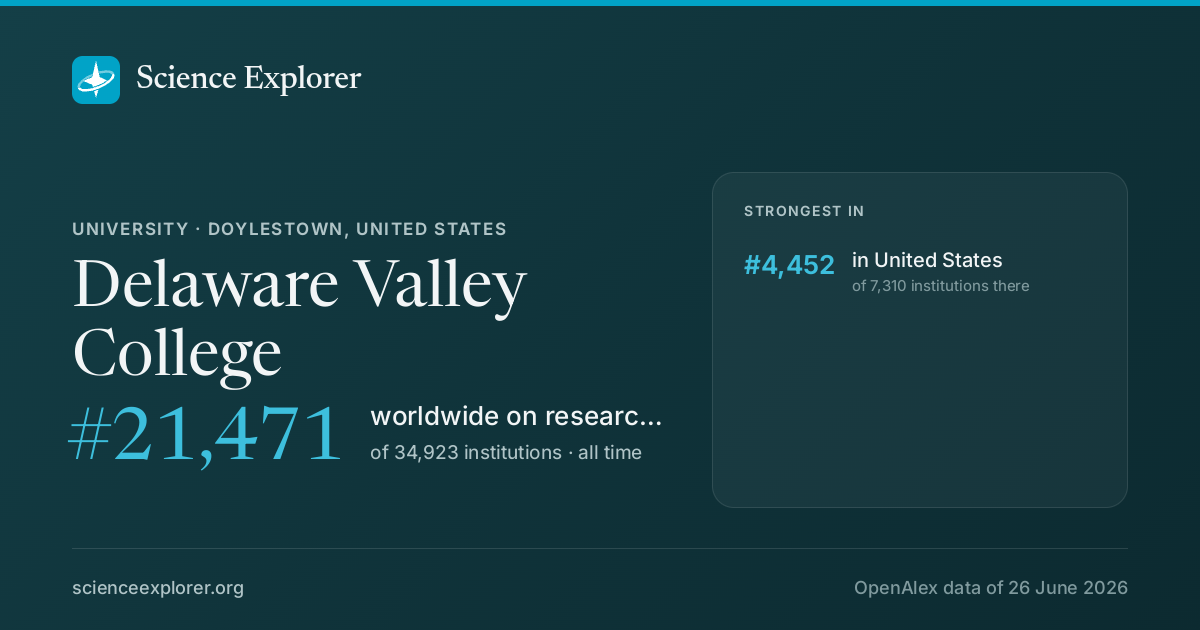
Delaware Valley College on Science Explorer

A card with Delaware Valley College's standing and the fields it leads in, for a post or a slide. A link to this page previews as the same card.

Download the card

1200 × 630 PNG, sized for social posts, drawn from the latest snapshot.

Badges for a website1Each links back here and updates with every snapshot

Research measures only: rankings here say nothing about teaching, admissions or student experience. Comparable institutions and collaboration partners have tabs of their own, above.

Discussion

Ask a question or share a note about Delaware Valley College. Keep it to the research: no personal attacks, advertising or links. Any reader can report a post, which collapses it for everyone until it is opened.
