Delta Electronics (China)
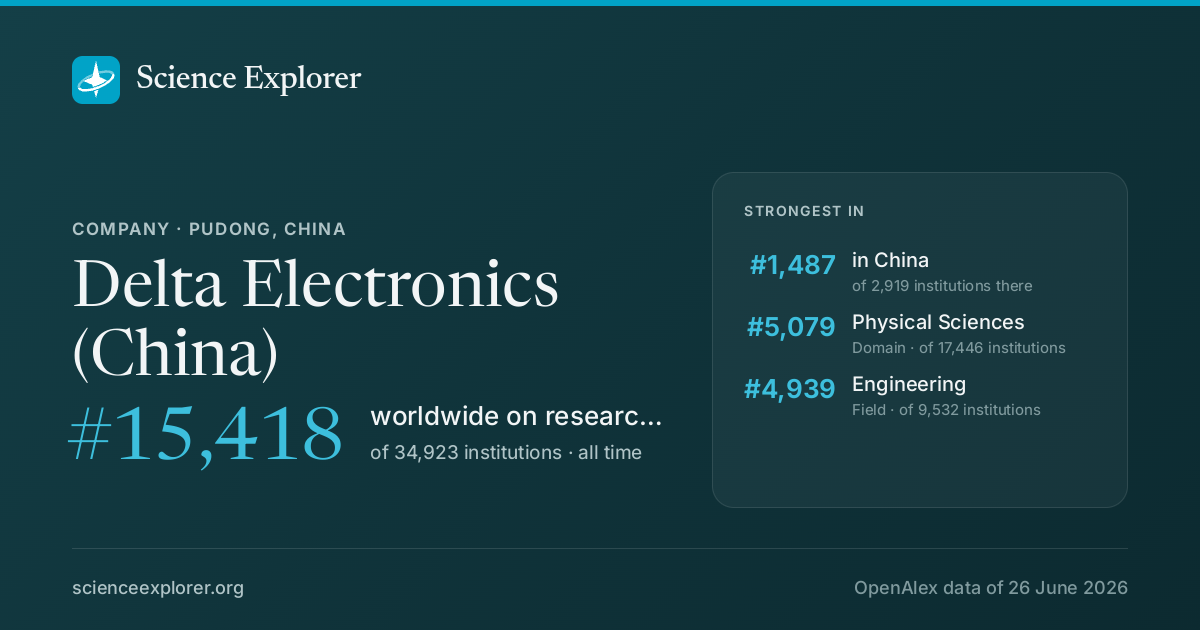
In research, Delta Electronics (China) stands highest in Physical Sciences (#5,079 of 17,446 worldwide) and Engineering (#4,939 of 9,532 worldwide), over all time.
- World rank, all time
- #15,418 of 34,923
- Rank in China
- #1,487 of 2,919
- Research works
- 269 ▼ 27% vs 2018-21
- Citations
- 5.5k 20.4 per fractional work
- Top-10% rate
- 9.6% all institutions 10.0%
- vs its own fields
- 1.27× 1.00× is exactly expected
- Open access
- 21% world 40%
- International
- 30% world 18%
What is Delta Electronics (China) known for in research?
The fields where it stands highest, over all time, ranked among every institution above the floor in each field.
| Field | World rank | Where that sits | Top-10% rate | Works |
|---|---|---|---|---|
| Physical SciencesDomain | #5,079 of 17,446 | 8.8% | 208 | |
| EngineeringField | #4,939 of 9,532 | 8.9% | 167 |
Each strip is that field's whole ranked pool, with the notch where Delta Electronics (China) sits in it, in the colour of the band that rank falls in. The track under the rate is the rate itself: it carries no average mark, because the average differs by field (from about 6% in Dentistry to 21% in Economics).
Which fields of science does Delta Electronics (China) work in?
In 2022-now, 64% of research at Delta Electronics (China) is in Physical Sciences, 17% in Social Sciences. Its largest fields are Engineering (46%), Medicine (13%), Social Sciences (10%). It does 1.5× the world's share of Physical Sciences.
Each ring splits the one inside it: the four domains of science, their fields, their subfields. Size is fractional works in 2022-now. Every slice is a page; the interactive view zooms down to single topics and colours each by how much more of it this institution does than the world.
Its 4 domains and 20 fields, with their numbers
- Physical Sciences2764.1%
- Engineering1946.2%
- Materials Science36.9%
- Physics and Astronomy24.7%
- Computer Science24.1%
- Mathematics01.2%
- Energy00.4%
- Environmental Science00.4%
- Earth and Planetary Sciences00.2%
- Chemistry00.1%
- Social Sciences717.2%
- Health Sciences613.7%
- Medicine512.9%
- Health Professions00.8%
- Life Sciences24.9%
Field profile
Location quotient across every field it publishes in: outside the ring is more than an institution of this size would be expected to publish, inside it is less.
Rings at 0.5×, 1× and 2×. Widest outward: Engineering, 3.1×. Every wedge is a field page.
All 20 fields, with their numbers
- Engineering3.08×19 works
- Physics and Astronomy2.10×2 works
- Materials Science1.98×3 works
- Economics, Econometrics and Finance1.11×1 works
- Mathematics1.01×0 works
- Decision Sciences0.82×0 works
- Social Sciences0.75×4 works
- Agricultural and Biological Sciences0.71×1 works
- Arts and Humanities0.69×1 works
- Business, Management and Accounting0.68×1 works
- Medicine0.67×5 works
- Computer Science0.53×2 works
- Energy0.43×0 works
- Immunology and Microbiology0.39×0 works
- Health Professions0.30×0 works
- Biochemistry, Genetics and Molecular Biology0.22×0 works
- Earth and Planetary Sciences0.13×0 works
- Psychology0.13×0 works
- Chemistry0.07×0 works
- Environmental Science0.07×0 works
- Engineering 3.1×
- Physics and Astronomy 2.1×
- Materials Science 2.0×
- Economics, Econometrics and Finance 1.1×
- Mathematics 1.0×
- Decision Sciences 0.8×
- Social Sciences 0.8×
- Agricultural and Biological Sciences 0.7×
- Arts and Humanities 0.7×
- Business, Management and Accounting 0.7×
- Medicine 0.7×
- Computer Science 0.5×
- Energy 0.4×
- Immunology and Microbiology 0.4×
- Health Professions 0.3×
- Biochemistry, Genetics and Molecular Biology 0.2×
- Earth and Planetary Sciences 0.1×
- Psychology 0.1×
- Chemistry 0.1×
- Environmental Science 0.1×
Who are the top researchers at Delta Electronics (China)?
Ranked on the quality score, Yuequan Hu, Jianping Ying and Jianhong Zeng lead among researchers whose main affiliation is Delta Electronics (China).
- 1
Yuequan Hu
 China · #1,842,522 worldwide
966 citations · 25 works
- 2
Jianping Ying
China · #2,234,581 worldwide
668 citations · 40 works
- 3
Jianhong Zeng
China · #4,663,015 worldwide
165 citations · 22 works
- 4
Zhigan Wu
China · #4,798,248 worldwide
107 citations · 19 works
- 5
Jianping Ying
China · #5,382,446 worldwide
126 citations · 30 works
- 6
J. Richard McElheny
China · #5,676,237 worldwide
10 citations · 50 works
Which keywords describe research at Delta Electronics (China)?
By fractional works in 2022-now, weighted toward what it does more of than the world: Power Electronics, Renewable Energy Integration, Electric Vehicle Charging, DC-DC Converters, High-Frequency Power Conversion, Thermal Management, Endovascular Repair and Wireless Power Transfer.
- Wireless Sensor Networks
- Efficiency
- Voltage Source Inverters
- Multilevel Converters
- Thermal Analysis
- Student Satisfaction
- Nanocomposites
- GaN
- Deep Learning
- Aortic Dissection
- Model Predictive Control
- Epidemiology
- Efficiency Optimization
- Wide Bandgap Semiconductors
- Online Learning
- Energy Efficiency
- Education
- Thermal Management
- DC-DC Converters
- Renewable Energy Integration
- Power Electronics
- Electric Vehicle Charging
- High-Frequency Power Conversion
- Endovascular Repair
- Wireless Power Transfer
- Reliability
- Silicon Carbide
- Aortic Aneurysm
- Induction Motors
- Light-Emitting Diodes
- Semiconductors
- Bicuspid Aortic Valve
- E-Learning
- III-Nitrides
- Risk Management
- Teaching Strategies
- Electric Vehicles
- Security
- Economic Growth
- Insurance
Size is fractional works in 2022-now in the topics tagged with each word; colour is the word's share of this institution's work against its share of the world's. The 40 words are chosen for being large and distinctive. Each links to the topic it comes from most.
All 40 words, with their numbers
- Power Electronics6▲ 41×6 topics
- Renewable Energy Integration4▲ 28×3 topics
- Electric Vehicle Charging4▲ 102×2 topics
- DC-DC Converters3▲ 114×1 topic
- High-Frequency Power Conversion3▲ 114×1 topic
- Thermal Management2▲ 17×2 topics
- Endovascular Repair2▲ 54×3 topics
- Education2▲ 2.3×5 topics
- Wireless Power Transfer2▲ 46×2 topics
- Energy Efficiency2▲ 4.0×4 topics
- Reliability2▲ 50×2 topics
- Online Learning2▲ 4.3×3 topics
- Silicon Carbide2▲ 73×1 topic
- Wide Bandgap Semiconductors2▲ 84×1 topic
- Aortic Aneurysm1▲ 51×2 topics
- Efficiency Optimization1▲ 75×2 topics
- Induction Motors1▲ 73×2 topics
- Epidemiology1▼ 0.79×4 topics
- Light-Emitting Diodes1▲ 20×2 topics
- Model Predictive Control1▲ 12×2 topics
- Semiconductors1▲ 10×2 topics
- Aortic Dissection1▲ 67×1 topic
- Bicuspid Aortic Valve1▲ 67×1 topic
- Deep Learning1▼ 0.86×6 topics
- E-Learning1▲ 2.9×2 topics
- GaN1▲ 85×1 topic
- III-Nitrides1▲ 98×1 topic
- Nanocomposites1▲ 3.7×5 topics
- Risk Management1▲ 5.8×2 topics
- Student Satisfaction1▲ 15×2 topics
- Teaching Strategies1▲ 9.9×3 topics
- Thermal Analysis1▲ 22×2 topics
- Electric Vehicles1▲ 8.7×2 topics
- Multilevel Converters1▲ 50×1 topic
- Security1▲ 3.9×2 topics
- Voltage Source Inverters1▲ 50×1 topic
- Economic Growth1▲ 2.9×1 topic
- Efficiency1▲ 8.2×2 topics
- Insurance1▲ 32×1 topic
- Wireless Sensor Networks1▲ 5.3×2 topics
Which research topics does Delta Electronics (China) publish most on?
By volume in 2022-now: Advanced DC-DC Converters, Silicon Carbide Semiconductor Technologies, GaN-based semiconductor devices and materials and Aortic Disease and Treatment Approaches.
Area is fractional works; colour is the subfield each topic belongs to.
- 1 Advanced DC-DC Converters Electrical and Electronic Engineering 3 works
- 2 Silicon Carbide Semiconductor Technologies Electrical and Electronic Engineering 2 works
- 3 GaN-based semiconductor devices and materials Condensed Matter Physics 1 works
- 4 Aortic Disease and Treatment Approaches Pulmonary and Respiratory Medicine 1 works
- 5 Multilevel Inverters and Converters Electrical and Electronic Engineering 1 works
- 6 Insurance and Financial Risk Management Economics and Econometrics 1 works
- 7 Wireless Power Transfer Systems Electrical and Electronic Engineering 1 works
- 8 Magnetic Properties and Applications Electronic, Optical and Magnetic Materials 1 works
- 9 Electromagnetic Compatibility and Noise Suppression Electrical and Electronic Engineering 1 works
- 10 Energy Harvesting in Wireless Networks Electrical and Electronic Engineering 1 works
How open and international is its research?
Against the world's own shares: the tick on each track. Both are shares of its output, so they sit on one scale and can be read against each other as well as against the world.
World: 40% of research is openly available.
World: 18% is written across borders.
How has Delta Electronics (China)'s research output changed?
Output in 2022-2025 was 27% lower than in 2018-2021.
The same series as a ribbon: one cell per year, darker for more. The line above answers how much; this answers when.
Its share of all research
Growing output can still be a shrinking share: all of science grows. This is Delta Electronics (China) as a percentage of every work published that year, 0.00018% in 2024.
Fractional works of Delta Electronics (China) over all fractional works that year. How the balance of science has shifted.
Other research institutions in Pudong
- Shanghai Jian Qiao University
- Shanghai First Maternity and Infant Hospital
- Shanghai Zhangjiang Laboratory
- China Construction Eighth Engineering Division (China)
- Shanghai Pudong New Area Gongli Hospital
- China Executive Leadership Academy Pudong
- Sinotech Genomics (China)
- Pan Asia Technical Automotive Center (China)
Share Delta Electronics (China)'s ranking
Badges for a website1Each links back here and updates with every snapshot

Research measures only: rankings here say nothing about teaching, admissions or student experience. Comparable institutions and collaboration partners have tabs of their own, above.
Discussion
Ask a question or share a note about Delta Electronics (China). Posts are plain text and can be reported.