Sinotech Genomics (China)
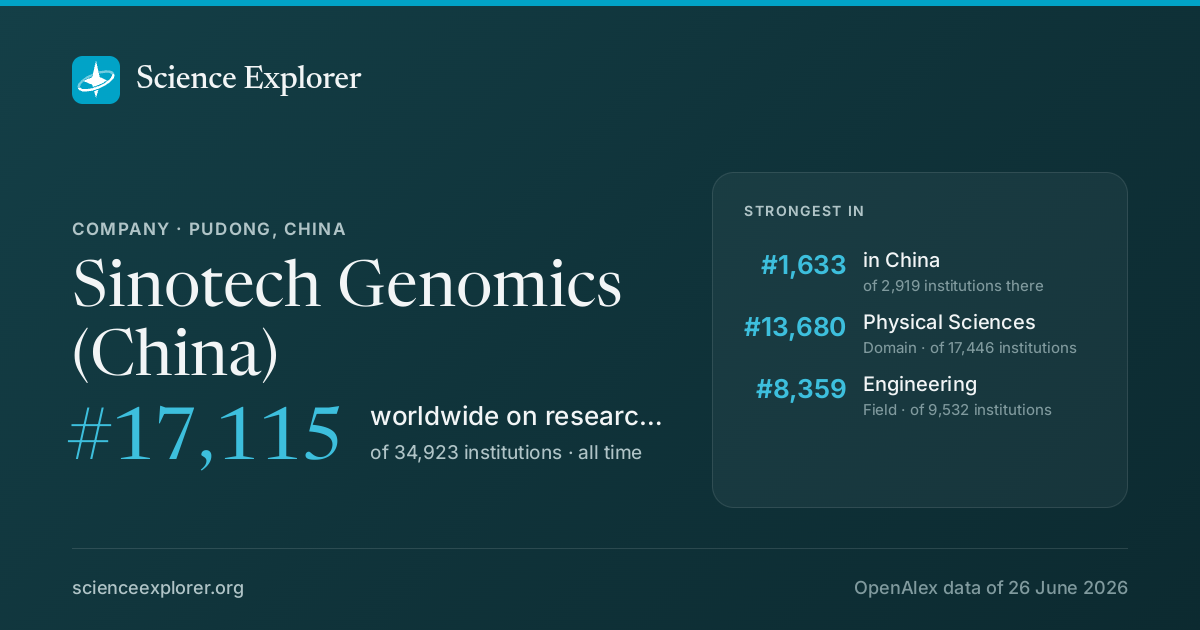
In research, Sinotech Genomics (China) stands highest in Physical Sciences (#13,680 of 17,446 worldwide) and Engineering (#8,359 of 9,532 worldwide), over all time.
- World rank, all time
- #17,115 of 34,923
- Rank in China
- #1,633 of 2,919
- Research works
- 340 ▼ 48% vs 2018-21
- Citations
- 3.3k 9.7 per fractional work
- Top-10% rate
- 12.2% all institutions 10.0%
- vs its own fields
- 0.92× 1.00× is exactly expected
- Open access
- 55% world 40%
- International
- 30% world 18%
What is Sinotech Genomics (China) known for in research?
The fields where it stands highest, over all time, ranked among every institution above the floor in each field.
| Field | World rank | Where that sits | Top-10% rate | Works |
|---|---|---|---|---|
| Physical SciencesDomain | #13,680 of 17,446 | 7.0% | 246 | |
| EngineeringField | #8,359 of 9,532 | 7.4% | 149 |
Each strip is that field's whole ranked pool, with the notch where Sinotech Genomics (China) sits in it, in the colour of the band that rank falls in. The track under the rate is the rate itself: it carries no average mark, because the average differs by field (from about 6% in Dentistry to 21% in Economics).
Which fields of science does Sinotech Genomics (China) work in?
In 2022-now, 39% of research at Sinotech Genomics (China) is in Physical Sciences, 32% in Life Sciences. Its largest fields are Biochemistry, Genetics and Molecular Biology (28%), Medicine (28%), Engineering (14%). It does 2.0× the world's share of Life Sciences.
Each ring splits the one inside it: the four domains of science, their fields, their subfields. Size is fractional works in 2022-now. Every slice is a page; the interactive view zooms down to single topics and colours each by how much more of it this institution does than the world.
Its 4 domains and 20 fields, with their numbers
- Physical Sciences2239.3%
- Engineering713.6%
- Environmental Science610.2%
- Earth and Planetary Sciences48.2%
- Computer Science12.3%
- Materials Science12.0%
- Chemistry11.6%
- Energy00.7%
- Chemical Engineering00.6%
- Physics and Astronomy00.1%
- Life Sciences1832.3%
- Health Sciences1527.7%
- Social Sciences00.7%
Field profile
Location quotient across every field it publishes in: outside the ring is more than an institution of this size would be expected to publish, inside it is less.
Rings at 0.5×, 1× and 2×. Widest outward: Biochemistry, Genetics and Molecular Biology, 5.3×. Every wedge is a field page.
All 20 fields, with their numbers
- Biochemistry, Genetics and Molecular Biology5.26×15 works
- Earth and Planetary Sciences5.20×4 works
- Environmental Science2.04×6 works
- Chemical Engineering1.72×0 works
- Medicine1.43×15 works
- Chemistry1.04×1 works
- Engineering0.91×8 works
- Energy0.77×0 works
- Immunology and Microbiology0.69×0 works
- Agricultural and Biological Sciences0.65×2 works
- Materials Science0.57×1 works
- Nursing0.31×0 works
- Computer Science0.29×1 works
- Neuroscience0.25×0 works
- Pharmacology, Toxicology and Pharmaceutics0.25×0 works
- Decision Sciences0.16×0 works
- Physics and Astronomy0.07×0 works
- Economics, Econometrics and Finance0.05×0 works
- Arts and Humanities0.03×0 works
- Social Sciences0.03×0 works
- Biochemistry, Genetics and Molecular Biology 5.3×
- Earth and Planetary Sciences 5.2×
- Environmental Science 2.0×
- Chemical Engineering 1.7×
- Medicine 1.4×
- Chemistry 1.0×
- Engineering 0.9×
- Energy 0.8×
- Immunology and Microbiology 0.7×
- Agricultural and Biological Sciences 0.7×
- Materials Science 0.6×
- Nursing 0.3×
- Computer Science 0.3×
- Neuroscience 0.2×
- Pharmacology, Toxicology and Pharmaceutics 0.2×
- Decision Sciences 0.2×
- Physics and Astronomy 0.1×
- Economics, Econometrics and Finance 0.1×
- Arts and Humanities 0.0×
- Social Sciences 0.0×
Who are the top researchers at Sinotech Genomics (China)?
Ranked on the quality score, Rui Liu, Yaxin Yao and Qiye He lead among researchers whose main affiliation is Sinotech Genomics (China).
- 1
Rui Liu
 China · #164,063 worldwide
1.6k citations · 39 works
- 2
Yaxin Yao
China · #520,314 worldwide
596 citations · 41 works
- 3
Qiye He
China · #530,680 worldwide
2k citations · 66 works
- 4
Zhenzhen Zhang
China · #1,174,185 worldwide
151 citations · 21 works
- 5
Hailiang Liu
China · #1,207,586 worldwide
1.5k citations · 51 works
- 6
Zhixi Su
China · #1,760,046 worldwide
145 citations · 21 works
- 7
Jyh‐Cherng Jong
China · #2,154,894 worldwide
993 citations · 30 works
- 8
Chengcheng Ma
China · #2,465,585 worldwide
543 citations · 49 works
- 9
Lun-Wei Wei
China · #3,119,103 worldwide
151 citations · 23 works
- 10
Shu-Yeong Chi
China · #3,444,641 worldwide
151 citations · 17 works
Which keywords describe research at Sinotech Genomics (China)?
By fractional works in 2022-now, weighted toward what it does more of than the world: Cell-Free DNA, Targeted Therapy, Cancer Genomics, Mutational Signatures, DNA Methylation, Epigenetic Reprogramming, Histone Modification and GIS-based Modeling.
- Lipid Peroxidation
- Hazard
- Feature Extraction
- Subduction
- Epigenetic Regulation
- Colorectal Cancer
- Cell Death
- Risk Assessment
- Precision Medicine
- Microbial Communities
- Maternal Plasma DNA Sequencing
- Aneuploidy Screening
- Immunotherapy
- GIS-based Modeling
- Gene Expression
- Machine Learning
- Oxidative Stress
- Epigenetic Reprogramming
- Mutational Signatures
- Targeted Therapy
- Cell-Free DNA
- Cancer Genomics
- DNA Methylation
- Histone Modification
- Cancer
- Remote Sensing
- Chemotherapy
- Tumor Microenvironment
- Prenatal Diagnosis
- Data Integration
- Biomarkers
- Mortality
- Prevention
- Screening
- Colonoscopy
- Earthquakes
- Neoadjuvant Therapy
- BRAF Mutation
- Ferroptosis
- Landslide
Size is fractional works in 2022-now in the topics tagged with each word; colour is the word's share of this institution's work against its share of the world's. The 40 words are chosen for being large and distinctive. Each links to the topic it comes from most.
All 40 words, with their numbers
- Cell-Free DNA6▲ 110×2 topics
- Targeted Therapy5▲ 42×3 topics
- Cancer Genomics5▲ 117×1 topic
- Mutational Signatures5▲ 117×1 topic
- DNA Methylation3▲ 48×2 topics
- Epigenetic Reprogramming3▲ 55×1 topic
- Histone Modification3▲ 75×1 topic
- Oxidative Stress2▲ 2.7×9 topics
- Cancer2▲ 3.1×7 topics
- Machine Learning2▲ 1.24×12 topics
- Remote Sensing2▲ 3.5×10 topics
- Gene Expression2▲ 5.8×7 topics
- Chemotherapy2▲ 4.9×7 topics
- GIS-based Modeling2▲ 40×2 topics
- Tumor Microenvironment2▲ 7.0×3 topics
- Immunotherapy2▲ 4.1×8 topics
- Prenatal Diagnosis2▲ 18×3 topics
- Aneuploidy Screening1▲ 93×1 topic
- Data Integration1▲ 14×3 topics
- Maternal Plasma DNA Sequencing1▲ 93×1 topic
- Biomarkers1▲ 3.1×7 topics
- Microbial Communities1▲ 4.8×3 topics
- Mortality1▲ 3.9×2 topics
- Precision Medicine1▲ 4.2×4 topics
- Prevention1▲ 5.1×2 topics
- Risk Assessment1▲ 3.3×2 topics
- Screening1▲ 22×3 topics
- Cell Death1▲ 8.2×2 topics
- Colonoscopy1▲ 44×1 topic
- Colorectal Cancer1▲ 24×1 topic
- Earthquakes1▲ 34×1 topic
- Epigenetic Regulation1▲ 9.1×5 topics
- Neoadjuvant Therapy1▲ 8.7×3 topics
- Subduction1▲ 26×1 topic
- BRAF Mutation1▲ 27×2 topics
- Feature Extraction1▲ 4.1×4 topics
- Ferroptosis1▲ 22×1 topic
- Hazard1▲ 27×1 topic
- Landslide1▲ 27×1 topic
- Lipid Peroxidation1▲ 17×1 topic
Which research topics does Sinotech Genomics (China) publish most on?
By volume in 2022-now: Cancer Genomics and Diagnostics, Epigenetics and DNA Methylation, Prenatal Screening and Diagnostics and earthquake and tectonic studies.
Area is fractional works; colour is the subfield each topic belongs to.
- 1 Cancer Genomics and Diagnostics Cancer Research 5 works
- 2 Epigenetics and DNA Methylation Molecular Biology 3 works
- 3 Prenatal Screening and Diagnostics Pediatrics, Perinatology and Child Health 1 works
- 4 earthquake and tectonic studies Geophysics 1 works
- 5 Colorectal Cancer Screening and Detection Oncology 1 works
- 6 Ferroptosis and cancer prognosis Pulmonary and Respiratory Medicine 1 works
- 7 Landslides and related hazards Management, Monitoring, Policy and Law 1 works
- 8 Thyroid Cancer Diagnosis and Treatment Endocrinology, Diabetes and Metabolism 1 works
- 9 Reproductive Biology and Fertility Public Health, Environmental and Occupational Health 1 works
- 10 Geological Modeling and Analysis Geochemistry and Petrology 1 works
How open and international is its research?
Against the world's own shares: the tick on each track. Both are shares of its output, so they sit on one scale and can be read against each other as well as against the world.
World: 40% of research is openly available.
World: 18% is written across borders.
How has Sinotech Genomics (China)'s research output changed?
Output in 2022-2025 was 48% lower than in 2018-2021.
The same series as a ribbon: one cell per year, darker for more. The line above answers how much; this answers when.
Its share of all research
Growing output can still be a shrinking share: all of science grows. This is Sinotech Genomics (China) as a percentage of every work published that year, 0.00015% in 2024.
Fractional works of Sinotech Genomics (China) over all fractional works that year. How the balance of science has shifted.
Other research institutions in Pudong
- Shanghai Jian Qiao University
- Shanghai First Maternity and Infant Hospital
- Shanghai Zhangjiang Laboratory
- China Construction Eighth Engineering Division (China)
- Shanghai Pudong New Area Gongli Hospital
- China Executive Leadership Academy Pudong
- Delta Electronics (China)
- Pan Asia Technical Automotive Center (China)
Share Sinotech Genomics (China)'s ranking
Badges for a website1Each links back here and updates with every snapshot

Research measures only: rankings here say nothing about teaching, admissions or student experience. Comparable institutions and collaboration partners have tabs of their own, above.
Discussion
Ask a question or share a note about Sinotech Genomics (China). Posts are plain text and can be reported.