Deutsche Bundespost

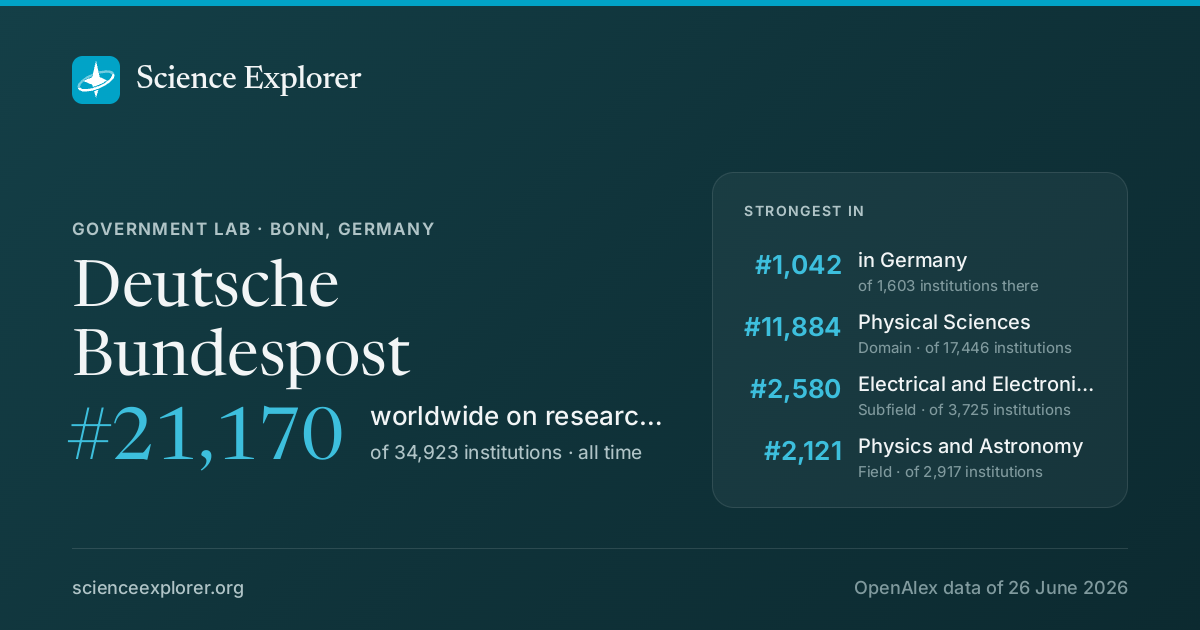
In research, Deutsche Bundespost stands highest in Physical Sciences (#11,884 of 17,446 worldwide), Electrical and Electronic Engineering (#2,580 of 3,725 worldwide) and Physics and Astronomy (#2,121 of 2,917 worldwide), over all time.
- World rank, all time
- #21,170 of 34,923
- Rank in Germany
- #1,042 of 1,603
- Research works
- 610 ▲ 67% vs 2018-21
- Citations
- 8.5k 14.0 per fractional work
- Top-10% rate
- 5.4% all institutions 10.0%
- vs its own fields
- 1.10× 1.00× is exactly expected
- Open access
- 7% world 40%
- International
- 8% world 18%
What is Deutsche Bundespost known for in research?
The fields where it stands highest, over all time, ranked among every institution above the floor in each field.
| Field | World rank | Where that sits | Top-10% rate | Works |
|---|---|---|---|---|
| Physical SciencesDomain | #11,884 of 17,446 | 7.5% | 552 | |
| Electrical and Electronic EngineeringSubfield | #2,580 of 3,725 | 6.6% | 216 | |
| Physics and AstronomyField | #2,121 of 2,917 | 13.3% | 122 | |
| EngineeringField | #7,804 of 9,532 | 6.2% | 304 |
Each strip is that field's whole ranked pool, with the notch where Deutsche Bundespost sits in it, in the colour of the band that rank falls in. The track under the rate is the rate itself: it carries no average mark, because the average differs by field (from about 6% in Dentistry to 21% in Economics).
Which fields of science does Deutsche Bundespost work in?
In all years, 90% of research at Deutsche Bundespost is in Physical Sciences, 7% in Social Sciences. Its largest fields are Engineering (50%), Physics and Astronomy (20%), Computer Science (11%). It does 2.2× the world's share of Physical Sciences.
Each ring splits the one inside it: the four domains of science, their fields, their subfields. Size is fractional works in all years. Every slice is a page; the interactive view zooms down to single topics and colours each by how much more of it this institution does than the world.
Its 4 domains and 21 fields, with their numbers
- Physical Sciences55290.4%
- Engineering30449.8%
- Physics and Astronomy12220.0%
- Computer Science6610.8%
- Materials Science223.5%
- Earth and Planetary Sciences122.0%
- Chemistry121.9%
- Mathematics71.2%
- Environmental Science50.9%
- Chemical Engineering10.2%
- Social Sciences447.3%
- Economics, Econometrics and Finance182.9%
- Social Sciences111.9%
- Business, Management and Accounting111.8%
- Arts and Humanities20.3%
- Psychology20.3%
- Decision Sciences10.2%
- Life Sciences91.5%
- Health Sciences50.9%
- Medicine40.7%
- Health Professions10.2%
Field profile
Location quotient across every field it publishes in: outside the ring is more than an institution of this size would be expected to publish, inside it is less.
Rings at 0.5×, 1× and 2×. Widest outward: Economics, Econometrics and Finance, 6.0×. Every wedge is a field page.
All 7 fields, with their numbers
- Economics, Econometrics and Finance6.03×0 works
- Social Sciences4.28×1 works
- Immunology and Microbiology1.42×0 works
- Engineering0.86×0 works
- Medicine0.82×0 works
- Health Professions0.70×0 works
- Psychology0.30×0 works
Who are the top researchers at Deutsche Bundespost?
Ranked on the quality score, W. Schlapp, Heinrich. Nickel and Walter Heitmann lead among researchers whose main affiliation is Deutsche Bundespost.
- 1
W. Schlapp
 Germany · #2,294,479 worldwide
4k citations · 174 works
- 2
Heinrich. Nickel
Germany · #3,278,559 worldwide
2.7k citations · 147 works
- 3
Walter Heitmann
Germany · #3,530,197 worldwide
674 citations · 28 works
- 4
E. Kuphal
Germany · #4,071,585 worldwide
1.4k citations · 86 works
- 5
R. Kallweit
Germany · #4,101,475 worldwide
639 citations · 17 works
- 6
E. Kühn
Germany · #4,576,965 worldwide
250 citations · 21 works
- 7
Heinz Schmiedel
Germany · #4,902,946 worldwide
171 citations · 18 works
- 8
H.W. Dinges
Germany · #4,905,262 worldwide
375 citations · 22 works
- 9
V. Hombach
Germany · #5,036,020 worldwide
433 citations · 25 works
- 10
Ottokar G. Leminger
Germany · #5,418,721 worldwide
392 citations · 40 works
Which keywords describe research at Deutsche Bundespost?
By fractional works in all years, weighted toward what it does more of than the world: Photovoltaics, Semiconductor, Nanowires, Band Parameters, Quantum Dots, Excitons, Single-Photon Source and Integrated Circuits.
- Beamforming
- Wireless Communications
- Coherent Detection
- Financial Analysis
- Monetary Policy
- Impulsive Noise
- Atomic Layer Deposition
- Nanoelectronics
- Smart Grid
- Optical Fiber
- Semiconductor Quantum Dots
- Channel Modeling
- Spintronics
- Microcavities
- Optical Modulators
- Semiconductor Lasers
- Integrated Circuits
- Excitons
- Band Parameters
- Nanowires
- Photovoltaics
- Semiconductor
- Quantum Dots
- Single-Photon Source
- Optical Interconnects
- Biosensors
- Raman Lasers
- Silicon Photonics
- Quantum Computing
- Electron Spin
- Solar Cells
- Broadband
- Wireless Networks
- OFDM Systems
- High-k Dielectrics
- Power Line Communications
- Asset Pricing
- Digital Signal Processing
- Nonlinear Effects
- Hydrological Modeling
Size is fractional works in all years in the topics tagged with each word; colour is the word's share of this institution's work against its share of the world's. The 40 words are chosen for being large and distinctive. Each links to the topic it comes from most.
All 40 words, with their numbers
- Photovoltaics50▲ 33×4 topics
- Nanowires48▲ 33×4 topics
- Semiconductor48▲ 24×5 topics
- Band Parameters47▲ 62×2 topics
- Quantum Dots46▲ 48×2 topics
- Excitons45▲ 93×1 topic
- Single-Photon Source45▲ 93×1 topic
- Integrated Circuits43▲ 31×3 topics
- Optical Interconnects38▲ 78×1 topic
- Semiconductor Lasers38▲ 64×1 topic
- Biosensors34▲ 9.9×5 topics
- Optical Modulators33▲ 26×2 topics
- Raman Lasers32▲ 31×2 topics
- Microcavities32▲ 33×1 topic
- Silicon Photonics32▲ 33×1 topic
- Spintronics25▲ 20×3 topics
- Quantum Computing24▲ 19×2 topics
- Channel Modeling23▲ 37×4 topics
- Electron Spin22▲ 53×1 topic
- Semiconductor Quantum Dots22▲ 53×1 topic
- Solar Cells22▲ 11×6 topics
- Optical Fiber22▲ 27×2 topics
- Broadband21▲ 62×2 topics
- Smart Grid18▲ 10×4 topics
- Wireless Networks18▲ 13×4 topics
- Nanoelectronics17▲ 18×2 topics
- OFDM Systems16▲ 50×2 topics
- Atomic Layer Deposition16▲ 20×1 topic
- High-k Dielectrics16▲ 20×1 topic
- Impulsive Noise16▲ 107×1 topic
- Power Line Communications16▲ 107×1 topic
- Monetary Policy14▲ 8.1×2 topics
- Asset Pricing14▲ 17×1 topic
- Financial Analysis14▲ 28×1 topic
- Digital Signal Processing14▲ 31×2 topics
- Coherent Detection13▲ 35×1 topic
- Nonlinear Effects13▲ 35×1 topic
- Wireless Communications12▲ 13×2 topics
- Hydrological Modeling11▲ 9.2×3 topics
- Beamforming11▲ 16×4 topics
Which research topics does Deutsche Bundespost publish most on?
By volume in 2022-now: Innovation, Technology, and Society, Diverse Scientific and Economic Studies, Human auditory perception and evaluation and Biomedical and Chemical Research.
Area is fractional works; colour is the subfield each topic belongs to.
- 1 Innovation, Technology, and Society Sociology and Political Science 1 works
- 2 Diverse Scientific and Economic Studies Economics and Econometrics 0 works
- 3 Human auditory perception and evaluation Aerospace Engineering 0 works
- 4 Biomedical and Chemical Research Surgery 0 works
- 5 Historical Influence and Diplomacy Political Science and International Relations 0 works
- 6 International Law and Aviation Political Science and International Relations 0 works
- 7 International Law and Human Rights Political Science and International Relations 0 works
- 8 Global Peace and Security Dynamics Political Science and International Relations 0 works
- 9 Psoriasis: Treatment and Pathogenesis Immunology 0 works
- 10 Urinary Bladder and Prostate Research Urology 0 works
How open and international is its research?
Against the world's own shares: the tick on each track. Both are shares of its output, so they sit on one scale and can be read against each other as well as against the world.
World: 40% of research is openly available.
World: 18% is written across borders.
How has Deutsche Bundespost's research output changed?
Output in 2022-2025 was 67% higher than in 2018-2021.
The same series as a ribbon: one cell per year, darker for more. The line above answers how much; this answers when.
Its share of all research
Growing output can still be a shrinking share: all of science grows. This is Deutsche Bundespost as a percentage of every work published that year, 0.0000020% in 2024.
Fractional works of Deutsche Bundespost over all fractional works that year. How the balance of science has shifted.
How much of it reaches the world top 10%
Year by year, against all institutions in the same year.
Of each year's output, the share that reached the world's 10% most cited for its field and year. Peak 12.5% in 1992.
Other research institutions in Bonn
- University of Bonn
- Bundesministerium für Landwirtschaft, Ernährung und Heimat
- IZA - Institute of Labor Economics
- Universitäts-Augenklinik Bonn
- Zentrum für Kinderheilkunde
- Centrum für Integrierte Onkologie
- Deutsche Forschungsgemeinschaft
- Deutsche Telekom (Germany)


Share Deutsche Bundespost's ranking
Badges for a website1Each links back here and updates with every snapshot

Research measures only: rankings here say nothing about teaching, admissions or student experience. Comparable institutions and collaboration partners have tabs of their own, above.
Discussion
Ask a question or share a note about Deutsche Bundespost. Keep it to the research: no personal attacks, advertising or links. Any reader can report a post, which collapses it for everyone until it is opened.