Science Explorer Back to mapMap
Discussion
Company · Düsseldorf · Germany

Dynavax Technologies (Germany)

In research, Dynavax Technologies (Germany) stands highest in Physical Sciences (#9,776 of 17,446 worldwide), over all time.

World rank, all time
#13,527
of 34,923
Rank in Germany
#677
of 1,603
Research works
291
▲ 92% vs 2018-21
Citations
7.9k
27.2 per fractional work
Top-10% rate
10.0%
all institutions 10.0%
vs its own fields
1.00×
1.00× is exactly expected
Open access
44%
world 40%
International
45%
world 18%

What is Dynavax Technologies (Germany) known for in research?

The fields where it stands highest, over all time, ranked among every institution above the floor in each field.

FieldWorld rankWhere that sitsTop-10% rateWorks
Physical SciencesDomain #9,776 of 17,446 8.0%137

Each strip is that field's whole ranked pool, with the notch where Dynavax Technologies (Germany) sits in it, in the colour of the band that rank falls in. The track under the rate is the rate itself: it carries no average mark, because the average differs by field (from about 6% in Dentistry to 21% in Economics).

Which fields of science does Dynavax Technologies (Germany) work in?

In 2022-now, 40% of research at Dynavax Technologies (Germany) is in Physical Sciences, 31% in Social Sciences. Its largest fields are Medicine (23%), Social Sciences (21%), Engineering (17%).

Physical Sciences: 27 fractional works · 40.2% of its workEngineering: 11 fractional works · 16.6% of its workElectrical and Electronic Engineering: 3 fractional works · 3.9% of its workOcean Engineering: 2 fractional works · 2.5% of its workAerospace Engineering: 1 fractional works · 2.1% of its workMechanical Engineering: 1 fractional works · 1.6% of its workControl and Systems Engineering: 1 fractional works · 1.4% of its workMechanics of Materials: 1 fractional works · 1.2% of its workIndustrial and Manufacturing Engineering: 1 fractional works · 0.9% of its workBuilding and Construction: 1 fractional works · 0.8% of its workCivil and Structural Engineering: 0 fractional works · 0.6% of its workBiomedical Engineering: 0 fractional works · 0.6% of its workAutomotive Engineering: 0 fractional works · 0.4% of its workArchitecture: 0 fractional works · 0.3% of its workSmaller subfields together: 0 fractional works · 0.1% of its workEnvironmental Science: 5 fractional works · 7.6% of its workManagement, Monitoring, Policy and Law: 2 fractional works · 3.0% of its workEnvironmental Engineering: 1 fractional works · 1.5% of its workIndustrial and Manufacturing Engineering: 1 fractional works · 1.1% of its workGlobal and Planetary Change: 1 fractional works · 1.0% of its workEnvironmental Chemistry: 0 fractional works · 0.6% of its workPollution: 0 fractional works · 0.3% of its workSmaller subfields together: 0 fractional works · 0.3% of its workComputer Science: 4 fractional works · 6.5% of its workInformation Systems: 2 fractional works · 2.6% of its workArtificial Intelligence: 1 fractional works · 1.8% of its workComputer Networks and Communications: 1 fractional works · 1.0% of its workSignal Processing: 1 fractional works · 0.8% of its workSmaller subfields together: 0 fractional works · 0.3% of its workEarth and Planetary Sciences: 2 fractional works · 3.7% of its workGeophysics: 1 fractional works · 1.2% of its workOceanography: 1 fractional works · 1.2% of its workGeochemistry and Petrology: 0 fractional works · 0.5% of its workAtmospheric Science: 0 fractional works · 0.3% of its workEarth-Surface Processes: 0 fractional works · 0.3% of its workSmaller subfields together: 0 fractional works · 0.2% of its workMaterials Science: 2 fractional works · 2.3% of its workMaterials Chemistry: 1 fractional works · 1.5% of its workPolymers and Plastics: 0 fractional works · 0.3% of its workElectronic, Optical and Magnetic Materials: 0 fractional works · 0.2% of its workSmaller subfields together: 0 fractional works · 0.3% of its workEnergy: 1 fractional works · 1.5% of its workRenewable Energy, Sustainability and the Environment: 1 fractional works · 0.9% of its workEnergy Engineering and Power Technology: 0 fractional works · 0.5% of its workSmaller subfields together: 0 fractional works · 0.1% of its workPhysics and Astronomy: 1 fractional works · 0.9% of its workCondensed Matter Physics: 0 fractional works · 0.6% of its workAtomic and Molecular Physics, and Optics: 0 fractional works · 0.2% of its workSmaller subfields together: 0 fractional works · 0.1% of its workChemistry: 0 fractional works · 0.7% of its workSpectroscopy: 0 fractional works · 0.4% of its workSmaller subfields together: 0 fractional works · 0.3% of its workChemical Engineering: 0 fractional works · 0.3% of its workCatalysis: 0 fractional works · 0.2% of its workSmaller subfields together: 0 fractional works · 0.1% of its workMathematics: 0 fractional works · 0.1% of its workSocial Sciences: 21 fractional works · 30.8% of its workSocial Sciences: 14 fractional works · 20.6% of its workSociology and Political Science: 5 fractional works · 7.4% of its workPolitical Science and International Relations: 2 fractional works · 2.6% of its workEducation: 2 fractional works · 2.3% of its workGender Studies: 2 fractional works · 2.2% of its workTransportation: 1 fractional works · 1.9% of its workUrban Studies: 1 fractional works · 1.5% of its workAnthropology: 1 fractional works · 0.8% of its workLaw: 0 fractional works · 0.7% of its workDemography: 0 fractional works · 0.5% of its workCultural Studies: 0 fractional works · 0.4% of its workHealth: 0 fractional works · 0.2% of its workArts and Humanities: 4 fractional works · 5.2% of its workHistory: 1 fractional works · 1.2% of its workArcheology: 1 fractional works · 1.2% of its workVisual Arts and Performing Arts: 1 fractional works · 0.8% of its workLanguage and Linguistics: 0 fractional works · 0.7% of its workPhilosophy: 0 fractional works · 0.6% of its workLiterature and Literary Theory: 0 fractional works · 0.5% of its workSmaller subfields together: 0 fractional works · 0.2% of its workEconomics, Econometrics and Finance: 1 fractional works · 1.7% of its workEconomics and Econometrics: 0 fractional works · 0.7% of its workFinance: 0 fractional works · 0.5% of its workGeneral Economics, Econometrics and Finance: 0 fractional works · 0.5% of its workBusiness, Management and Accounting: 1 fractional works · 1.4% of its workManagement Information Systems: 1 fractional works · 0.8% of its workStrategy and Management: 0 fractional works · 0.3% of its workManagement of Technology and Innovation: 0 fractional works · 0.3% of its workSmaller subfields together: 0 fractional works · 0.1% of its workPsychology: 1 fractional works · 1.4% of its workClinical Psychology: 0 fractional works · 0.7% of its workDevelopmental and Educational Psychology: 0 fractional works · 0.5% of its workSmaller subfields together: 0 fractional works · 0.2% of its workDecision Sciences: 0 fractional works · 0.4% of its workManagement Science and Operations Research: 0 fractional works · 0.4% of its workHealth Sciences: 16 fractional works · 23.8% of its workMedicine: 15 fractional works · 22.8% of its workReproductive Medicine: 4 fractional works · 5.9% of its workComplementary and alternative medicine: 2 fractional works · 2.4% of its workOncology: 1 fractional works · 2.1% of its workPediatrics, Perinatology and Child Health: 1 fractional works · 1.7% of its workPathology and Forensic Medicine: 1 fractional works · 1.6% of its workSurgery: 1 fractional works · 1.4% of its workEpidemiology: 1 fractional works · 1.2% of its workPulmonary and Respiratory Medicine: 1 fractional works · 1.0% of its workObstetrics and Gynecology: 0 fractional works · 0.6% of its workHepatology: 0 fractional works · 0.6% of its workHematology: 0 fractional works · 0.6% of its workInfectious Diseases: 0 fractional works · 0.6% of its workRadiology, Nuclear Medicine and Imaging: 0 fractional works · 0.6% of its workPhysiology: 0 fractional works · 0.5% of its workGenetics: 0 fractional works · 0.5% of its workPublic Health, Environmental and Occupational Health: 0 fractional works · 0.4% of its workNeurology: 0 fractional works · 0.3% of its workOrthopedics and Sports Medicine: 0 fractional works · 0.3% of its workOtorhinolaryngology: 0 fractional works · 0.2% of its workSmaller subfields together: 0 fractional works · 0.6% of its workHealth Professions: 1 fractional works · 0.8% of its workGeneral Health Professions: 0 fractional works · 0.3% of its workHealth Information Management: 0 fractional works · 0.3% of its workSmaller subfields together: 0 fractional works · 0.2% of its workDentistry: 0 fractional works · 0.2% of its workLife Sciences: 4 fractional works · 5.2% of its workBiochemistry, Genetics and Molecular Biology: 2 fractional works · 3.3% of its workMolecular Biology: 1 fractional works · 1.7% of its workCancer Research: 0 fractional works · 0.6% of its workGenetics: 0 fractional works · 0.5% of its workBiotechnology: 0 fractional works · 0.3% of its workSmaller subfields together: 0 fractional works · 0.3% of its workImmunology and Microbiology: 1 fractional works · 0.8% of its workImmunology: 0 fractional works · 0.6% of its workSmaller subfields together: 0 fractional works · 0.1% of its workNeuroscience: 0 fractional works · 0.5% of its workCognitive Neuroscience: 0 fractional works · 0.3% of its workSmaller subfields together: 0 fractional works · 0.2% of its workPharmacology, Toxicology and Pharmaceutics: 0 fractional works · 0.4% of its workPharmacology: 0 fractional works · 0.3% of its workSmaller subfields together: 0 fractional works · 0.0% of its workAgricultural and Biological Sciences: 0 fractional works · 0.3% of its workALL ITS WORKDynavaxTechnologies…68fractional works, 2022-now
Life Sciences5%Physical Sciences40%Health Sciences24%Social Sciences31%

Each ring splits the one inside it: the four domains of science, their fields, their subfields. Size is fractional works in 2022-now. Every slice is a page; the interactive view zooms down to single topics and colours each by how much more of it this institution does than the world.

Its 4 domains and 24 fields, with their numbers
    1. Engineering1116.6%
    2. Environmental Science57.6%
    3. Computer Science46.5%
    4. Earth and Planetary Sciences23.7%
    5. Materials Science22.3%
    6. Energy11.5%
    7. Physics and Astronomy10.9%
    8. Chemistry00.7%
    9. Chemical Engineering00.3%
    10. Mathematics00.1%
    1. Social Sciences1420.6%
    2. Arts and Humanities45.2%
    3. Economics, Econometrics and Finance11.7%
    4. Business, Management and Accounting11.4%
    5. Psychology11.4%
    6. Decision Sciences00.4%
    1. Medicine1522.8%
    2. Health Professions10.8%
    3. Dentistry00.2%
    1. Biochemistry, Genetics and Molecular Biology23.3%
    2. Immunology and Microbiology10.8%
    3. Neuroscience00.5%
    4. Pharmacology, Toxicology and Pharmaceutics00.4%
    5. Agricultural and Biological Sciences00.3%
All of science, and how each field's share has moved since 1950: the Science domain explorer

Field profile

Location quotient across every field it publishes in: outside the ring is more than an institution of this size would be expected to publish, inside it is less.

Agricultural and Biological Sciences: 0.06× its world share, 0 worksAgricultural and Bio…Biochemistry, Genetics and Molecular Biology: 0.63× its world share, 2 worksBiochemistry, Geneti…Immunology and Microbiology: 0.75× its world share, 0 worksImmunology and Micro…Neuroscience: 0.31× its world share, 0 worksNeurosciencePharmacology, Toxicology and Pharmaceutics: 1.06× its world share, 0 worksPharmacology, Toxico…Chemical Engineering: 0.91× its world share, 0 worksChemical EngineeringChemistry: 0.45× its world share, 0 worksChemistryComputer Science: 0.84× its world share, 4 worksComputer ScienceEarth and Planetary Sciences: 2.34× its world share, 2 worksEarth and Planetary …Energy: 1.61× its world share, 1 worksEnergyEngineering: 1.10× its world share, 11 worksEngineeringEnvironmental Science: 1.54× its world share, 5 worksEnvironmental ScienceMaterials Science: 0.65× its world share, 2 worksMaterials ScienceMathematics: 0.10× its world share, 0 worksMathematicsPhysics and Astronomy: 0.41× its world share, 1 worksPhysics and AstronomyDentistry: 0.34× its world share, 0 worksDentistryHealth Professions: 0.30× its world share, 0 worksHealth ProfessionsMedicine: 1.19× its world share, 15 worksMedicineArts and Humanities: 1.82× its world share, 4 worksArts and HumanitiesBusiness, Management and Accounting: 0.44× its world share, 1 worksBusiness, Management…Decision Sciences: 0.42× its world share, 0 worksDecision SciencesEconomics, Econometrics and Finance: 0.80× its world share, 1 worksEconomics, Econometr…Psychology: 0.45× its world share, 1 worksPsychologySocial Sciences: 1.63× its world share, 14 worksSocial Sciences1×world share
more than its size predictsabout as predictedless

Rings at 0.5×, 1× and 2×. Widest outward: Earth and Planetary Sciences, 2.3×. Every wedge is a field page.

All 24 fields, with their numbers
  1. Earth and Planetary Sciences2.34×2 works
  2. Arts and Humanities1.82×4 works
  3. Social Sciences1.63×14 works
  4. Energy1.61×1 works
  5. Environmental Science1.54×5 works
  6. Medicine1.19×15 works
  7. Engineering1.10×11 works
  8. Pharmacology, Toxicology and Pharmaceutics1.06×0 works
  9. Chemical Engineering0.91×0 works
  10. Computer Science0.84×4 works
  11. Economics, Econometrics and Finance0.80×1 works
  12. Immunology and Microbiology0.75×0 works
  13. Materials Science0.65×2 works
  14. Biochemistry, Genetics and Molecular Biology0.63×2 works
  15. Chemistry0.45×0 works
  16. Psychology0.45×1 works
  17. Business, Management and Accounting0.44×1 works
  18. Decision Sciences0.42×0 works
  19. Physics and Astronomy0.41×1 works
  20. Dentistry0.34×0 works
  21. Neuroscience0.31×0 works
  22. Health Professions0.30×0 works
  23. Mathematics0.10×0 works
  24. Agricultural and Biological Sciences0.06×0 works

Who are the top researchers at Dynavax Technologies (Germany)?

Ranked on the quality score, Juan Segurola lead among researchers whose main affiliation is Dynavax Technologies (Germany).

  1. 1 Juan Segurola Germany · #6,995,112 worldwide 305 citations · 803 works
All ranked researchers at Dynavax Technologies (Germany)

What are the most cited papers from Dynavax Technologies (Germany)?

The most cited paper from Dynavax Technologies (Germany) is "The MOST Asteroseismology Mission: Ultraprecise Photometry from Space" (G. A. H. Walker, Jaymie M. Matthews, R. Kuschnig et al., 2003), with 560 citations. Next come "Immunostimulatory DNA Sequences Inhibit IL-5, Eosinophilic Inflammation, and Airway Hyperresponsiveness in Mice" (389) and "An Introductory Characterization of a Combat-Casualty-Care Relevant Swine Model of Closed Head Injury Resulting from Exposure to Explosive Blast" (282).

Most cited papers
#PaperReleasedCitations
1 The MOST Asteroseismology Mission: Ultraprecise Photometry from Space G. A. H. Walker, Jaymie M. Matthews, R. Kuschnig et al. · Publications of the Astronomical Society of the Pacific Open access 22 Aug 2003 560
2 Immunostimulatory DNA Sequences Inhibit IL-5, Eosinophilic Inflammation, and Airway Hyperresponsiveness in Mice David H. Broide, Jürgen K.J. Schwarze, Helen Tighe et al. · The Journal of Immunology Open access Dec 1998 389
3 An Introductory Characterization of a Combat-Casualty-Care Relevant Swine Model of Closed Head Injury Resulting from Exposure to Explosive Blast Richard Alexander Bauman, Geoffrey S.F. Ling, Lawrence C. Tong et al. · Journal of Neurotrauma Jun 2009 282
4 Immunostimulatory DNA-based vaccines induce cytotoxic lymphocyte activity by a T-helper cell-independent mechanism Hearn Jay Cho, Kenji Takabayashi, Pei-Ming Cheng et al. · Nature Biotechnology May 2000 260
5 Selective immune redirection in humans with ragweed allergy by injecting Amb a 1 linked to immunostimulatory DNA F. Estelle R. Simons, Yasufumi Shikishima, Gary Van Nest et al. · Journal of Allergy and Clinical Immunology Jun 2004 206
All 60 most cited papers, with filters and sorting

Which keywords describe research at Dynavax Technologies (Germany)?

By fractional works in 2022-now, weighted toward what it does more of than the world: Psychological Impact, Gender Differences, Infertility, Assisted Reproductive Technology, Reproductive Technologies, Quality of Life, Literature and Epidemiology.

▲ more of its work than of the world's◆ about the world's share▼ less than the world's

Size is fractional works in 2022-now in the topics tagged with each word; colour is the word's share of this institution's work against its share of the world's. The 40 words are chosen for being large and distinctive. Each links to the topic it comes from most.

All 40 words, with their numbers
  1. Epidemiology5▲ 1.90×14 topics
  2. Quality of Life4▲ 4.6×8 topics
  3. Psychological Impact4▲ 18×3 topics
  4. Gender Differences4▲ 15×2 topics
  5. Infertility4▲ 40×2 topics
  6. Assisted Reproductive Technology4▲ 89×1 topic
  7. Reproductive Technologies4▲ 139×1 topic
  8. Sustainability3▲ 1.99×12 topics
  9. Renewable Energy3▲ 3.2×16 topics
  10. Literature3▲ 7.9×6 topics
  11. History2▲ 4.8×4 topics
  12. Energy Efficiency2▲ 3.2×8 topics
  13. Healthcare2▲ 2.6×5 topics
  14. Philosophy2▲ 5.8×2 topics
  15. Legal Regulation2▲ 10×2 topics
  16. Pedagogy2▲ 4.6×2 topics
  17. Herbal Medicine2▲ 8.0×2 topics
  18. Sex Ratios2▲ 135×1 topic
  19. Son Preference2▲ 135×1 topic
  20. Student Competencies2▲ 34×1 topic
  21. Teaching Methods2▲ 14×1 topic
  22. Ethnicity1▲ 5.6×2 topics
  23. Religion1▲ 4.5×4 topics
  24. Cancer Treatment1▲ 8.3×3 topics
  25. Innovation Development1▲ 26×2 topics
  26. Nationalism1▲ 4.4×4 topics
  27. Unmanned Aerial Vehicles1▲ 10×2 topics
  28. Air Force1▲ 16×1 topic
  29. Cybersecurity1▲ 7.0×4 topics
  30. Economic Security1▲ 8.7×1 topic
  31. Integrative Medicine1▲ 31×1 topic
  32. Islam1▲ 8.9×1 topic
  33. Linguistics1▲ 11×2 topics
  34. Medical Ethics1▲ 14×1 topic
  35. Modernization1▲ 10×1 topic
  36. Pediatric1▲ 29×1 topic
  37. Traditional Chinese Medicine1▲ 15×1 topic
  38. Transport Policy1▲ 15×1 topic
  39. Legal Implications1▲ 22×2 topics
  40. Cultural History1▲ 12×3 topics

Which research topics does Dynavax Technologies (Germany) publish most on?

By volume in 2022-now: Reproductive Health and Technologies, Demographic Trends and Gender Preferences, Education, Innovation and Language Studies and Legal and Regulatory Analysis.

  1. 1 Reproductive Health and Technologies Reproductive Medicine 4 works
  2. 2 Demographic Trends and Gender Preferences Gender Studies 2 works
  3. 3 Education, Innovation and Language Studies Education 2 works
  4. 4 Legal and Regulatory Analysis Transportation 1 works
  5. 5 Military Technology and Strategies Aerospace Engineering 1 works
  6. 6 Linguistic, Cultural, and Literary Studies Sociology and Political Science 1 works
  7. 7 Medical Research and Treatments Complementary and alternative medicine 1 works
  8. 8 Ethics and Legal Issues in Pediatric Healthcare Pediatrics, Perinatology and Child Health 1 works
  9. 9 Multiple Sclerosis Research Studies Pathology and Forensic Medicine 1 works
  10. 10 Marine and Offshore Engineering Studies Ocean Engineering 1 works

How open and international is its research?

Against the world's own shares: the tick on each track. Both are shares of its output, so they sit on one scale and can be read against each other as well as against the world.

openly available43.7%not open56.3%

World: 40% of research is openly available.

with international co-authors45.2%domestic only54.8%

World: 18% is written across borders.

How has Dynavax Technologies (Germany)'s research output changed?

Output in 2022-2025 was 92% higher than in 2018-2021.

still counting1990200020102020
grewheldshrank

The same series as a ribbon: one cell per year, darker for more. The line above answers how much; this answers when.

Its share of all research

Growing output can still be a shrinking share: all of science grows. This is Dynavax Technologies (Germany) as a percentage of every work published that year, 0.00022% in 2024.

still counting0.00050%0.0010%0.0015%Dynavax Technologies (Germany)0.00051% in 202519801990200020102020

Fractional works of Dynavax Technologies (Germany) over all fractional works that year. How the balance of science has shifted.

Other research institutions in Düsseldorf

All research institutions in Düsseldorf

Share Dynavax Technologies (Germany)'s ranking
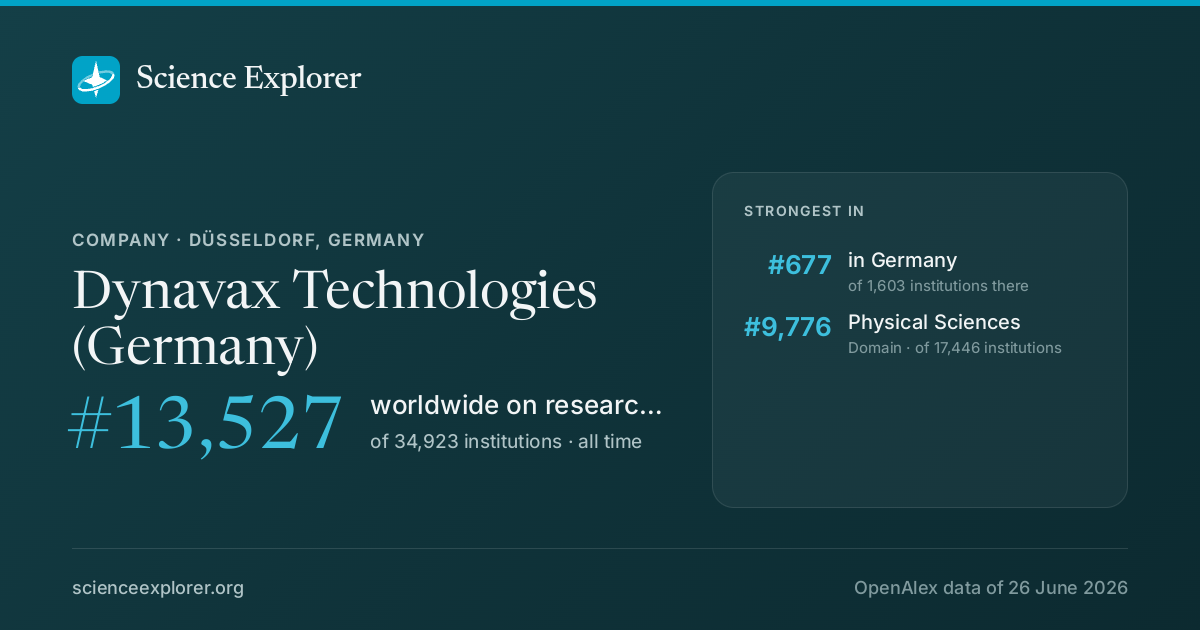
Dynavax Technologies (Germany) on Science Explorer

A card with Dynavax Technologies (Germany)'s standing and the fields it leads in, for a post or a slide. A link to this page previews as the same card.

Download the card

1200 × 630 PNG, sized for social posts, drawn from the latest snapshot.

Badges for a website1Each links back here and updates with every snapshot

Research measures only: rankings here say nothing about teaching, admissions or student experience. Comparable institutions and collaboration partners have tabs of their own, above.

Discussion

Ask a question or share a note about Dynavax Technologies (Germany). Posts are plain text and can be reported.