Science Explorer Back to mapMap
Discussion

Electronic Sensor Technology (United States)

World rank, all time
#16,647
of 34,923
Rank in United States
#3,459
of 7,310
Research works
246
▲ 189% vs 2018-21
Citations
3.5k
14.3 per fractional work
Top-10% rate
7.1%
all institutions 10.0%
vs its own fields
0.92×
1.00× is exactly expected
Open access
23%
world 40%
International
16%
world 18%
Electronic Sensor Technology (United States)

Which fields of science does Electronic Sensor Technology (United States) work in?

In 2022-now, 54% of research at Electronic Sensor Technology (United States) is in Health Sciences, 19% in Physical Sciences. Its largest fields are Medicine (49%), Social Sciences (9%), Engineering (7%). It does 2.0× the world's share of Health Sciences.

Health Sciences: 24 fractional works · 54.0% of its workMedicine: 22 fractional works · 48.8% of its workSurgery: 3 fractional works · 5.8% of its workOncology: 3 fractional works · 5.8% of its workEndocrinology, Diabetes and Metabolism: 2 fractional works · 5.6% of its workNeurology: 2 fractional works · 4.3% of its workEpidemiology: 2 fractional works · 4.1% of its workPulmonary and Respiratory Medicine: 2 fractional works · 3.5% of its workPharmacology: 1 fractional works · 2.9% of its workRadiology, Nuclear Medicine and Imaging: 1 fractional works · 2.7% of its workAnesthesiology and Pain Medicine: 1 fractional works · 2.2% of its workCardiology and Cardiovascular Medicine: 1 fractional works · 2.2% of its workRehabilitation: 1 fractional works · 1.8% of its workPathology and Forensic Medicine: 1 fractional works · 1.2% of its workNephrology: 0 fractional works · 1.1% of its workPhysiology: 0 fractional works · 0.8% of its workFamily Practice: 0 fractional works · 0.7% of its workPublic Health, Environmental and Occupational Health: 0 fractional works · 0.7% of its workEmergency Medicine: 0 fractional works · 0.6% of its workHepatology: 0 fractional works · 0.6% of its workOphthalmology: 0 fractional works · 0.6% of its workHematology: 0 fractional works · 0.4% of its workCritical Care and Intensive Care Medicine: 0 fractional works · 0.4% of its workSmaller subfields together: 0 fractional works · 0.8% of its workDentistry: 1 fractional works · 2.7% of its workOral Surgery: 1 fractional works · 2.5% of its workSmaller subfields together: 0 fractional works · 0.2% of its workHealth Professions: 1 fractional works · 2.0% of its workEmergency Medical Services: 1 fractional works · 1.4% of its workGeneral Health Professions: 0 fractional works · 0.2% of its workPhysical Therapy, Sports Therapy and Rehabilitation: 0 fractional works · 0.2% of its workSmaller subfields together: 0 fractional works · 0.1% of its workNursing: 0 fractional works · 0.2% of its workNutrition and Dietetics: 0 fractional works · 0.2% of its workVeterinary: 0 fractional works · 0.2% of its workSmall Animals: 0 fractional works · 0.2% of its workPhysical Sciences: 8 fractional works · 18.5% of its workEngineering: 3 fractional works · 7.0% of its workMechanical Engineering: 1 fractional works · 1.8% of its workAerospace Engineering: 1 fractional works · 1.5% of its workIndustrial and Manufacturing Engineering: 1 fractional works · 1.5% of its workAutomotive Engineering: 0 fractional works · 0.7% of its workBiomedical Engineering: 0 fractional works · 0.6% of its workElectrical and Electronic Engineering: 0 fractional works · 0.2% of its workMedia Technology: 0 fractional works · 0.2% of its workOcean Engineering: 0 fractional works · 0.2% of its workSmaller subfields together: 0 fractional works · 0.1% of its workEnvironmental Science: 2 fractional works · 4.1% of its workGlobal and Planetary Change: 1 fractional works · 1.9% of its workWater Science and Technology: 0 fractional works · 0.7% of its workEcology: 0 fractional works · 0.6% of its workNature and Landscape Conservation: 0 fractional works · 0.6% of its workManagement, Monitoring, Policy and Law: 0 fractional works · 0.2% of its workComputer Science: 1 fractional works · 2.4% of its workArtificial Intelligence: 1 fractional works · 2.1% of its workSmaller subfields together: 0 fractional works · 0.3% of its workPhysics and Astronomy: 1 fractional works · 2.4% of its workAstronomy and Astrophysics: 1 fractional works · 2.3% of its workSmaller subfields together: 0 fractional works · 0.0% of its workMaterials Science: 1 fractional works · 2.1% of its workMaterials Chemistry: 0 fractional works · 1.1% of its workSurfaces, Coatings and Films: 0 fractional works · 0.7% of its workPolymers and Plastics: 0 fractional works · 0.2% of its workSmaller subfields together: 0 fractional works · 0.0% of its workChemistry: 0 fractional works · 0.5% of its workElectrochemistry: 0 fractional works · 0.3% of its workSmaller subfields together: 0 fractional works · 0.2% of its workMathematics: 0 fractional works · 0.1% of its workSocial Sciences: 7 fractional works · 16.4% of its workSocial Sciences: 4 fractional works · 8.8% of its workSociology and Political Science: 1 fractional works · 3.4% of its workEducation: 1 fractional works · 2.2% of its workPolitical Science and International Relations: 0 fractional works · 1.0% of its workGeography, Planning and Development: 0 fractional works · 0.7% of its workDemography: 0 fractional works · 0.6% of its workGeneral Social Sciences: 0 fractional works · 0.5% of its workAnthropology: 0 fractional works · 0.2% of its workSmaller subfields together: 0 fractional works · 0.1% of its workPsychology: 2 fractional works · 4.5% of its workClinical Psychology: 1 fractional works · 2.7% of its workDevelopmental and Educational Psychology: 0 fractional works · 0.9% of its workExperimental and Cognitive Psychology: 0 fractional works · 0.6% of its workSocial Psychology: 0 fractional works · 0.4% of its workArts and Humanities: 1 fractional works · 1.9% of its workLiterature and Literary Theory: 1 fractional works · 1.4% of its workVisual Arts and Performing Arts: 0 fractional works · 0.6% of its workBusiness, Management and Accounting: 0 fractional works · 0.7% of its workStrategy and Management: 0 fractional works · 0.7% of its workEconomics, Econometrics and Finance: 0 fractional works · 0.4% of its workGeneral Economics, Econometrics and Finance: 0 fractional works · 0.3% of its workSmaller subfields together: 0 fractional works · 0.0% of its workLife Sciences: 5 fractional works · 11.0% of its workBiochemistry, Genetics and Molecular Biology: 2 fractional works · 5.1% of its workMolecular Biology: 1 fractional works · 3.2% of its workCell Biology: 0 fractional works · 0.9% of its workGenetics: 0 fractional works · 0.7% of its workEndocrinology: 0 fractional works · 0.2% of its workSmaller subfields together: 0 fractional works · 0.1% of its workImmunology and Microbiology: 1 fractional works · 2.1% of its workImmunology: 1 fractional works · 2.1% of its workNeuroscience: 1 fractional works · 2.0% of its workCellular and Molecular Neuroscience: 0 fractional works · 0.7% of its workCognitive Neuroscience: 0 fractional works · 0.7% of its workNeurology: 0 fractional works · 0.3% of its workEndocrine and Autonomic Systems: 0 fractional works · 0.2% of its workAgricultural and Biological Sciences: 1 fractional works · 1.7% of its workAnimal Science and Zoology: 0 fractional works · 1.0% of its workPlant Science: 0 fractional works · 0.6% of its workSmaller subfields together: 0 fractional works · 0.1% of its workPharmacology, Toxicology and Pharmaceutics: 0 fractional works · 0.2% of its workALL ITS WORKElectronic SensorTechnology…44fractional works, 2022-now
Life Sciences11%Physical Sciences19%Health Sciences54%Social Sciences16%

Each ring splits the one inside it: the four domains of science, their fields, their subfields. Size is fractional works in 2022-now. Every slice is a page; the interactive view zooms down to single topics and colours each by how much more of it this institution does than the world.

Its 4 domains and 22 fields, with their numbers
    1. Medicine2248.8%
    2. Dentistry12.7%
    3. Health Professions12.0%
    4. Nursing00.2%
    5. Veterinary00.2%
    1. Engineering37.0%
    2. Environmental Science24.1%
    3. Computer Science12.4%
    4. Physics and Astronomy12.4%
    5. Materials Science12.1%
    6. Chemistry00.5%
    7. Mathematics00.1%
    1. Social Sciences48.8%
    2. Psychology24.5%
    3. Arts and Humanities11.9%
    4. Business, Management and Accounting00.7%
    5. Economics, Econometrics and Finance00.4%
    1. Biochemistry, Genetics and Molecular Biology25.1%
    2. Immunology and Microbiology12.1%
    3. Neuroscience12.0%
    4. Agricultural and Biological Sciences11.7%
    5. Pharmacology, Toxicology and Pharmaceutics00.2%
All of science, and how each field's share has moved since 1950: the Science domain explorer

Field profile

Location quotient across every field it publishes in: outside the ring is more than an institution of this size would be expected to publish, inside it is less.

Agricultural and Biological Sciences: 0.35× its world share, 1 worksAgricultural and Bio…Biochemistry, Genetics and Molecular Biology: 0.96× its world share, 2 worksBiochemistry, Geneti…Immunology and Microbiology: 2.05× its world share, 1 worksImmunology and Micro…Neuroscience: 1.22× its world share, 1 worksNeurosciencePharmacology, Toxicology and Pharmaceutics: 0.66× its world share, 0 worksPharmacology, Toxico…Chemistry: 0.31× its world share, 0 worksChemistryComputer Science: 0.31× its world share, 1 worksComputer ScienceEngineering: 0.47× its world share, 3 worksEngineeringEnvironmental Science: 0.82× its world share, 2 worksEnvironmental ScienceMaterials Science: 0.60× its world share, 1 worksMaterials ScienceMathematics: 0.08× its world share, 0 worksMathematicsPhysics and Astronomy: 1.07× its world share, 1 worksPhysics and AstronomyDentistry: 5.52× its world share, 1 worksDentistryHealth Professions: 0.78× its world share, 1 worksHealth ProfessionsMedicine: 2.54× its world share, 22 worksMedicineNursing: 0.51× its world share, 0 worksNursingVeterinary: 1.71× its world share, 0 worksVeterinaryArts and Humanities: 0.67× its world share, 1 worksArts and HumanitiesBusiness, Management and Accounting: 0.23× its world share, 0 worksBusiness, Management…Economics, Econometrics and Finance: 0.17× its world share, 0 worksEconomics, Econometr…Psychology: 1.48× its world share, 2 worksPsychologySocial Sciences: 0.70× its world share, 4 worksSocial Sciences1×world share
more than its size predictsabout as predictedless

Rings at 0.5×, 1× and 2×. Widest outward: Dentistry, 5.5×. Every wedge is a field page.

All 22 fields, with their numbers
  1. Dentistry5.52×1 works
  2. Medicine2.54×22 works
  3. Immunology and Microbiology2.05×1 works
  4. Veterinary1.71×0 works
  5. Psychology1.48×2 works
  6. Neuroscience1.22×1 works
  7. Physics and Astronomy1.07×1 works
  8. Biochemistry, Genetics and Molecular Biology0.96×2 works
  9. Environmental Science0.82×2 works
  10. Health Professions0.78×1 works
  11. Social Sciences0.70×4 works
  12. Arts and Humanities0.67×1 works
  13. Pharmacology, Toxicology and Pharmaceutics0.66×0 works
  14. Materials Science0.60×1 works
  15. Nursing0.51×0 works
  16. Engineering0.47×3 works
  17. Agricultural and Biological Sciences0.35×1 works
  18. Chemistry0.31×0 works
  19. Computer Science0.31×1 works
  20. Business, Management and Accounting0.23×0 works
  21. Economics, Econometrics and Finance0.17×0 works
  22. Mathematics0.08×0 works

Who are the top researchers at Electronic Sensor Technology (United States)?

Ranked on the quality score, Jeffrey Saver, Marek Ch. Bleszynski and Joe Dysart lead among researchers whose main affiliation is Electronic Sensor Technology (United States).

  1. 1 Jeffrey Saver United States · #2,881,180 worldwide 1 citations · 20 works
  2. 2 Marek Ch. Bleszynski United States · #5,055,074 worldwide 1.3k citations · 84 works
  3. 3 Joe Dysart United States · #5,750,756 worldwide 22 citations · 44 works
  4. 4 Judy Capko United States · #7,257,229 worldwide 74 citations · 121 works
  5. 5 Jennifer Granholm United States · #7,526,292 worldwide 15 citations · 221 works
All ranked researchers at Electronic Sensor Technology (United States)

What are the most cited papers from Electronic Sensor Technology (United States)?

The most cited paper from Electronic Sensor Technology (United States) is "Denosumab for Prevention of Fractures in Postmenopausal Women with Osteoporosis" (Steven Ron Cummings, Javier San Martín, Michael R. McClung et al., 2009), with 3,503 citations. Next come "WSX-1 Is Required for the Initiation of Th1 Responses and Resistance to L. major Infection" (412) and "Reduction of Health–Related Quality of Life in Chronic Hepatitis C and Improvement With Interferon Therapy" (403).

Most cited papers
#PaperReleasedCitations
1 Denosumab for Prevention of Fractures in Postmenopausal Women with Osteoporosis Steven Ron Cummings, Javier San Martín, Michael R. McClung et al. · New England Journal of Medicine Open access 11 Aug 2009 3,503
2 WSX-1 Is Required for the Initiation of Th1 Responses and Resistance to L. major Infection Hiroki Yoshida, Shinjiro Hamano, Giorgio Senaldi et al. · Immunity Open access Oct 2001 412
3 Reduction of Health–Related Quality of Life in Chronic Hepatitis C and Improvement With Interferon Therapy Herbert L. Bonkovsky, Michael J. Woolley · Hepatology Open access 1999 403
4 Structural and Functional Characterization of Disulfide Isoforms of the Human IgG2 Subclass Thomas M. Dillon, Margaret Speed Ricci, Chris Vezina et al. · Journal of Biological Chemistry Open access 14 Mar 2008 293
5 Identification of likely orthologs of tobacco salicylic acid‐binding protein 2 and their role in systemic acquired resistance in Arabidopsis thaliana A. Corina Vlot, Po‐Pu Liu, Robin K. Cameron et al. · The Plant Journal 9 Jul 2008 233
All 62 most cited papers, with filters and sorting

Which keywords describe research at Electronic Sensor Technology (United States)?

By fractional works in 2022-now, weighted toward what it does more of than the world: Neuroprotection, Glycemic Control, Risk Factors, Complications, Insulin Therapy, Ischemic Stroke, Clinical Guidelines and Clinical Outcomes.

▲ more of its work than of the world's◆ about the world's share▼ less than the world's

Size is fractional works in 2022-now in the topics tagged with each word; colour is the word's share of this institution's work against its share of the world's. The 35 words are chosen for being large and distinctive. Each links to the topic it comes from most.

All 35 words, with their numbers
  1. Epidemiology3▲ 1.52×14 topics
  2. Risk Factors2▲ 5.2×9 topics
  3. Neuroprotection2▲ 15×4 topics
  4. Glycemic Control2▲ 33×4 topics
  5. Complications2▲ 9.2×6 topics
  6. Insulin Therapy2▲ 36×3 topics
  7. Quality of Life2▲ 2.7×6 topics
  8. Globalization2▲ 1.76×5 topics
  9. Ischemic Stroke2▲ 22×2 topics
  10. Clinical Guidelines1▲ 11×3 topics
  11. Clinical Outcomes1▲ 14×2 topics
  12. Depression1▲ 3.6×7 topics
  13. Global Burden1▲ 5.6×2 topics
  14. Inflammation1▲ 1.53×13 topics
  15. Psychological Factors1▲ 15×3 topics
  16. Endovascular Therapy1▲ 43×1 topic
  17. Thrombolysis1▲ 43×1 topic
  18. Cardiovascular Outcomes1▲ 46×1 topic
  19. Climate Change1◆ 0.96×7 topics
  20. Diabetes1▲ 5.6×5 topics
  21. Neurological Disorders1▲ 4.7×4 topics
  22. Type 2 Diabetes1▲ 11×1 topic
  23. Clinical Trials1▲ 3.7×5 topics
  24. Deep Learning1▼ 0.71×8 topics
  25. Dental Anxiety1▲ 113×1 topic
  26. Local Anesthetics1▲ 113×1 topic
  27. Machine Learning1▼ 0.74×8 topics
  28. Metastasis1▲ 7.2×4 topics
  29. Sustainability1◆ 0.97×4 topics
  30. Angiogenesis1▲ 6.8×5 topics
  31. Difficult Airway Society1▲ 71×1 topic
  32. Radicalization1▲ 87×1 topic
  33. Terrorism1▲ 49×1 topic
  34. Tracheal Intubation1▲ 71×1 topic
  35. Wound Healing1▲ 8.4×2 topics

Which research topics does Electronic Sensor Technology (United States) publish most on?

By volume in 2022-now: Acute Ischemic Stroke Management, Diabetes Treatment and Management, Dental Anxiety and Anesthesia Techniques and Terrorism, Counterterrorism, and Political Violence.

  1. 1 Acute Ischemic Stroke Management Epidemiology 1 works
  2. 2 Diabetes Treatment and Management Endocrinology, Diabetes and Metabolism 1 works
  3. 3 Dental Anxiety and Anesthesia Techniques Oral Surgery 1 works
  4. 4 Terrorism, Counterterrorism, and Political Violence Sociology and Political Science 1 works
  5. 5 Airway Management and Intubation Techniques Anesthesiology and Pain Medicine 1 works
  6. 6 Corneal Surgery and Treatments Radiology, Nuclear Medicine and Imaging 1 works
  7. 7 Intracranial Aneurysms: Treatment and Complications Neurology 1 works
  8. 8 Cannabis and Cannabinoid Research Pharmacology 1 works
  9. 9 Cancer Diagnosis and Treatment Oncology 0 works
  10. 10 Immunodeficiency and Autoimmune Disorders Immunology 0 works

How open and international is its research?

Against the world's own shares: the tick on each track. Both are shares of its output, so they sit on one scale and can be read against each other as well as against the world.

openly available22.7%not open77.3%

World: 40% of research is openly available.

with international co-authors15.6%domestic only84.4%

World: 18% is written across borders.

How has Electronic Sensor Technology (United States)'s research output changed?

Output in 2022-2025 was 189% higher than in 2018-2021.

still counting1990200020102020
grewheldshrank

The same series as a ribbon: one cell per year, darker for more. The line above answers how much; this answers when.

Its share of all research

Growing output can still be a shrinking share: all of science grows. This is Electronic Sensor Technology (United States) as a percentage of every work published that year, 0.00017% in 2024.

still counting0.00050%0.0010%Electronic Sensor Technology (United States)0.00019% in 202519801990200020102020

Fractional works of Electronic Sensor Technology (United States) over all fractional works that year. How the balance of science has shifted.

Other research institutions in Thousand Oaks

All research institutions in Thousand Oaks

Share Electronic Sensor Technology (United States)'s ranking
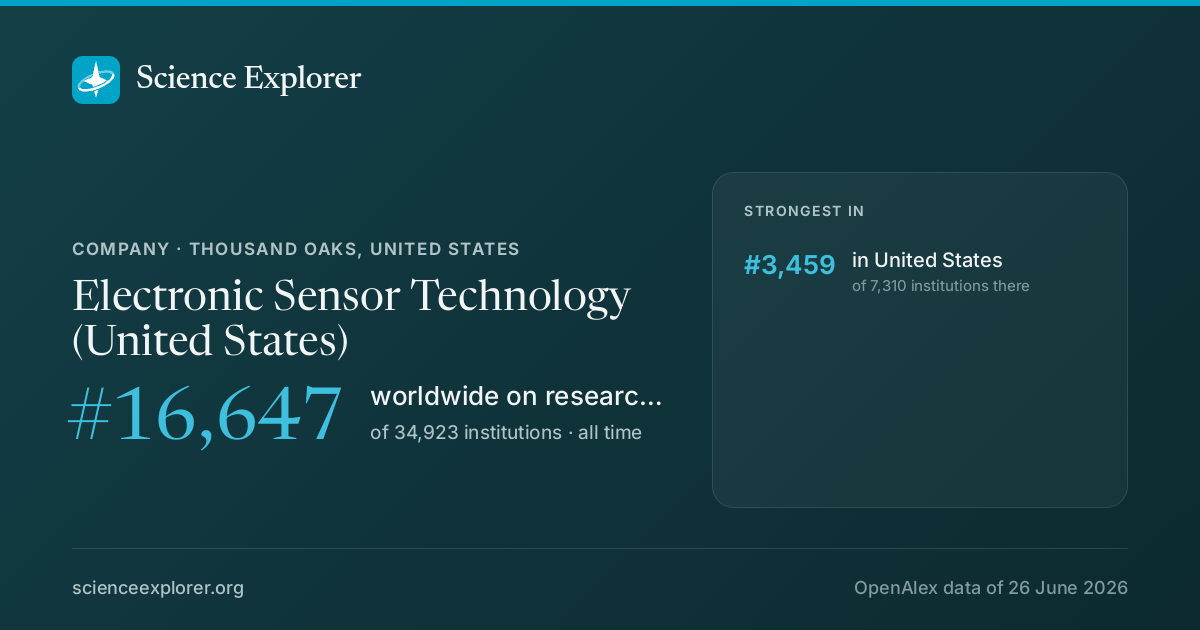
Electronic Sensor Technology (United States) on Science Explorer

A card with Electronic Sensor Technology (United States)'s standing and the fields it leads in, for a post or a slide. A link to this page previews as the same card.

Download the card

1200 × 630 PNG, sized for social posts, drawn from the latest snapshot.

Badges for a website1Each links back here and updates with every snapshot

Research measures only: rankings here say nothing about teaching, admissions or student experience. Comparable institutions and collaboration partners have tabs of their own, above.

Discussion

Ask a question or share a note about Electronic Sensor Technology (United States). Keep it to the research: no personal attacks, advertising or links. Any reader can report a post, which collapses it for everyone until it is opened.
